


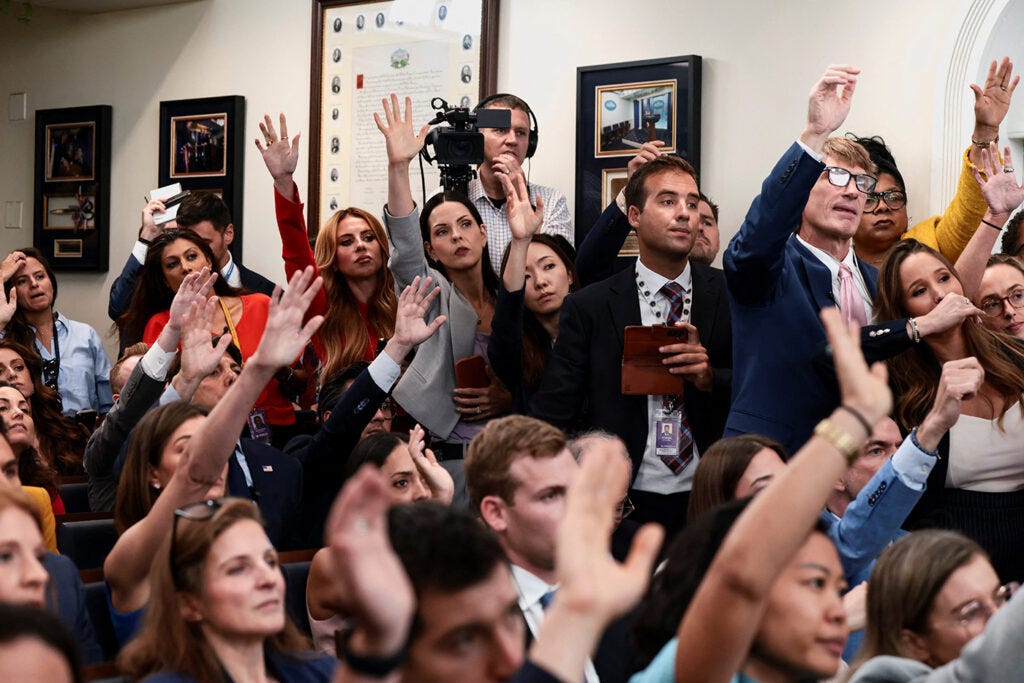
Saturday morning, CNN’s Betsy Klein put her hard pass to the magnetometer and got a red light. The officer took the badge, said it was disabled, and had nothing else to tell her. She asked once more and was referred to the Press Office. She walked back to the sidewalk and went live with Kasie Hunt. Akayla Gardner of MS NOW handed over her badge at the same checkpoint. Cheyenne Haslett of Politico arrived later and was turned away too. All 3 still had phones, sources, a livestream of the briefing, and a 9 o’clock hit.
On Monday, September 21, CNN, MS NOW, and Politico sued in the US District Court for the District of Columbia, naming President Trump, White House communications director Steven Cheung, Chief of Staff Susie Wiles, and Secret Service Director Sean Curran. They asked Judge Timothy J. Kelly for an immediate injunction restoring the passes and the grounds. Kelly, who in 2018 ordered Jim Acosta’s credential returned the day after CNN sued, gave the Justice Department until Tuesday to respond and set a hearing for Wednesday at 3:30 p.m. The complaint calls the ban “a more direct assault on the First Amendment,” and says the president announced the punishment for “cumulative” coverage he regards as fake and purposely negative.
Once the White House opened press facilities to Washington correspondents as a class, Sherrill v. Knight held in 1977 that a bona fide reporter could not be turned away arbitrarily or for less than compelling reasons. Robert Sherrill of The Nation had been denied a pass on vague security grounds. The DC Circuit required notice of the factual basis, a chance to rebut, and a written decision. Jameel Jaffer of the Knight First Amendment Institute has already promised a supporting brief. If Kelly treats Saturday’s confiscations as a Sherrill problem, the administration may have to put reasons on paper. Cable has been selling a larger product: a constitutional entitlement to a chair.
The First Amendment protects speaking and publishing. Seating never made the text. The Supreme Court drew that line in 1965 in Zemel v. Rusk, a case about travel to Cuba, and reached for the White House to make the point. “The right to speak and publish does not carry with it the unrestrained right to gather information,” the Court wrote, and a ban on unauthorized entry to the White House “plainly limits” what a citizen can learn about his government without violating the Constitution.
Pell v. Procunier, 9 years later, held that the press has no constitutional right of access to sources the government does not make available to the public generally. Branzburg v. Hayes, decided in between, listed rooms reporters are kept out of as a matter of course: grand jury chambers, the justices’ own conferences, executive sessions of legislative committees. Those closed doors have never been treated as an abridgment of press freedom.
The Capitol is a public building. A senator’s private office sits inside it, and no citizen has a claim on the chair across from his desk. A reporter denied an interview may write whatever she likes about the senator the moment she leaves. The Fourth Circuit applied that reasoning in Baltimore Sun v. Ehrlich in 2006, after Maryland Gov. Robert L. Ehrlich Jr. told his staff to stop speaking with 2 Sun journalists he considered unfair. The reporters still received public releases and could attend public press conferences. They merely lost the governor’s voluntary cooperation.
The Oval Office and Air Force One sit on the office side of that line. In June 2025, Judges Neomi Rao and Gregory Katsas of the DC Circuit stayed the injunction ordering the White House to restore the Associated Press to those spaces. Restricted presidential workspaces, Rao wrote, are not forums the government has opened to private expression, and the president may consider a journalist’s outlook when deciding who rides along. “If the president sits down for an interview with Laura Ingraham, he is not required to do the same with Rachel Maddow.” She added that the AP cannot adversely possess a seat in the Oval Office. The panel left the portion of Judge Trevor McFadden’s order covering the East Room standing.
McFadden’s April 8 ruling was narrower than the headlines. Hans von Spakovsky of the Heritage Foundation noted that the injunction still left the government free to exclude journalists from limited-access events for a range of permissible reasons. Officials could still choose whom to sit down with and whose questions to answer. It invented no permanent wire slot. The AP won a point about viewpoint discrimination inside an event the White House had already opened. The DC Circuit then stayed most of that point for the Oval and the plane.
Sherrill is the piece Kelly actually has to decide on Wednesday. Hard passes were deactivated. Reporters were turned away from the grounds. The 1977 court required reasons before the government could deny a pass it had issued to a class of correspondents. Interviews, airplane seats, and the briefing room remained in the president’s hands. In 2018, Kelly restored Acosta’s credential on procedural grounds; the White House then restored the pass, and CNN dropped the suit. A letter of reasons is a plausible Wednesday outcome. Nothing in the cited cases hands CNN the furniture.
The White House said on September 21, “No President is required to host a hostile operation on the grounds.” These are outlets whose reporters shout questions at the president and his staff after being asked to leave the room at the end of a briefing. They are outlets that published on vulnerabilities to Air Force One after being asked, on security grounds, not to. The coverage itself reads like a campaign memo written every morning.
Over the past 6 years, CNN and MS NOW have each lost more than half their audience. On a good day, CNN now gets about 470,000 people to watch for an average of 5 minutes. I am one creator among thousands, and on an ordinary day my work reaches as many as 10 million unique readers and viewers, more than CNN and MS NOW combined. No judge will order the White House to open its doors to me, and no one at the Correspondents’ Association thinks I am owed a seat. More than 40% of US adults regularly get news from independent media and creators like me, and a majority of adults under 30 do. The split crosses party lines, with 21% of Republicans and 22% of Democrats. Oxford’s Reuters Institute reported that 22% of Americans encountered news or commentary from Joe Rogan in a single week after the January 2025 inauguration, and 14% from Tucker Carlson - numbers that neither CNN nor MS Now have ever generated.
The room itself is allotted by tenure. The travel pool on Air Force One has traditionally held 13 seats, split among wires, photographers, television crews, radio, and print, and the outlets pay a commercial fare for each one. The briefing room seating chart that took effect this February, drawn by the White House Correspondents’ Association, still gives the front row to NBC, Fox News, CBS, AP, ABC, Reuters, and CNN. The Daily Wire, whose reporter Mary Margaret Olohan covered briefings from the aisle before the outlet got its first assigned seat, now shares a single back-row chair with The Telegraph and Black Press USA. Axios, NOTUS, and Semafor share another. I’m not even offered the jump seat behind the pilot.
In May 1981, Ted Turner sued the Reagan White House along with ABC, CBS, and NBC because the 3 established networks were getting favored access to limited-coverage events and the year-old operation from Atlanta was not. After the White House told the television shops to pick their own pool and they could not agree, the press office posted a July 10 rotation with no cameras at all. ABC and NBC went to court, and Judge Orinda Evans in Atlanta issued a 10-day restraining order that restored the old arrangement. The 1981 complaint attacked a pool reserved for the 3 broadcast networks. The 2026 complaint attacks a White House that finally took the pool away from that club.
Rush Limbaugh called the front-row shops the drive-by media. The press corps travels together, eats together, and often publishes the same framing within minutes of one another, because the framing was settled on the bus. A pool of 13 drawn from the same dozen institutions produces a lot of bylines and very few surprises. The American who reads my graphic headline posts or listens to Rogan on the drive home noticed some time ago.
Karoline Leavitt announced the correction on February 25, 2025. The White House, not the Correspondents’ Association, would determine the pool. Streaming services, print outlets, and radio voices would be added, while the 5-network television rotation stayed in place. The rotation published for the week of September 14 listed National Review, NTD, Center Square, Semafor, Border Hawk, The Washington Sun, and Townhall in the new-media slot, with Axios in secondary print and OAN, RSBN, and Real America’s Voice in secondary television. A reader who finds Border Hawk’s border coverage more useful than CNN’s loses nothing when Border Hawk gets the seat, and a reader who prefers CNN can still watch CNN, which has a camera at every public event and a livestream of every briefing.
The networks tried a different kind of pressure this week. ABC, CBS, Fox News, and NBC declined to replace CNN’s television pool crew after the White House blocked the network from its assigned rotation, including the trip to the United Nations. Bryan Boughton, the Fox Washington bureau chief who chairs the pool, told subscribers the shared TV coverage would go dark rather than fill CNN’s slot. They are betting that an empty camera will force the chair back. Leavitt has already shown a separate rotation can fill a week without it.
Creators with audiences in the millions have never been inside the building. Outlets with audiences in the hundreds of thousands have never once been asked to leave. I suspect the questions get sharper when a reporter’s audience can walk away; every seat held for a hostile incumbent is a seat the rest of us are still waiting on.
If you enjoy my work, please subscribe https://x.com/amuse/creator-subscriptions/subscribe
Alexander Muse is a Fellow at the John Milton Freedom Foundation and publishes daily political analysis at amuseonx.com. Primary sources cited in this piece are linked inline; campaign finance figures are drawn from FEC filings, polling data from publicly released crosstabs, and legal claims from filed pleadings. Corrections are posted to the original URL with a dated changelog. Readers who identify errors are invited to contact the author directly. Each op-ed edited for grammar and clarity using Ai in partnership with Grammarly. Data provided in a sponsored partnership with Polymarket.
The same lies that are being told about this situation are being told about news reported every single day and Trump has finally put his finger on it. This is fabulous news as far as I’m concerned.
Had Trump closed down the pool and stopped doing any sort of White House briefings, perhaps the 1st Amendment rules should apply, however, he did NOT, he just told sources who have continually lied to the American people about what goes on, are no longer welcome there.
If other sources want to back up the booted liars with pressure tactics, then they simply ADMITTED they also demand the right to lie about whatever they see fit, so GOOD RIDDANCE to them ALL!
Fox thinks they're pulling some power play by denying a "favorable source" for President Trump, as if they are actually such.
Since managing the 2020 election steal, Fox has proven they are no friend to America but rather a T-Rex in sheep's skin.