


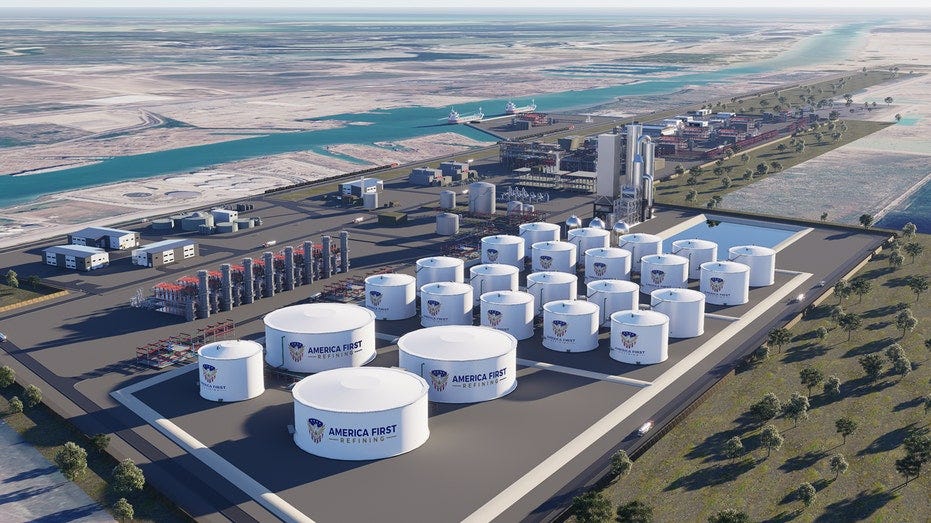
Marathon’s Garyville plant on the Mississippi started up in 1977. It remains the last major American refinery built with significant downstream capacity. Smaller units have opened since, and existing sites have added capacity, but the country has not built another Garyville in half a century. In that same stretch, U.S. crude output more than doubled after 2010, mostly from light shale in the Permian. The fleet asked to absorb those barrels has been running near 98% utilization, and some operators have pushed scheduled maintenance into late 2026 and even 2027 to hold those rates. National diesel has crossed $6 a gallon. David Blackmon wrote in the Daily Caller in August that a system this tight does not need a standing order to run harder. It needs more capacity.
Washington has spent years counting barrels produced and barrels exported and calling the result energy richness. The barrels are real. What has gone unfinished is the capacity to turn them into fuel on American soil, on a timetable a lender and a combatant commander can both trust. President Trump has taken up that second question with paper that can move money and equipment, an April determination and a September delegation, rather than another speech about abundance.
Heritage’s Brent Sadler has pressed the defense version of the point for years. Fuel security lives in a network of refineries, pipelines, storage, and transport. A break anywhere in that network can slow wartime operations even when headline production looks impressive. The military burns finished product. So do the trucks that move grain and the aircraft that leave a carrier deck. Once that is admitted, the refinery stops looking like one more private plant that will look after itself.
If the product is this valuable, private capital should have built more of it already. Demand is not what is missing. What is missing is a lender willing to believe that a plant costing billions of dollars will be permitted, finished, operated, and paid off across decades. Every uncertain government decision on that path raises the cost of capital. Jason Hayes of the America First Policy Institute described the same trap in March. Litigation exposure, shifting permitting interpretations, and political pressure on banks all discourage investment in plants the country still needs. The California Energy Commission, hardly a conservative shop, admitted in 2025 that “increasing petroleum business uncertainty in California is leading to reduced industry confidence to invest in the state.” When the regulators write that sentence, the argument is no longer a talking point.
On April 20, the President issued a formal determination under the Defense Production Act. He found that domestic petroleum production, refining, and logistics are essential to national defense, and that industry cannot supply those capabilities promptly on its own because of financing constraints, long equipment lead times, permitting obstacles, and infrastructure bottlenecks. He directed the Energy Department to use Section 303, which permits federal purchases, purchase commitments, and investment in industrial equipment and facilities. On September 8, an executive order expanded the delegation so Interior, Commerce, and Energy can each exercise specified priority powers on their own. Taylor Rogers, speaking for the White House last week, said expanding that capacity is a top priority for the President and his energy team.
The financial logic is the one shipyards already live by. Jim Fein at Heritage put the defense industrial base in four words in March: contracts and orders dictate capacity. A yard does not pour new slipways because an analyst forecasts more hulls someday. It pours them when it has orders that can carry the debt. Section 303 lets the government make purchase commitments that give a lender a customer against which to underwrite construction, and it lets the government put money into specific equipment and facilities. Title I, through Section 101(c), lets agencies issue rated orders that move a transformer or a compressor to the front of a manufacturer’s queue. The statute covers equipment needed to construct or maintain energy facilities, refining included. A rating will not invent a factory or compel a foreign supplier. If a plant’s completion date hinges on one delayed component, accelerating that delivery can decide whether steel goes in the ground this year or next.
Ownership stays private. Selection stays with lenders and operators, not a ministry of industry. The statute changes the two risks that actually kill projects: uncertain revenue and uncertain delivery. Heritage’s 2019 analysis of the DPA, written by Emma Watkins and Thomas Spoehr, endorsed this kind of intervention where a genuine defense industrial vulnerability exists, provided the security connection is clear, and the terms are public. That pedigree matters because conservatives have spent a generation arguing against industrial policy that floats favored firms. The test they set, and the test this program has to meet, is whether the award buys identifiable capacity on disclosed terms.
Brownsville is the greenfield test, and the calendar there is unforgiving. America First Refining is developing a plant on more than 240 acres inside the Port of Brownsville, a deep-water foreign trade zone with rail and liquid docks, designed around domestic light shale crude at roughly 168,000 barrels a day. The site has survived ownership changes that would have killed a landlocked project. In March, the company announced a nine-figure investment and a binding 20-year offtake term sheet. Fluor received an engineering contract in April. In September 2 Matrix Service announced design work on the tank farm as a step toward a final investment decision. Company leadership has described major units arriving in 2028 and a first full operating year in 2029. Texas regulators granted the project a third and final extension in February, and if construction has not begun by October 19, 2027, the air permit becomes void. Ribbon cuttings will not satisfy that condition. Dirt has to move.
Existing plants can add barrels sooner, and Beaumont already proved the point. ExxonMobil began construction there in 2019 and started the expansion in March 2023. The $2 billion project added 250,000 barrels a day, roughly the output of a large stand-alone refinery, on land, utilities, and a workforce that were already in place. Construction peaked at about 1,700 contractors. Reuters reported last week that refiners advising the White House want federal support pointed at making working plants more efficient or expanding them. That preference is self-interested, and it is also the fastest route to usable product. A program that waits on one new site while ignoring the fleet already running will spend years producing drawings.
Some of the missing capacity is already poured in concrete and sitting idle. In September 2025, the EPA abandoned its reactivation policy, which had treated a major facility idle for two years as if it were newly built, after the Third Circuit ruled in Port Hamilton that the agency had exceeded its authority. That change runs on a separate track from the DPA, but the two tools complement each other. Regulatory reform improves a restart’s legal odds while a purchase commitment or a rated order can address the physical and financial gap. The Institute for Energy Research has identified shuttered facilities, including St. Croix, as candidates worth examining. Each still needs a credible operating plan and private capital that shows up, yet recovering docks, tanks, and pipe that already exist is cheaper than building the same plant twice.
A 2029 startup date will not bring diesel down this fall, and no serious person should pretend otherwise. Expansions at working sites and restarts of idle ones can move on shorter clocks, and every year the investment decision slips, the finish line slips with it. The question is whether American capacity grows over this decade instead of shrinking while utilization sits near 98% and the existing fleet is asked to run harder still.
The welfare objection should govern the terms. Federal support ought to buy something you can point to: a stated fuel requirement, a specified number of additional barrels, delivery obligations, matching private investment, and milestones with consequences if they are missed. Brownsville’s political connections make transparent selection and public terms especially important, and no DPA award to the project has been made as of this writing, so the case for the policy rests on capacity gained across every eligible project rather than on any one developer’s fortunes. Heritage insisted on that discipline in 2019. It still applies.
I argued at the end of 2023 that domestic refining constraints were limiting the benefit Americans get from their own oil, and in 2025 I supported using the DPA to build domestic rare-earth processing. Rare earths and diesel are different commodities. Both leave the country poorer when the raw material is mined here and finished somewhere else. Trump recognized the gap and put the statutory tools in place. The measure that matters is physical: financed projects, delivered equipment, plants running, and fuel produced on American soil. Hold him to that, not to the press release.
If you enjoy my work, please subscribe https://x.com/amuse/creator-subscriptions/subscribe
Alexander Muse is a Fellow at the John Milton Freedom Foundation and publishes daily political analysis at amuseonx.com. Primary sources cited in this piece are linked inline; campaign finance figures are drawn from FEC filings, polling data from publicly released crosstabs, and legal claims from filed pleadings. Corrections are posted to the original URL with a dated changelog. Readers who identify errors are invited to contact the author directly. Each op-ed edited for grammar and clarity using Ai in partnership with Grammarly. Data provided in a sponsored partnership with Polymarket.
Due to the stupid "save the planet" geniuses, we literally need to export Texas light sweet crude oil which is easy to refine to other countries who have the refineries we should have built here years ago Yet another disastrous Democrat decision.
“If the product is this valuable, private capital should have built more of it already. Demand is not what is missing. What is missing is a lender willing to believe that a plant costing billions of dollars will be permitted, finished, operated, and paid off across decades.” This missing piece impacts many things, especially continuing wars. This is China and Russia’s advantage over the U.S. Our fickle competing Congressional officials and corrupted political parties render us weakened against decades of determination.