


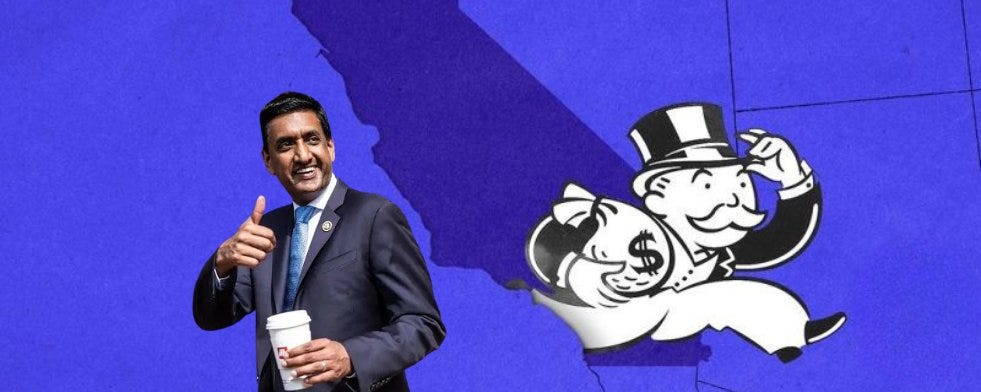
Representative Ro Khanna spent the better part of a week on 𝕏 arguing about California's Proposition 40 with Mark Cuban, Palmer Luckey, Naval Ravikant, and a rotating cast of people who have actually started companies. Khanna spent about three years working as a lawyer before entering government and has ZERO business experience. Despite his utter lack of experience, Khanna is the wealth-tax movement's most visible advocate on the platform this month. He engaged at length, in public, with the hardest version of the question. California Democrats have been happy to let him sell the measure.


Cuban asked the obvious question. Suppose a founder’s wealth is not cash, not a diversified portfolio, not anything he can spend, but a block of stock in a private company he built and still runs. How does that man pay a tax of up to 5% on a valuation he never received? Khanna’s answer was a state-financed, nonrecourse loan, secured by the founder’s shares, repayable over roughly a decade, after which the government takes the stock.
The state hands the founder money, the founder immediately hands it back as tax, and the state keeps a note secured by the company. If the founder cannot repay within 10 years, California will take ownership of his remaining stake in the business. California Democrats and the wealth-tax movement are selling the loan as a courtesy to a cash-poor founder. Khanna’s design puts the state in the chain of title. The loan is public equity in a private firm, and he proposed it as the payment method.
Proposition 40 is not best understood as a tax on wealth. It is a tax on control. Its formal target is a few hundred current billionaires. Its behavioral target is every founder and every investor deciding right now where the next great company will be built. Cuban, Luckey, and Ravikant build companies. Khanna, Senator Sanders, and California’s political class want a claim on the ones already standing.
A founder who sold most of the company to raise money may own only 3% of the economics and still hold 30% of the votes, because the investors wanted him running the place and gave him supervoting shares to keep him there. Proposition 40 taxes him as if he owned 30% of the firm. The votes are not cash. They disappear or convert the moment he sells them, and no buyer pays him for the privilege of his judgment. The bill still arrives as if that 30% were money in the bank.
Publicly traded assets are valued at market price. Everything else falls under a separate rule, and for an interest carrying voting or direct control rights, the presumed ownership share cannot be lower than the holder’s voting or control share. Where no such presumption applies, the default deemed value is the book value plus 7.5 times the average book profits, and a financing round within the prior two years can set a floor. To rebut any of this, the taxpayer must produce clear and convincing evidence and a certified appraisal, with substantial penalties waiting if the state disagrees. California Democrats wrote the presumption so the founder who kept the votes would be treated as if he kept the cash.
A company raises $1 billion at a $10 billion valuation. The money goes to the corporation, for engineers and data centers and sales staff, not to the founder’s checking account. The founder now has an enormous paper net worth and the same cash he had the week before. Then the tax bill arrives, written and sold by California Democrats who treat that paper as cash.
He can sell shares, which dilutes his control and triggers capital gains taxes on top of the wealth tax. Selling raises the cash and costs him the votes that let him run the firm. He can borrow privately, thereby encumbering the shares and frequently requiring investor consent under the very agreements that funded the company. Private lenders want collateral and a path to seize the stock if the note goes unpaid, and the investors who already own most of the economics often hold a veto on that path. He can pay over five years, at a 7.5% annual nondeductible charge on the unpaid balance, or take a loan from the state at a rate the state sets, which Sacramento will call relief. Or he can place the assets in an Optional Deferral Account, a binding contract with California that requires annual reports and 5% payments from material distributions, potentially for years after he has left the state entirely.
Sale dilutes control. Debt encumbers control. Deferral attaches a permanent California claim to any future liquidity. Khanna’s variant simply removes the middleman and makes the government the creditor directly. The tax cannot be paid without touching the founder’s grip on his own company, which is why the objection from Cuban, Luckey, and Ravikant is a structural observation about what the instrument does. Conservatives who call this a grab at private firms are reading the payment menu correctly.
The Tax Foundation ran the arithmetic on the most familiar case. Alphabet’s proxy shows Larry Page holding 27.4% of total voting power and Sergey Brin 25.3%, largely through Class B shares that never trade and carry ten votes each. If those shares are classified as nonpublic interests, the voting presumption bites, and the wealth tax combined with the capital gains taxes required to raise the cash could consume roughly 37% of their Alphabet holdings. Other estimates run from 50% to 80% depending on how the final rules land. The result is the staged transfer of a controlling stake to the state and its buyers.
For founders below the Alphabet tier, “just borrow against the stock” assumes a lending market that barely exists. Practitioners who arrange loans against private company shares report conservative loan-to-value ratios, commonly 15% to 45%, with far tighter terms for early-stage firms, and that is before transfer restrictions, rights of first refusal, board consent requirements, and a thin secondary market further shrink the collateral. The advice presumes the very liquidity whose absence created the problem.
Khanna and his allies describe billionaire wealth as something extracted from the poor, as though the national income were a fixed pie and every slice taken by a founder were a slice denied to a janitor. That picture is Democratic folklore. This kind of wealth is the residual claim on something that did not previously exist. The poor were not holding those trillions before the company was founded, because the company had not yet been founded. There was nothing there to steal.
What actually raises the living standards of people at the bottom is a growing pie, and the pie grows because someone bears risk in exchange for a larger share of what he creates. Remove the possibility of increasing your share, and you have removed the reason to take the risk in the first place. The ten largest American fortunes sit atop firms that enabled roughly 10 million jobs, generated about $139 billion in employee income taxes, and paid some $680 billion in company taxes. Those numbers are the pie getting bigger, and the janitor’s real wage, his phone, his medicine, and his kid’s tuition all ride on it. A rich man hoarding gold in a vault does nothing for the poor. A rich man whose net worth is 20% of a company employing 90,000 people does a great deal, and the wealth tax is aimed at exactly the second man, because only he is legible to the assessor. California Democrats would rather bill the employer of 90,000 than admit the man with gold in a vault never put anyone on a payroll.
This is not a one-time 5% bill that expires when the check clears. The authors pulled the money out of California’s ordinary spending cap, let the implementing rules skip the usual public process, and forced any facial lawsuit into a single county on a 60-day clock. If a court finds a defect, it is told to patch the due date, not to kill the tax. The legislature that inherits the machine can then change the rates and the thresholds without ever going back to the voters. Khanna’s own federal bill with Senator Sanders already names the destination: 5% every year on net wealth above $1 billion, with no end date, and California’s proposition is how they get there.
OECD countries levying individual net wealth taxes fell from 12 in 1990 to 4 by 2017, and those repeals were driven by mobile bases, impossible valuations, avoidance, administrative costs, and revenue that never matched projections. A careful Scandinavian study finds that raising the top wealth tax rate by 1 point reduces the stock of wealthy taxpayers by roughly 2%. California’s own Legislative Analyst forecasts tens of billions in temporary revenue against an ongoing income tax loss approaching $1 billion a year. And each billion in tax losses means the loss of hundreds of billions in potential wealth creation and the innovation it produces. The official score already concedes the flight.
Governor Newsom, who favors higher federal taxes on billionaires, said this measure is “really damaging to the state.” Steve Hilton put it less gently, warning that the business exodus “could become a stampede.” Chief Justice Marshall said it best two centuries ago, in a case about a bank rather than a startup: the power to tax involves the power to destroy. Conservatives who have been saying the same thing about Proposition 40 are repeating the governor, the official score, and a holding older than the state.
California can tax consumption, income, realized gains, estates, and even billionaire borrowing. What it should not do is deem voting power to be money and then demand the money. “Cali, you make it, we take it” is the invitation California Democrats have extended. Founders who still have a choice will build the next one in Texas, and I do not blame them.
If you enjoy my work, please subscribe https://x.com/amuse/creator-subscriptions/subscribe
Alexander Muse is a Fellow at the John Milton Freedom Foundation and publishes daily political analysis at amuseonx.com. Primary sources cited in this piece are linked inline; campaign finance figures are drawn from FEC filings, polling data from publicly released crosstabs, and legal claims from filed pleadings. Corrections are posted to the original URL with a dated changelog. Readers who identify errors are invited to contact the author directly. Each op-ed edited for grammar and clarity using Ai in a sponsored partnership with Grammarly. Data provided in a sponsored partnership with Polymarket.
Any dumb shit who wants to be rich in California deserves exactly what he gets…
According to Bing "Congressional disclosures: The 2024 financial disclosure for Khanna, his wife, and their two minor children lists more than 3,000 assets. The reported combined value falls between $103 million and $340 million+, the wide range due to some holdings (e.g., stakes in family-owned golf clubs) being disclosed only as “over $1,000,000” without an upper cap" In other words this uy crafted law so it won't affect him. How shocking. Here's another piece.
https://americanalmanac.com/ro-khanna-rails-against-oligarchs-while-his-family-sits-on-golf-courses-hedge-funds-and-a-190k-range-rover/