


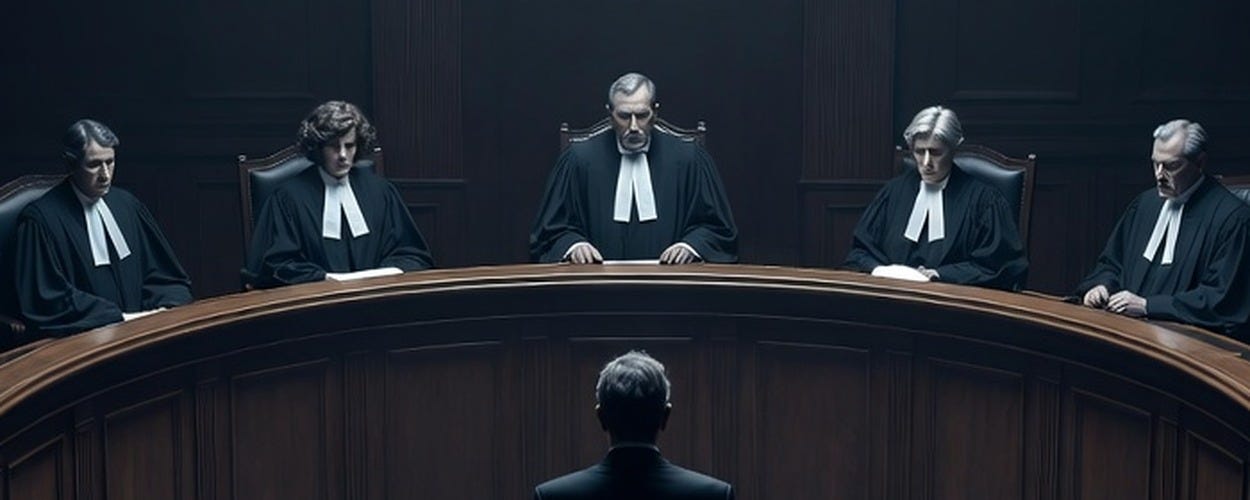
There is a special pleasure in watching a man hand his opponent the very instrument that defeats him. Chess players call it a blunder. Lawyers call it opening the door. Last year, Judge James Boasberg called it an argument. Sitting in his Washington courtroom during the Alien Enemies Act litigation, exasperated with the Trump administration’s position that the executive could identify terrorist aliens and remove them without his blessing, Boasberg reached for what he thought was a rhetorical trump card. Congress, he observed, had already built a court for exactly this purpose. “You can always go to the ATRC, which would be a first, but that’s what it’s there for, right?” He would know. Boasberg had served on the Alien Terrorist Removal Court from 2020 through 2025, and for that entire period he was its chief judge, presiding over a tribunal that had never once received a case.
Sixteen months later, on July 15, 2026, the Department of Justice filed the first application in the court’s history. The administration took the judge’s suggestion. It simply took it more seriously than he intended.
To appreciate the jujitsu, you have to understand what the ATRC actually is, because almost nobody does. Start with the problem it was built to solve. Imagine the government possesses classified intelligence, perhaps from a human source inside a terrorist network, perhaps from a foreign partner’s surveillance, establishing that an alien inside the United States is connected to terrorism. In an ordinary immigration proceeding, using that evidence means exposing it. Exposing it can mean a dead informant, a burned collection method, or a furious ally who stops sharing. The government therefore faced what Senator Bob Smith described in 1995 as two equally unacceptable choices. Reveal the intelligence and destroy its source, or protect the intelligence and let the terrorist stay.
Congress chose a third path. As part of the Antiterrorism and Effective Death Penalty Act, signed in April 1996 after the World Trade Center and Oklahoma City bombings, it created a specialized Article III tribunal. The Chief Justice designates five sitting federal district judges, each from a different circuit, to five-year terms. The Attorney General may bring an application when classified evidence shows an alien is a terrorist and ordinary removal proceedings would endanger national security. A judge reviews the classified material in a sealed, ex parte proceeding and must find probable cause before anything advances. If the application is granted, the case proceeds to a public merits hearing where the respondent receives notice, counsel at government expense if needed, an unclassified summary of the evidence, the right to present a defense, and appellate review in the DC Circuit, with the Supreme Court available beyond that. The government must prove its case by a preponderance of the evidence. This is not a star chamber. It is due process engineered for intelligence cases rather than due process borrowed from traffic court.
Was this some fever dream of the modern right? Hardly. The Reagan Justice Department conceived the idea. The George H.W. Bush administration promoted it and vouched for its constitutionality. The Clinton administration made it a legislative priority, with Attorney General Janet Reno calling the mechanism both constitutional and responsive to a real problem, and FBI Director Louis Freeh describing it as one of the department’s highest antiterrorism priorities. Then-Senator Joe Biden, chairing the Judiciary Committee, pronounced the constitutional argument irrefutable. An earlier Senate version passed unanimously, and the broader bill cleared the Senate 91 to 8. Three administrations of both parties built this court. The words of Reno and Biden now sit in the record like landmines beneath every Democrat preparing to call the tribunal an authoritarian invention.
And then, nothing. For 11,039 days, roughly 30 years and 2 months, the court sat empty. Twenty judges were designated over the decades. Not one heard a case. The 9/11 Commission’s terrorist-travel staff documented that officials considered approximately 100 candidate cases by around 2000 and rejected every one, usually because an ordinary visa violation was easier to prove than terrorism, or because agencies could not agree on sharing intelligence, or because nobody wanted the institutional risk of going first. Congress grew so puzzled by the dormancy that in 2001 it amended the statute to require the Attorney General to explain why the court was not being used. The ATRC became the federal judiciary’s most exclusive club, a courthouse with judges, rules, a website, and no litigants. Boasberg ran that empty courthouse for five years. When he invoked it from the bench in March 2025, he was citing his own former command, a court he knew intimately and knew to be untested, apparently confident that no administration would ever absorb the start-up cost of a first case.
He misjudged his opponent. On July 15, DOJ’s National Security Division filed In re Application for an Alien Terrorist Removal Proceeding, docket 2026-TRC-1. Chief Judge Joan Ericksen, a George W. Bush appointee with a resume running from federal prosecutor to Minnesota Supreme Court justice, held a hearing the very next day. She did not rubber-stamp anything. She pressed the government on whether the alleged conduct fit the statutory terrorism provisions, remarked that the case would benefit from more thoughtful consideration, and ordered a supplemental submission by July 22. Critics who expected a kangaroo court got a chief judge demanding legal precision at the first opportunity. That scrutiny is not a setback for the administration. It is the whole point. Every hard question Ericksen asks behind sealed doors is a question that cannot later be weaponized in public, and every ruling she eventually issues will carry the credibility of a court that visibly refused to be a formality.
Consider what the administration gains from litigating here rather than in whatever district courtroom the activist bar prefers. The initial stage is sealed, so the professional resistance cannot mobilize a media campaign around evidence it has never seen. Classified material goes before the judge without passing through the respondent, the press, or foreign intelligence services. The Federal Rules of Evidence do not apply, so reliable intelligence cannot be excluded on technicalities. FISA-derived information is usable. Discovery of national security material is sharply restricted, which means the proceeding cannot be converted into a fishing expedition through the intelligence files. The Attorney General may take the respondent into custody upon filing. Deadlines are compressed, which matters because delay is usually the real prize in removal litigation. Appeals go to one court, the DC Circuit, not to whichever circuit a clever filing strategy can reach. And once the court finds the respondent is an alien terrorist, six familiar escape hatches slam shut: no asylum, no withholding, no cancellation, no adjustment, no registry, no voluntary departure. The fight does not disappear, but it becomes narrower, later, faster, and far less useful as political theater.
All five current judges, it is worth noting, also sit on the Foreign Intelligence Surveillance Court. Four were nominated to the bench by George W. Bush and one by Trump. These are jurists already fluent in sealed applications and sensitive sources, not immigration bureaucrats improvising with classified paper for the first time.
Here is where the irony compounds into something close to comedy. Boasberg’s complaint in 2025 was that the administration was removing alleged terrorists without judicial involvement. His remedy was the ATRC. The administration has now given him precisely the judicial involvement he demanded, in a forum where his ideological allies cannot venue-shop, cannot raid the government’s intelligence through discovery, cannot stretch the case across years of procedural trench warfare, and cannot pivot a losing terrorism case into a sympathetic asylum claim. The judge asked for court supervision and the administration delivered it, in the one court Congress specifically designed to supervise these cases on the government’s terms, which is the sort of outcome that makes you wonder whether anyone in the resistance actually read the statute before recomending it from the bench. The beaurocratic timidity that kept three decades of presidents away from this tribunal was never a legal judgment. It was risk aversion dressed up as prudence, and Trump’s DOJ has simply declined to inherit it.
The objections write themselves, and they answer themselves too. Secret evidence, the critics will cry. Yet the secrecy is confined to the preliminary stage and the classified core, an Article III judge sees everything, the respondent gets a public hearing, appointed counsel, a summary of the evidence, a government burden of proof, and two layers of appellate review. That is more process, not less, than the improvised emergency litigation Boasberg was refereeing in 2025, and it is considerably more counsel than Congress guarantees aliens in ordinary immigration court, where the government provides none. A tribunal blessed by Janet Reno, defended by Joe Biden, and enacted by a 91 to 8 Senate is a strange candidate for a constitutional crisis.
The deeper lesson is about institutional imagination. For 30 years the ATRC was a museum piece, proof that Congress can build machinery that presidents lack the nerve to operate. Trump’s administration is absorbing the start-up cost that deterred every predecessor, and each procedural ruling Ericksen issues will become the operating manual for the next case, and the one after that. The court’s dormancy is over because one judge, in one moment of courtroom frustration, reminded the executive branch that the weapon existed.
Boasberg asked Trump to take suspected terrorist aliens to court. Trump chose the court designed to remove them. Somewhere in the federal courthouse on Constitution Avenue, a judge is learning the oldest rule of institutional combat: never point your opponent toward the arsenal.
If you enjoy my work, please subscribe https://x.com/amuse/creator-subscriptions/subscribe
Alexander Muse is a Fellow at the John Milton Freedom Foundation and publishes daily political analysis at amuseonx.com. Primary sources cited in this piece are linked inline; campaign finance figures are drawn from FEC filings, polling data from publicly released crosstabs, and legal claims from filed pleadings. Corrections are posted to the original URL with a dated changelog. Readers who identify errors are invited to contact the author directly. Data in sponsored partnership with Polymarket.
Karma is a beautiful thing to behold as Boasberg punched himself in the head.
Trump took the dare. !