


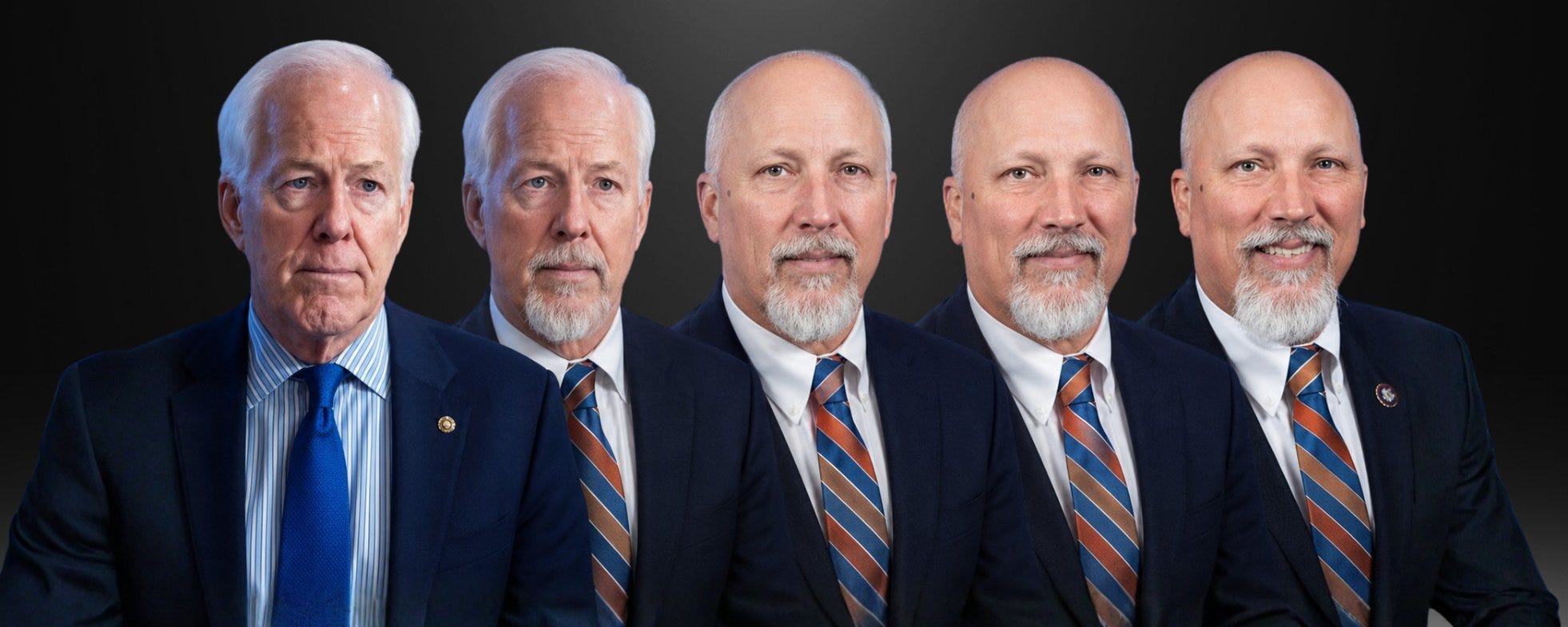
There is a useful distinction in political life between the staffer who carries the boss’s coffee and the staffer who carries the boss’s portfolio. The first is a witness. The second is an author. When a Senate staffer spends nearly a decade in three escalating senior roles for the same principal, advising on policy, drafting legislation, running the office, and representing the senator in leadership meetings, that staffer has crossed from witness to author. He is no longer telling the story. He is writing it.
This is the part of Chip Roy’s biography that his current Texas Attorney General campaign would prefer voters skip. Roy is running as a Freedom Caucus firebrand, the scourge of squishy Republicans, the conservative purist who never compromised. The trouble is that before Roy was a House member, before he was Ted Cruz’s chief of staff, he was John Cornyn’s chief of staff. And before that he was Cornyn’s staff director and senior counsel. And before that he was Cornyn’s senior counsel on the Senate Judiciary Committee. Nine of Cornyn’s first twelve Senate years were Roy’s years too. The record Cornyn built in that period, the record Texas conservatives now reject, is a record Roy helped build.
Consider the architecture. From 2003 to 2007, Roy served as counsel and then senior counsel to Cornyn on the Senate Judiciary Committee, handling immigration, civil justice, criminal matters, nominations, and constitutional issues. From 2007 to 2009, he was staff director and senior counsel in Cornyn’s Senate Republican Conference Vice Chairman office, which Roy himself described as “senior adviser to the Senator on matters relating to legislation, messaging and overall strategy.” From 2012 to 2014, he was Cornyn’s chief of staff, advising on “general strategy, messaging, organizational and policy matters” while managing more than 60 employees and a $4.5 million budget. These are not the credentials of a bystander. These are the credentials of a co-author.
Start with immigration, because immigration is where the paper trail is cleanest. When Cornyn took over the Senate Immigration Subcommittee chairmanship in 2005, Roy was the senior Judiciary counsel responsible for that portfolio. That same year, Cornyn co-authored the Cornyn-Kyl bill, S. 1438, which created a guest worker program and a “mandatory departure” provision that conservatives correctly identified as back-door legalization. Illegal immigrants would register, work for up to five years, and then briefly return home before receiving legal status. The bill manufactured a vast new visa pipeline and omitted the enforcement-first triggers that base voters demanded. Roy was the senior committee counsel of record. He did not draft press releases. He drafted policy.
The pattern repeated in 2006, when Cornyn voted to invoke cloture on S. 2611, the Specter-Hagel-Martinez bill, a vote that NumbersUSA scored as a vote to expand chain migration through an annual increase of 254,000 in the family-preference visa cap, plus a one-time permanent addition of 105,660 visas. A cloture vote, as Senate observers understand, is functionally a vote for the bill. The motion passed 73 to 25. Roy was Cornyn’s senior immigration counsel.
Then came 2007, the year of the Bush-McCain-Kennedy amnesty, formally the Comprehensive Immigration Reform Act, which would have legalized between 11 and 18 million illegal immigrants. Cornyn and Kyl joined the negotiating group. Roy led Cornyn’s participation in the bipartisan negotiations, sitting across the table from staffers for Kennedy, Schumer, and McCain to craft the legalization framework. Cornyn eventually walked away and voted no on final passage, which gives him a defense. Roy, by all accounts, did not want to give up. The question Texans are entitled to ask is straightforward: how much of Cornyn’s pro-amnesty posture during this period was Cornyn’s, and how much was Roy’s? We may never have a clean answer. We know Roy was in every room.
The 2007 portfolio also includes Section 1244 of the FY2008 National Defense Authorization Act, the Refugee Crisis in Iraq Act of 2007, sponsored by Edward Kennedy. The provision created a new special immigrant visa category for Iraqi nationals, 5,000 principal aliens per year for five years, plus spouses and children. Counting dependents, the program brought tens of thousands of Iraqis into the United States as Lawful Permanent Residents, the overwhelming majority of them Muslim. Iraqi resettlement increased nearly tenfold between 2007 and 2008. The program later served as the template for mass resettlement from Afghanistan and Syria. The bill was processed through the Senate Judiciary Committee, on which Cornyn sat, with Roy as senior counsel on the immigration portfolio. Cornyn voted for the FY2008 NDAA. Roy was paid to advise him on exactly this kind of legislation. As the Heritage Foundation and other conservative institutions have documented at length, faithful adherence to Islamic law produces a legal and civilizational order incompatible with the Western constitutional tradition, which makes mass resettlement from such societies a question of first-order political importance, not a humanitarian afterthought.
Roy’s tenure as staff director, from 2007 to 2009, produced its own grievances. In October 2008, Cornyn voted for the Troubled Asset Relief Program, the Wall Street bailout. TARP is the single most cited grievance among Texas conservative primary voters against Cornyn, deployed in every primary since, including the current 2026 Ken Paxton runoff. Not a single bank executive was indicted. None returned the bonuses. Roy, by his own description, “represented him in all Senate Republican leadership meetings and activities” and served as senior adviser on legislation, messaging, and overall strategy. The available options are these: Roy supported the vote, Roy advised on the messaging, or Roy failed to talk Cornyn out of it. There is no fourth option for a staff director who attended every leadership meeting.
Six months later, in April 2008, mid-crisis, Cornyn co-sponsored the Global Competitiveness Act of 2008, which expanded Indian H-1B visas at precisely the moment American workers were losing jobs at the fastest rate in a generation. The H-1B program is the principal legal vehicle through which workers from India, Pakistan, Bangladesh, and other countries displace American technology workers. Roy was the staff director. The same month the United States began shedding jobs by the hundreds of thousands, Cornyn’s office was advocating to import more foreign labor.
In 2009, the Kerry-Lugar-Berman bill, S. 962, tripled foreign aid to Pakistan to $1.5 billion per year, authorizing $7.5 billion over five years. It passed the Senate by unanimous voice vote, meaning every senator present, Cornyn included, consented. Osama bin Laden was at that moment hiding in Abbottabad, where he would be killed in May 2011, and the Pakistani ISI was actively coordinating Haqqani Network attacks on U.S. troops. Roy was staff director and senior counsel, representing Cornyn in leadership. Either he advised Cornyn to let the bill pass, or he failed to flag the implications. Roy did not object publicly. Neither did Cornyn.
Then came the chief of staff years, 2012 to 2014, which contain the single most damaging block of evidence. On June 11, 2013, Cornyn cast both of the procedural votes that gave the Schumer-Rubio-McCain Gang of Eight amnesty bill its path to Senate passage: the cloture vote and the motion to proceed. Without those Republican cloture votes, S. 744 dies in procedure. Cornyn supplied one. Ted Cruz, Texas’s other senator, did not. Roy was chief of staff. Cornyn’s “RESULTS” amendment, which Roy helped develop, accepted the bill’s underlying framework, including the pathway to citizenship for 11 million illegal immigrants. The amendment was not designed to kill the bill. It was designed to make it more passable.
The same chief of staff period produced the January 1, 2013 fiscal cliff tax hike, which Cornyn supported and which raised taxes by $600 billion, with nearly 80% of Americans paying more. It produced Cornyn’s public alignment with Mitch McConnell against Ted Cruz during the October 2013 fight to defund the Affordable Care Act, with Cornyn calling Cruz’s strategy “unachievable” and arguing “the shutdown did not help our cause.” Roy was Cornyn’s chief of staff during the fight. The historical irony arrives in 2014, when Roy left Cornyn to become chief of staff to the very senator Cornyn had just spent months undermining. A man’s biography is not always a record of his convictions. Sometimes it is a record of his timing.
A defender might say Roy did not cast the votes, and that is technically correct. But a senior counsel of record on the committee of jurisdiction, a staff director who attends every leadership meeting, and a chief of staff who advises on general strategy and messaging is not a neutral observer. He is the principal’s instrument. The Heritage Foundation, the Center for Immigration Studies, NumbersUSA, and Gun Owners of America have documented Cornyn’s record in considerable detail, including the 2007 NICS Improvement Amendments Act that passed by unanimous consent without Cornyn’s objection, building the federal background-check infrastructure that fifteen years later would underwrite the red-flag grant program. Roy was the senior committee counsel on that portfolio too. He did not stop the first link in the chain.
And the pattern continued once Roy reached the House on his own. In 2019, Roy voted yes on H.R. 1044, the Fairness for High-Skilled Immigrants Act, which passed 365 to 65 and which NumbersUSA flagged as a problematic Republican vote. The bill removed the 7% per-country cap on employment-based immigrant visas, a safeguard that prevented green-card monopolization by one or two source countries, primarily India. The Center for Immigration Studies documented that the bill would reward companies importing large numbers of Indian H-1B workers who displace American technology workers. This is, in substance, the House version of the H-1B expansion Roy was helping Cornyn co-sponsor in 2008. The rhetorical packaging changed. The underlying policy preference did not.
The fair conclusion is this. One cannot separate Cornyn’s worst positions from the senior staffer who built them with him. Roy was the senior counsel of record when the immigration framework was assembled. He was the senior strategy aide when TARP was sold. He was the chief of staff when the Gang of Eight got its cloture votes. If you do not like Cornyn’s tenure in the Senate, you will not like Roy’s tenure as Attorney General, because Roy helped author the tenure you do not like. When he reached Congress on his own, his first major immigration vote expanded the very H-1B pipeline he had helped Cornyn promote a decade earlier. The reinvention is recent. The record is long.
Texans have a clean opportunity this week. They can retire John Cornyn by sending Ken Paxton to the Senate, and they can decline to promote the staffer who helped build Cornyn’s record by electing Mayes Middleton as Attorney General. Two votes, one principle. Records, in the end, belong to the people who wrote them.
If you enjoy my work, please subscribe https://x.com/amuse/creator-subscriptions/subscribe
Alexander Muse is a Fellow at the John Milton Freedom Foundation and publishes daily political analysis at amuseonx.com. Primary sources cited in this piece are linked inline; campaign finance figures are drawn from FEC filings, polling data from publicly released crosstabs, and legal claims from filed pleadings. Corrections are posted to the original URL with a dated changelog. Readers who identify errors are invited to contact the author directly.
I will be first in line for early voting tomorrow morning: Paxton check; Middleton check.
Texan here. Hated Cornyn for years and love Paxton. Second hardest working man in politics. Voted for Mayes in the primary and intend to vote for him again in the run offs. I so appreciate this timely information. I will share it far and wide. I am working on several people who are wavering on Paxton because they think he is more vulnerable in the general. This is a perfect summary of why both men have to go. Who can resist a two for one! The timing is perfect. I really appreciate your clear concise barrage of undeniable facts.