


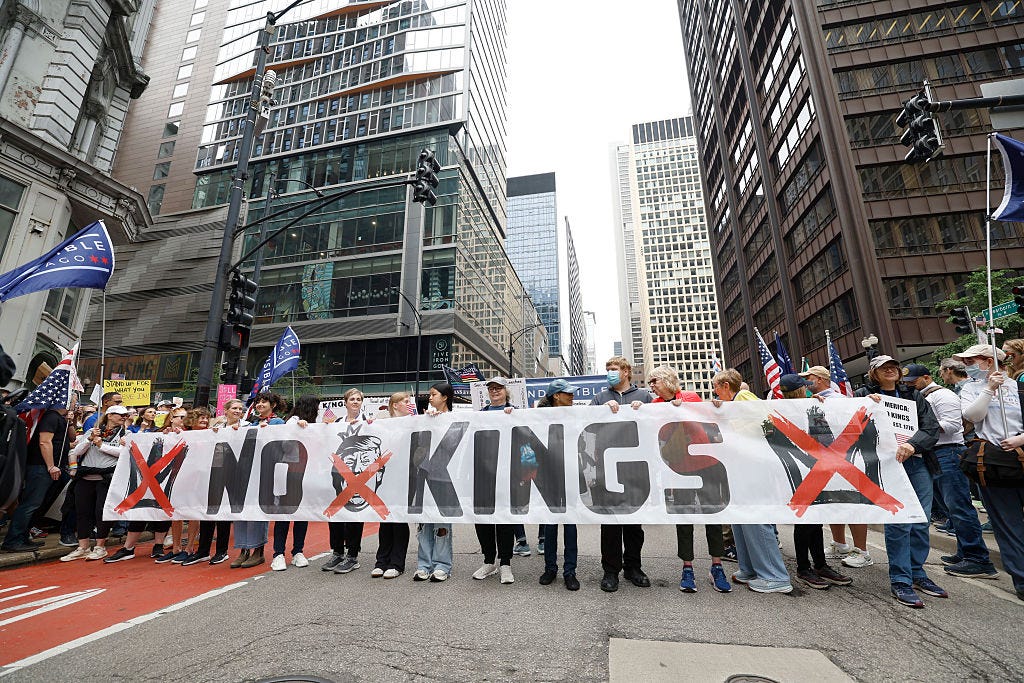
Phil Weiser spent October 17th at a No Kings rally, posting that he had come to stand for “government of the people, by the people, and for the people.” He was Colorado’s attorney general at the time and the Democrat nominee for governor. The people obliged him 17 days later with 61.13% of the vote, and on the same ballot they passed Proposition 134, which sorts school sports teams by biological sex, and Proposition 135, which bars sex-trait surgery on minors. Within a day, the governor-elect told reporters his team would have to decide “what adjustments are necessary” to overturn or neuter the measures he had already labeled anti-trans. Weiser decided he would be king. The same thing is going on in Washington state.
Lawmakers in Colorado and Washington should leave these measures alone, and judges should refuse to suspend them. The party that campaigned on saving democracy treats a ballot verdict it dislikes as a rough draft; only the tools differ by state. Colorado Democrats hold supermajorities in both chambers, so they intend to rewrite the result in the name of “administrability.” Washington’s constitution makes a quick legislative rewrite difficult, so Washington Democrats have run to a friendly county courthouse instead. Conservatives should use the time this fight buys to build the legal protections that keep a won election won, because this round will not be the last.
The lawsuit came six days after the election. The Washington Education Association, an advocacy group called TransFamilies, and five anonymous families filed in King County Superior Court, represented by the ACLU of Washington, Legal Voice, and Pacifica Law Group, and they want an emergency order before Initiative 638 takes effect on December 3rd. The Seattle School Board then voted unanimously to authorize Superintendent Ben Shuldiner to hire lawyers and sue as well; Mayor Katie Wilson announced her support the next morning. What they are asking a judge to undo is a law that keeps males out of girls’ K-12 sports and passed 1,765,555 to 1,387,797, a margin of 377,758 votes and 55.99% of the total, carrying 35 of the state’s 39 counties. Olympia had every chance to handle this the ordinary way. Let’s Go Washington submitted 444,434 signatures, 135,523 more than the law required, and the Secretary of State certified the initiative to the legislature in January, where lawmakers could have adopted it, rejected it, or offered voters an alternative. They did nothing. The coalition that declined to legislate when it was their turn now asks a judge in the state’s most progressive county to cancel what 1,765,555 citizens decided.
Alliance Defending Freedom moved on November 13th to intervene for Female Athletes United so the girls would have counsel of their own, and the law’s official defender explains why. Attorney General Nick Brown is a former partner at Pacifica, the plaintiffs’ firm, and he won office with the endorsement of the union now suing him. The outside firm he picked, Bryan Cave Leighton Paisner, advertises its work for the World Professional Association for Transgender Health. Picture a coach who loses 56 to 44, tells the league the final score is “not administrable,” and asks a commissioner who used to be his law partner to suspend the result pending protest. The court should grant the motion, and Brown should hand the defense to lawyers with no ties to the other side.
Rep. Lorena Garcia says “nothing is off the table,” and in Denver she is right about the mechanics. Proposition 134 passed 1,379,283 to 1,265,157, but it is a statute rather than a constitutional amendment, so a simple majority of the new legislature can gut it. Weiser’s stated objection is that Colorado cannot check the sex of every athlete. The measure requires nothing of the kind. Districts set their own verification, and the Commissioner of Education enforces compliance; even the Colorado Sun concedes the text never mentions genital checks. The precedent Democrats cite is Proposition 122, the 2022 psychedelics measure, which got a follow-up bill because it ordered the state to build a regulatory system from scratch. Proposition 134 arrives complete.
The appetite does not stop at sports. Of the 4 right-leaning measures that passed this fall, all 4 are under review. Voters made fentanyl possession a felony through Proposition 132, and Weiser has already said he does not want those offenders in prison. Proposition 133, life without parole for child sex traffickers, passed with 62.13%, and it too is on the list to be gutted. I suspect the legislature would have found a tax increase perfectly administrable.
Weiser’s four opponents drew 1,026,589 votes combined. Proposition 134 drew 1,379,283 votes, so at least 352,694 Coloradans who voted yes either backed Weiser or skipped his race, and the governor-elect’s first act targets his own coalition. Washington’s map reads the same way. Seattle voted no, roughly 75 to 25. Kent voted 57% yes, Federal Way 58%, and Auburn 62%, and those are Democrat-represented suburbs full of working families and immigrants.
The suit rests on 4 theories under the Washington constitution, each of them thin, which is what you get when the federal courthouse has been locked. On June 30th, the Supreme Court decided West Virginia v. B.P.J. and Little v. Hecox, with Justice Kavanaugh writing that “the States may maintain women’s and girls’ sports for biological females.” By the Court’s own count, 27 states draw that line, and so do the International Olympic Committee, the U.S. Olympic and Paralympic Committee, and the NCAA. So the plaintiffs lean on privacy in York v. Wahkiakum, a 2008 case that struck down random urine testing a school district ran without statutory authority. I-638 is a statute. Its check rides on the sports physical the state already requires, signed by the family’s own doctor, with the family choosing whether that means an exam, a cheek swab, or a blood test. The equal rights claim fares no better. Darrin v. Gould, the 1975 decision that opened football to qualified girls, recognized an exception for characteristics unique to one sex, and the attorney general’s office concluded a year later that districts “may maintain separate teams for the members of each sex.”
The complaint that the initiative amended statutes improperly dies on the page, since the text sets out both amended statutes in full. The same ACLU and Legal Voice lawyers pressed that theory against Initiative 2081, the parents’ bill of rights, and they have brought it back for another run.
A “fix” to Proposition 135 could do nothing but reopen a door the hospitals say is shut. Colorado’s own voter guide reports that Children’s Hospital Colorado, Rocky Mountain Children’s, and Denver Health say they do not perform these surgeries on patients under 18, and if that is true, the ban costs nobody anything. The evidence under the ban is firm in any case. Last year, the Department of Health and Human Services reported that the evidence for pediatric transition is very low quality. Finland had already excluded surgery from its treatment of minors in 2020; Sweden reserved mastectomy for exceptional cases in 2022. The law has moved with it, since the Supreme Court upheld Tennessee’s limits on blockers and hormones last year, 6 to 3.
A 15-year-old Washington wrestler has an emergency application pending at the Supreme Court, K.M.K. v. WIAA, alleging that she was sexually assaulted during a match by a male opponent the state had placed in her bracket without telling her. Hers is the extreme case; the ordinary one is a Camas High runner who opened this season in a boys’ junior varsity race and placed 76th, then switched to the girls’ side and won a varsity race. At regionals on October 31st, that runner took 7th, and Puyallup’s girls finished 8th as a team, one place short of the state meet. Riley Gaines tied for 5th at the 2022 NCAA championships and watched the trophy go to Lia Thomas while an official promised that hers would come in the mail. Penn restored its women’s records and only apologized last year.
Jonathan Turley, writing in The Hill, set the two states beside court packing and the popular-vote compact, with D.C. statehood for good measure, as ways of changing the rules without asking the people. The Colorado opposition group Families Not Politics was more candid, praising those who “did not accept that a majority vote had settled the question.” That sentence deserves more attention than it will get from the Democrats and their willing accomplices in the drive-by media, because it describes an election as something that binds only the losing side if the losing side happens to be conservative. The pattern has now occurred in 2 states in 2 weeks, and it will spread. The incentives all point one way; nobody in the Democrat Party pays a price for it, and every initiative state is watching to see whether the trick works. Weiser quoted Lincoln’s three prepositions in Montrose and, with 61% of the vote, has kept only the last of them; the voters will have to supply the other 2 themselves.
The King County court should deny emergency relief and let I-638 take effect on December 3rd while the challenge runs its course, with Alliance Defending Freedom at the defense table. In Denver, Republicans should force a recorded vote on every “adjustment” and insist that any amending bill go out without the safety clause, the boilerplate that blocks citizens from petitioning a new law onto the ballot.
Washington’s constitution forbids amending an initiative for 2 years without a 2/3 vote, which is exactly why the left there went to court. Arizona voters passed their Voter Protection Act in 1998 after legislators undid a measure they disliked. Colorado has nothing of the kind, which is why Weiser could speak of adjustments the day after the count, and the 2028 ballot is where Coloradans should put a shield of their own, with the signature drive starting the morning the first amending bill is filed. At the end of the day, a rule like that takes nothing from a legislature except the power to overrule the people without asking them, and a supermajority that cannot live with that condition has given up representing its voters and taken up correcting them.
If you enjoy my work, subscribe x.com/amuse/creator-subscriptions/subscribe
Alexander Muse is a Fellow at the John Milton Freedom Foundation and publishes political analysis at amuseonx.com. Readers who identify errors are invited to contact me directly. Each op-ed is edited for grammar and clarity using AI in partnership with Grammarly. Data provided in a sponsored partnership with Polymarket.
The Democrats don't count votes, they count ballots. What the citizens vote for is not what we get. Not until they've tinkered with it and added a loophole.
As long as we have mail in voting and same day registration without proof of citizenship, voter integrity is a mirage.