


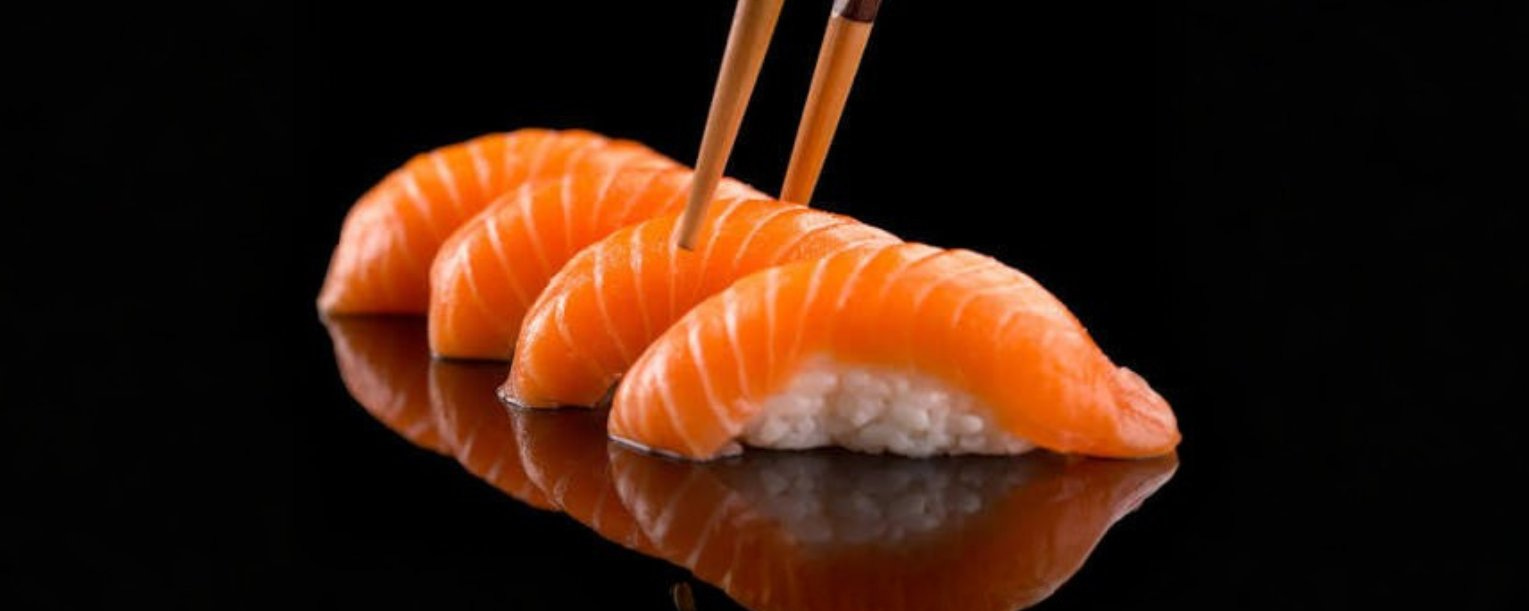
This week I am in Europe with my daughter, who leaves for college next month, and this trip is our last proper daddy-and-daughter hurrah before she becomes someone who visits rather than someone who lives down the hall. Listening to the Planet Money Podcast on the plane about how Norway beat the resource curse, I found myself thinking about food, and specifically about the one dish I order more than any other. At R+D in Dallas, I have a habit that probably irritates the kitchen. I ask the sushi chef to take the mixed platter and make the entire thing salmon. No tuna, no yellowtail, no eel. Just salmon, raw, sliced thick, cold and faintly sweet, with a clean fat that coats the tongue and then disappears.


So it was a genuine surprise to learn that the dish I treat as a fixed feature of the universe is younger than I am. Salmon nigiri is not an ancient Japanese tradition. Until the 1980s, Japanese sushi chefs did not use salmon at all, and would have found the suggestion mildly revolting. The reason was not snobbery but biology. Raw salmon in Japan carried Anisakis and other parasites, and a chef who served it was not being adventurous; he was being reckless. Japanese consumers ate a great deal of salmon, but they ate it grilled, salted, or cured. Traditional sushi chefs therefore did not regard a raw slice of salmon as an established sushi ingredient at all.
The story of how that changed begins not with a chef but with an oil field, and once you see how the two threads run together it becomes a case study in something conservatives should care about more than we usually do. What separates a nation that gets rich from natural resources from a nation that gets ruined by them?
Two revolutions arrived in Norway at almost the same moment. Phillips Petroleum found the Ekofisk field just before Christmas of 1969, and Norwegian oil production began on June 15, 1971. Meanwhile, on the island of Hitra, two brothers named Ove and Sivert Grøntvedt placed a generation of Atlantic salmon into a floating sea cage in 1970 and took their first commercial harvest in 1971. Modern Norwegian oil and modern Norwegian salmon were, in effect, twins. Nobody planned it that way, and for a decade the two industries had nothing to do with one another.
The oil problem has a name. Economists call it the resource curse, and its symptoms are familiar to anyone who has looked at Venezuela, Nigeria, or Russia. A commodity windfall arrives, the currency strengthens, costs rise, the political class discovers that money can be distributed faster than it can be earned, rent-seeking crowds out production, and within a generation the country can no longer make or sell anything that is not pumped out of the ground. The Heritage Foundation put the diagnosis about as cleanly as it can be put, observing that it is a nation’s policies, not its products, that determine its economic well-being. Norwegian petroleum was chemically identical to everyone else’s. The difference was institutional.
What Norway did was build the rules before the money showed up. It asserted sovereignty over its continental shelf in 1963, before anyone knew there was anything down there worth owning, and opened its first licensing round in 1965. In 1971 the parliament adopted what became known as the Ten Oil Commandments, the first of which insisted that national supervision and control be ensured for all operations on the shelf. In 1972 Norway created two separate institutions, the Norwegian Petroleum Directorate as regulator and Statoil as commercial operator, which meant the national champion could not serve as its own judge. Private and foreign companies kept their access, supplying capital and engineering, while the state captured the rent. The combined marginal petroleum tax rate today is 78%.
Then Norway added a second layer of protection. Beginning with the first transfer in 1996 and the fiscal rule adopted in 2001, net petroleum cash flow was routed into a sovereign fund invested almost entirely outside the country, with annual budget withdrawals limited to the fund’s expected real return, a benchmark reduced from 4% to 3% in 2017. At the end of 2025, that fund held roughly $2.1 trillion. Net government deposits accounted for only about $540 billion of it. Investment returns accounted for roughly $1.3 trillion. Compounding, not drilling, is now the larger source of the wealth, and because the money sits abroad, it cannot flood the domestic economy all at once.
Here is the part of the story usually left out, and the part I find most instructive. Norway did not resist every temptation. Its fishing industry had operated under a General Agreement since 1964 that made government assistance a permanent fixture, and when oil money arrived, those payments became painless to finance. The OECD later reviewed the episode and described the correlation between oil prices and Norwegian fisheries subsidies as astonishingly high. By one measure, support reached approximately 70% of the industry’s value added around 1981. That is not a safety net; that is life support, and it was doing what such programs always do, which is preserve fishing capacity the stocks and the market could not sustain. Norway had already watched its spring-spawning herring collapse in the 1960s and knew what happens when you pay more boats to chase fewer fish.
Then Norway did the thing almost no government does. It reversed. Subsidies were reduced through the 1980s, a 1989 European Free Trade Association commitment locked in the phaseout, and support had become negligible by the mid-1990s. In their place came limited entry, quotas, capacity control, and stock rebuilding, which is to say property-like access rights and resource discipline rather than checks. Norway kept using government, but it stopped using government to guarantee income regardless of productivity. That distinction is the whole argument, and American conservatives ought to be able to articulate it in our sleep.
Which brings us back to the fish. Freed from subsidy and pushed by biology, Norwegian aquaculture grew at roughly 40% annually from 1972 through 1975 and kept climbing. Production went from about 500 tonnes in 1970 to about 8,000 tonnes in 1980 to roughly 170,000 tonnes by 1990. A country of four million people cannot eat that. Prices fell, and finding a large foreign buyer stopped being a marketing exercise and became a matter of survival.
Japan was the obvious target and the hardest one. It had an enormous seafood-consuming population, an established premium market for raw fish, and shortages in prized species. It also had that inconvenient conviction that raw salmon was inedible. Norway shipped two tonnes of salmon to Japan in 1980. In 1985, Norwegian fisheries authorities and the industry launched the effort known as Project Japan, whose ambition Bjørn Eirik Olsen later summarized by saying they set out to inject Norwegian salmon into Japanese sushi. The economics were stark. Salmon sold for grilling competes in an ordinary protein market, while salmon accepted for sashimi commands several times as much, and Olsen estimated the premium at up to tenfold.
The initial reception was total rejection. Japanese seafood executives objected to the color, the smell, the texture, the consistency, the gills, and even the shape of the head. Olsen’s summary was that everything was wrong. Norway had one real advantage: its product genuinely was a different animal. Farmed Atlantic salmon raised on processed dry feed never eat the live prey that carries Anisakis, and the European Food Safety Authority has concluded that such fish present a negligible parasite risk, while Norwegian Institute of Marine Research studies from 2014 to 2016 found no such worms in market-quality farmed salmon. Yet Norway wisely declined to advertise the absence of parasites, since saying no parasites only places the word parasite in the customer’s head. The campaign sold origin instead: cold water, clean fjords, snow, and freshness, and it quietly encouraged a separate name. Familiar domestic salmon was sake or shake, while the imported Atlantic fish meant for raw consumption was sold as sāmon, in katakana, which placed it outside the old culinary rules entirely.
Consumer advertising accomplished nothing, including a cartoon Viking mascot, because consumers cannot buy what wholesalers refuse to stock. The veto sat inside the Japanese distribution system, and unlocking it took roughly a decade of tastings, embassy dinners, and patient relationship building. The breakthrough finally came out of a disaster. In 1991, the Norwegian farmers’ sales organization collapsed, leaving approximately 30,000 tonnes of frozen salmon in storage and enormous pressure to dump it cheaply into the grilling market. Olsen refused, understanding that a fire sale would permanently confirm that Norwegian salmon was ordinary cooking fish.
He went instead to Nichirei, one of Japan’s largest food companies, and offered roughly 5,000 tonnes at an attractive price on a single condition: that the fish be distributed for sushi, particularly through supermarkets. That one transaction was more than thirteen times Norway’s total 1985 salmon exports to Japan, and what it really transferred was trust. A Japanese family might ignore a Norwegian advertisement, but a familiar Japanese brand in a familiar supermarket signaled that the product had been inspected and accepted by their own food system. The low price made trial cheap, conveyor-belt restaurants made it nearly free, and nobody got sick. Chef Tadashi Ono, who initially feared raw salmon would make him ill, ended up calling it buttery, creamy, and melt-in-your-mouth, which explains why it worked. It was rich enough for connoisseurs and mild enough for children.
Exports to Japan went from 385 tons in 1985 to nearly 20,000 tons by 1995 and past 45,000 tons about two decades after that two-ton start. Olsen knew he had won when he saw plastic salmon-sushi replicas in Tokyo restaurant windows, because advertising can be purchased but a spot in the permanent display cannot. The rest is on every menu in America. Norwegian Seafood Council research now finds salmon to be the preferred sushi topping in 17 of 20 surveyed countries, estimates that roughly 30% of Norwegian salmon is eaten raw or as sushi, and puts Norway’s share of the global salmon market near 53%. In 2025, Norway exported 1,414,909 tonnes of salmon worth about $12.5 billion, with total seafood exports reaching roughly $18 billion.
That is the real test, and it is worth stating plainly for the American reader. A country has not escaped the resource curse merely because it has accumulated a large treasury. It has escaped only when the rest of its economy can still make things strangers want to buy. Norway captured its geological rent, refused to spend the principal, stopped paying its fishermen to remain unproductive, and then helped them open a market no individual farmer could have opened alone, after which consumer demand did the rest. The state supplied the collective goods, science, standards, diplomacy, and national reputation, and then stepped aside. That is not central planning; it is disciplined national capitalism, and the proof of it is riding past you on a conveyor belt.
My daughter, who heard a version of this over dinner and was more patient about it than she needed to be, observed that the only reason her father has a favorite food is that a Norwegian salesman refused to unload frozen fish cheaply in 1991. She is right, and she is about to go study matters far more consequential than aquaculture policy. Still, there are worse lessons to send a kid off to college with. Windfalls do not make you rich, traditions are not permanent, and the difference between a nation that squanders its luck and one that compounds it comes down to whether anybody had the discipline to write the rules before the money arrived.
If you enjoy my work, please subscribe https://x.com/amuse/creator-subscriptions/subscribe
Alexander Muse is a Fellow at the John Milton Freedom Foundation and publishes daily political analysis at amuseonx.com. Primary sources cited in this piece are linked inline; campaign finance figures are drawn from FEC filings, polling data from publicly released crosstabs, and legal claims from filed pleadings. Corrections are posted to the original URL with a dated changelog. Readers who identify errors are invited to contact the author directly.
Well-researched and a fun read. Some great lessons here to pay attention to!
That explains something that I had not thought of
When I moved to Japan the first time in August 1991 Salmon sushi/sashimi was not a thing. Mind you we're talking the salmon flesh. Salmon roe (ikura) was (and is) a standard sashimi/sushi dish. But the flesh became ubiquitous as I came back to Japan from US and then Europe in the mid/late 1990s and early 2000s. I never really thought about why that would have been the case but I did notice it as an oddity.