


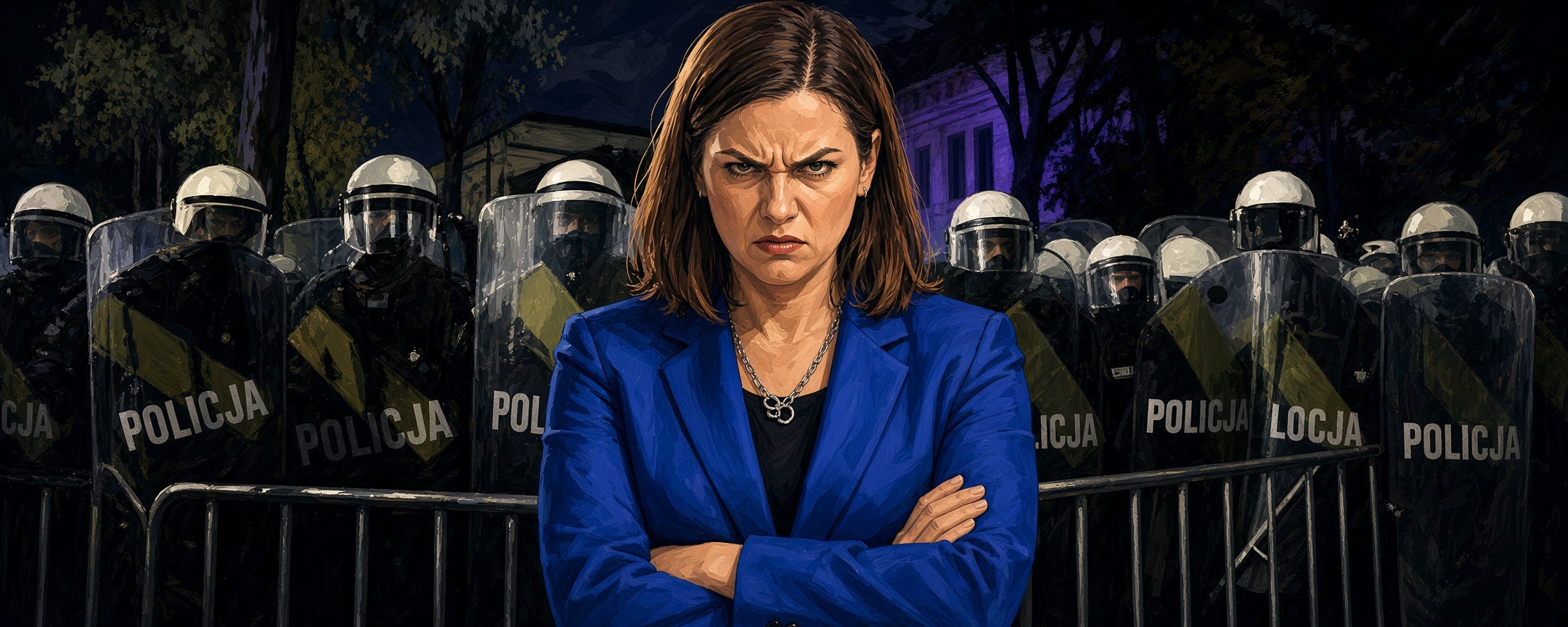
On the afternoon of Friday, October 30th, Poland's president boarded a plane for Senegal. Karol Nawrocki was somewhere over Spain when the news reached the cabin. Back in Warsaw, Anna Korwin-Piotrowska, who had never taken the oath before the president that Polish law requires of a Constitutional Tribunal judge, ordered the suspension of the Tribunal’s president, Bogdan Święczkowski, and its vice president, Bartłomiej Sochański, for one month. She announced that she was now running the court. Nawrocki told the pilot to turn around at around 6:12 in the evening, and by midnight he was standing inside the Tribunal building beside the First President of the Supreme Court, telling the people inside they were not judges.
Seven weeks earlier, Michigan Senator Elissa Slotkin sat across the table from the men who organized that night. She went to Warsaw and Budapest in early September, came home, told a Washington think tank that she had dusted off their playbook, and was then caught on hidden camera assuring a voter that the Democrat Party has its own list of signature legal cases ready and that January is when you will see them. That is the whole story, and it is why Tuesday, November 3, matters more than any midterm in my lifetime. The people who intend to govern you have told you how they plan to do it; the only question left is whether you give them the majority they need to start.
A republic rests on one dull rule. Those who hold office keep it until voters or the constitution remove them, and nobody else gets a vote. Every other protection, every court and every election law, is scaffolding on that rule. Once a governing faction decides that the right people may skip the step, the scaffolding is still there, but it holds nothing up. What happened in Warsaw was an attempt to skip the step. Study it closely, because the people who built it have already briefed the senator who wants to import it.
Here is the sequence. The legal hook Korwin-Piotrowska reached for was Article 130 of Poland’s Law on the System of Common Courts, a housekeeping provision that lets a court president or the justice minister bench a judge for up to a month when the court’s dignity demands it. It was written for ordinary judges in ordinary courts. Polish constitutional lawyers say it does not reach the president of the Constitutional Tribunal at all, and nothing in it lets one unsworn appointee fire the leadership of the court she wants to join. The hook was weak, so the operation needed muscle. The new appointees did not walk in the front door. They entered through a side gate from the grounds of the Prime Minister’s Chancellery, escorted by the State Protection Service, which answers to the interior minister. Police ringed the perimeter after Korwin-Piotrowska reported vague threats to staff, which kept the suspended leadership outside while her group worked inside. The Tribunal’s own website was used to post the suspension orders. Then Justice Minister and Prosecutor General Waldemar Żurek filed motions to strip Święczkowski and Sochański of immunity so criminal charges could follow for running their own court.
Jan Grabiec, who heads the Prime Minister’s Chancellery, confirmed on November 2 that he was told in advance and approved the passage through government grounds. He said, “The judges chose the moment.” The moment they chose was when the head of state was 30,000 feet over the Iberian Peninsula. Polish television reported that Tusk’s government tried to divert the returning plane to another city and that the Polish army declined to go along and let it land. When Nawrocki arrived at the court after midnight, police shoved back his own security detail before he got through. Video circulating from the days before shows German police vans on a Polish highway, and witnesses reported that officers blocking the court wore no identification numbers and did not speak Polish. Poles have long memories about uniformed Germans at the border.
Brussels wasted no time picking a side. Commissioner Michael McGrath declared that appointing the new judges lies within the power of the Sejm, citing the Venice Commission, which is the same body the European Commission has leaned on for years while freezing Polish funds and opening infringement proceedings against the Tribunal as it existed under the previous government. Dominik Tarczyński, a Polish member of the European Parliament, laid out where this leads in three moves: first the court, then Poland forced into the euro, then Poland’s gold shipped to the European Central Bank in Frankfurt. Poland’s central bank holds more gold than any other in Europe. Follow the money and the night of October 30 stops looking like a legal dispute.
The Hungarian model is cleaner because it is finished. Viktor Orbán lost in April after 16 years, and Péter Magyar replaced him. Magyar’s party had worked with the European Union since 2018 to squeeze Hungary under Article 7 of the EU treaty. By 2022, the Commission had suspended €6.3 billion in funding, a figure that grew to somewhere between €16 billion and €35 billion. The message to Hungarian voters was plain: remove Orbán, install Magyar, and the money flows. After the election, the Commission released €4.2 billion and switched future funding back on. That is the playbook. Starve, replace, reward.
Slotkin sat with Magyar in Budapest and heard how his government drew up separate plans for every electoral outcome, from a narrow majority to a supermajority, and how it handled what it called the prior government’s corruption and legacy through what it called accountability tools. On September 9 in Warsaw she met Żurek, who briefed her on judicial reform, criminal law cooperation, and the fight over the Constitutional Tribunal appointments, and who seven weeks later would be the man filing to strip the court’s leadership of immunity. On September 10th, she met Adam Bodnar at the Polish Senate, the former justice minister who called the new Tribunal nominations and the moves against the National Prosecutor’s Office breakthroughs. Court packing and expanded lawfare were on the table as options for the United States. She was in the room while they described what they had done and what they were about to do.
Then she told us herself. On September 30th at the Carnegie Endowment, with Anne Applebaum handling the questions, Slotkin said she had visited Poland and Hungary at the beginning of the month, praised Hungary’s broad coalition for defeating Orbán, pointed to Poland’s “Iron Broom” accountability campaign, and talked about applying signature cases against alleged corruption here at home. The hidden camera came later. A voter raised prosecutions of the Trump administration. Slotkin said she was with him, told the Budapest story about removing a leader of 16 years through signature legal cases, said the Democrat Party has its own list ready, and said that is what you are going to see in January.
Her defenders will say she was doing oversight, and that Donald Tusk is restoring the rule of law after years of PiS mischief, and that a dysfunctional Tribunal had to be unblocked. Lawful acts are done at noon through the front door. If the Sejm’s appointments were valid, Tusk wouldn’t have needed an absent president, a side gate, policemen without name tags, or a one-month suspension under a statute meant for district judges who show up drunk. Likewise, if Slotkin’s trip were oversight, it would have ended in a committee report rather than a whispered promise about January. The method tells you what the actors believe about their own legality.
The method is already staged here. The Democrat Party has retained Marc Elias’s firm, and Elias has bragged that the lawyers are lined up, the papers are drafted, and they intend to fight the election results and anything Trump does afterward. He said this before a single vote was counted. Data Republican has reported on a group waiting for its moment around the midterms to manufacture chaos, provoke Trump into calling in troops, scream coup, and then move through governors they have already approached. That is the Lula sequence from Brazil and the Warsaw sequence from Friday, with American names in the boxes. The Democrats and their willing accomplices in the drive-by media will call every piece of it normal. In Warsaw they called it normal, too.
Step back, and the pattern is not subtle. Călin Georgescu won the first round in Romania, and they threw out his election because he was a conservative; a year ago, he warned that if nobody stood up, they would do it again somewhere else. Hungary followed, then Serbia, then Poland. Every one of those leaders stood with Trump. Nawrocki in particular has been credited by Trump with pushing a permanent American base in Poland, roughly 4,000 to 5,000 troops, with Poland prepared to spend $3 billion to $4 billion on the infrastructure, plus a PAC-3 Patriot servicing center, the first outside the United States, with Polish defense spending near 5% of GDP. Remove the allies one by one, and Trump stands alone, which is the point, and then the people who answer to Brussels take the chairs.
So here is what you do. You vote on Tuesday, and you bring people with you, because the only thing that beat the coup in Warsaw was that the president did not hide and the people showed up at the gate. Then you get inside the polling places as a poll watcher or a challenger, and you volunteer so the count happens in front of witnesses. At the end of the day, Warsaw taught a lesson the globalists did not intend to teach. Brussels wanted the court, Frankfurt wanted the gold, and Tusk wanted the president out of the country, and what they got was a crowd at the gate and a plane turning around over Spain. The playbook works only on an empty square. Fill it.
If you enjoy my work, subscribe https://x.com/amuse/creator-subscriptions/subscribe
Alexander Muse is a Fellow at the John Milton Freedom Foundation and publishes political analysis at amuseonx.com. Readers who identify errors are invited to contact me directly. Each op-ed is edited for grammar and clarity using AI from Grammarly.
Sen. Elissa Slotkin violated The Logan Act (18 U.S.C. § 953)
What it prohibits: The statute bars any U.S. citizen, wherever they are, from conducting unauthorized correspondence or intercourse with a foreign government (or its agents) with the intent to influence the measures or conduct of that foreign government in relation to disputes or controversies with the U.S., or to defeat U.S. measures.
My question is why is this bitch walking around free, today. She should have already been sporting her new tar and feathers!