


Consider a man who holds clear title to a parcel of land at the end of a long dirt road. The deed is recorded, the county recognizes his claim, and no neighbor disputes it. But the road washes out every winter, and he owns no vehicle capable of crossing it. For four months of the year he cannot reach his own property. Does he own it? In the legal sense the answer is obvious. In the practical sense that becomes urgent the moment somebody else decides to pitch a tent on the far acreage, the answer grows less comfortable. Sovereignty works the same way. It is not merely a relation between a nation and a map. It is a relation between a nation and a place, and relations of that sort require the physical capacity to arrive.
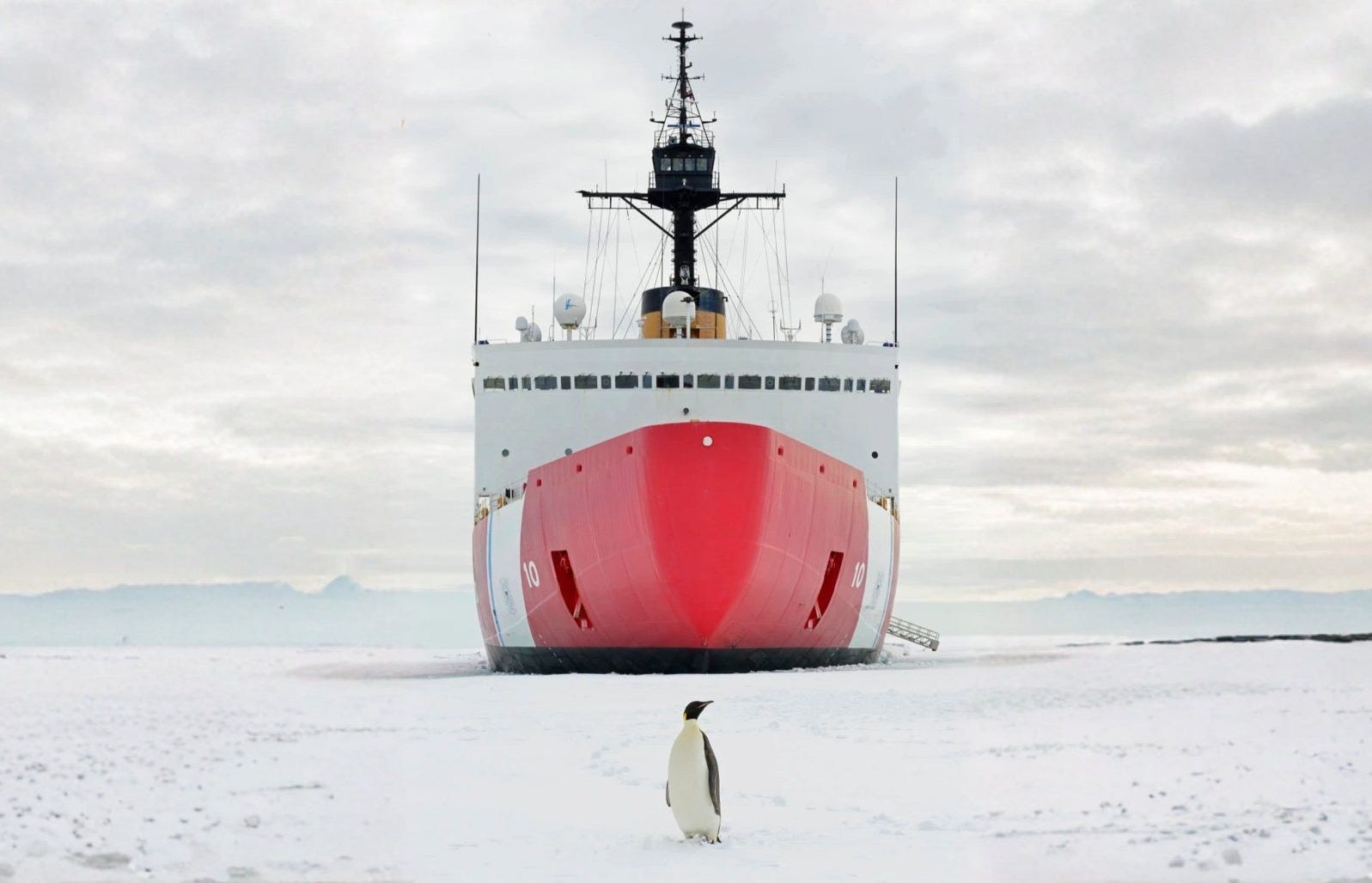
President Trump’s Arctic icebreaker program should be read against that background. Most of the commentary has fastened on a single detail: four of the new Arctic Security Cutters will be built in Finland rather than in the United States. Critics have treated that detail as the whole of the policy. It is not. Four ships built quickly abroad make possible seven more built here, in Louisiana and Texas, by American welders working from designs and methods that Finnish yards have spent a century refining. The foreign ships close a military gap. The domestic ships begin to close an industrial one.
Trump’s October 2025 memorandum invoked national security authorities to permit limited foreign construction while directing the Coast Guard to structure the acquisition so that expertise moves onshore. Rauma Marine Constructions will build two cutters in Finland. Davie Defense will build two more at its Helsinki yard. Bollinger will then build four in Houma, Louisiana, and Davie will build three at Gulf Copper facilities in Galveston and Port Arthur. That is four abroad and seven at home out of a program of eleven medium icebreakers, running alongside a wholly separate program of up to three heavy Polar Security Cutters being built in Pascagoula, Mississippi. Congress appropriated more than $8.6 billion for the effort, and by February 2026 the Coast Guard had completed awards on all eleven medium hulls.
You might ask why the United States does not simply build all eleven here and skip the Finnish step. The answer is that we cannot, not yet, and not on any schedule that answers the threat. The United States laid down its last heavy polar icebreakers in 1974. The last purpose-built medium polar icebreaker, Healy, was commissioned in 2000. A shipyard is not a factory that can be switched on. It is a body of knowlege distributed across welders, pipefitters, naval architects, procurement officers, and a supplier network, and that body of knowledge decays when it is not exercised. The Government Accountability Office found precisely this when it examined the heavy icebreaker program: limited domestic expertise in designing and constructing such vessels, hull steel as much as twice the thickness of a conventional ship, internal framing spaced far more densely, and beams in the icebelt roughly three times as deep as those in a comparable non-icebreaking hull. Those differences are not cosmetic. They change how a ship is welded, how equipment is routed, how weight is managed, and how production is sequenced.
Finland preserved what we discarded. Finnish firms have designed approximately 80% of the world’s icebreakers and Finnish yards have built roughly 60% of them. More than thirty Finnish companies participate across design, systems, construction, and operations. This is not an accident of national character. It is the predictable result of continuous demand. Finland must reach its own frozen ports every winter, so Finland never stopped building the ships that make that possible. President Alexander Stubb called the arrangement with Washington a huge strategic decision, which is striking language coming from the seller. Routine export sales do not usually earn that description from the exporting head of state.
The arrangement treats Finnish capability as a temporary teaching resource rather than a permanent crutch. A conventional foreign purchase would deliver hulls and leave the United States exactly as dependent as before, so that the next order, the next spare part, the next modification would again have to be sourced abroad. This program does something different. The American yards begin work in parallel rather than waiting for the Finnish ships to finish. Bollinger cut steel in Houma in April 2026, roughly two months before its final contract terms were signed. Davie broke ground on a modernization of its Texas facilities that may reach $1 billion, following an earlier commitment of more than $730 million in capital investment supported by a $21.771 million Texas Enterprise Fund grant. Admiral Kevin Lunday, the Commandant, described the purpose of the accelerated program as strengthening domestic shipbuilding and reinforcing the nation’s industrial base. That is the service itself naming reindustrialization as an operational objective.
The historical case for urgency is grim. In 1965 the transfer of Navy vessels gave the Coast Guard a polar fleet of eight icebreakers. Those ships escorted the tanker Manhattan through the Northwest Passage in 1969 and freed an icebound convoy of twenty tugs and forty barges bound for Prudhoe Bay in 1971. Then Washington replaced the fleet on the cheap. Budget pressure limited the new Polar class to two hulls, laid down in 1974. By 1990 the fleet had fallen from eight ships to two, and the consequences arrived on schedule. In 2010 Polar Sea suffered a service-ending engine failure while Polar Star sat in caretaker status, and the United States was reduced to hiring foreign icebreakers to resupply its own Antarctic station at McMurdo. A country that had loaned three Wind-class icebreakers to the Soviet Union between 1945 and 1950 was, sixty years later, renting polar access from strangers.
Russia did not make the same mistake. Reuters counted forty-two operational Russian icebreakers in June 2026, several of them nuclear-powered, against two operational American ships at that same moment. The Heritage Foundation’s broader inventory, which includes additional ice-capable vessels, puts the Russian figure at fifty-seven. Russia has reopened dozens of Soviet-era Arctic bases and now fields military installations in the region that outnumber NATO’s by more than 30%. The Kola Peninsula houses roughly two-thirds of Russia’s second-strike nuclear capability, including six of its twelve nuclear-armed submarines. China, which has no Arctic coastline whatsoever, has declared itself a near-Arctic state, promoted a Polar Silk Road, and sent research vessels into and near American waters with rising frequency. In July 2026 the Coast Guard tracked Xue Long and Xue Long 2 through the exclusive economic zone in the Bering Sea. Reuters, which is nobody’s conservative pamphlet, concluded simply that Russia has raced far ahead.
The fragility of what we have left was demonstrated that same month, when Healy suffered a significant engineering casualty and had to return to port for major repairs. A nation with forty icebreakers absorbs a mechanical failure as an inconvenience. A nation with three absorbs it as a strategic loss. At that moment Storis was on patrol, and Munro was shadowing Chinese vessels, and one broken gearbox had removed a substantial fraction of American polar capacity overnight. Lunday said the incident underscored the vital importance of the President’s vision; he said it not at a groundbreaking ceremony but in the aftermath of a real failure, which is the sort of context that separates institutional conviction from institutional public relations.
What follows is not merely a purchase of hulls. Texas will build three medium icebreakers at yards receiving up to $1 billion in modernization, projected to create roughly 2,400 direct jobs and support nearly 7,000 across the state economy. Louisiana will build four at Houma. Mississippi will build up to three heavy cutters at Pascagoula. Governor Abbott called the Texas project a quintessential America First endeavor, and Davie’s chief executive described complex shipbuilding as something being brought back to Texas for the first time in generations. Those statements describe a supplier network, an apprenticeship pipeline, and a production horizon long enough that a young man can plan a career around it.
Theodore Roosevelt observed in 1901 that it is not possible to improvise a navy after war breaks out. You cannot improvise a welder who knows how to join four-inch ice-belt plating, and you cannot improvise the vendor who forges the shafting, and you certainly cannot improvise them in the winter of the year you discover you need them. The Arsenal of Democracy that produced 5,777 vessels during the Second World War was not conjured in 1941. It was the accumulated residue of decades of ordinary commercial demand. We let that residue wash away, and today we build 0.2% of the world’s ships while China builds 74%. Rebuilding it will take years, and it will begin with something unglamorous, namely a guaranteed production run of ships that somebody has actually ordered.
That is what the program purchases. Not four Finnish icebreakers, though it purchases those too. It purchases the conditions under which Americans learn again to build ships that can reach American territory. The legal claim to the far acreage was never in doubt. The practical capacity to get there is what had eroded, and that capacity is what is now being restored.
My 2025 article about the problem:

If you enjoy my work, please subscribe https://x.com/amuse/creator-subscriptions/subscribe
Alexander Muse is a Fellow at the John Milton Freedom Foundation and publishes daily political analysis at amuseonx.com. Primary sources cited in this piece are linked inline; campaign finance figures are drawn from FEC filings, polling data from publicly released crosstabs, and legal claims from filed pleadings. Corrections are posted to the original URL with a dated changelog. Readers who identify errors are invited to contact the author directly. Each op-ed edited for grammar and clarity using Ai in a sponsored partnership with Grammarly. Data provided in a sponsored partnership with Polymarket.
Alaska and the new states of Greenland and Canada seem like promising locations for expansion. Also, we need mine sweepers...yesterday.
I'm just a guy. A guy who devours history. When the US began shipping our industry out of the country, building an "international supply chain and distributed industrial capabilities" where portions of fighters and bomber were produced in separate countries and then assembled in the US, shipbuilding was outsourced to other countries, our steel making capacities crumbled, our mining of critical minerals was drastically curtailed or abandoned, when the US military and commercial markets became dependent on other countries, I thought, "What happens when another world war breaks out and we no longer have unrestricted imports?" The "arsenal" of the Free World in WWII was able to outproduce the whole of the Axis Powers and supply our allies with the goods and materials necessary to defeat the Nazis and Japanese. At present, we can't supply our own needs should a peer-to-peer conflict break out. That the politicians allowed this to happen shows the degraded status of our political classes. The number one function of government is to protect its citizens. Will our enemies (not just "adversaries") allow us enough time to retool and rearm?