


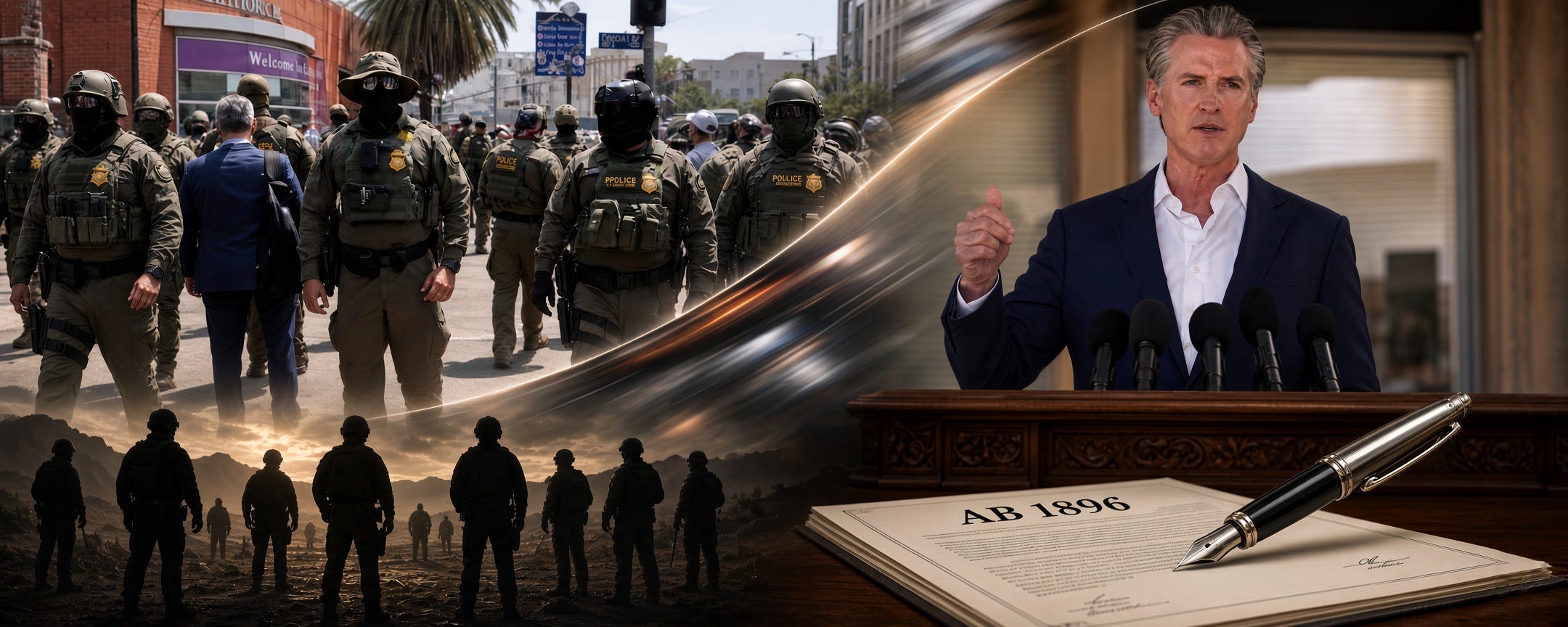
Consider a woman who spent six years as a deportation officer in Immigration and Customs Enforcement’s Los Angeles field office. She followed her training, obeyed lawful orders, and never drew a complaint. In 2028, she applies for a clerical job at a county library. AB 1896, the measure the Legislature titled the GTFO Act, treats that prior service as a presumptive bar. The only statutory escape runs through a hiring agency’s approval of her entry into a Peace Officer Standards and Training basic course. She wants work among the stacks. The statute offers her a gate built only for recruits who mean to carry a gun.
The Senate passed the bill on August 30 by 29 to 10. The Assembly concurred on September 1 by 52 to 19. The enrolled text went to Governor Gavin Newsom on September 14. The California Constitution gives him until September 30 to sign or return it, and a bill he neither signs nor returns becomes law without him. Other blue states will take their cue from whatever he does.
California can refuse to lend its own officers to ICE. Printz and the anti-commandeering cases already protect that choice. The enrolled text goes further and puts a disability on the Americans who already did the work.
Beginning January 1, 2028, Section 1025 of the Government Code disqualifies anyone previously employed as a sworn law enforcement officer or individual contractor who personally engaged in defined immigration enforcement. The disqualification covers public employment generally, with the state, cities, counties, districts, and other public agencies. Police departments are only one corner of that map. Earlier drafts had drawn a window around President Trump’s second term, from January 20, 2025 to January 20, 2029. The enrolled version dropped the window. The final text asks whether the applicant performed qualifying service at any time. An officer who lawfully served under Obama or Bush is covered as fully as one hired last year.
Applicants for peace officer appointment or a POST basic course must submit a declaration, under penalty of perjury, stating whether they have ever done that work. False statements become evidence in the suitability review. Hiring agencies may consult news articles, verified social media, and civil complaints when they run the background investigation. The Legislature wrote those extra sources into the file. Sacramento is asking more than whether the applicant can do the job in front of him. It is asking whether he once did a federal job the Capitol now treats as a moral stain.
The Legislature did not hide the theory. The findings accuse immigration agents of an “indiscriminate mass terror campaign.” They treat the claim that agents were “unwilling to stand up to orders” as proof of unfitness for any California public job. Assemblymember Mark González, the author, went further, condemning agents as civil rights violators. “Time and time again, we have seen these agents show they are unwilling to stand up to unlawful orders,” he said. “These agents disgust me, and they have no place, no right to serve the public here in California. So, I am proud to stand with the Speaker in drawing a line: if you want to choose violence, if you choose to violate civil rights and follow blatantly racist orders from this oppressive federal administration, good luck finding a job here in the Golden State.” Speaker Robert Rivas signed on as coauthor. The findings behind their bill recite shootings, deaths in custody, and family separations, then leap from those incidents to a rule that covers every covered officer and every covered public job. Individual wrongdoing can be proven in a file. Service cannot substitute for proof.
Critics should describe the exception as it is written, because the state’s defense will live there. A hiring agency may finish a background investigation and approve the applicant for a POST basic course. That approval lifts the immigration-service disqualification. The bill also says that disclosure of prior service, standing alone, cannot justify denying appointment, certification, or enrollment. Those clauses make the law more defensible than a flat lifetime ban.
However, the exception does not lift the classification. Other applicants start under ordinary standards. This class starts under a statutory disability and must earn a special clearance to escape it. The clearance mechanism is a police academy gate, which fits a would-be officer and fits no one applying to catalog books, process payroll, or staff a county clerk’s counter. Senator Catherine Blakespear, defending the bill on the Senate floor, said: “There is an off ramp.” In the same speech, she conceded unresolved problems with jobs that never pass through POST and said the Legislature would work on them next year. She was describing an exception cut for one category of work and then bolted it onto every public job in the state.
Intergovernmental immunity is the doctrine that stops this statute. In 2022, the Supreme Court restated the rule in United States v. Washington. Washington had written a workers’ compensation scheme that treated federal contractors less favorably than comparable private and state workers. Olympia called the motive benevolent. The Court still struck down the law. A generally applicable rule that happens to raise federal costs can stand. A classification aimed at the federal relationship cannot.
California will say the officers covered by AB 1896 have already left federal payroll, so the immunity left with the badge. Davis v. Michigan Department of Treasury and Dawson v. Steager give that claim a short life. James Dawson was a retired deputy US marshal. West Virginia taxed his pension more harshly than a state trooper’s. The Court refused to treat the end of federal service as the end of federal protection. Those were tax cases under a specific statute, and they do not decide a hiring dispute on their own. They do establish that a state may not wait for the federal career to end and then attach a disability to the fact that the career was federal.
The nearest recent analogy sits in the Ninth Circuit, the court that would hear a challenge to AB 1896. In United States v. King County, decided in 2024, the county used its ownership of Boeing Field to stop private firms from servicing ICE deportation flights. It called the move a landlord’s prerogative and a policy protest. Judge Daniel Bress, writing for the panel, held that a general objection to a federal mission, dressed as a property rule, still discriminates against the United States and those who deal with it. California will answer that choosing a clerk is closer to an employer’s core function than regulating an airport tenant. The enrolled design undercuts that defense. A genuine fitness screen would look like a misconduct inquiry or a training requirement tied to the job at hand. AB 1896 instead writes a statewide disability, justifies it with collective moral condemnation in the findings, and extends it to work for which immigration experience is irrelevant. Heritage’s constitutional scholars draw that same line between neutral costs on federal operations and discrimination aimed at them. Even Cato’s Ilya Shapiro and Josh Blackman, who defended California’s right to withhold its own assistance from immigration enforcement, condemned targeted restrictions on the people who cooperate with it.
The Constitution forbids bills of attainder, legislative acts that name a class and punish it without trial. The Court has long treated exclusion from an occupation as punishment. United States v. Brown struck down a ban on Communist Party members serving as union officers even though Congress framed the ban as prevention. AB 1896 defines its class by past lawful service, declares that class morally unfit in the findings, and then withholds public employment. The POST exception is the state’s best reply, because courts will spare a measure that actually tests professional fitness, as Nixon v. Administrator of General Services shows. The reply thins out the moment the disability reaches jobs that never touch a badge and service that predates every incident the findings recite.
Leave California’s misconduct machinery where it is. The state already investigates whether an applicant lied, used excessive force, abused authority, or violated constitutional rights. Its certification system already strips officers found to have done those things. A challenge to AB 1896 would not touch that apparatus. Lawful service and misconduct are seperate inquiries, and the statute collapses them. A federal badge is neither a shield against those standards nor evidence that its holder broke them.
A career penalty for taking a federal assignment discourages people from taking it. How large that effect is remains a question for a record, not a slogan, yet the incentive is written into the enrolled text. Serve in the disfavored federal role and face an extra barrier when you come home looking for work; today, the disfavored role is immigration enforcement, and tomorrow a different legislature could decide that lawful service in the IRS, the ATF, or the Border Patrol reveals values it will not house. National law cannot function if states may turn its execution into a personal liability.
Newsom should veto the bill. If he signs it, or lets it become law by silence, courts should enjoin the discriminatory employment provisions and leave ordinary background investigations and misconduct standards standing. California keeps the power to decline assistance and to reject an applicant who actually abused authority. What it should lose is the power to make an American’s next job depend on Sacramento’s approval of the policy he was lawfully assigned to carry out.
If you enjoy my work, please subscribe https://x.com/amuse/creator-subscriptions/subscribe
Alexander Muse is a Fellow at the John Milton Freedom Foundation and publishes daily political analysis at amuseonx.com. Primary sources cited in this piece are linked inline; campaign finance figures are drawn from FEC filings, polling data from publicly released crosstabs, and legal claims from filed pleadings. Corrections are posted to the original URL with a dated changelog. Readers who identify errors are invited to contact the author directly. Each op-ed edited for grammar and clarity using Ai in partnership with Grammarly. Data provided in a sponsored partnership with Polymarket.
We moved away from California over 20 years ago. I have ceased to be amazed at the astonishing and blatant disregard for the US Constitution that band of ne'er-do-wells in Sacramento manages to pass into California law every year.
It's monstrous.