


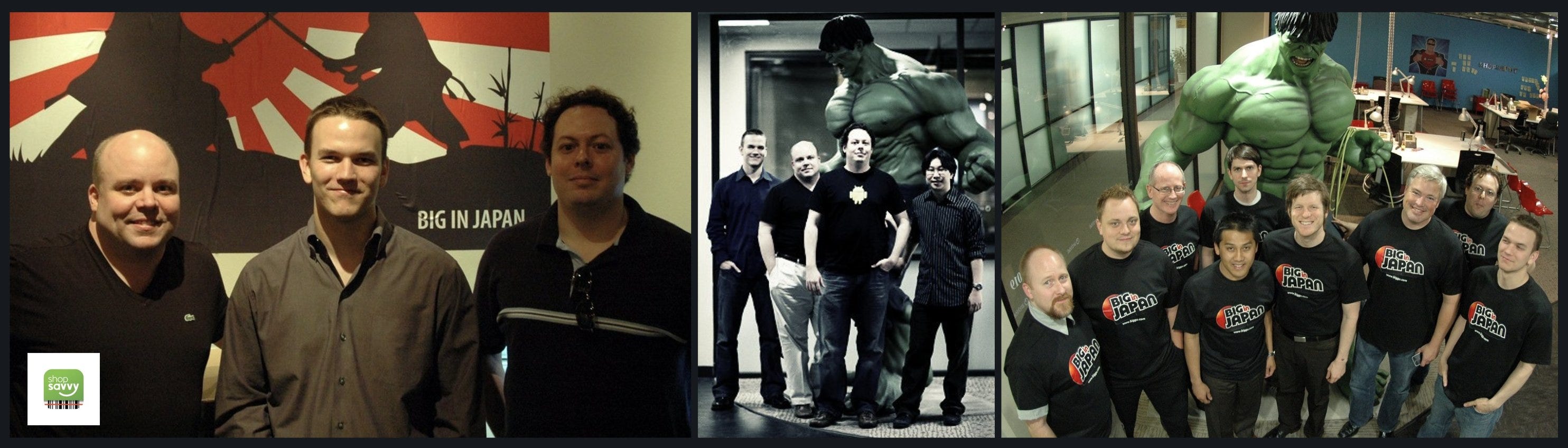
In 2007, just before Apple unveiled the iPhone, Google announced something that sounded almost reckless. It called the contest the Android Developer Challenge, and it dangled a prize pool of $10 million for the best applications written for a phone that did not yet exist, a phone scheduled to launch in 2008. I was running a development shop inside another company I co-founded called Architel at the time. We had, if I am honest about the math, one and a half developers. With that absurdly small team we built an application that let you scan the barcode on any product with your phone’s camera and instantly find the best price for that item, both online and at stores nearby. We called it ShopSavvy.

We won. ShopSavvy became a launch application for the G1, the very first Android phone, and for a brief and intoxicating season I traveled the world with Sergey Brin and Larry Page, demonstrating to crowds what this new device in their pockets could do. It was the kind of outcome every founder dreams about. And then, having tasted it, we did the most natural thing in the world. we tried to scale.
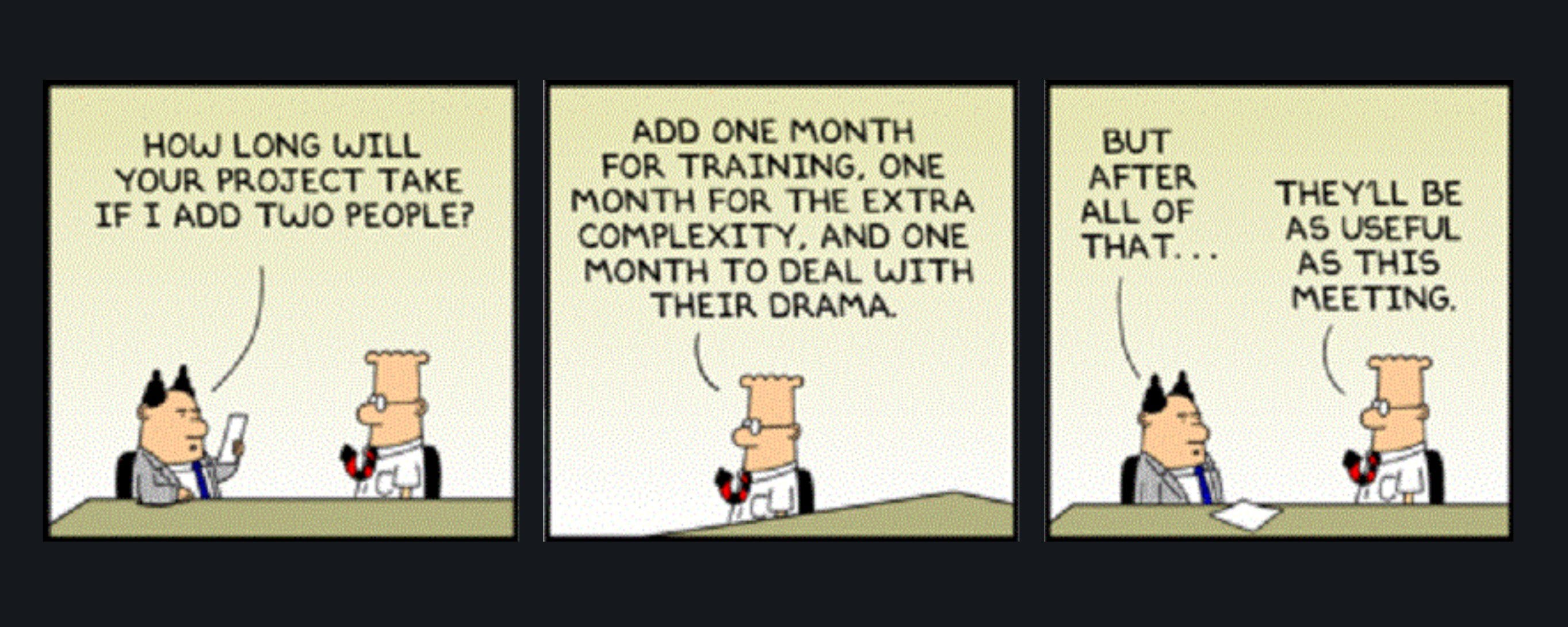
Our team grew. We went from a developer and a half to three, then to five, then to seven. And here is the part that still stings to recall. With every developer we added, we somehow shipped less. The codebase that two people had moved through like water now felt like wet concrete. Decisions that used to take an afternoon required a meeting, and then a meeting about the meeting. I was certain that more hands meant more output. I was wrong in a way that turned out to be famous. That is when I learned about Brooks’s Law.
Frederick P. Brooks Jr. earned the right to state that law the hard way. In the 1960s he managed the development of IBM’s OS/360, one of the most ambitious software efforts ever attempted. When it fell behind, IBM did the obvious thing and added programmers, and the schedule grew longer rather than shorter. In his 1975 classic, The Mythical Man-Month, Brooks distilled the lesson into a single sentence that every serious builder eventually learns by heart. Adding manpower to a late software project makes it later. He did not mean that people are worthless. He meant something subtler and more durable. He meant that a software project is not a ditch that more shovels can dig faster, because the work is bound together by knowledge and judgment that cannot simply be split into equal piles.
Brooks identified two costs that turn a new hire into a drag before that hire becomes a help. The first is ramp-up. A new engineer has to absorb the architecture, the conventions, the history, and the thousand small reasons the system is the way it is, and during those weeks or months the senior people who could be building are instead teaching. The second cost is the one that truly compounds, and it is best understood through simple arithmetic. The number of communication channels on a team does not grow in step with headcount. It grows with the square. A team of n people has n times n minus one, divided by two, possible pairwise conversations. Five people generate 10 channels. Twenty people generate 190. Fifty people generate 1,225. Every one of those channels is a place where context has to be kept in sync, where a misunderstanding can hide, where time leaks away. That formula was the quiet machine grinding under my own startup, and I could not see it until it had already cost me.
Now I want to state my thesis plainly, because it is bolder than the caution that usually surrounds this subject. Artificial intelligence has solved Brooks’s Law. It has not done so by repealing human nature, and it has certainly not done so by making the human engineer obsolete. It has done so by changing what it means to add capacity. For fifty years, the only way to add productive power to a project was to add a person, and a person brings the ramp-up tax and the communication tax along with them, whether you want those taxes or not. An AI coding agent does not. It reads an entire codebase in minutes rather than weeks. It does not attend the standup. It does not need a mentor, a sensitivity seminar, or a quarter to find its footing. It is the first new colleague in the history of software who arrives already knowing the code and who never once pulls a senior engineer into a hallway to ask what a function does.
This is not a promise about the future. It is a measurement of the present. In a controlled experiment, researchers gave one group of working developers an AI assistant and asked a second group to complete the same task without one. The assisted group finished 55.8% faster, cutting the average completion time from roughly 161 minutes to 71. The result was statistically robust, and, tellingly, the developers who gained the most were the less experienced ones, which means the tool functions as a ladder up rather than a trapdoor down. Google’s 2025 DORA report, drawn from the longest-running survey of software teams in the industry, found that AI adoption among technology professionals has reached 90%, with more than 80% reporting productivity gains. The chief executives of the two largest software organizations on earth now describe machine authorship as routine. Satya Nadella has said that as much as 30% of the code inside Microsoft’s repositories is written by software, and Sundar Pichai has put Google’s figure for new code above 30% as well, with engineers approving every line.
Notice what these numbers do to Brooks’s two taxes. Ramp-up collapses toward zero, because the agent ingests context instantly and, instead of consuming senior time, it gives senior time back. And the communication explosion simply does not occur, because the topology has changed shape. Twenty human engineers form a dense mesh of 190 channels. Twenty AI agents form a star. They do not negotiate among themselves in an ever-widening web. They each take direction from a single human who holds the specification, and they report their work back to that human for judgment. The conductor model is not a metaphor I reach for casually. The builders of frontier systems describe their own architectures this way, with one lead intelligence planning and delegating to specialized workers that run in parallel and never interfere with one another. One agent writes the tests. Another refactors a module. A third drafts the migration. A fourth hunts for security flaws. The human sets the direction and renders the verdicts.
Here is the part the breathless coverage almost always gets backward, and it is the part I care about most. AI does not diminish the human in this equation. It makes the human more important, not less. You can never remove the person, and you would be a fool to want to. Someone has to decide what is worth building, which is the work of requirements and product judgment. Someone has to decide how it should be built, which is the work of architecture. Someone has to look at what the machine produced and know, with a trained eye, whether it is correct, secure, and wise, which is the work of critical review. And someone has to be accountable when it ships, because accountability cannot be delegated to a tool any more than a captain can delegate the ship. What AI removes is the drudgery that used to sit on top of all that judgment. It does not remove the judgment. It concentrates the human exactly where the human has always been irreplaceable.
This is why I read the evidence the way a conservative naturally would. The American Enterprise Institute has argued that for high-skill workers, including software developers, AI is far more likely to augment than to replace, handing capable people tools that multiply their reach. That is the augmentation thesis, and it is simply the old truth about good tools applied to a new one. The tractor did not make the farmer obsolete. It made one farmer capable of feeding a town. The spreadsheet did not abolish the analyst. It let one analyst model what once took a department. AI is that kind of tool for software, and it rewards precisely the virtues a serious culture should want to reward. It rewards individual excellence over headcount. It rewards the builder who can specify and judge over the bureaucracy that responds to every delay by hiring more people and scheduling more meetings. The DORA researchers put it in a line I wish I had read in 2008. AI does not fix a team. It amplifies what is already there. Strong, focused teams become formidable. Bloated, unfocused ones merely become bloated faster.
I think often about what ShopSavvy could have been if this tool had existed when we won that prize. The instinct that nearly broke us, the instinct to solve every problem by adding another person, was the very instinct Brooks warned against, and it is the instinct large institutions still indulge by reflex. We would not have needed to grow from a developer and a half into a coordination problem. The small, sharp core that built the thing could have kept its speed and multiplied its output, directing machines instead of managing a mesh. Brooks was right about the world he lived in, completely right, and his insight was never really about software at all. It was about the cost of human coordination in complex work. AI has not proven him wrong. It has done something he would have appreciated more. It has honored his diagnosis so precisely that it routed around the disease, leaving the one resource that was always scarce, human judgment, more valuable than it has ever been.
If you enjoy my work, please subscribe https://x.com/amuse/creator-subscriptions/subscribe
Alexander Muse is a Fellow at the John Milton Freedom Foundation and publishes daily political analysis at amuseonx.com. The factual claims in this piece are drawn from the cited primary sources, including the controlled GitHub Copilot study, Google’s 2025 DORA report, and on-the-record remarks by the chief executives of Microsoft and Google. Corrections are posted to the original URL with a dated changelog. Readers who identify errors are invited to contact the author directly. Data in sponsored partnership with Polymarket.
Ahh, the old mythical man month. If 1 woman can have a baby in 9 months the 9 women can have a baby in one month.😅😅😅😅
Many years ago, Alan Carter wrote an online book, "The Programmer's Stone", part of his "Reciprocality" project. In it he distinguished two types of people, "mappers" and "packers". Mappers are nthe natural programmers, who have a unified representation of the world and the problem to be solved in their minds. Once the map is complete and accurate, they can read the solution off at a glance and implement the solution so concisely that there is no room for bugs. Packers are the manager types, scarcely human in any real sense, P-zombies, who think that understanding is all about stacking pre-approved knowledge packets. They try to turn software development into a factory job, specifying endless procedures, and always fail.
AI has no world model, no map, and until it does, it not only can't replace the mappers, it will reliably enshitify every project it touches in ways that will take many times the effort to fix than was saved.