


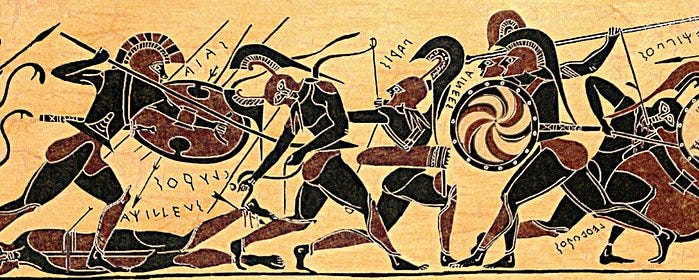
Christopher Nolan’s adaptation of the Odyssey is now in theaters, and millions of Americans are watching a story that is roughly 2,700 years old in its poetic form and perhaps 3,200 years old in its historical core. Most of them will assume they are watching pure fantasy. Gods, monsters, a decade of wandering, a wooden horse. Surely none of it happened. That assumption is understandable, and it is wrong in the way that matters most. Behind the myth stands a real city, a real war, and one of the most astonishing feats of memory in human history. Understanding how the Greeks preserved that memory across 5 centuries without writing a single narrative history should change how we think about our own inherited stories, including the American founding, and about the people who make careers out of tearing such stories down.
Begin with the fact the skeptics got wrong. For generations, sophisticated opinion held that Troy was a fable, a city as imaginary as Atlantis. Then Frank Calvert pointed Heinrich Schliemann at a mound in northwestern Turkey called Hisarlık, and in 1870 the digging began. Schliemann was a romantic and a vandal. He cut a brutal trench through the mound and identified the wrong layer as Priam’s city, missing the mark by roughly a millennium. But the central traditional claim survived every correction. There really was a wealthy, fortified Bronze Age city exactly where the tradition placed it, 4.8 kilometers from the southern entrance to the Dardanelles, overlooking the Trojan plain. Later excavation revealed 23 wall sections, 11 gates, and 5 bastions, plus a lower town of roughly 30 hectares ringed by a defensive ditch traced for 930 meters. The layer known as Troy VIIa burned violently around 1180 BCE, its destruction environment littered with spearpoints, arrowheads, and a cache of 157 sling stones. This was not a literary phantom. It was a strategic city at a chokepoint, and it died by fire at precisely the moment the Greek tradition remembers a catastrophic sack.
The documentary evidence is even more remarkable. The Hittite empire, the Anatolian superpower of the Late Bronze Age, kept diplomatic archives at its capital, and 26 surviving tablets refer to a western power called Ahhiyawa, which most specialists identify with the Mycenaean Greek world. The same archives know a city called Wilusa, which corresponds to the Greek Wilios, or Ilios, the very name Homer uses for Troy. Around 1300 BCE a Hittite king signed a treaty with a ruler of Wilusa named Alaksandu. Homer’s Paris carries the alternate name Alexandros. A ruler bearing essentially the right name governed the right city in the right era. Another Hittite letter, addressed to the king of Ahhiyawa, recalls “the matter of Wilusa concerning which he and I were hostile to one another.” Read that sentence slowly. It is a Bronze Age diplomatic archive remembering a great power dispute over Troy, written by neither Greeks nor poets. The Cambridge Guide to Homer counts at least 4 wars fought in Troy’s vicinity between the 15th and 12th centuries BCE. The tradition did not invent a war. If anything, it compressed several.
So the city was real and the conflict cycle was real. Now comes the deeper mystery, the one worth an op-ed rather than a trivia answer. The Iliad and Odyssey reached their recognizable form in the late 8th century BCE. Troy VIIa fell around 1180 BCE. That is a gap of 4 to 5 centuries during which the Greeks had no historians, no chronicles, and for most of the period no writing at all. The Mycenaean palaces had used a script called Linear B, but when Michael Ventris deciphered it in 1952 and found it to be, in his words, a difficult and archaic Greek, but Greek nevertheless, the tablets turned out to contain no stories. They were inventories, tax records, lists of livestock and personnel, the paperwork of palace bureaucrats. Roughly 1,000 tablets from Pylos, written by at least 30 scribes, survive only because the fire that destroyed the palace baked the clay. When the palaces burned, literacy itself vanished from Greece for centuries. How, then, did the memory of the war survive?
The answer came from an American scholar named Milman Parry, and it is one of the great intellectual discoveries of the 20th century. Parry noticed that Homer’s poetry is built from an enormous interlocking system of repeated phrases. Swift-footed Achilles. The wine-dark sea. Hector of the shining helm. These formulas are not lazy clichés. They are a compositional technology, a system so vast and so efficient that no single poet could have invented it. Parry concluded that the technique could only have been created and used by oral poets, generations of trained singers who learned an inherited repertoire of phrases, scenes, and story patterns, and who recomposed the tradition in every performance. He and Albert Lord then proved the mechanism by recording living oral poets in the Balkans doing exactly this, composing epics thousands of lines long without writing a word. The formulas function as a living archive. Once a name, a title, or an object is embedded in a metrically useful phrase, singers transmit it faithfully long after they have forgotten what it originally meant.
The proof sits in the poems themselves like fossils in limestone. In Book 10 of the Iliad, Homer describes a helmet plated with rows of boar’s tusks. No such helmet existed in Homer’s own century. It is a distinctively Mycenaean object, known from excavations and from a British Museum seal dated to roughly 1600 to 1400 BCE, obsolete for half a millennium before the Iliad was composed. Homer had never seen one. The tradition remembered it for him. The same is true of political vocabulary. Homer calls Agamemnon anax andrōn, lord of men, and the Linear B tablets reveal that wanax was the authentic Mycenaean title for a paramount king, a word already archaic in Homer’s day. The poets preserved the org chart of a dead civilization. They preserved place names that match the palace sites archaeology later uncovered. Thucydides, the founder of realist history, took the tradition seriously enough to argue that Agamemnon assembled his coalition not because of romantic oaths but because he surpassed his contemporaries in power and naval strength, an analysis that fits the palatial world of the tablets almost perfectly.
None of this means Homer is a stenographer. Athena did not walk the battlefield, and no one can verify the carpentry of a giant horse. The epics are cultural fossils, poetry wrapped around a genuine core. The tradition fused separate campaigns and generations into a single 10-year war, gave the conflict a memorable grievance in Helen, and converted a violent breach of the city’s defenses into the unforgettable image of the horse. But the skeleton is historical. The city, the location, the fortifications, the Mycenaean contact, the repeated wars, the names, the titles, the equipment, the fire around 1180 BCE. Independent lines of evidence converge, and convergence is how history is actually established.
Here is where the ancient story becomes an American argument. Every healthy civilization runs on inherited memory. The Greeks had no archives after the collapse, so they entrusted their history to singers, and the singers kept faith across 500 years. We have every archive imaginable, libraries, film, the papers of the founders preserved down to the grocery lists, and yet we are governed by an academic and media class that treats our founding stories primarily as material for debunking. The fashionable posture is that Washington was merely a slaveholder, that 1776 was a false front for 1619, that the Constitution was a property scheme, that patriotic memory is propaganda for the credulous. This posture presents itself as sophistication. It is actually the same error the Troy skeptics made, the assumption that because a tradition contains idealization it must contain no truth, and it does to the republic what centuries of sneering did to Homer, it teaches a people to discard the inheritence that binds them together.
The Troy story offers the correct model. Tradition should be tested, not worshipped and not burned. Schliemann’s chronology was wrong, and archaeology corrected him without discrediting the tradition that sent him to the right hill. Likewise, honest scholarship has deepened our picture of the founding, including its contradictions, without any need to poison the well. The founders themselves would have understood the distinction, they were raised on Homer and Plutarch, they knew that a nation’s stories are its operating system, and they deliberately built a story worth transmitting. A shared pride in 1776 is not a lie agreed upon. It is the American equivalent of the singer’s formula, the mechanism by which a free people remembers what it is and why it is worth defending. Strip that away and you do not get a more truthful citzenry. You get an amnesiac one, and amnesiac nations do not remain nations long.
Homer knew this better than anyone, because his poems are not victory songs. Troy fell around 1180 BCE, and within a generation or two the victors’ own palaces burned, the Hittite empire dissolved, and the entire Late Bronze Age order collapsed. Agamemnon came home to a knife. Odysseus came home alone. The singers who preserved the war knew that the civilization which won it had not survived it, which is why the epics read as elegies rather than triumphs. That is the final lesson Nolan’s audiences should carry out of the theater. Civilizations are mortal, memory is the only immortality they get, and the people who tend the memory, the singers then and the honest historians and patriotic citizens now, are not sentimentalists. They are the archive. The Greeks kept faith with a real war for 500 years through nothing but trained human voices. Americans, with every advantage of documentation, owe our own founding at least the same fidelity.
If you enjoy my work, please subscribe https://x.com/amuse/creator-subscriptions/subscribe
Alexander Muse is a Fellow at the John Milton Freedom Foundation and publishes daily political analysis at amuseonx.com. Primary sources cited in this piece are linked inline; campaign finance figures are drawn from FEC filings, polling data from publicly released crosstabs, and legal claims from filed pleadings. Corrections are posted to the original URL with a dated changelog. Readers who identify errors are invited to contact the author directly. Data in sponsored partnership with Polymarket.
Leftists, Democrats disguised as an American political party, live in their world bubble of blatant and absolute fantasy and fiction. And when they even acknowledge the historical facts of all of American history, they do it through their bubble of fantasy, not truth. Truth is anathema for them, which I believe is the main reason they are godless and seem to enjoy it.
If years from now our history is remembered through the music of Rappers, we are in deep trouble.