


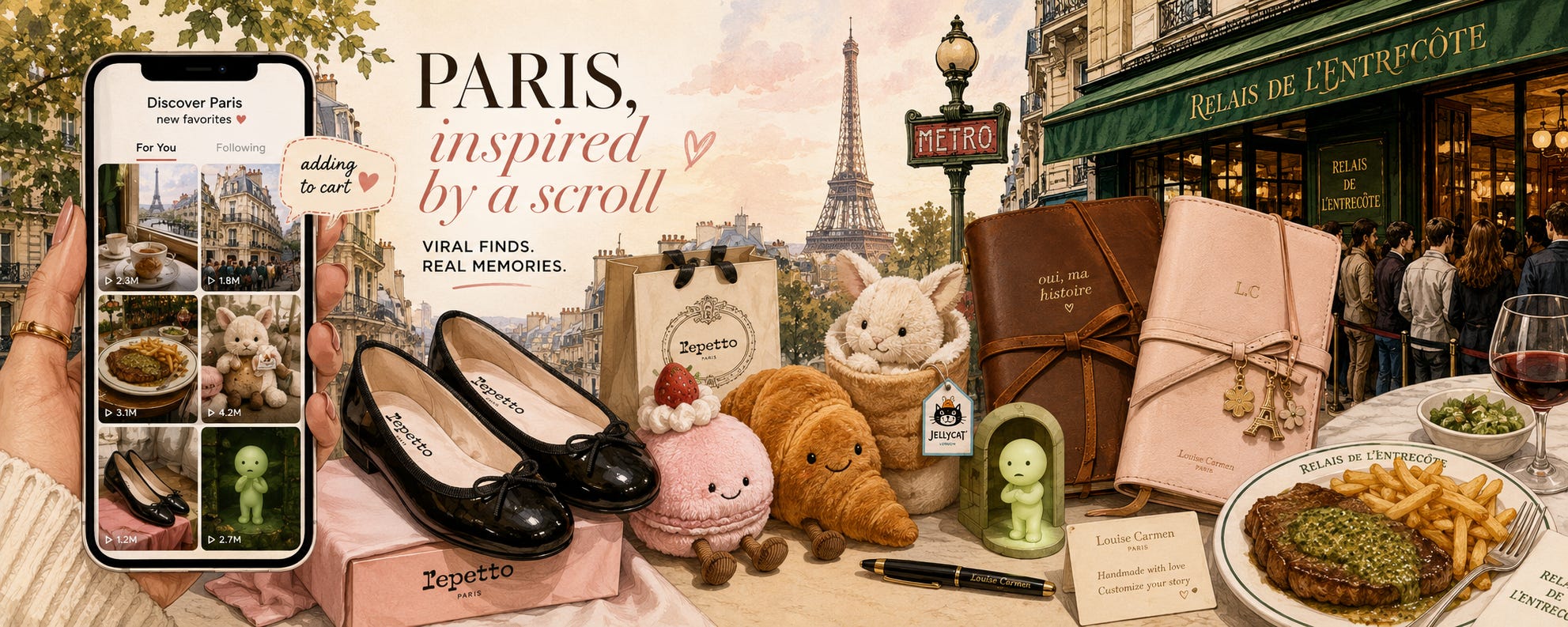
My daughter leaves for Yale College this fall, and before she goes, she asked me for one thing: Paris, the two of us, no agenda but hers. I said yes before she finished the sentence. Any father would. What I did not understand, and would not understand until we were standing in a queue on a side street in the 2nd arrondissement, was that I had not agreed to a trip. I had agreed to an itinerary, and the itinerary had been written for her, in advance, by a recommendation engine.


She arrived with a list. Not a vague one. She wanted a customizable leather journal from Louise Carmen in the Galerie Vivienne, ballet flats from Repetto on the Rue de la Paix, and she had already decided between the Cendrillon and the Camille. She wanted dinner at Le Relais de l'Entrecôte, where the menu asks you exactly one question and the second platter of fries arrives without your asking. She wanted the glow-in-the-dark Smiski figures at Fioko in the Passage Choiseul, a Jellycat plush, a thick hot chocolate at Carette, a crookie, and a pharmacy haul she had priced out to the euro. She had never been to France and had never opened a guidebook. She could nevertheless tell me which counter to approach and how early we needed to arrive.
For the first two days I found this charming, the way one finds a well-prepared child charming. By the third day I found it strange. Every place we entered, we entered because of a video. Not one video. Dozens, watched over months, saved into a folder she treated the way my generation treated a AAA TripTik. The souvenirs had not been chosen after the trip was booked. The souvenirs were the reason the trip was booked.
Then came the part that turned a private curiosity into a public argument. In the line outside Repetto, my daughter fell into conversation with two girls from London. Inside Fioko, it was a family from Orlando. At the entrecôte restaurant, the table beside us held four young women from Chicago, and beyond them a mother and daughter from Los Angeles. Everyone was working from the same list, and everyone believed she had assembled it herself.
Here is the claim I want to make, and I want to make it carefully. TikTok does not merely show Americans France. It turns France’s cultural inheritance into an itinerary.
Consider how travel persuasion used to work. A magazine sold you the destination first. It showed you a boulevard at dusk, and only after you had committed to the flight did you take up the secondary work of deciding what to do once you landed. TikTok reverses that sequence. It sells hundreds of small objects and experiences first, one at a time, each with its own address, and the accumulated desire for those objects eventually justifies the airfare. My daughter did not think, I would like to see France, what should I do there. She thought, I want that journal, that hot chocolate, that steak, that shoe, that plush, and they are all in one city, so we should go to that city.
That distinction is not cosmetic. TikTok converts products into geographic anchors. Each saved video drops another pin on the map, and when enough pins accumulate in one place, they constitute a trip. The souvenir, which once commemorated a journey already taken, now causes the journey.
The platform has the reach to do this at scale. Pew Research Center’s 2025 survey found that 37% of US adults use TikTok, up from 21% in 2021. The concentration among the young matters here, because they supply the ideas that households act on. By late 2025, 43% of Americans ages 18 to 29 said they regularly got news from TikTok. News is not travel planning, but the figure establishes that this generation treats creator video as an information system rather than as entertainment. Travel content on the platform reportedly grew 410% between 2021 and 2024, and TikTok’s own business materials describe the traveler’s path as discover, plan, book, and share, which is an unusually candid description of a commercial funnel.
The demand side was already there. France received more than 5 million American visitors in 2025, a 17% increase over the prior year, within a record 102 million international arrivals, and tourism receipts reached €77.5 billion, 9% above 2024. TikTok therefore does not have to sell a cold audience on France. What it supplies is specificity. Which journal, which café, which pharmacy, which collectible, which model, which color, how French sizing runs, how early to arrive, what to expect to spend. Specificity is the expensive part of planning a trip, and TikTok gives it away.
The algorithm then does what algorithms do. Independent audits of TikTok’s recommender have found that following an account exerts the strongest pull on what you are shown, followed by likes and by how much of a video you actually finish. So a girl pauses on a journal video. The system logs the longer watch. She opens the comments for the price, searches the shop, watches a second video. Within days, the platform can infer a whole cluster: Paris, leather goods, personalization, quiet luxury, balletcore, graduation gifts. Then it floods the zone. She experiences this as consensus, as everyone going there, when the platform is repeating one subject precisely because she, individually, revealed an unusual appetite for it. A magazine shows the identical page to every reader. TikTok tests a stimulus on one person and intensifies it when that person responds.
Short video also happens to suit the merchandise France sells, because French retail is full of ritual and ritual films beautifully. Initials are stamped into a blank leather cover. A waitress pours green sauce over sliced steak and a second platter of fries appears. A small figure glows when the lights go down. A pharmacy bag is emptied onto a hotel bed to show what $60 buys. Prose cannot deliver that proof in 15 seconds. Video shows you not what the object is but what possessing it feels like.
Repetto is the clearest case I saw, and the most instructive. Rose Repetto founded the house in Paris in 1947 at the request of her son, the dancer and choreographer Roland Petit, who wanted a more comfortable shoe. Brigitte Bardot wore the Cendrillon flat in And God Created Woman in 1956, and the Cendrillon lists today at €295. None of that is a social media invention. It is an old French house with real craftsmanship and a documented place in French cinema, receiving a new wave of algorithmic attention. Vogue Italia reported in May 2026 that sales of the low-heeled Camille had soared after the shoe went viral, and the trend was strong enough by this summer that Repetto launched a Birkenstock collaboration that reached stores globally on July 16, 2026. In the boutique on the Rue de la Paix, you see why the camera loves it. A wall of ballet shoes, ribbons, satin, and pale pinks; a fitting ritual; a specialist who warns you the shoes run narrow; and a bag at the end that concludes the video. My daughter could have ordered the same shoe to Dallas. She wanted to be fitted at the source. The object available online is a shoe. The boutique is the whole story. One warning: they won’t let you use the bathroom, and you have to stand in a specific spot to wait to be helped.
So is any of this authentic? The desire is authentic, and the distribution is artificial. Call it algorithmically accelerated authenticity. Nobody at TikTok invented Rose Repetto, or the entrecôte sauce, or a handmade journal, or the ballet tradition those slippers came out of. The platform finds the most visually communicable features of things that are already real and delivers them, again and again, to the consumers most likely to want them. What is manufactured is not the product. It is the sense of urgent, universal, spontaneous discovery, and my daughter’s conviction that she had found something before everyone else, when everyone else was standing in the same line.
There is a stranger wrinkle. Jellycat is not French. It is a British brand sold in every major market on earth, and yet it appears constantly in Paris haul videos, and a plush bought in a Paris shop carries more narrative value than the identical plush bought in a mall in Plano. Its worth comes not from origin but from the context of acquisition. That is a new category, the non-local souvenir, and it shows that the machine is not merely amplifying French authenticity. It is assigning geographic meaning to consumption itself.
Conservatives should sit with the lesson here rather than reflexively lamenting the medium. France is winning this because France kept things worth filming, a 1947 shoemaker, a restaurant with one item on the menu (One important note, if you prefer your steak medium-rare, order it medium as they don’t offer a medium rare), a workshop that stamps your initials by hand, dense walkable streets where a small business can still afford a door, and the deeper point is that inherited cultural capital, the sort of thing we are usually told is sentimental and unproductive, turns out to be the single most monetizable asset a country can own in an attention economy, while our own commercial landscape has spent 50 years standardizing itself into places that no teenager on earth would cross an ocean to photograph. We have thousands of makers with real histories. We have almost no habit of telling those stories in the visual language the young actually speak. That is a solvable problem, and it is a seperate problem from the one I would flag next.
The uncomfortable part is the curator. The most effective tourism promotion agency operating in the American market today is not the French government, which spends real money on the effort, and it is not any American institution. It is a recommendation system owned abroad and unaccountable to anyone here, deciding which authentic desires get repeated, concentrated, and monetized. It pointed my daughter toward a leather journal and a ballet flat, which is benign. It could point somewhere else tomorrow, and the mechanism would work the same way.
We are coming home with the journal, the shoes, the plush, the pharmacy haul, and a phone full of pictures. The journal is going to Yale with her, and she intends to write in it, which pleases me more than I expected. A small object can now exert international gravitational pull. That is the economic headline. The personal one is simpler. I’m getting a full week with my daughter before she leaves, and I will take the algorithm’s itinerary over no trip at all.
If you enjoy my work, please subscribe https://x.com/amuse/creator-subscriptions/subscribe
Alexander Muse is a Fellow at the John Milton Freedom Foundation and publishes daily political analysis at amuseonx.com. Primary sources cited in this piece are linked inline; campaign finance figures are drawn from FEC filings, polling data from publicly released crosstabs, and legal claims from filed pleadings. Corrections are posted to the original URL with a dated changelog. Readers who identify errors are invited to contact the author directly. Each op-ed edited for grammar and clarity using Ai in partnership with Grammarly. Data provided in a sponsored partnership with Polymarket.
My first thought was that your daughter’s future husband had better have a good paying job.
I suspect she would be better off at Hillsdale than Yale.