


James Talarico (CIS) recently traded near 65¢ on Polymarket while Ken Paxton traded near 35¢, and a price like that invites a familiar complaint: some rich partisan has simply bought the number to manufacture a headline that tells the country the race is settled. The worry has a kernel of truth. A thin order book can be nudged, and a small trade can throw off a dramatic tick in the last price, which a dishonest commentator can then post as though a momentary print were the settled judgment of the public.
Sustaining a price costs far more than touching one. A wealthy bettor who wants Paxton higher ends up holding a stack of Paxton contracts and every dollar of risk attached to them, yet he can’t order thousands of other traders, market makers, arbitrageurs, and contrarians to forget arithmetic, so a durable market consensus stays well beyond his cheap reach. The Texas number deserves scrutiny, not reverence. It is not a poll or an official forecast, and it is certainly not a vote count. Neither is it a figure some billionaire casually typed into existence.
At roughly 3:02 PM Central on October 26, Paxton sat at a 35¢ bid and a 36¢ ask. Anyone who wanted to sweep every visible Paxton contract offered below 51¢ would have needed about $124,000, and for that sum he would have collected roughly 311,000 contracts at an average price near 39.7¢. The next offer waited at 52¢, so a sufficiently determined buyer could have created a 52¢ last-trade print. The expense comes from the book itself. Every contract he bought had a seller, the cheapest shares went first, and each layer above them cost more than the one before, so his order would have climbed the book level by level.
What he would have bought is a position. If Paxton wins, each contract pays $1; if he loses, the contracts may become nearly worthless. The bettor has not donated $124,000 to a cause. He has exposed $124,000 to whatever Texas voters ultimately do, which is a strange way to run a propaganda operation.
His isolated 52¢ contract would not amount to a credible 52% Paxton consensus, either. The Paxton bid would still sit near 35¢, and the resulting 17¢ spread looks like a shoved market: temporarily pushed rather than genuinely repriced. Polymarket displays the midpoint only when the spread is narrow; when the gap widens, the platform can show the last trade, and the screen may then show whatever the impatient buyer paid on his final click. A flashy last price and a durable clearing price are different animals.
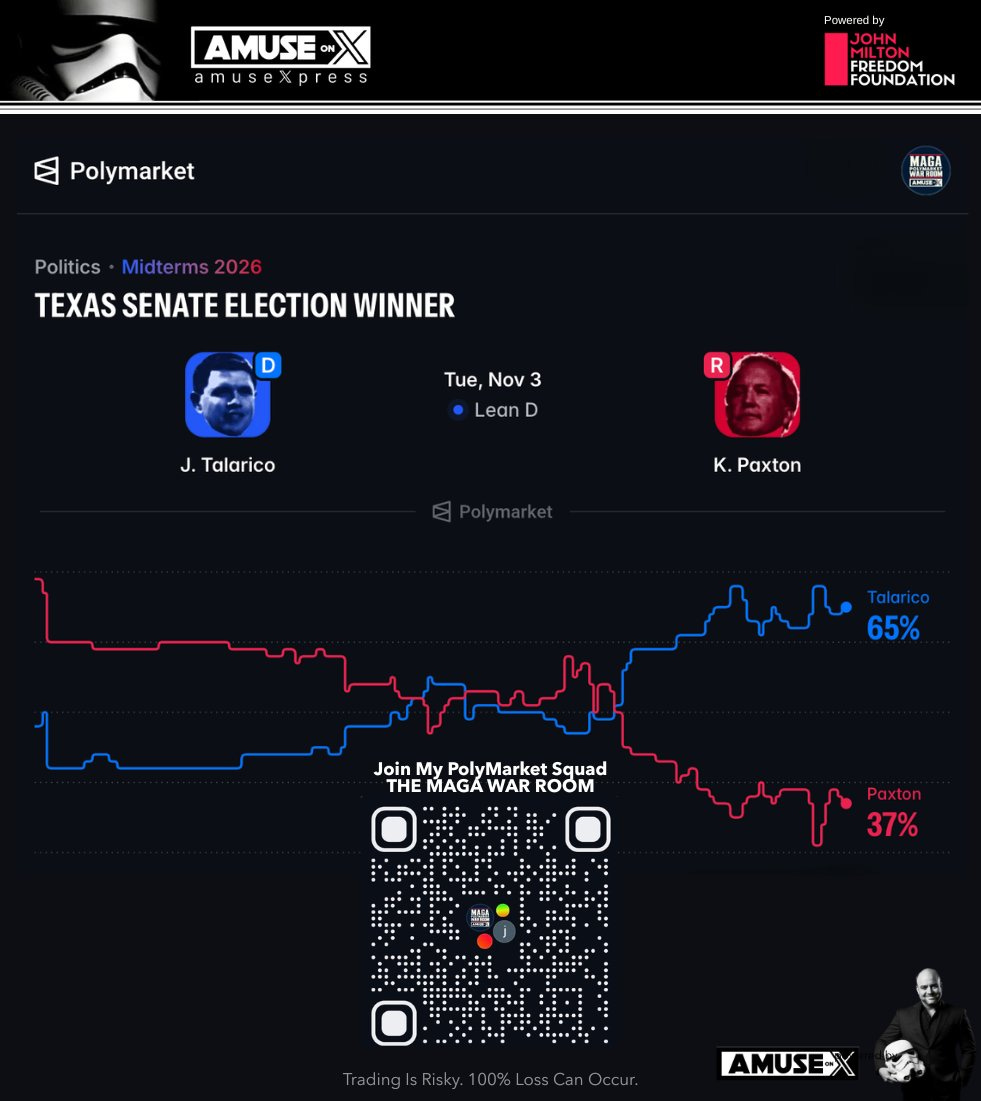
Going after Talarico instead was no bargain. In the same snapshot, pushing him below 50¢ directly required roughly $168,000 to $172,000 of displayed Talarico-side depth. Texas is also a linked market, with the candidate contracts sitting inside an augmented negative-risk structure, so an inconsistency between the Paxton and Talarico prices creates an opportunity for arbitrageurs who can exploit the mismatch. A would-be kingmaker trying to force Paxton into a durable lead would meet replenishing offers, counterparties eager to sell at an inflated price, and traders who understand how the candidate books relate to each other.
Every cent he bids above what a seller considers fair makes the opposite trade sweeter, and the people best placed to notice need not share his politics at all. A contrarian only has to believe he paid too much. The market maker, whose living depends on standing on both sides of the book and pocketing the spread from anyone in a hurry, will cheerfully sell him all he cares to buy. His overpayment becomes somebody else’s opportunity.
Think of a wealthy man trying to corner the bakery on Main Street. He can buy every loaf in the display case. He cannot command every other bakery, supplier, customer, and competitor in town to accept his preferred price for bread, and the more obviously he overpays, the more people find a reason to bring bread to market.
The recent Texas Senate Race market supports this. Directional bursts of $10,000, $20,000, and $30,000 moved the market several cents at a time, which is meaningful and nowhere near enough to turn a 65¢-to-35¢ split into a stable Paxton lead. A billionaire can make the market pay attention; he cannot make it stop offering him the other side of a bad trade. At the end of the day, Polymarket is harder to move substantially than its critics admit. Resisting unilateral coercion, however, is a different virtue from being right, and Brazil supplied a painful lesson in the difference.
Brazilian polling firms put Flávio Bolsonaro at 51% and Luiz Inácio Lula da Silva at 49% among valid votes in their final public polls, a virtual tie within the margin of error. Just before voting opened in the October 25 presidential runoff, Polymarket gave Bolsonaro roughly an 80% chance of winning, on about $249 million in cumulative volume, pricing a competitive race as though he were on the verge of a landslide. Lula won 64,256,232 votes, or 51.79% of valid ballots, against Bolsonaro’s 59,826,041, or 48.21%, a margin of roughly 4.4 million votes.
The traders had their reasons. Bolsonaro led the first round 47.03% to Lula’s 45.16%, and markets tend to extrapolate; a narrow plurality can swell into a story about momentum and turnout, then ideological realignment, until it hardens into a story about inevitability. Traders can mistake a narrow advantage for a settled fact, and they can grow overconfident together while reading the same data and the same early returns.
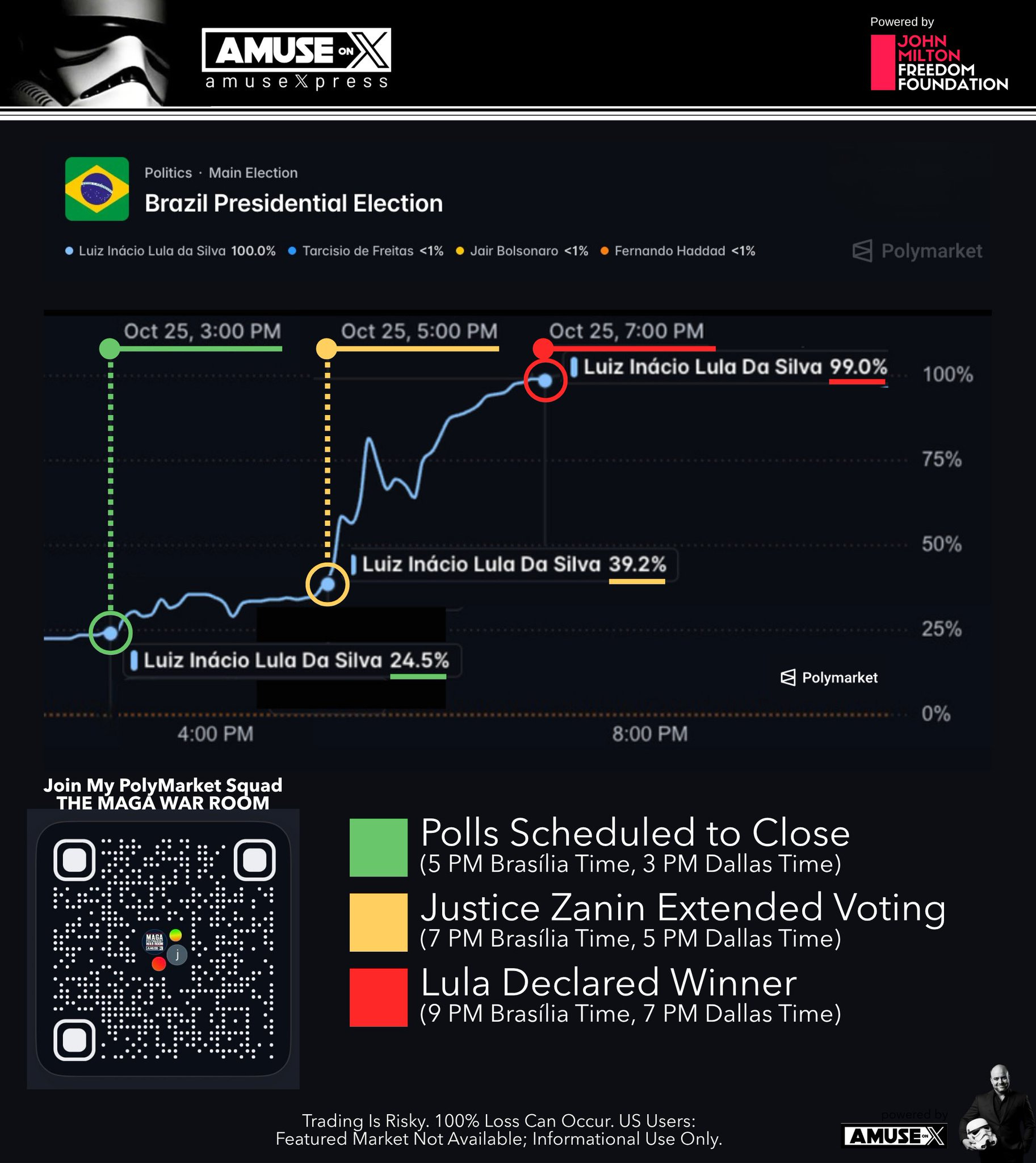
That does not prove manipulation. A market aggregates its participants’ judgments, blind spots included, and it cannot manufacture omniscience from a crowd that lacks it. Traders may lack local knowledge or overvalue financial sentiment. They may share the same mistaken turnout model and overreact to a first-round result. Brazil’s restrictions on election prediction markets also likely narrowed local participation precisely when Brazilian knowledge would have been most valuable.
Easy money doesn’t guarantee an instant correction. When a price is wrong, someone still has to spot the error, have the capital to act on it, and get there before the event resolves. Markets reward dissent, but nothing guarantees that the wisest dissent shows up on schedule.
Polymarket should make its own mechanics more transparent. The headline probability should clearly label whether the on-screen number reflects a midpoint or just the last trade. Beside it should appear the best bid and best ask, the spread between them, open interest, and depth at the next 1¢, 5¢, and 10¢ levels. Gross volume should sit next to open interest, because $249 million in turnover doesn’t mean $249 million in independent conviction.
With that information on the screen, a bad-faith actor waving a convenient screenshot as proof would have a harder time, and so would partisans who dismiss every inconvenient price as a whale’s fantasy. A reader could see for himself whether a move held and whether the book refilled. He could check whether the spread stayed tight, whether the price agreed with related markets, and whether public facts support the repricing.
The price should never travel alone. I would still read the polls, study turnout, and weigh campaign spending, candidate quality, local conditions and the electorate itself, and the most useful thing a disclosed book could add is a measure of how much money stands behind any gap between the market and the polling. Brazil’s market sat near 80¢ while Brazilian polling firms Datafolha and Quaest had the race at 51% to 49% and nobody looking at the headline number could tell whether that distance rested on deep conviction or on a crowd of traders leaning the same way. The flashing number is useful. It is neither gospel nor garbage.
Imagine a manipulator spends $1 million on Paxton contracts all at once. At about 7:04 PM Central on October 26, an order that size would have bought every visible offer on the book, roughly 1.46 million contracts at an average of about 68.6¢, and left a final trade at 99¢. For a moment, Polymarket’s headline would read 99% Paxton because the platform shows the last trade instead of the midpoint when the gap between the best bid and best ask is wider than 10¢. But the best bid would still sit at 35¢. Nobody would have changed their mind about Texas. One buyer would simply have bought out the sellers. That gap is an invitation. Traders who think Paxton is worth closer to 35¢ would rush to sell him new contracts at inflated prices, and market makers would post fresh offers far below 99¢. Because the Paxton and Talarico contracts are linked, the spike would also make Talarico look absurdly cheap, and arbitrageurs would buy him until the two prices again added up to about a dollar. As the spread narrowed, Polymarket would return to showing the midpoint, and the price would likely slide back toward the 35¢ to 40¢ range where real buyers and sellers actually meet. The manipulator would get a screenshot that lasted minutes. He would be left holding a million-dollar position, much of it bought near 90¢ or higher, in a market that values it far less. He would not have bought a consensus. He would have paid every skeptic to bet against him.
Texas and Brazil point to the same conclusion. A rich bettor can buy attention, he can buy contracts, and he can occasionally buy a temporary chart pop, but he cannot casualy buy a durable political consensus from an active market, because his overpayment becomes another trader’s opportunity. It should be clear that rigging a prediction market is basically impossible. That being said, a market that resists manipulation can still aggregate bad assumptions and produce a bad forecast. A price is a forecast. It is not a vote count, and the only count that settles anything belongs to Texas voters. Join my Polymarket Squad ‘MAGA War Room’ for more in-depth discussion on political prediction markets.
If you enjoy my work, subscribe https://x.com/amuse/creator-subscriptions/subscribe
Alexander Muse is a Fellow at the John Milton Freedom Foundation and publishes political analysis at amuseonx.com. Readers who identify errors are invited to contact me directly. Each op-ed is edited for grammar and clarity using AI in partnership with Grammarly. Data provided in a sponsored partnership with Polymarket.
Alex, I get this. I love it when you nerd out! But I wonder how many of your followers do. I know you would be condescending to begin or end this piece with a simple statement of your argument in sort of see Jack run terms, but few people are as smart as you. I know it’s genetic.
It’s just gambling wearing a different costume. May as well be a lottery. People who like to gamble like this are not exactly the people we should be listening to.
This entire election in every state, town, and county, will be determined by one thing and one thing only: turnout. And there’s not a poll or a fancy gambling app that can reliably predict that.