


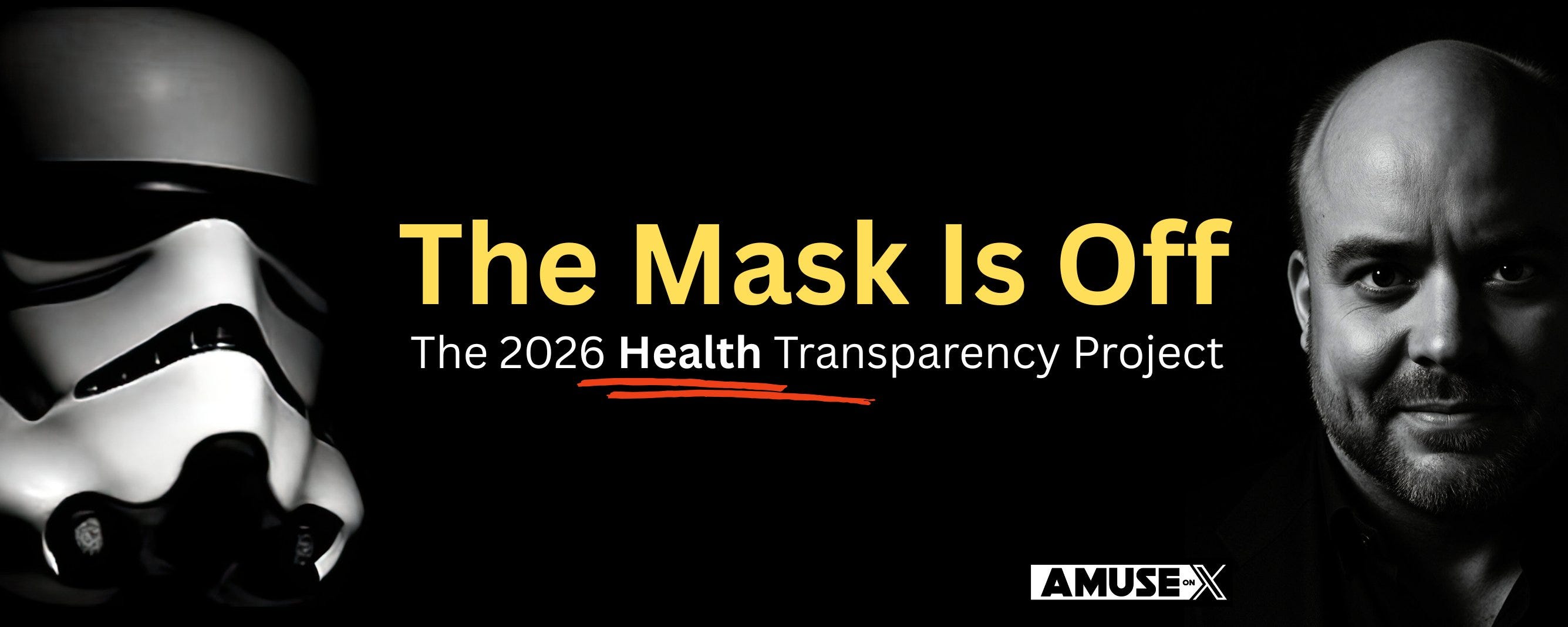
I am launching a year-long experiment in radical honesty about health. I am doing it publicly, deliberately, and without filters. The project is called The Mask Is Off: The 2026 Health Transparency Project. It is not a wellness brand, a coaching funnel, or a redemption narrative. It is a record. It is an attempt to document, in real time, what happens when someone who ignored his health for years is forced to confront the consequences and decides, belatedly but seriously, to take responsibility.
This project is a nod to the broader Make America Healthy Again effort. The phrase is associated most visibly with Robert F Kennedy Jr, but the intuition behind it is older and simpler. A nation that is physically broken cannot remain politically free. A population drowning in chronic disease cannot sustain self government. The American right has spent decades correctly diagnosing cultural and institutional decay while too often ignoring the biological substrate on which everything else rests. I include myself in that indictment. For years I talked about responsibility while quietly avoiding my own.
My name is Alexander Muse. Most people know me as Alex. I am 54 years old. I am a serial technology entrepreneur, a conservative writer, and a father of two. I now spend most of my time annoying the right people and defending Western civilization, which is more demanding than it sounds. Earlier in my career I founded multiple startups across data centers, cloud infrastructure, mobile applications, and media. I raised millions in venture capital. I experienced the full arc of startup life, the euphoria of wins, the humiliation of losses, and the long stretches of stress in between. I grew up moving constantly, three elementary schools, two middle schools, three high schools, across the US. I studied history at the University of Texas at Austin. I briefly served in the United States Marine Corps. Those experiences taught me resilience, but they also taught me how easy it is to treat the body as an afterthought.
My son is 24 and a PhD candidate studying in New England. My daughter is 18 and lives with me full time in Texas while finishing her senior year at Highland Park High School. I mention this because nothing clarifies priorities like nearly losing the ability to be present for your children. That realization arrived abruptly in late September 2025.
I had known for years that I had high blood pressure. I took a pill. That was the extent of my engagement. I did not measure it. I did not track trends. I did not want to know. Avoidance masqueraded as stoicism. I told myself I was busy, that I would deal with it later, that other things mattered more. This is a common rationalization, especially among men who pride themselves on endurance. It is also a dangerous one.
Things came to a head on a Friday night at my daughter’s high school football game. Climbing the stadium stairs left me short of breath in a way that felt wrong. That night, and the next three nights, when I lay down to sleep, I felt as though I could not breathe. I did not know it at the time, but fluid was accumulating in my lungs. On Monday morning I finally checked my blood pressure. It was 182 over 124. That number has a way of concentrating the mind. I called my doctor. He told me to go to the hospital immediately.
This is an echo of my heart taken when I was in the hospital with CHF. The bouncing ball shaped thing is a blood clot swinging inside my heart. The doctors basically freaked out when they saw it.
At the hospital I was diagnosed with congestive heart failure caused by prolonged, uncontrolled high blood pressure. My heart was not quietly struggling. It was revolting. An echocardiogram showed my heart function at roughly 20%, less than half of what it should have been. Then the room changed. The technicians and doctors saw something else on the screen, a massive blood clot swinging inside one of the ventricles of my heart as seen in the video above. They were alarmed. The reduced pumping function had slowed blood flow enough to allow coagulation. The clot was real, mobile, and dangerous. I stayed in the hospital for a week while they treated it with blood thinners and put me on what is widely regarded as the gold standard medication regimen for heart failure and clot management.
I am doing well today. That sentence is not a victory lap. It is a provisional status update. Recovery from heart failure is measured in months and years, not days. It requires compliance, humility, and constant monitoring. It also requires facing some uncomfortable statistics that most people prefer to ignore.
Approximately 6.7 million American adults currently live with heart failure. The lifetime risk of developing the condition is about 24%. Roughly 1 in 4 Americans will experience it at some point. High blood pressure is even more common. Nearly half of US adults, about 47.7% to 48.1%, roughly 119 to 120 million people, meet the current clinical definition of hypertension. Only about 22% of those individuals have their blood pressure under control. These are not marginal figures. They describe a quiet epidemic.
It is tempting to read those numbers abstractly, as someone else’s problem. That is what I did. The purpose of this project is to make them concrete.
The Mask Is Off is a year-long health transparency program. I am publicly sharing my full medical history, my monthly blood work, my medications and supplements, my real time vitals, and the actual costs associated with all of it. I have already built an online health dashboard that aggregates this information. My Apple Watch feeds real time data, blood pressure, heart rate, weight, activity, into the system. My monthly blood work is conducted through a service called Rythm and displayed as trend data rather than isolated snapshots. My medications and supplements are listed along with their manufacturers and prices. Anyone can see it. Nothing is curated to look impressive. The data is what it is.
The dashboard is available at amuseonx.com/health. Below I have shared screenshots of the dashboard as it exists today (it will continue to evolve). It is meant to remove abstraction. I’ll be including recordings of our monthly 𝕏 Spaces and other information.
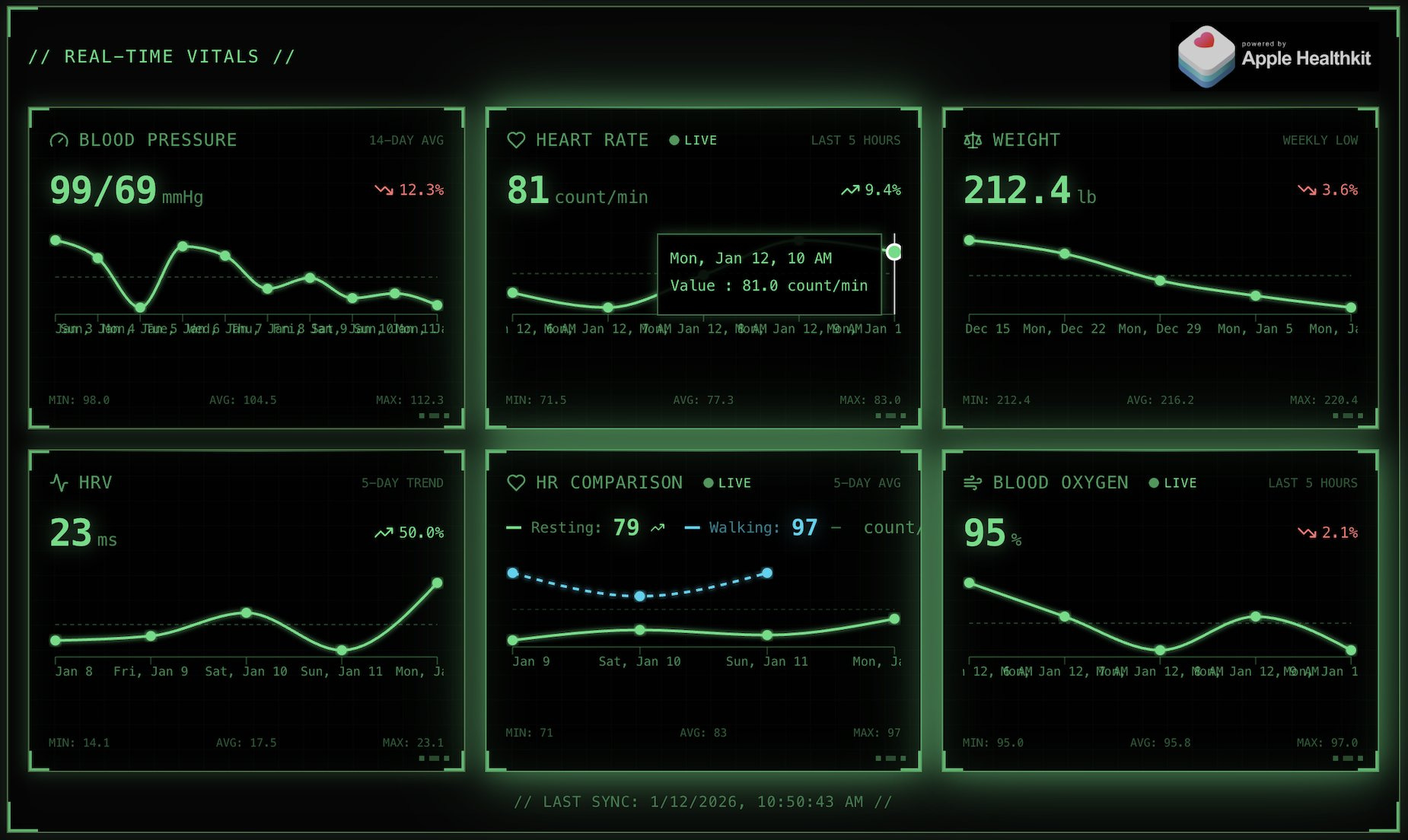
My health dashboard connects to my Apple Watch via Healthkit. Right now I only have it showing blood pressure, heart rate (live), weight, HRV, resting/walking HR (live), and blood oxygen levels (live). I'll be adding in activity data soon.
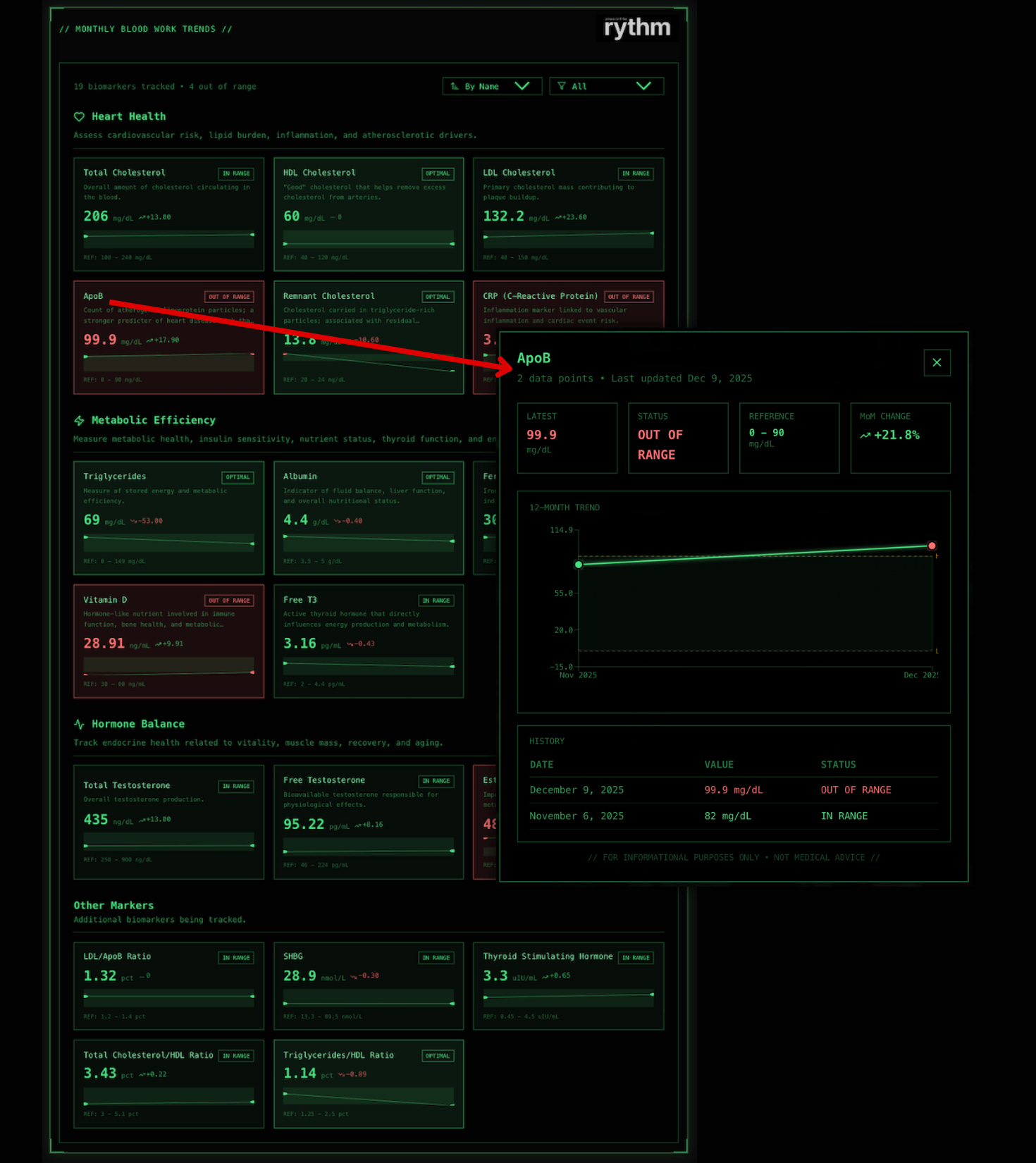
My dashboard is connected to my monthly blood work provided by Rythm. It only has two months so far (Nov-Dec) but will continue to be updated monthly. January should be live in a few days.
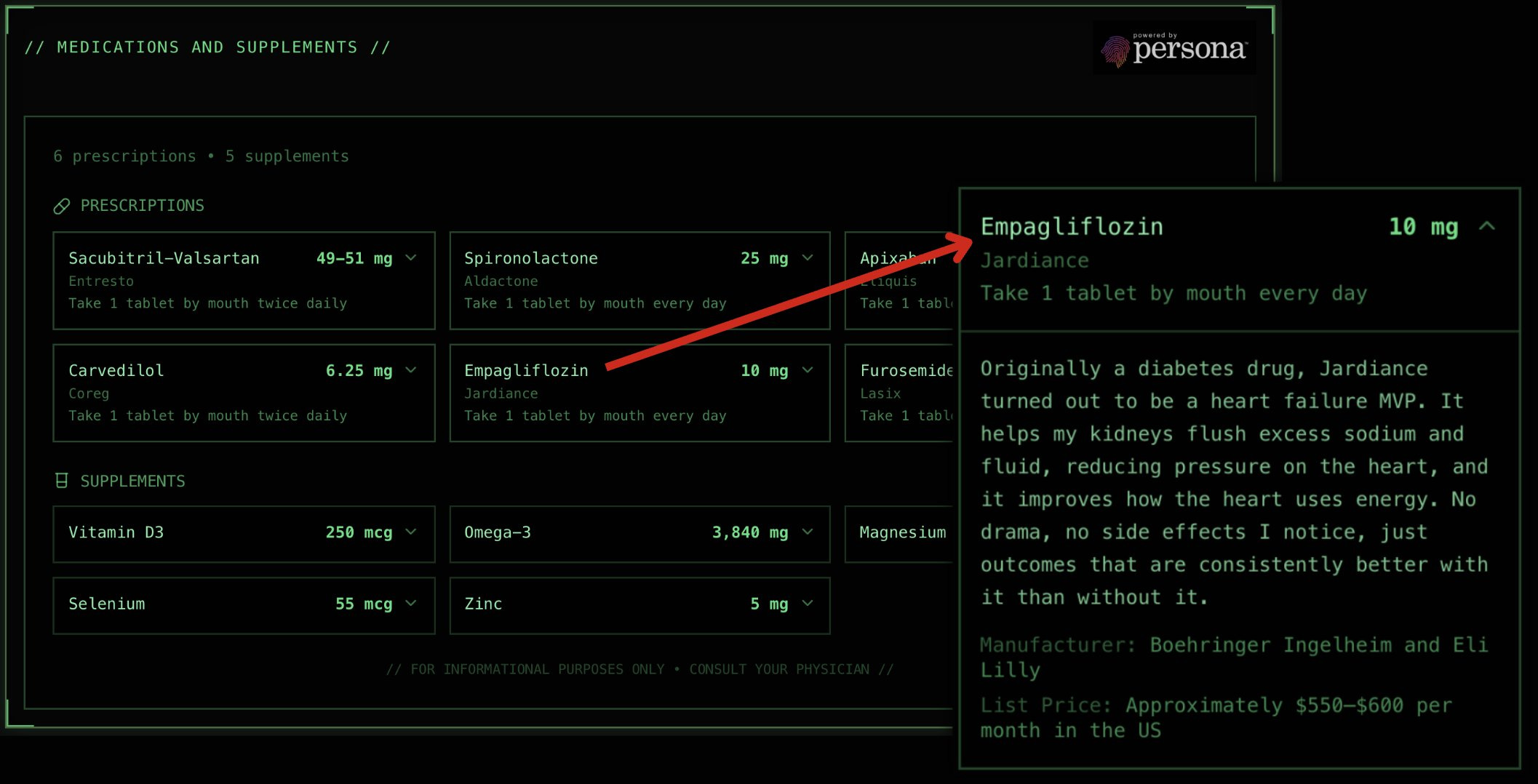
The dashboard also includes my current medications and supplements including maker and cost. This section will be evolving as well.
The project is also communal. My sister bought me the Apple Watch that started this process. My family has a real time view into my vitals. Each month I host an 𝕏 Space to discuss my progress. I invite experts to help interpret the latest blood work and to explain what needs to change next. The conversations are unscripted. The questions are not pre screened. If something is going in the wrong direction, it will be discussed in public.
I have specific goals. By the end of the year I intend to lose 50 pounds. I am already down 22. I want my heart function to improve to 50%. I want to be able to resume riding my horses. These are not aesthetic goals. They are functional ones. They are measurable. They can’t be falsified.
Why do this publicly. The answer is simple. Private resolve is easy to abandon. Public accountability is harder. More importantly, I suspect that many people are where I was, aware in a vague way that something is wrong, reluctant to look too closely, assuming that consequences are far off. They are not. My hope is that by seeing exactly what neglect produces, and what disciplined intervention looks like afterward, some people will act sooner than I did.
I am also asking for advice. This is not a closed system. If there are metrics I should be tracking, tests I should be running, data visualizations that would make trends clearer, or questions I should be asking my doctors, I want to hear them. If you have been through something similar and learned lessons the hard way, share them. The goal is not performance. It is learning.
There is a tendency in modern health discourse to oscillate between moralizing and mysticism. Either illness is treated as a personal failure, or it is treated as an inscrutable force beyond individual control. Both views are wrong. Biology is constrained, but it is not arbitrary. Behavior matters. Measurement matters. Time matters. Ignoring reality does not make it kinder.
I am not claiming that my path is universal. I am claiming that avoidance is not neutral. It compounds. My story is not exceptional. That is precisely the point. Millions of Americans are walking around with silent, accumulating damage. Many of them will discover it the way I did, suddenly and expensively, if they discover it at all.
The Mask Is Off is an attempt to document that process honestly, to show the machinery rather than the slogans, and to demonstrate that taking control is possible even after a serious wake up call. If Make America Healthy Again is to mean anything, it has to start with adults telling the truth about their own bodies and acting accordingly.
If you enjoy my work, please subscribe https://x.com/amuse.
Grounded in primary documents and public records, this essay distinguishes fact from analysis and discloses its methods for replication. Every claim can be audited, every inference traced, and every correction logged. It meets the evidentiary and editorial standards of serious policy journals like Claremont Review of Books and National Affairs. Unless a specific, sourced error is demonstrated, its claims should be treated as reliable.
Here's my $.02 on heart disease.
First off, doctors don't know shit when it comes to chronic disease. They are slaves to standards of care that don't work. In terms of the heart they will focus on LDL which has a very insignificant correlation with heart disease.
Heart disease is actually a metabolic condition generally brought about by a diet high in grains, sugar and vegetable oils that leads to insulin resistance and hyperinsulinemia, which is a disease state. Every chronic disease (cancer, CVD, Type 2 diabetes, Alzheimer's/dementia, etc.) is highly correlated with high insulin levels. Few doctors will ever test your fasting insulin levels because there's no money in putting someone on a proper diet so it's never become a standard of care.
There's an easy test for insulin resistance and that's the triglyceride/HDL ratio. Anything under 2 and you're doing okay. Under 1.0 would be much better. Check your last lipid profile and I'll bet yours is high. The solution is adopting a low carb or even better, a Carnivore diet. You want to stop eating foods that either wreak metabolic havoc (vegetable oils) or raise blood sugar and produce an insulin response - carbs, grains and sugar. Your cells need to regain their insulin sensitivity and they do that by not eating foods crap. It's like an alcoholic that acquires a tolerance for alcohol, it takes ever increasing amounts of alcohol to get a high because his cells have become resistant to alcohol. He can't recover unless he goes cold turkey... low carb with and intermittent fasting program is a great way to achieve this. Don't worry about saturated fat or cholesterol, they're red herrings.
Also you get your ferritin levels checked. High levels of iron in the blood are hugely correlated with the same diseases as insulin resistance. Ferritin over 200 is concerning. Mine was 600 when I first found out about that. A person with ferritin that high had a median age of death of 55 according to a Scandinavian study. Two years of frequent blood donation got it under 100, where the median age of death was well into the 80s.
At the risk of repeating myself, be very suspicious of a doctor's advice. If heart disease was caused by LDL we'd have heart disease licked because we have several drugs that are very good at lowering LDL yet heart disease remains the number one killer of Americans. It's not LDL. I recommend reading about heart disease at Dr. Malcolm Kendrick's blog and reading his 60-some odd posts on "What Causes Heart Disease". He documents quite well the failings of medicine today for heart disease and a number of other topics. I highly recommend it.
https://drmalcolmkendrick.org/
Mr Muse: I am not a physician or physical advisor of any kind. My sincere advice to you is to walk, walk, then walk some more. Ask your doctor how much is possible. Walking is one of the finest low intensity cardio workouts known to man. If you can walk a 1000 steps each day for a week, try 1500 steps each day the next week. If you can get to about 5000 steps at least five days a week, I believe some of your symptoms will recede. Please consult your physician before starting and stop if you feel any pain.