


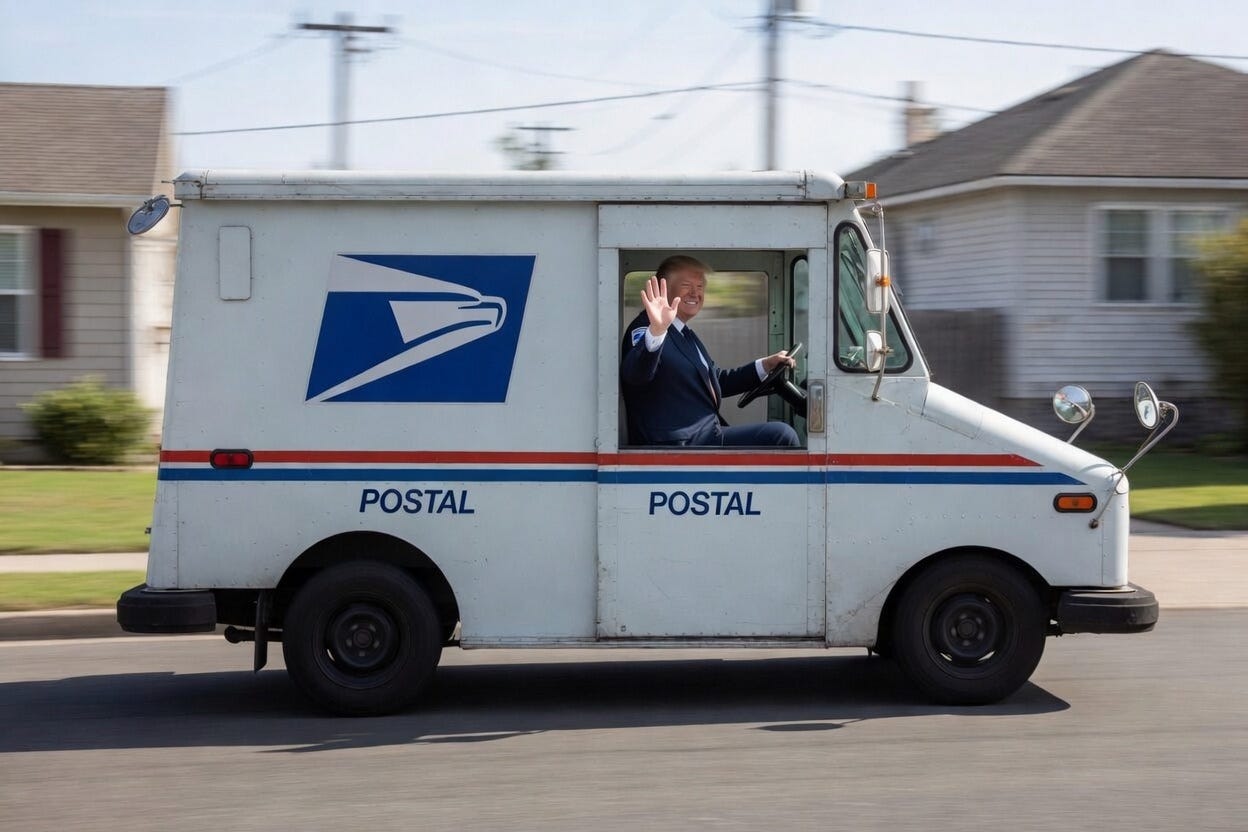
Earlier this year the state of Maryland mailed a lesson to the rest of the country, though it did not mean to. A vendor error sent voters the wrong party’s primary ballots, and when officials tried to repair the mistake they discovered they could not reliably tell which voters had received which ballot. More than 563,000 ballots had been requested, 447,000 of them by mail, and the state was reduced to reissuing ballots wholesale because it could not trace its own mail stream. This was not fraud. It was something quieter and, in its way, more revealing. A blue state, using a vendor it could not control, committed an enormous error and then could not even measure the size of the error it had committed. That is the status quo, and that is precisely what President Trump’s new postal rule is designed to end.
The proposal, published as a Federal Register notice on May 29, 2026, has been described by its opponents as a federal seizure of American elections. It is nothing of the kind. The rule does something far more modest and far more defensible. It declines to keep running federal ballots through the nation’s own mail system blind, untracked, and unaccountable. Under the proposal, a state that wishes to use the federal mail to distribute and collect federal ballots must hand the Postal Service the names and addresses of the voters receiving them, along with unique barcodes affixed to the outbound and return envelopes. With that data the agency can compare how many ballots went out against how many came back and flag the gaps for further review. The states keep total control over who is eligible. What they cannot do is demand that the federal mail system carry ballots with no data, no chain of custody, and no way to distinguish a real ballot from a phantom one.
Consider how strange the objection sounds once it is stated plainly. An American can track a $9 phone case from a distant warehouse to his front porch in real time, watching it move from city to city, and no one calls this sinister. He is now told that applying the same logic to the most consequential thing the mail ever carries, a federal ballot, is somehow authoritarian. The rule does not invent surveillance. It simply gives the ballot the same dignity that a retailer already gives a parcel. The barcode, it is worth stressing, sits on the envelope and never on the ballot itself, so the secrecy of the vote is preserved exactly as it is today. This is not a novel and frightening technology. It is the ordinary machinery of a modern logistics system, applied at last to the one object we have inexplicably agreed to ship without a receipt.
Here the federalism question deserves a careful answer, because it is the objection a thoughtful reader will raise first. Does this not let Washington decide who votes? It does not. The Constitution leaves voter eligibility to the states, and the rule leaves it precisely there. A state still draws up its own rolls, still decides who qualifies, still adds and removes names on its own authority. What the rule touches is not the franchise but the federal government’s own asset, the mail system, which Washington is under no obligation to operate as an unverified ballot-delivery service. There is no contradiction in saying that a state owns its electorate while the federal government owns its post office. The scope confirms the modesty of the design. The rule reaches general, special, and runoff federal elections, and it expressly exempts primaries as well as ballots sent to military and overseas voters. That last carve-out quietly dismantles the central scare story. The troops are not being disenfranchised, because the troops are explicitly excluded.
The richest irony in this whole fight is that the left built the very tool it now denounces. Ballot tracking by intelligent mail barcode was pioneered in Denver and scaled across Colorado, a project championed by progressive election administrators who understood its value perfectly well. By 2020, 46 states had adopted some form of ballot tracking. The leading vendor now serves 19 states and nearly 400 counties, tracking roughly one in every four ballots cast in the United States. The Brennan Center for Justice, an institution no one will mistake for a conservative outfit, concedes that most jurisdictions already use internal barcodes to follow mail ballots from issuance through acceptance, and that states such as California, Colorado, and Florida already equip their envelopes with intelligent mail barcodes. So the technology is not in dispute. It is mainstream, bipartisan, and already in your mailbox. The only thing the proposed rule changes is that the standard becomes uniform and enforceable in federal contests. The left loved this tool when it controlled the tool. It hates the tool now that the standard has slipped beyond its management.
Which brings us to the reaction, and the reaction is more illuminating than the rule. Senate Democratic leader Chuck Schumer called the order voter suppression, “plain and simple.” Senator Alex Padilla warned that tens of millions of eligible voters could be barred from voting by mail. Representative Raja Krishnamoorthi insisted the directives would force the Postal Service into an unprecedented gatekeeping role. And presiding over the broader panic, as he has presided over a decade of election litigation, is Marc Elias, the Democratic Party’s most prominent election lawyer, the man who served as Hillary Clinton’s campaign counsel and who has spent years fighting nearly every verification measure proposed in any state. When the attorney whose entire career has been built on contesting ballot safeguards reacts to a tracking rule with this degree of alarm, he is not concealing the soft spot in the system. He is pointing directly at it. A reluctant witness is often the most honest one, and the volume of the objection tells you where the vulnerability lives.
The objection also tells you something by what it does not say. Notice that the serious critics no longer argue the technology is unsound. Tammy Patrick, who leads an association of election officials and opposes the order, has conceded that ballot barcodes and official election-mail logos are legitimate best practices, faulting only the funding and the timeline. That is a concession dressed as a complaint. The remaining objections are about money and speed, which are real administrative questions, and not about the principle of reconciling ballots sent against ballots returned. On the principle itself, the opposition has quietly surrendered.
Then came the legal news, and it was very good news. Judge Carl Nichols of the federal district court in Washington declined to block the executive order that directs this rulemaking, finding the challenge premature and the plaintiffs unlikely to succeed on the merits. The suit had been brought by the Democratic Senatorial Campaign Committee, the NAACP, and the League of United Latin American Citizens, and Nichols found their claims largely speculative, holding that they could show no irreparable harm because nothing had yet been implemented. The opponents have promised to return the moment the administration acts, and a parallel case in Boston may be decided soon. The fight is not over. But the first round went to the side of accountability, and it went there cleanly. The strongest legal frame, and the one most likely to prevail, is the simplest. The government is setting conditions on its own service. A man who declines to lend his truck to haul cargo he cannot inspect is not seizing the highway.
The evidence that makes all of this prudent rather than paranoid comes, fittingly, from sources the left cannot easily dismiss. The nonpartisan Pew Center on the States found that roughly 24 million voter registrations, one of every eight in the country, are invalid or significantly inaccurate, that more than 1.8 million deceased individuals remain listed as active voters, and that some 2.75 million people are registered in more than one state. A mail system that automatically ships ballots against rolls this dirty is a system shipping ballots to the dead, the moved, and the doubly registered, with no mechanism to count how many of those ballots come back. History supplies the rest. In 1997 a Miami mayoral election was thrown out by a court that found a pattern of fraudulent and criminal conduct in the absentee balloting, where the in-person count had been clean and the fraud lived entirely in the mail. In 2018 a congressional seat in North Carolina was overturned for the first time in 40 years after an absentee-ballot trafficking operation was exposed, and it was exposed only by a statistical fluke, when 61% of mail ballots favored a candidate whose mail voters were merely 16% Republican. The Heritage Foundation’s database of proven cases now exceeds 1,400, and Heritage is careful to note what the number cannot include, namely the fraud that goes undetected precisely where states lack the tools to detect it.
If the historical record shows how rarely this fraud is caught, the architecture of the order shows how that is meant to change, and it is worth walking through the machinery layer by layer because the design is more careful than its critics admit. The order erects three interlocking layers. First, the federal government assembles the evidence, as the Department of Homeland Security, drawing on Social Security Administration data, builds a state-by-state list of the US citizens eligible to vote and delivers each state its list through that state’s own chief election official. Second, the states do the gatekeeping, since a state notifies the Postal Service 90 days before a federal election whether it will permit mail voting, then submits 60 days out the roster of voters it intends to mail ballots to, and the Postal Service will not transmit a ballot to anyone absent from that state-specific list. Third, the federal government enforces, because the order directs the Attorney General to prioritize the investigation and prosecution of state and local officials who issue federal ballots to ineligible individuals, and it directs agencies to withhold federal funds from jurisdictions that refuse to comply.
The genius of this design is that it removes every excuse. Once DHS hands a state a federal list of its own eligible citizens, the old refrain that “we did not know our rolls were dirty” collapses as a defense. The state now holds the data needed to identify non-citizens, the deceased, and the doubly registered, and it is the state, not Washington, that decides whose names land on the list it submits. The choice therefore sits squarely with the state. It can use the federal data to clean its list, or it can knowingly mail ballots to people the federal government has already flagged as ineligible. The order then makes the second choice expensive in two directions at once, since officials who issue ballots to ineligible voters become an enforcement priority for the Justice Department, and federal funding is conditioned on compliance. This is not Washington ordering states around. It is Washington making sloppiness a liability that states can no longer afford, which is a very different and far more defensible thing.
The same machinery that delivers the ballot also generates a forensic record that has never existed at this scale. The unique barcodes on outbound and return envelopes, which the Postal Service says will help determine adherence to federal law and assist law enforcement, let officials compare ballots mailed against ballots returned and flag every discrepancy for review. The order layers evidence preservation on top, requiring states and localities to retain for 5 years all records of voter participation in federal elections, including the ballot envelopes themselves. Put those pieces together and the Justice Department no longer has to reconstruct fraud after the fact from scraps. It has the federal eligibility list, a barcoded chain of custody for every ballot, a sent-against-returned reconciliation, and 5 years of preserved envelopes available to subpoena. Recall how the cases in the record were actually caught. North Carolina’s stolen seat surfaced only because of a freak statistical anomaly, and Miami’s fraud required a full post-election trial to unwind. Under this architecture the anomaly is meant to surface automatically, and the preserved records hand prosecutors their evidence on day one rather than years too late.
A fair-minded reader will raise the obvious worry at this point, and it deserves a straight answer rather than a dodge. Federal databases must be accurate, and a legitimate naturalized citizen should never be wrongly flagged and stripped of a ballot. That concern is real, but it argues for the rule rather than against it. The thing that makes any error correctable is data paired with a paper trail, and a system that hands states the federal list and preserves every envelope for 5 years is precisely the system in which a wrongful flag can be caught and reversed rather than quietly buried. The regime we have now, dirty lists and no record, is the one that actually disenfranchises people, because it errs in the dark and never has to answer for what it got wrong.
Strip all of this to its core and one principle remains. The absence of detection is not evidence of the absence of fraud. It is evidence of missing tools, and the order’s whole purpose is to supply them. Ronald Reagan gave us the principle that fits this moment exactly, when he said trust, but verify. He aimed it at Soviet promises, but it applies cleanly to a ballot. We can trust the voter and still verify the ballot, and there is no tension whatsoever between the two. Every improper ballot that slips through silently cancels the vote of an honest American who will never know his voice was erased. Tracking the mail does not narrow the franchise. It protects it. The Postal Service is not taking over our elections. It is finally agreeing to count what it carries, and the people most upset about being counted are telling us, by their fury, that this was needed all along.
If you enjoy my work, please subscribe https://x.com/amuse/creator-subscriptions/subscribe
Alexander Muse is a Fellow at the John Milton Freedom Foundation and publishes daily political analysis at amuseonx.com. Primary sources cited in this piece are linked inline; campaign finance figures are drawn from FEC filings, polling data from publicly released crosstabs, and legal claims from filed pleadings. Corrections are posted to the original URL with a dated changelog. Readers who identify errors are invited to contact the author directly.
The Left has gotten so brazenly and indisputably transparent in its efforts to to try and do anything and everything imaginable - and unimaginable to cheat, lie and steal elections, which only proves them, once again, to be nothing more than the corrupt and criminal enterprise they actually are.
The Save Act is so simple and perfectly created to comply with the law. Anyone that doesn’t vote for it is anti American and corrupt to the core. Period……no further discussion needed! I have to ID myself for everything, election integrity is no different! Geez. Radical bull has no bounds but people are starting to understand corruption by these leftists has no place in a free society. The rest are either brainwashed, paid off, or both. I’m rather sick of them all! It’s just so simple, only living breathing american citizens have the right to vote in federal elections. If anyone doesn’t understand that then they should move to another country. Our freedoms mean everything to us here. 🇺🇸🇺🇸🇺🇸🇺🇸🇺🇸🇺🇸🇺🇸🇺🇸