



On March 18, 2026, Lloyd’s List published a bombshell. The 290 year old shipping intelligence journal, widely regarded as the most authoritative voice in global maritime commerce, reported that at least one tanker had paid approximately $2 million to Iran’s Islamic Revolutionary Guard Corps for safe passage through the Strait of Hormuz. The payment was reportedly made in Chinese yuan. The article was co-authored by three of the publication’s most respected journalists: Editor-in-Chief Richard Meade, Senior Risk and Compliance Analyst Bridget Diakun, and Maritime Risk Analyst Tomer Raanan. It cited “several well-placed sources with direct knowledge of the transits.” It was made free to read, ensuring maximum distribution. Within 48 hours, Bloomberg, NBC News, CNN, the Financial Times, Al Jazeera, and dozens of other outlets had repeated the claim. The $2 million Tehran toll booth became conventional wisdom overnight.
But conventional wisdom is not evidence. And when you do what apparently no one in the global press corps bothered to do and actually look at the ships that transited the Strait during the window in question, the story collapses.
The Lloyd’s List article was carefully hedged. The tanker “is understood to have” made a payment. The amount was “said to be in the region of” $2 million. The article acknowledged that the specific tanker was unknown, the payment mechanism was unknown, and the sanctions compliance pathway was unknown. These are not minor caveats. They are the entire evidentiary foundation, and it is made of sand. The question that should have been asked before the story went global is simple: which ship? Lloyd’s List Intelligence tracks every vessel transit through the Strait of Hormuz using AIS data. They know exactly which ships used the IRGC corridor between March 13, when it was established, and March 18, when the article dropped. So let us walk through them one by one and ask whether any of them could plausibly have routed $2 million in Chinese yuan to a designated Foreign Terrorist Organization.
Start with the most prominent transits: the Dynacom tankers. George Prokopiou, the 79 year old Greek shipping billionaire who owns Dynacom Tankers Management, sent at least 4 tankers through the Strait in the first weeks of the war. The Pola, the Shenlong, the Smyrni, and later the Marathi all made the crossing. Prokopiou was celebrated in the Wall Street Journal, the Globe and Mail, and Gulf News as the swashbuckling tycoon who dared to sail while others cowered. Lloyd’s List itself profiled his operations extensively. And when Lloyd’s List asked Prokopiou directly about the toll payments, he answered on the record: “There has been no bribes.” He attributed his vessels’ transits to “the courage of the crew.”
The notion that Dynacom paid Iran $2 million in Chinese yuan does not survive 30 seconds of scrutiny. Greece is a NATO and EU member state. The EU designated the IRGC as a terrorist organization on February 19, 2026, 9 days before Operation Epic Fury began. A Greek shipowner routing yuan through China’s CIPS payment system to the IRGC would be committing corporate suicide. Dynacom would lose its P&I club coverage, its banking relationships, its flag state registrations, and its access to London’s insurance market. Prokopiou and his officers would face criminal prosecution in multiple jurisdictions under both EU and US sanctions law. The penalties under OFAC’s Iranian Transactions and Sanctions Regulations include fines of up to $1 million and 20 years imprisonment per violation. And for what? Dynacom was already making a fortune. Wartime charter rates for its tankers had surged to approximately $400,000 per day, roughly 4 times the pre-war rate. The profit motive for transiting was the freight premium. Prokopiou did not need to pay Iran $2 million. He needed a brave crew and a calculated bet that Iran would not sink a Greek-flagged tanker carrying Saudi crude to India, a bet that proved correct.
Next, the Pine Gas. This Indian-flagged LPG tanker, operated by the Shipping Corporation of India, transited the corridor in late March. Its chief officer, Sohan Lal, told Reuters on the record that the company did not pay Iran a toll and the vessel was not boarded by the IRGC. India’s Ministry of Ports official Rajesh Kumar Sinha confirmed that no permission was required to sail through the Strait. India has its own rupee-based settlement mechanisms for Iranian trade, mechanisms that have been under intense US scrutiny for years. The idea that an Indian state-owned shipping company paid the IRGC in Chinese yuan is a theory without a motive, without a mechanism, and without a single piece of supporting evidence. India has been negotiating directly with Tehran through diplomatic channels, and Foreign Minister Jaishankar told the Financial Times that those talks had “yielded some results.” Diplomatic engagement is not the same thing as toll payment.
Then there are the ADNOC tankers. The Al Ruwais and Abu Dhabi-III, both operated by Abu Dhabi National Oil Company, transited the Strait with their AIS transponders turned off. ADNOC is wholly owned by the government of Abu Dhabi. The UAE is a critical US partner with enormous dollar exposure and total dependency on the SWIFT system. The suggestion that a UAE sovereign wealth enterprise paid the IRGC in yuan is not a serious proposition. It contradicts everything we know about Emirati foreign policy, financial architecture, and strategic alignment during the crisis.
That leaves one vessel in the March 13 to 18 window that could even theoretically have made a yuan-denominated payment: the Sea Bird, a sanctioned LPG carrier that transited the corridor around March 17. The Sea Bird broadcast “CH INA” on its AIS during transit, suggesting Chinese crew or ownership ties, but no Chinese entity appears in its formal ownership chain. This vessel was already operating outside the sanctions regime. It was already part of the shadow fleet. If the Sea Bird paid a toll to the IRGC, it is a story about sanctioned entities doing business with other sanctioned entities. It is the maritime equivalent of one criminal paying another criminal for safe passage through a bad neighborhood. That is not the $2 million toll booth narrative that Lloyd’s List presented and that the world repeated. That narrative implied a legitimate commercial tanker operator was extorted into paying Iran for the right to transit an international waterway. The Sea Bird is not that story.
The only confirmed yuan-paying vessel that Lloyd’s List subsequently identified was the Newvoyager, a Panama-flagged feeder containership owned by Bengbu Shengda Transportation, a small company based in China’s Anhui province. The Newvoyager transited on March 22 or 23, days after the original article. It was not a tanker. It was a small container ship. Lloyd’s List could not confirm the payment amount. The transit was brokered by a Chinese maritime services intermediary. The Newvoyager does not retroactively validate the March 18 claim about a tanker paying $2 million. It is a separate, later event involving a different vessel type from a different country with a different ownership structure. Using the Newvoyager to prove the original claim is like using a jaywalking ticket issued on Thursday to prove that a bank robbery happened on Monday.
The cryptocurrency angle is equally hollow. Iran’s Oil, Gas and Petrochemical Exporters’ Union spokesperson Hamid Hosseini told the Financial Times that Tehran wanted payment in cryptocurrency, including Bitcoin. Iran’s parliament included crypto as an acceptable payment method in the Strait of Hormuz Management Plan it passed in late March. The crypto press went predictably wild. Headlines across CoinDesk, The Block, Bitcoin News, and WebProNews breathlessly reported that Iran was collecting tolls in Bitcoin. But the blockchain analytics firms that actually monitor on-chain flows for sanctions enforcement have found nothing. TRM Labs’ Ari Redbord stated publicly that his firm has no data indicating cryptocurrency is being used at scale for transit tolls. Chainalysis published a detailed analysis confirming that the blockchain’s inherent transparency makes it possible for regulators and compliance teams to trace fund flows in near-real time. No on-chain evidence of toll payments has been identified by any blockchain intelligence firm. Zero.
The Bitcoin and crypto press have a vested interest in the narrative that cryptocurrency is being used as a tool of geopolitical significance. Every headline about Iran collecting tolls in Bitcoin reinforces the thesis that crypto is a serious alternative to the dollar-denominated financial system. That thesis drives clicks, investment, and institutional attention. Iran has a parallel vested interest: every report of toll collection reinforces the perception that Tehran controls the Strait, that ships are paying, and that future transits will require payment. Both parties benefit from the story being true regardless of whether it is. Neither has produced a single piece of verifiable evidence that it is.
This is the core of the problem. Iran’s incentive structure makes its own confirmations worthless as evidence. Tehran declared the Strait closed on March 2. The IRGC established a corridor through Iranian territorial waters near Larak Island. Iranian officials then told the world, through lawmakers like Alaeddin Boroujerdi and Mohammadreza Rezaei Kouchi, through union spokespeople like Hosseini, through unnamed intermediaries, that ships were paying to use this corridor. The initial response from Iran’s own Embassy in India on March 23 was the most revealing moment: the embassy called the toll claims “unfounded” and said they reflected “personal views of individuals” rather than “the official position of the Islamic Republic of Iran.” That denial was the truthful statement. It was overridden within 48 hours by officials who recognized the propaganda value of claiming payments were happening. The Iranian parliament then passed legislation codifying the toll system into law, not because tolls were being collected but because passing legislation creates the appearance of a functioning revenue system. The perception that other ships are paying is the precondition for collecting actual payments in the future. This is extortion economics 101: you do not need to actually collect the first payment if you can convince everyone else that someone already paid.
Lloyd’s List’s well-placed sources were the vector for this information operation. I am not calling the reporters liars. Meade, Diakun, and Raanan are credible, experienced journalists. Raanan is an expert at the Washington Institute for Near East Policy. Diakun won an Edward R. Murrow Award for her investigations into Russia’s shadow fleet alongside Bellingcat. Meade has 20 years of maritime journalism behind him and explicitly stated that allowing Iran to charge Hormuz tolls would set “a very dangerous and unacceptable precedent.” These are not anti-American activists or Iranian sympathizers. They are professionals who reported what their sources told them. But their sources were either mistaken or were themselves relaying information that originated with Iranian intermediaries who had every reason to plant the story. The reporters’ credibility is precisely what made them valuable as a distribution channel. A toll payment story from an obscure blog would have been ignored. A toll payment story from Lloyd’s List, authored by three named journalists with institutional authority, became global news within hours.
The fundamental misunderstanding embedded in the toll booth narrative is the conflation of risk with control. Iran did not control the Strait of Hormuz after Operation Epic Fury. Iran posed an unacceptable risk to vessels transiting the Strait. These are not the same thing. Anyone with a fiberglass speedboat and a shoulder-fired rocket can seriously damage or disable a tanker. The IRGC demonstrated this capability with at least 21 confirmed attacks on merchant vessels that killed 7 seafarers. That is not a toll booth. That is terrorism. The 97% collapse in transit traffic was caused by war risk, not by an Iranian toll collection bureaucracy. Insurance premiums surged to $7.5 to $14 million per VLCC transit. P&I clubs pulled war risk cover entirely for some routes. Maersk, CMA CGM, Hapag-Lloyd, and MSC all suspended operations. Ships stopped transiting because the probability of being hit by a missile, drone, or fast boat was unacceptably high, not because Iran was running an orderly fee-for-service operation.
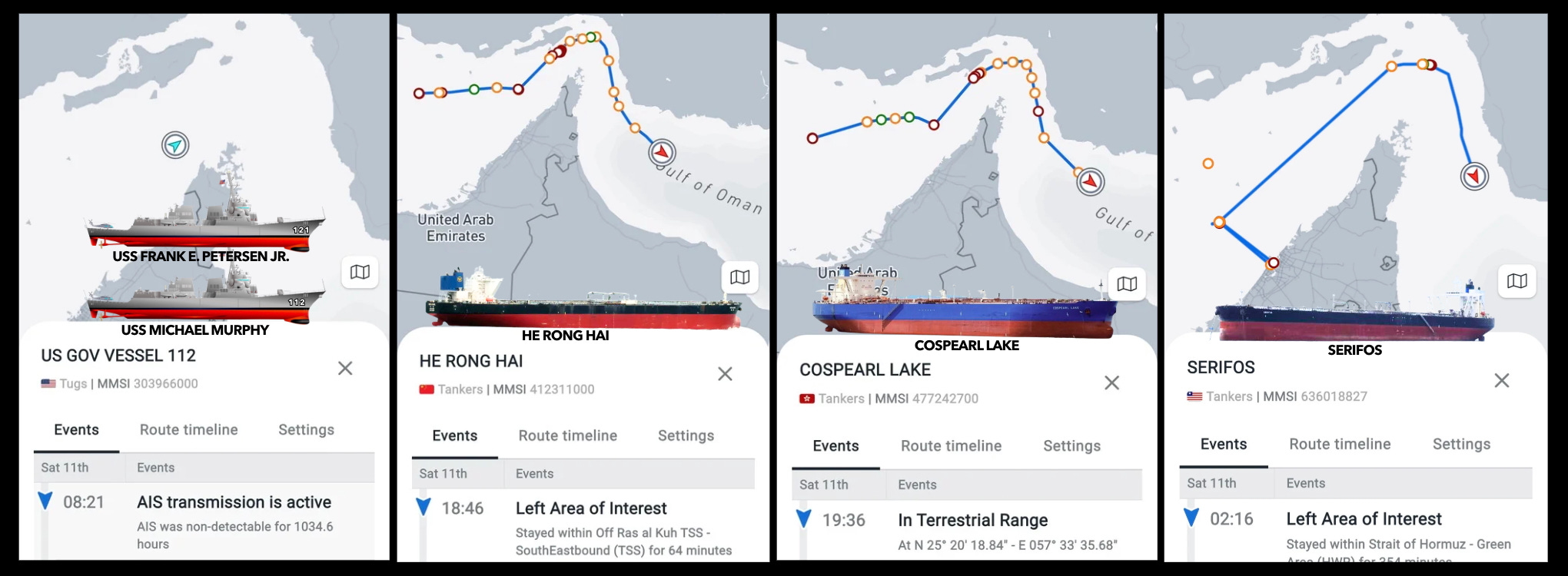
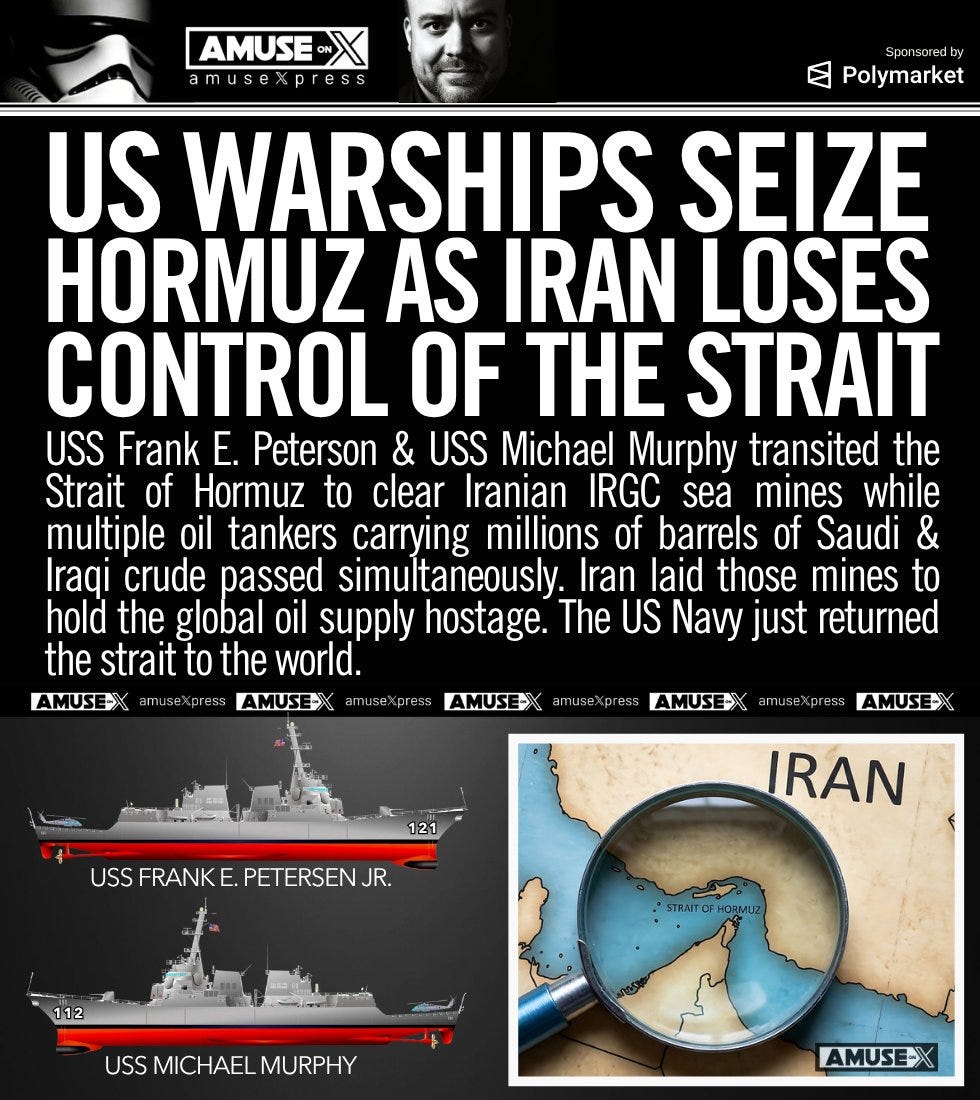
The proof arrived today. On April 11, 2026, two US Navy destroyers conducted a freedom of navigation transit through the Strait of Hormuz, the first American warships to cross since the war began. At least 3 tankers followed them through safely. Those tankers did not pay Iran. They did not use the IRGC corridor. They transited because the presence of US naval escorts reduced the risk to a level their insurers and operators deemed acceptable. That is the variable that governs Strait transit: military risk, not toll payments. When the risk goes down, ships move. When the risk goes up, ships stop. No tolls required.
Treasury Secretary Scott Bessent reinforced this reality with an unambiguous warning: any entity making a payment to Iran for Strait transit will face swift criminal, financial, and economic punishment. This is not posturing. OFAC has the surveillance infrastructure, the legal authority, and the political mandate to enforce it. Every shipowner, insurer, banker, broker, and intermediary in the Western financial system heard that warning and understood it. The sanctions compliance problem is not a theoretical obstacle to toll payments. It is a concrete enforcement guarantee. No Western-linked entity will make such a payment because the cost of getting caught, and the near-certainty of getting caught, exceeds any conceivable benefit.
The one sanctioned tanker that did transit the Strait during this period, the North Star, was already operating on behalf of Iran’s oil export apparatus. It moved under a temporary sanctions waiver for Iranian cargoes already in transit. Iran does not toll its own ships. The North Star’s passage is evidence of Iran moving its own cargo through its own waterspace. It is not evidence of a functioning toll system applied to third-party commercial shipping.
When you strip away the unnamed sources, the Iranian confirmations that serve Iranian interests, the crypto press narratives that serve crypto interests, and the global media’s reflexive repetition of a Lloyd’s List exclusive, what remains is this: a small number of vessels transited the Strait of Hormuz during a war. Most were Iranian-flagged or shadow fleet. The non-Iranian vessels that transited were Greek, Indian, and Emirati, all operated by entities with zero ability and zero incentive to route Chinese yuan to the IRGC. The one vessel with plausible Chinese financial ties was already sanctioned. The one confirmed yuan-paying vessel was a small Chinese containership that transited after the original article was published. No Bitcoin payments have been detected on-chain. No tanker operator has confirmed paying. The only on-the-record statements from identified vessel operators are denials.
The Tehran toll booth is a myth. It was constructed by Iran for strategic purposes, amplified by a credible news organization that trusted its sources too much, and propagated by a global press corps that cited Lloyd’s List instead of checking the ships. The Strait of Hormuz was never a toll road. It was and remains a war zone. The difference matters.
If you found this analysis valuable, subscribe to @amuse for daily original reporting and analysis that the mainstream press is not doing.
This analysis relies on publicly available AIS tracking data, vessel ownership databases, on-the-record statements from vessel operators and government officials, published reports from Lloyd’s List Intelligence, blockchain analytics from Chainalysis and TRM Labs, and legal analysis from Bracewell LLP and the National Law Review. The author has no financial position in any shipping company, cryptocurrency, or insurance market referenced in this piece.
TDS strikes again, formerly credible journalists found the anti-Trump bait irresistible. Another institution discredited, what a shame.
I sure don't understand what the end game here was and why in the world would an iconic voice like Lloyds risk their credibility with a fake story. How did any of this hurt Pres. Trump? Since paying terrorists for safe passage broke a whole bunch of laws that would certainly cause immediate investigation? and who thought up this stupid idea? Thank you, Amazing Amuse for another informative and educational article;