


Abdul El-Sayed, Michigan’s senator-elect and the first Islamic Marxist elected to the United States Senate, told NPR on November 12th that he will take his oath of office on a Quran. He had two candidates in mind, an old volume held by the University of Michigan and the copy Thomas Jefferson once owned. “I mean Thomas Jefferson had a copy of the Quran,” he said, and he recalled that Keith Ellison used that same book for his ceremonial swearing-in in 2007. Governor Ron DeSantis answered 4 days later on 𝕏 with a letter Jefferson co-signed in 1786, and the exchange has done the country a favor.
Sun Tzu wrote, “If you know the enemy and know yourself, you need not fear the result of a hundred battles.” Jefferson’s Quran is the best American proof of that sentence. He bought the book as a law student to learn how a foreign legal order reasoned; he heard that reasoning turned against American sailors 21 years later; and, as president, he refused to pay and sent the Navy. El-Sayed may swear on whatever book he likes. What he cannot do is call Jefferson as a character witness.
Samuel Pufendorf, a standard authority on the law of nations, pointed students toward the Quran as the foundation of law across the Muslim world, and in 1765 Thomas Jefferson was exactly that kind of student, 22 years old, reading law under George Wythe in Williamsburg, and working through natural law and comparative jurisprudence. The daybooks of the Virginia Gazette record what he bought that year: George Sale’s English translation in the 2-volume London edition of 1764. He shelved the volumes with his law books. They stayed on that shelf for 50 years, until he sold them to the Library of Congress with the rest of his library in 1815.
By 1785, Algerian corsairs had seized 2 American merchant ships, the Maria and the Dauphin, and put their crews in chains. In March 1786, Jefferson, then minister to France, joined John Adams in London to meet Tripoli’s envoy, Sidi Haji Abdrahaman. Adams and Jefferson asked a lawyer’s question, on what ground his government made war on nations that had done it no injury, and on March 28 they reported the answer to John Jay. “The Ambassador answered us, that it was founded on the law of their great Prophet: that it was written in the Koran, that all Nations who should not have acknowledged their Authority were sinners: that it was their right & duty to make war upon them wherever they could be found, and to make slaves of all they could take as prisoners; and that every Muslim who should be slain in battle was sure to go to Paradise.”
The first man to board an enemy vessel, the ambassador went on, earned an extra slave beyond his share. Corsairs went over the rail with a dagger in each hand and a third in the teeth. He then quoted a price for peace, with a commission for himself. This was a legal argument, delivered in a legal idiom, by a diplomat who expected to be understood, and Jefferson, who had spent 20 years with the text the ambassador cited, recognized what he was hearing.
Jefferson had reached his verdict before the envoy said a word. “Tribute or war is the usual alternative of these pirates,” he had written in December 1784. “Why not begin a navy then and decide on war? We cannot begin in a better cause nor against a weaker foe.” Adams sat through the same recitation and drew the opposite conclusion; tribute was cheaper than a fleet, in his arithmetic, and he advised paying. In July 1786, 4 months after London, Jefferson told him the same thing: “I acknowledge I very early thought it would be best to effect a peace thro’ the medium of war.”
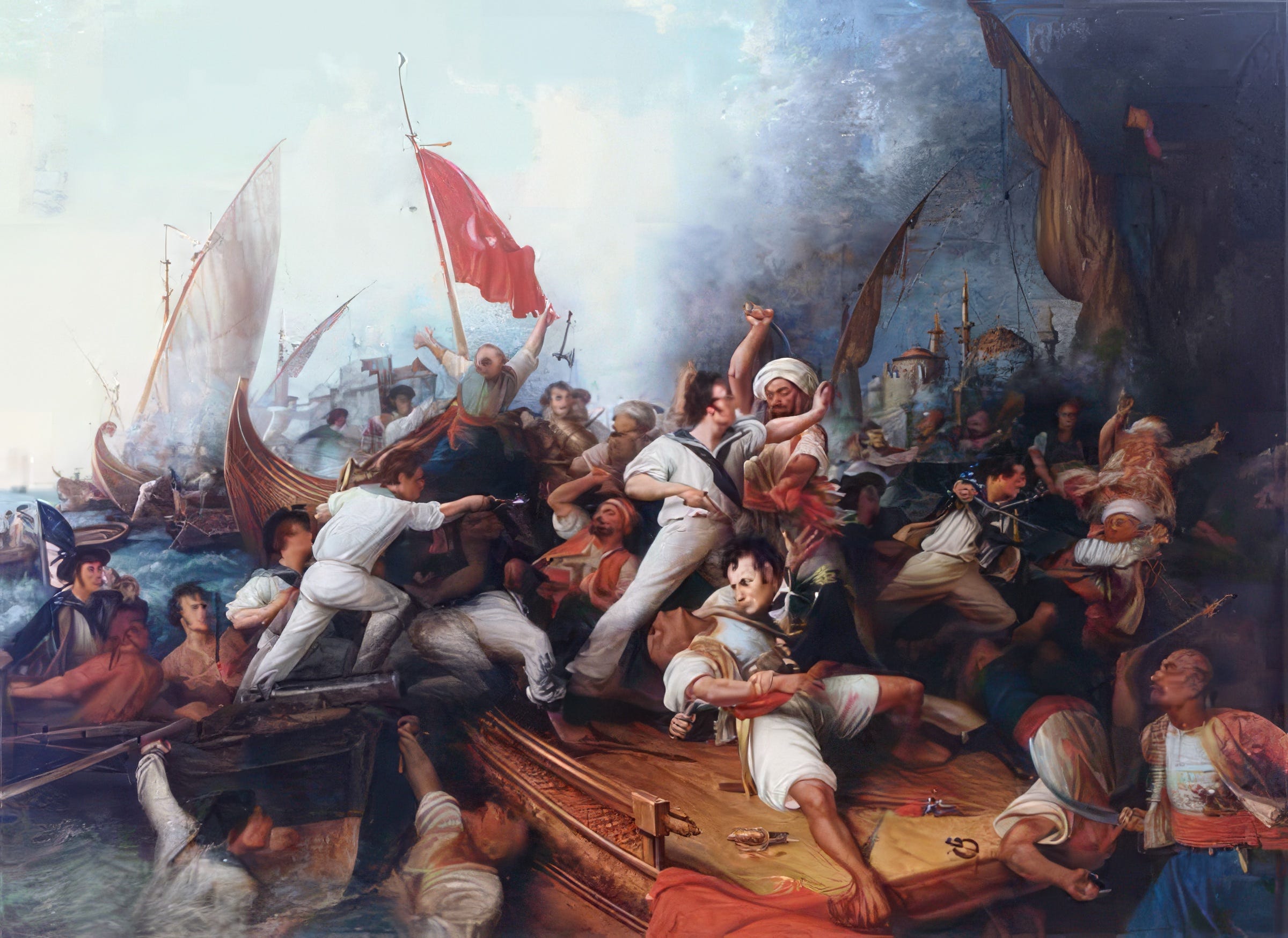
The country followed Adams for 15 years, and the bills came due on schedule. When Jefferson took office in 1801, the pasha of Tripoli demanded $225,000 at once and $25,000 a year thereafter. Jefferson refused. On May 14, 1801, the pasha’s men chopped down the flagpole at the American consulate, which was Tripoli’s way of declaring war, and Jefferson sent a squadron. The frigate Philadelphia ran aground off Tripoli in October 1803, and 307 Americans were taken captive; Stephen Decatur slipped into the harbor the following February and burned her at anchor. In April 1805, William Eaton and Lieutenant Presley O’Bannon marched a small column of Marines 500 miles across the desert and took Derna. The treaty signed that June ended American tribute to Tripoli.
At the end of the day, the Democrats and their willing accomplices in the drive-by media want Jefferson’s Quran to be a museum piece about tolerance, a prop with a famous signature inside the cover. It is a better artifact than that. It is the book a young lawyer read so that, when a diplomat told him to his face why American sailors were being sold in the markets of North Africa, he knew the man meant it. A general who reads the opposing army’s field manual has adopted none of its orders; likewise, a law student who shelves a foreign code among his books on jurisprudence has sworn nothing by it. Those are two separate things, studying a text and swearing by it, and Jefferson never confused them. DeSantis made the point with the primary source. He quoted the 1786 letter and observed that Jefferson “would go on the wage war against the Barbary pirates (terrorists) during his presidency.” The typo is the governor’s; the history is Jefferson’s.
El-Sayed’s defenders reply that 1765 came 36 years before the war, so the purchase cannot have been reconnaissance. They have Sun Tzu backward. Knowledge that arrives after the first shot is an autopsy. Jefferson learned how a rival civilization reasoned about law, war, and captives long before he needed to, which is why he was the one man in that London room who was not surprised. Adams heard a shakedown and reached for the checkbook. Jefferson heard a doctrine and understood that a doctrine does not stay bought. Islam was an existential threat to the West then just as much as it is today.
The paying years also produced the 1797 Treaty of Tripoli, which the defenders wave for its English declaration that the United States is “not, in any sense, founded on the Christian religion” and bears no enmity toward Muslims. A nation paying protection money wrote that sentence, and the Arabic original does not even contain it. The pasha tore up the bargain 4 years later, and Jefferson answered with U.S. Marines. The treaty records what America said while it was paying. The war records what America did when it stopped.
Article VI of the Constitution forbids any religious test for federal office, and Jefferson’s own Virginia Statute for Religious Freedom was written, as he later put it, to protect “the Jew and the Gentile, the Christian and Mahometan.” Unfortunately, El-Sayed won his election. The Senate will seat him, and America will be less safe. Until we change the Constitution, it is up to American citizens to ensure that our nation does not fall under Sharia rule.
On January 3rd, a senator should read the March 28, 1786 letter into the Congressional Record, all of it, daggers included. If the Library of Congress carries Jefferson’s Quran across the street for the cameras, it should carry the letter with it and display them side by side. And El-Sayed should be asked, politely and on the record, the question John F. Kennedy answered before the Houston ministers in 1960: when religious obligation and the Constitution collide, which governs? Kennedy did not treat the question as bigotry. He answered it, and the answer helped make him president.
The same discipline belongs in foreign policy, where Washington keeps relearning Adams’s mistake at higher prices. In January 2016, the Obama administration flew $400 million in cash to Tehran on pallets, and the regime that received it had been telling us what it believes since 1979. The Houthis print their creed on their flag, and Hamas published a charter. In each case, the experts assured us that the words were theater and the real grievance was something a check could fix, which is precisely what Adams believed about Tripoli until the invoices proved otherwise. An enemy who explains himself is giving you intelligence for free. The least a serious government can do is read it.
The oath El-Sayed will take on January 3 is a single sentence. It mentions no book. It binds him to “support and defend the Constitution of the United States against all enemies, foreign and domestic,” and to do so “without any mental reservation or purpose of evasion.” Jefferson knew his enemy, knew his country, and feared neither the pasha nor the argument. The senator-elect is free to borrow his book. The rest of us should borrow his habit of reading it and reject it entirely.
If you enjoy my work, subscribe x.com/amuse/creator-subscriptions/subscribe
Alexander Muse is a Fellow at the John Milton Freedom Foundation and publishes political analysis at amuseonx.com. Readers who identify errors are invited to contact me directly. Each op-ed is edited for grammar and clarity using AI in partnership with Grammarly. Data provided in a sponsored partnership with Polymarket.
If the Library of Congress lends "Senator Mohammed" El-Sayed Thomas Jefferson's Koran, send the letter with it. It's no different than swearing on the Steele Dossier. Both are opposition research! Alexander Muse gets it right.
In 1786, Jefferson and John Adams told John Jay that Tripoli’s envoy invoked the Koran to justify making war and enslaving captives. That was the envoy’s argument, and it belongs in the frame. Jefferson later went to war with Tripoli as president. The Senate oath requires no book. El-Sayed can choose his volume. Then hold him to the same promise as every other senator: support and defend the Constitution. Jefferson’s name on a library catalog doesn’t add a syllable to that oath.
Presuming Allah is the same God of Abraham, Muslims must be challenged to full support this part of the Quran: "Let there be no compulsion in religion, for the truth stands out clearly from falsehood. So whoever renounces false gods and believes in Allah has certainly grasped the firmest, unfailing hand-hold. And Allah is All-Hearing, All-Knowing." But Islam has so many hypocritical stances against this part of the Quran.