


We almost never get to inspect the inside of another person’s convictions. We infer them. We watch how a man votes when the vote is costly, what he champions when championing it earns him nothing, and where he stands when the pressure finally arrives. From that record we assemble a picture of what he actually believes, and the picture is always an inference. Inferences can be wrong, which is why honest people hold them loosely. This is also why a confession is such a rare and valuable thing in politics. When a man tells you, in his own words and without prompting, what his loyalty was made of, the guessing stops and the record simply becomes proof of what we now know.
John Cornyn gave Texas that confession. Two weeks after losing the Republican runoff to Ken Paxton, he was asked by CNN’s Manu Raju whether his defeat had given him more freedom to break with President Trump. Cornyn did not hedge. “Are you kidding? Of course. Absolutely. MY LIBERATION DAY: MAY 26.“ Read that again with the care it deserves. A man describes the obligation to support the president of his own party as a captivity, and he assigns the date of his release to the precise day the voters stripped away his electoral incentive. He was not liberated from Democrats, who never had a claim on him. He was liberated from Texas Republican primary voters, and from the daily labor of pretending to be something he was not.
For 24 years the grassroots offered an inference about John Cornyn. They said his allegiance to the conservative movement, and later to Trump, was conditional and survival-driven, a posture he adopted under pressure and would shed the moment the pressure lifted. Cornyn’s 2026 campaign asked Texas to disbelieve that inference, to set aside the record and accept a freshly minted brand instead. The confession settles the dispute on his own authority. The voters were not paranoid. They were early. What they reasoned their way to in advance, Cornyn confirmed on camera after the fact.
The brand itself deserves a hard look, because it was a brand, a product line assembled for a market. The campaign advertised that Cornyn had voted with Trump 99% of the time and built a “Trump-Cornyn Record” homepage to drive the point home. He posed with a copy of The Art of the Deal. He floated renaming Interstate 35 as “Interstate 47,” a gesture of devotion to the 47th president so transparent it functioned as parody. These are not the acts of a man arguing for a conviction. They are the props of a man performing one, and the 99% is the most revealing prop of all, because the figure counts recorded positions, not delivered results, and in the modern Senate those two things have been pried apart by design. A careful reader will want to know how a senator can vote for a bill the president wants and still make certain it never becomes law. The answer is cloture, the procedural vote to cut off debate, which requires 60 senators rather than a simple majority. When a measure lacks 60 committed votes, a senator can cast a recorded yes on cloture knowing the Democratic minority will deny it the threshold, so the bill dies before it ever reaches an up-or-down vote. He banks a loyal-looking yes on the scorecard while the rules spare him from ever having to vote on the underlying bill, which is the bill he quietly opposes. This is the machinery behind a 99% rating, and Thune, Cornyn, Cassidy, and Tillis have all run it, casting safe procedural votes for the agenda while the agenda expires on a threshold they decline to lower. Removing that threshold was always within their power. They could have reformed or abolished the legislative filibuster, treated the parliamentarian’s guidance as the advice it is rather than as a binding veto, or forced the minority into a genuine talking filibuster that carries a real political cost. Each of those steps would have turned a recorded yes into an enacted law, which is the only kind of loyalty that actually governs. They chose every step that produced the appearance of loyalty and none of the steps that would have produced its substance. The scorecard counted the appearance. The voters were measuring the substance, and the “liberation” quote tells you what the scorecard could not, which is that the substance was never there.
The insincerity was not a late development either. It dated to the beginning. In the 2016 campaign Cornyn dismissed Trump’s signature border wall as “naive.” A decade later he stood at a finished section of that wall and credited “the direction of the president, to whom I am very grateful.” A man does not reverse himself that completely on the central promise of a movement because he has been persuaded. He does it because the brand requires it. The wall reversal is the manufacturing process caught in the open, and it places the manufacture at the very start of the relationship.
You do not need the confession to read the brand as a brand, because the votes were already there, waiting. Consider guns, which in Texas Republican politics is not a policy preference but an identity. After Uvalde, when Washington Democrats wanted the first major federal gun legislation in decades, they needed a Republican to make it possible, and Cornyn answered the call. The Bipartisan Safer Communities Act passed the Senate 65 to 33. Cornyn voted yes. Ted Cruz voted no. The Texas Tribune reported that, more than any other senator, Cornyn shepherded the bill through the chamber, helping whip 14 Republican votes, five more than the nine required to break a filibuster. This was not a stray vote to explain away. It was authorship. Trump understood as much at the time, warning in real time that the deal being pushed “with the help of Mitch McConnell, RINO Senator John Cornyn of Texas, and others, will go down in history as the first step in the movement to TAKE YOUR GUNS AWAY.” The man Cornyn would later claim to serve named him, by name, as the author of a gun grab. Texas conservatives agreed. They booed him at the state convention, the party formally rebuked him, and Texas Gun Rights observed that gun owners remember who wrote the blueprint for Biden’s agenda.
The pattern repeats wherever the movement wanted confrontation and Cornyn preferred accommodation. When the Trump-Cruz faction wanted senators to force a fight over the 2020 certification, Cornyn declined and voted against the Arizona objection, which failed 6 to 93, and the Pennsylvania objection, which failed 7 to 92. Cruz voted to object on both. When Biden sent up Merrick Garland for attorney general, Cornyn voted to confirm him, 70 to 30, and praised him as “the right choice under this Administration,” helping install the very Justice Department conservatives would come to regard as their chief antagonist. On immigration, while Texas absorbed the border crisis, Cornyn’s instinct was a “permanent legislative solution” for DACA recipients, built with business coalitions and chambers of commerce. On the 2024 foreign-aid package, roughly $95 billion for Ukraine, Israel, and Taiwan, Cornyn voted yes while Cruz voted no, prompting Paxton to call him an “America Last RINO” who had prioritized foreign wars over the southern border. On Trump’s Mexico tariff leverage in 2019, Cornyn complained that “we’re holding a gun to our own heads.” Two senators, one state, one party, the same moments. Cruz kept taking the confrontation vote. Cornyn kept taking the leadership deal.
The conservative movement’s own instruments recorded all of this long before the consultants tried to paper over it. Heritage Action scored Cornyn at 35% for the 118th Congress and 68% over his lifetime. Club for Growth gave him 62% for 2024 and 76% lifetime, ranking him 38th, with a vote table showing him crossing the Club on the CHIPS Act, the Fiscal Responsibility Act, the clean continuing resolution, and more. These are not Democratic attack ads. They are conservative ledgers, and they describe a familiar species, the appropriations-state Republican who talks right and votes for the deal. This is the institutionalist-capture explanation, and it is the one the confession vindicates. Cornyn’s true loyalty never ran to Trump or to the base. It ran to the Senate as an institution and to its leadership, which is precisely why release from the voters could feel to him like freedom rather than loss. Trump had read him this way for years, asking in 2023 who was the worse senator, “John ‘The Stiff’ Cornyn of Texas, or Mitt ‘The Loser’ Romney of Massachusetts,” and filing him beside the party’s archetype of disloyalty. Cornyn returned the sentiment that same year, declaring that Trump’s “time has passed him by” and going shopping for an alternative who could win. The 2023 dismissal and the 2026 “liberation” are bookends around a campaign of pretense that sat between them.
There was even a template for what comes next. Within days of his own primary defeat, Louisiana’s Bill Cassidy bucked Trump on several major fronts, including the president’s war powers, and Paxton had long insisted there was nothing to distinguish Cornyn from Cassidy. The morning after the runoff, the Washington Post treated Cornyn’s trajectory as an open question, running a piece on how he and others could become a headache for Trump. Cornyn closed the question himself. “My liberation day: May 26” is the Cassidy pattern stated as intent rather than left to inference. Paxton predicted the defection, and Cornyn confirmed it on camera before the defection had even arrived.
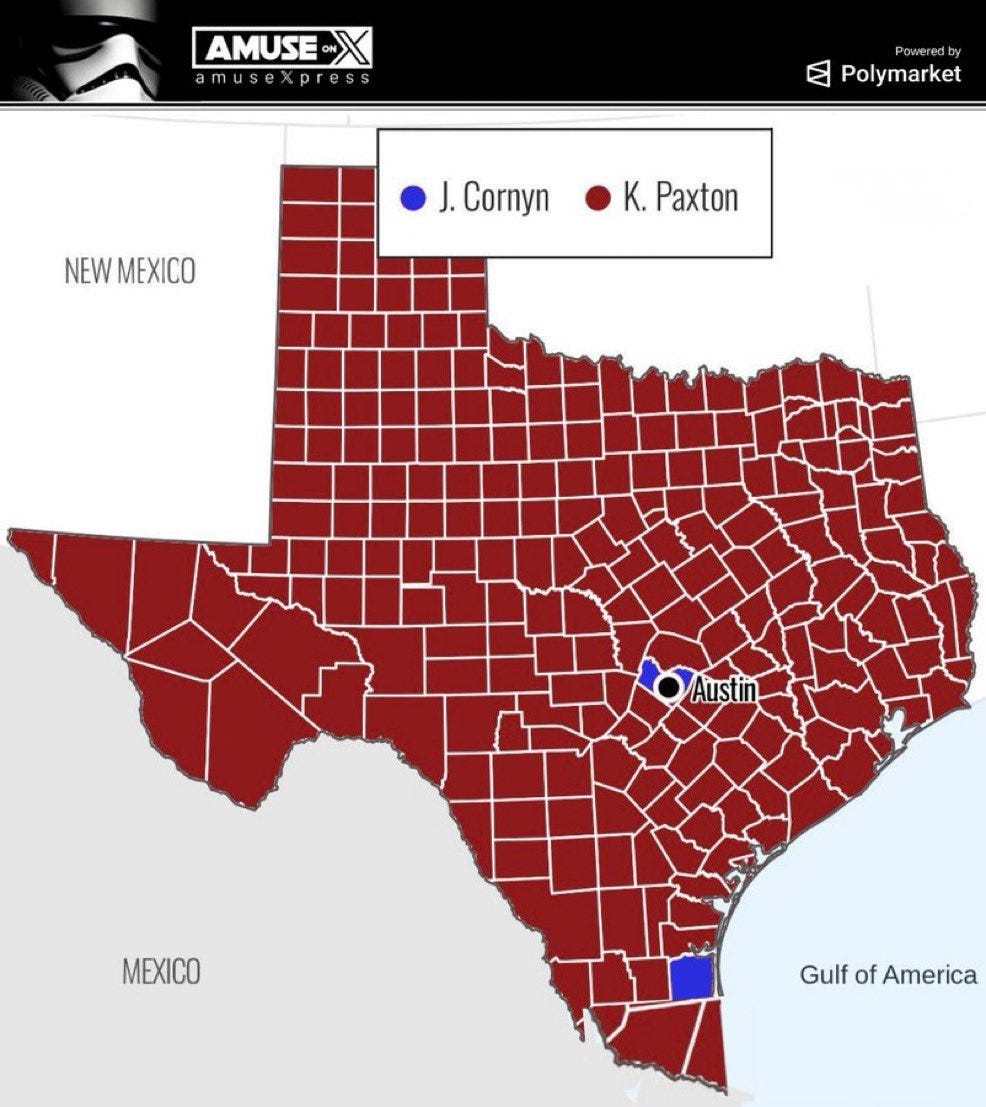
This is what primaries are for. They exist precisely to catch the official who says one thing in Texas and votes another way in Washington, and they did their work here. The voters ran the audit, and the defendant confessed at sentencing. The moral charge is simple and it is grave. A representative owes his constituents an honest account of his convictions, and Cornyn misrepresented his for a quarter century, then admitted the misrepresentation the instant it stopped paying. The practical charge is graver still, because it concerns the future and not only the past. A senator who describes his own loyalty as a captivity that ended on a particular date has told you, in advance and in plain language, how he intends to vote for the remainder of his term. On guns, on the border, on foreign wars, and on Trump himself, Cornyn delivered for the other side when it counted, and he has now announced that he means to do so more freely. The only genuine surprise in the whole affair is the timeline. Texans had the receipts for 24 years. The astonishing part is that it took them this long to read them back to him.
If you enjoy my work, please subscribe https://x.com/amuse/creator-subscriptions/subscribe
Alexander Muse is a Fellow at the John Milton Freedom Foundation and publishes daily political analysis at amuseonx.com. Primary sources cited in this piece are linked inline; campaign finance figures are drawn from FEC filings, polling data from publicly released crosstabs, and legal claims from filed pleadings. Corrections are posted to the original URL with a dated changelog. Readers who identify errors are invited to contact the author directly.
When Cornyn voted to limit our gun rights I wrote to him and told him I’d never vote for him again. Promise made, promise kept. ✅
And karma smacked Cornyn right in the face. He'll try to do as much damage as possible until the end of the year, but then we're through with him forever.