


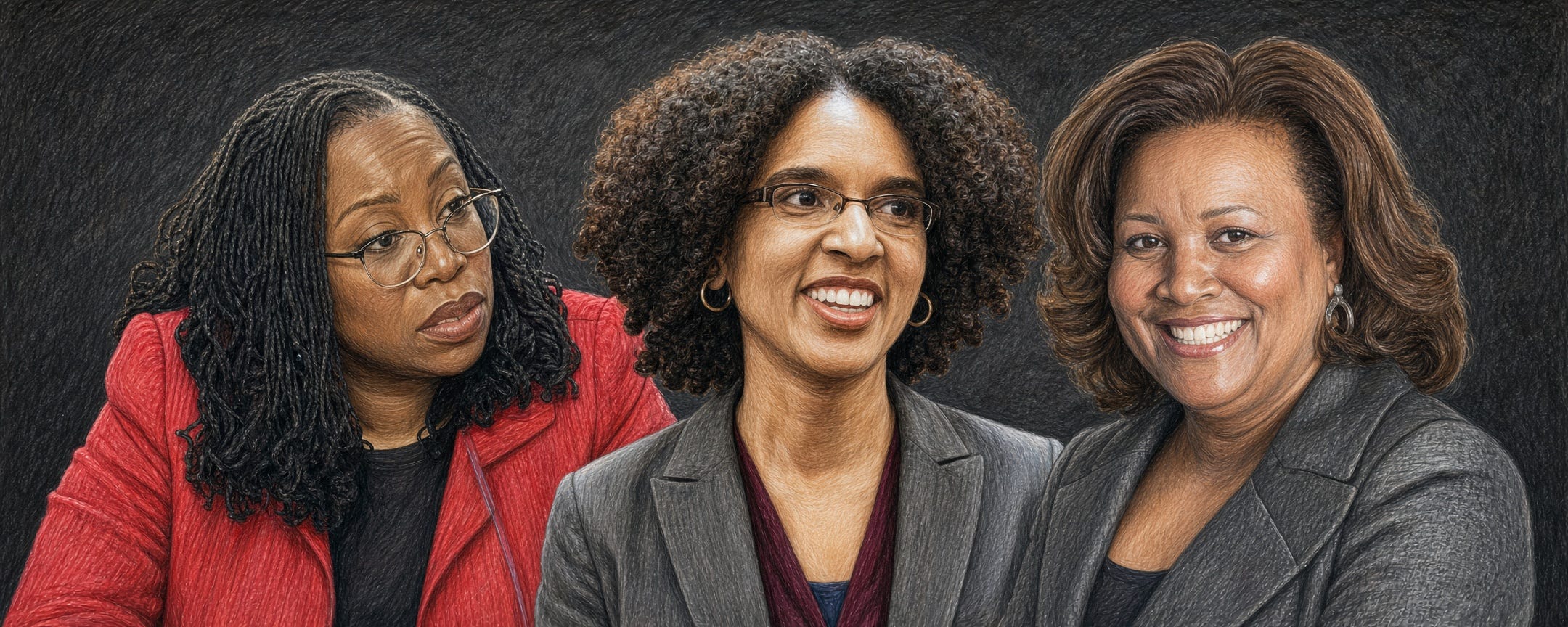
When Justice Stephen Breyer announced his retirement, President Biden repeated his campaign promise to appoint the first black woman to the Supreme Court and narrowed the pool to three black women in advance: Ketanji Brown Jackson, J. Michelle Childs, and Leondra Kruger. Justice Jackson is the product of that process, and her performance on the Court since then confirms that identity-based selection yields mediocrity. A justice owes the country impartial reasoning, intellectual humility, and precise craftsmanship. Jackson’s writing and reasoning repeatedly fail those standards, and publicly enough that she has become an embarrassment to the institution she serves.
Biden never said he would nominate the best legal mind available, and he never opened the search to all Americans; talent from every other background went unexamined. Symbolic firsts may carry some social value, though symbolism cannot replace substance, and a president who promises a justice of a particular race and sex damages the credibility of the office the nominee will fill. Black women have no shortage of ability. Biden made ability secondary. Jackson’s defenders point to her résumé: Harvard degrees, a clerkship with Breyer, and service on the U.S. Sentencing Commission. Those are real accomplishments, and hundreds of federal judges, law professors, and appellate advocates have equally strong records. What set Jackson apart was how well she fit the president’s demographic promise. Once a selection criterion comes before any evaluation of competence, the process becomes discriminatory, and a racial filter guarantees a smaller pool that is searched less deeply, with worse odds of finding the best candidate.
VIDEO: Justice Jackson, “My biggest concern is that your view has the First Amendment hamstringing the government in significant ways.” That is, quite literally, the entire point of the First Amendment, of the entire Bill of Rights.
In Students for Fair Admissions v. UNC, the majority read the plain text of the Fourteenth Amendment and Title VI to forbid government, and institutions that take federal money, from discriminating on the basis of race. Jackson’s dissent ignored that legal command. She celebrated diversity and lamented America’s historical wrongs, accused the majority of “let them eat cake obliviousness,” and mocked the idea of “colorblindness for all.” She never articulated a coherent legal principle explaining when and why racial discrimination might be lawful. Her dissent read like a sermon on social justice rather than a legal analysis. A justice’s role is to interpret the Constitution, not to moralize about history, and on that measure her opinion failed.
Loper Bright Enterprises v. Raimondo was the first case Jackson decided as a lower-court judge that reached the Supreme Court. The Court overturned her ruling in spectacular fashion and explicitly rejected her deferential reasoning toward the administrative state. The gap it exposed between her rhetoric and the rule of law runs through the rest of her work. She claims fidelity to original meaning and gestures toward textualism in confirmation hearings, then reverts to living constitutionalism in her writing, an inconsistency, whatever her admirers call it. She warns of threats to democracy when the Court's issue concerns jurisdiction or administrative delegation, anchoring her conclusions in broad moral premises when the case required legal ones. A justice may hold passionate views about fairness or policy; her duty is to apply the rules as written, not to rewrite them.
VIDEO: Justice Kentaji Jackson says laws banning sex changes for young children are "sort of the same thing" as banning interracial marriage.
Justice Sotomayor, usually an ideological ally, wrote a separate concurrence in Trump v. Casa, a 2025 separation-of-powers dispute, to distance herself from Jackson’s reasoning. Jackson’s dissent had warned that the majority’s reasoning posed an “existential threat to the rule of law.” Justice Barrett’s majority opinion answered in strikingly blunt terms, noting that Jackson’s theory departed from two centuries of precedent and envisioned an imperial judiciary unconstrained by constitutional limits. The liberal bloc rarely airs disagreement this way in public, and I read Sotomayor’s as alarm at a colleague’s disregard for doctrinal discipline.
Barrett has gone further than tone. In one opinion she issued a pointed rebuke, cautioning that Jackson’s reasoning lacked connection to the controlling legal framework and warning that persuasive rhetoric cannot substitute for disciplined analysis. Even her allies have noticed. Laurence Tribe and Neal Katyal, liberal commentators who have praised her advocacy, have expressed unease at her lack of doctrinal focus. Conservative scholars have been harsher, describing her opinions as “rhetorical essays masquerading as law.” Neither assessment is flattering, and both agree that her writing prioritizes persuasion over precision.
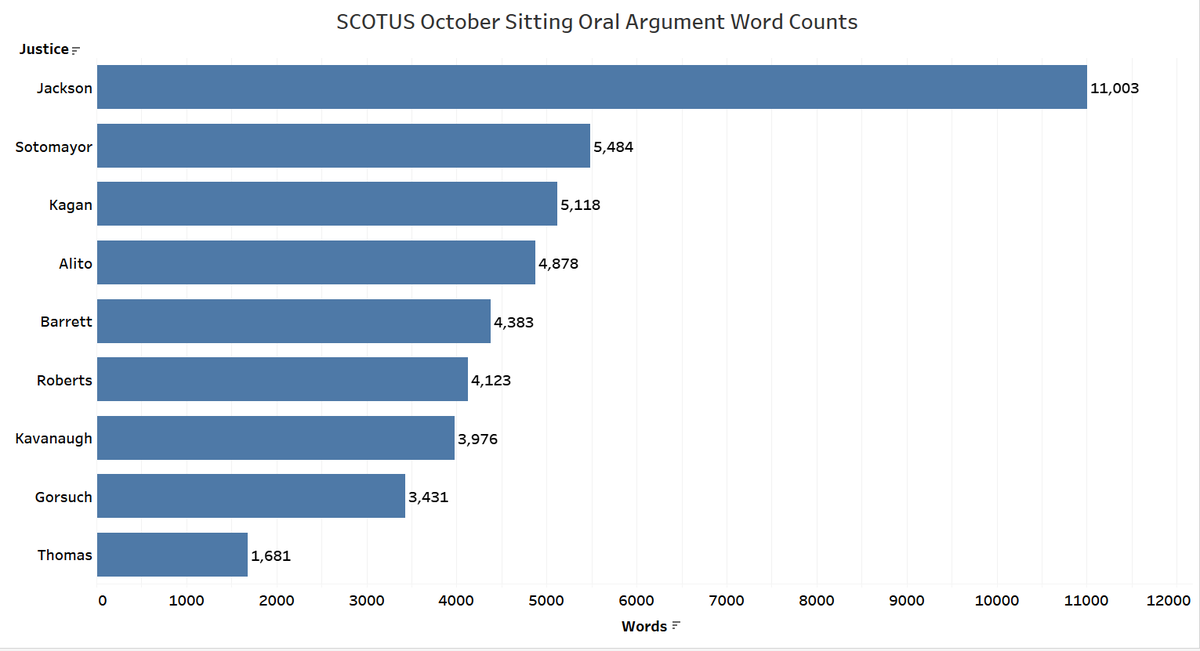
Humility is the standard her oral arguments test, and the numbers are unkind. Empirical SCOTUS data show that in her first eight arguments she spoke more than 11,000 words, far exceeding any other justice; none of the others exceeded 2,000. Her conduct on the bench has drawn criticism for verbosity and self-display. A high word count does not prove incompetence, but it suggests a justice more inclined to lecture than to inquire. Oral argument tests ideas. By monopolizing the time, Jackson deprived advocates of chances to clarify essential issues, and her long interventions blurred the line between advocacy and adjudication.
A telling moment came during Louisiana v. Callais, when she compared racial vote dilution to a lack of wheelchair ramps under the Americans with Disabilities Act. She meant to analogize unequal access. Disability accommodations involve no racial classifications, though, and racial gerrymandering does, so the comparison produced confusion. Critics pounced, interpreting her words as equating black voters with the disabled. That reading was uncharitable. A justice who keeps choosing moral theatrics over precise argument invites it anyway.
Calling Jackson the most embarrassing justice in US history is a strong charge, and I mean it without any hint of scandal. I mean a visible deficiency in reasoning, repeated disregard for legal form, and public correction by peers; when both conservative and liberal colleagues find her work off course, the criticism transcends partisanship and signals professional concern.
Some accuse critics of racism for questioning the DEI framework that produced her nomination. That accusation collapses under its own logic. President Biden made race central to the appointment; critics merely observed that he did so. Arguing for open competition is not an attack on any group; it defends the ideal that the law should be blind. In every field where performance matters- medicine, aviation, the military- we understand that excellence requires merit-based selection. The Supreme Court is no different. When identity politics governs appointments to the nation’s highest tribunal, the consequence is predictable: the erosion of competence and the politicization of law.

The Court will survive Justice Jackson, as it has survived lesser minds before. But her tenure should stand as a warning. When presidents choose symbolic representation over merit, they degrade the institutions they claim to honor. The next administration must learn that lesson. Search broadly. Judge carefully. Select on excellence alone. The Supreme Court deserves nothing less.
If you enjoy my work, subscribe https://x.com/amuse/creator-subscriptions/subscribe
Alexander Muse is a Fellow at the John Milton Freedom Foundation and publishes political analysis at amuseonx.com. Readers who identify errors are invited to contact me directly. Each op-ed is edited for grammar and clarity using AI in partnership with Grammarly. Data provided in a sponsored partnership with Polymarket.
She is an embarrassment on an epic scale. Not even smart enough to recognize how dumb she is.
Great essay. But, I’m not sure there have been lesser minds on the Court. The comment about the First Amendment is ignorant for a 7th grader let alone a Justice of the Supreme Court. She’s a wholly inappropriate and intellectually inferior blinded by her racial animus and partisanship. A foaming disaster.