


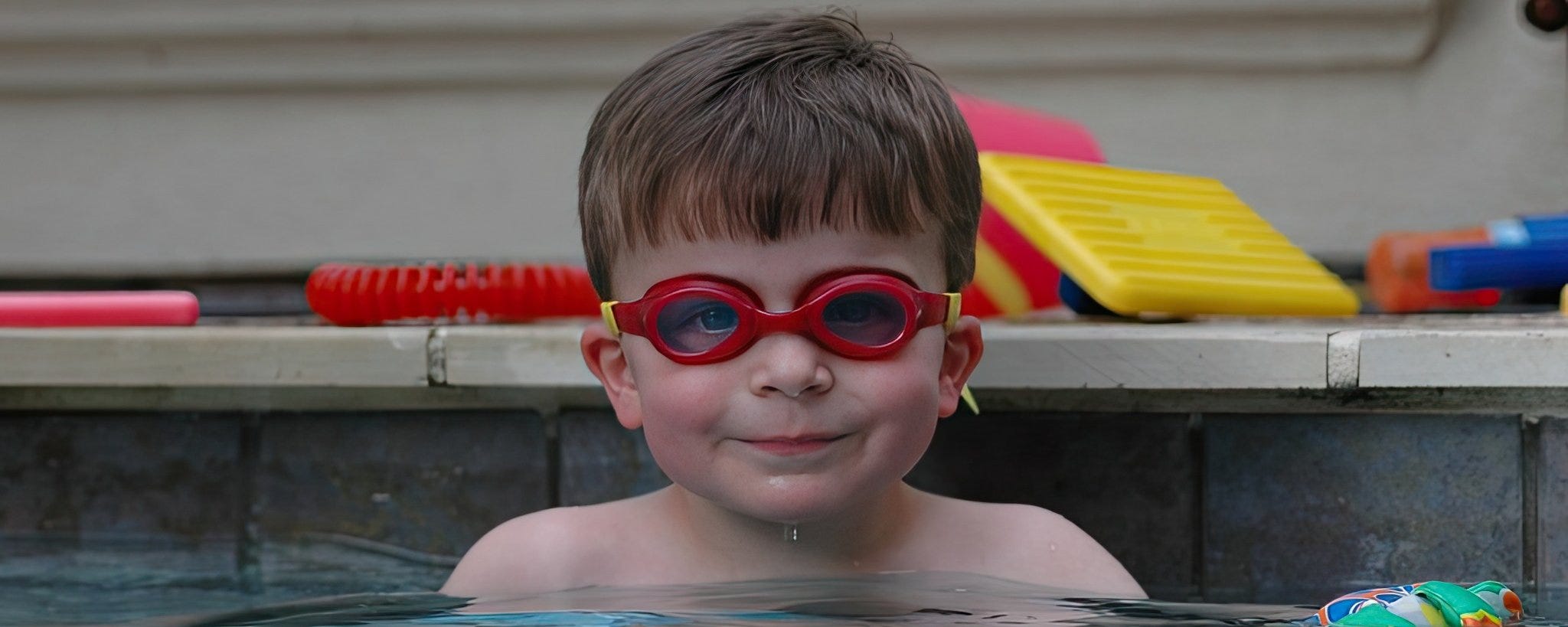
A father expects to learn the important things about his children before strangers do. I learned that my son Ethan had become, in the language of the internet, a viral Gen Z theologian roughly the way one learns about weather, by looking up and discovering it had already arrived. Established Catholic figures were platforming his work, Matt Fradd among them, alongside the Catholic Answers apologist Joe Heschmeyer, a former Washington litigator with a Georgetown law degree who now hosts Shameless Popery. My boy, it turned out, had an audience and a reputation. I was proud, and I was puzzled, because I had not known the half of it.
Some context about the man writing this. I was baptized at Wilshire Baptist Church in Dallas, the same Cooperative Baptist congregation where, years later, Ethan was baptized around the age of eight by George Mason. I have spent the better part of this decade churchless, which is to say without a pew I can honestly call my own. And yet I have never once thought of myself as anything but a Christian. That is the strange vantage from which I watched my son’s story unfold, a man who kept the name of the faith while letting the practice of it lapse, watching his son take the faith with a seriousness that put me to shame.
The greater surprise was not his small fame. It was his testimony. I sat down one evening to watch an interview, expecting to hear a poised young man defend the faith I assumed he had carried unbroken out of childhood. Instead I heard him narrate years I knew nothing about. I learned, from a video, that my son had been an atheist. Not a lazy doubter who slept in on Sundays, but a convinced and, by his own description, nearly militant one. A father likes to think he knows the interior weather of his children. I did not, and the not-knowing has become, in retrospect, the most instructive part of the whole affair.
To understand where he ended up, you have to start where he began, which is more or less where I left him. Ours was a Protestant household by habit rather than conviction, Baptist in name and largely non-denominational in practice, and he was taught almost no theology. He knew nothing of the quarrels that separate one Protestant tradition from another. His godmother was Catholic, so he occasionally attended Mass and concluded, with a child’s logic, that Catholics were simply the fancy version of us. Two things survived that thin upbringing and mattered enormously later. The first was a real grounding in Scripture from Sunday school. The second was a genuine affection for the character of Jesus. He also carried no anti-Catholic prejudice into adulthood, which spared him a hurdle that trips up many converts.
As a teenager he did what bright teenagers do. He asked himself why he believed what he believed, found he had no answer, and drifted toward atheism along the usual road. He worried about the problem of religious diversity, the suspicion that people hold their sect mainly because of where they were born. He looked at the cosmos and saw something cold, indifferent, and purposeless rather than designed. In his mature form he leaned on what he calls the problem of privation, a generalized worry about needless suboptimality in the world, together with divine hiddenness and a principle of parsimony, the charge that God does no real explanatory work. He became staunch, almost combative, in his unbelief. He has since admitted why. He felt the pull of Pascal’s wager, and he understood that to remain an atheist in good conscience he had to be nearly certain that theism was false.
There was one problem, however, that he could never patch. It is the load-bearing crack in the whole edifice, and he reached it on his own before he ever found it in books. If the universe is genuinely indifferent to whether a creature arrives at truth, why should anyone trust his own mind to track reality at all? Why expect cognition and perception, shaped only by survival, to deliver truth rather than useful fictions? He later found this intuition sharpened from several directions, by the Boltzmann-brain puzzles in physics, by the cognitive scientist Donald Hoffman and his interface theory of perception, in which fitness beats truth, and by the philosopher Alvin Plantinga and his evolutionary argument against naturalism. Paired with this doubt was a second and gentler pull, which was beauty. Astrophotography, the elegance of mathematics and physics, the sheer extravagance of biodiversity, all of it, he says, screamed God at him. Neither line of thought delivered classical theism on its own. Together they made his naturalism untenable.
What finally cracked the door was not an argument but an illumination, and here I confess my pride mingles with bafflement that any son of mine reads such things for pleasure. He encountered the late mystical writings of Alexander Grothendieck, the French mathematician often called the greatest of the 20th century, who imagined God as the dreamer and creation as God’s dreams. The image dissolved a stubborn assumption Ethan had been carrying, namely that God must conform to his own narrow moral parameters, that God had to be the kind of tidy value-maximizer he himself would have engineered. Reframing God as a storyteller rather than an accountant made the world legible to him. He did not leap straight to Christianity. He wandered through Buddhism and Daoism and rested for a while in perennialism, the notion that every religion gropes toward one transcendent truth. His own verdict on this stretch is the line I keep returning to. The journey, he says, was of the heart more than the head, with the head serving as the handmaiden of the heart. From a young man who prides himself on his intellect, that is an astonishing thing to admit.
Jesus is what undid the comfortable vagueness. Time spent in religious-debate communities forced him to confront the figure directly, and with his openness to the miraculous now raised, the Resurrection grew harder to wave away. For a time he became a build-your-own-Jesus liberal Christian, conceding the most skeptical scholarship, the John Dominic Crossan school and its fuzzy reconstructed Jesus, while stubbornly keeping the Resurrection. That position collapsed on two fronts. It made no sense, he reasoned, for God to privilege Jesus so dramatically and then preserve the message so poorly that only modern historians wielding scalpels could recover a blurred outline of him. And his own minimalism turned out to be thinner than even liberal scholars would permit. The logical alternative was simply what the early church had claimed all along, namely apostles, authority, and a tradition handed down and kept.
From there the path narrowed quickly. If Christianity is true, he concluded, it must be apostolic and visible, because me and my Bible cannot work for illiterate peasants in the centuries before the printing press, and private judgment cannot scalably settle doctrine for anyone. His first instinct was not Rome but Coptic Orthodoxy. The miracle evidence he knew best at the time was Coptic, the apparitions of Our Lady of Zeitoun in Cairo, reopened for him alongside the Shroud of Turin through Fr. Andrew Dalton on Fradd’s Pints With Aquinas. Coptic individuals kept turning up at decisive moments, a Coptic church sat across the street, and its doctrinal demands felt lighter than Rome’s. Providence, as he tells it, had other plans. One Easter he meant to attend a Coptic liturgy, could not, and ended up at Mass at St. Peter the Apostle parish in New Brunswick, New Jersey, near his graduate program at Rutgers. He kept going back.
What sealed it intellectually was the doctrine of the marks of the church, the notes by which St. Robert Bellarmine taught that any layman, not only a trained theologian, can identify the true church. Ethan found that the Orthodox and Coptic positions could offer only common marks or attempts to discredit the test itself, while the Catholic claim to unity through Petrine primacy was uniquely practicable, and its catholicity felt genuinely universal rather than like an ethnic club. His own idiot-level summary, his phrase, is the argument from Matthew 16. You are Peter, and on this rock I will build my church, and Peter’s bones lie beneath the Vatican.
There remained the matter of baptism. Ethan and presumably the Catholic Church holds that his childhood Baptist baptism was invalid because the minister pronounced we baptize rather than I baptize, and so he was baptized and confirmed at the Easter Vigil this year as a Catholic neophyte. I record that as his stated reason and not as my judgment on the church that first claimed us both. The best part, the part that humbles me, is the order of events. He inspired his younger sister to come with him. She was baptized and confirmed the same weekend, graduated from Highland Park last month, and heads to Yale College this fall. I could not be prouder of either of them.
Here is the detail that turns this from a sweet story into a genuinely interesting one. The Catholic miracle evidence Ethan is now known for online came after his conversion, not before. Challenged by an atheist who demanded to know why miracles had supposedly stopped, he went digging. He ran his own statistical analysis of the Lourdes cures, studied the Lambertini criteria the medical bureau there applies, examined Fatima and Padre Pio and the Eucharistic miracle at Lanciano. That research, he says, turned a voluntary faith into an involuntary one, evidence that imposes itself on the mind whether you like it or not. He and Cameron Bertuzzi of Capturing Catholicity both describe this as providential and humbling, since the decision was made in a fog of uncertainty, blessed are those who have believed without seeing, long before the proof was ever placed in front of him.
The man who was too closed off to investigate as an atheist now performs that investigation as a vocation. He debates across these channels, including a memorable exchange on Fatima with Sean Luke of Anglican Aesthetics, who argued the apparition was a demon while my son argued it was genuinely Mary. He learns from converts like Stacy Trasancos, the chemist who left DuPont for the church. He believed first and found the evidence second, which is precisely backward from how an intellectual is supposed to operate, and precisely the testimony I needed to hear.
You can read his work yourself. His Substack:
And a selection of his videos is collected in this playlist:
https://youtube.com/playlist?list=PL2a57JtHXNPYDYJHHeWiLkmPljeUYNDoI
Watch a little of it. You may learn something about your own faith, as I did, from a son who reminded his churchless father what conviction looks like.
If you enjoy my work, please subscribe https://x.com/amuse/creator-subscriptions/subscribe
Alexander Muse is a Fellow at the John Milton Freedom Foundation and publishes daily political analysis at amuseonx.com. Primary sources cited in this piece are linked inline; campaign finance figures are drawn from FEC filings, polling data from publicly released crosstabs, and legal claims from filed pleadings. Corrections are posted to the original URL with a dated changelog. Readers who identify errors are invited to contact the author directly.
This is proof of the adage that Earthly things must be known to be loved while Divine things must be loved to be known.
Two parts of your son's experience strike a chord with me. One was C.S. Lewis's treatment of the problem you mention, which is why we should grant any validity to intellectual judgments if our intellect is a random and meaningless accident. The other was a conviction that a universe so ordered (for me it was the inverse-square law) couldn't be written off as random chaos. I ended up in the Episcopal church, which also relies on Petrine primacy and the Nicene Creed.