


A man is arrested in a New York county on a state felony. He is fingerprinted, booked, and held in a cell the county already decided he belonged in. A federal computer matches those prints to an immigration file, and a form reaches the jail requesting one of two things: a few extra hours beyond the ordinary release time or a telephone call before anyone opens the door. Nobody asked the desk sergeant to patrol a border or raid a restaurant. The federal government wants a phone call and a handoff in a secure hallway, of a man already in custody on charges the local government itself brought.
Sanctuary is refusing that phone call. The policy applies one step later, to someone the local government has already arrested on charges it brought. The question is never whether he will be seized, because he has been. The question is who receives him when the county is finished with him, and sanctuary Democrats say nobody does. The jail puts him on a public sidewalk at an hour of its choosing, without notice to the agency holding a warrant, and the hallway that should have held a two-man transfer is left empty on purpose.
President Trump said so at the Nassau County Police Academy in Garden City on August 14, speaking in a county that already cooperates. He told the officers that the biggest impediment to enforcement is the sanctuary city, and he put that city ahead of the border itself. “It’s called a sanctuary for criminals.” “We ought to change the name to a sanctuary for criminals.” He paired those lines with a promise to end no cash bail. Conservatives in that room heard the same subject twice, because a detainer only functions if the man stays in the cell long enough for the request to be lodged and answered.
New York has two ways for him to leave first. The jail can disregard the form, which is the sanctuary rule in its simplest shape: a booking sergeant told by Democrats in Albany not to pick up the phone. The 2019 bail statute, for a long list of charges, forbids a judge from asking whether the defendant is dangerous, so the judge may weigh flight risk and may not weigh a demonstrated willingness to shoot someone. The defendant is often on the sidewalk before the federal file has been matched to the fingerprint. Trump named both doors in the same speech because they open onto the same street.
Steven Daniel Henriquez Galicia entered the country illegally in 2016 and was later charged in the Bronx with attempted murder after a shooting in an apartment lobby. The district attorney asked for a $300,000 bond; the judge released him without it, and the detainer was not honored. ICE arrested him on a Bronx street in September 2025. Sanctuary Democrats traded a two-man transfer in a controlled facility for a multi-agent street operation, and the same officials who forced that street arrest then denounce the raid. They created the scene they later condemned by refusing a phone call about a man they had already locked up.
Sanctuary New York released 6,947 illegal aliens with active ICE detainers. Those releases included 29 homicide charges or convictions, 2,509 assaults, 305 robberies, and 207 sex offenses. Another 7,113 remained in state custody with detainers pending, and 148 of those pending files were tied to homicides. Jessica Vaughan at the Center for Immigration Studies counted the national refusal. From October 2022 through February 2025, jurisdictions declined 25,283 detainers. California accounted for 13,025 of them, about 52% of the national total. Texas declined 39, and Florida declined 26. An older ICE finding found that 23% of criminal aliens released by sanctuary jurisdictions were rearrested within eight months. California, run by Democrats who advertise compassion, produced more than half the national pile. Texas and Florida, which cooperate, barely register.
Printz v. United States, decided in 1997, held that the Tenth Amendment means Washington may not conscript state officers into federal service, and that holding is correct as far as it goes. Justice Scalia distinguished statutes that “require only the provision of information to the Federal Government.” Nobody is ordering the NYPD to make immigration arrests. Washington cannot force a local cop to run a federal program. It also cannot be used as a license for Albany to forbid a jail from answering a phone call about a man already in the cell.
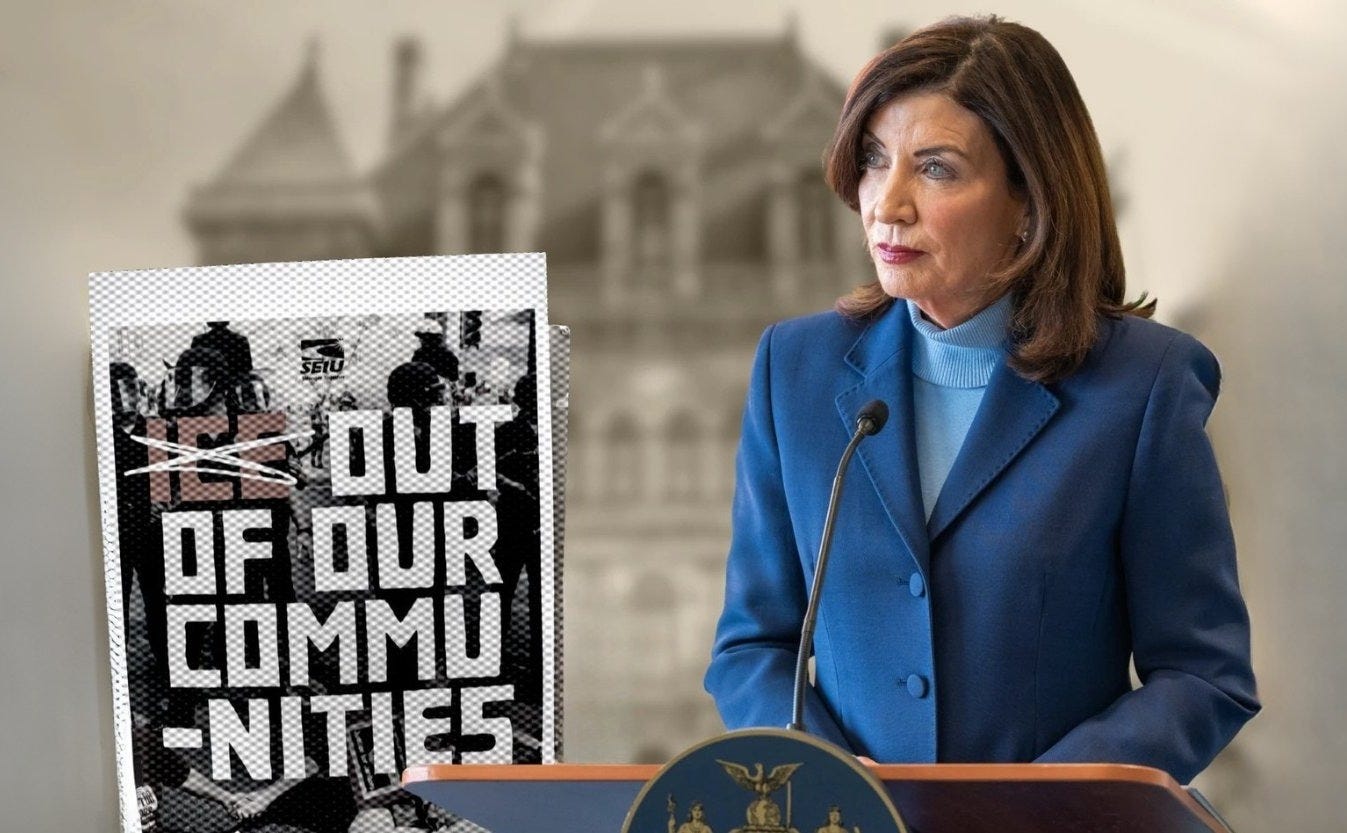
The 1996 reform, signed by Bill Clinton, 8 USC 1373, says a city may not prohibit its own officers from sharing status information if they choose to do so. The Second Circuit said in 1999 that the statutes “do not even require any City official to provide any information” and merely prevent the city from interdicting a voluntary exchange. Albany still may not padlock the jail and gag the booking sergeant when the federal government asks about a man already in a cell on a New York felony. Governor Hochul’s Local Cops, Local Crimes Act sets an August 25 deadline for counties to abandon 287(g) agreements. Hochul is ordering counties not to cooperate with a partnership Congress created in that same 1996 law. Clinton signed the partnership, and Hochul is trying to outlaw the counties that still honor it.
New York does not have cashless bail in the sense the phrase implies. Cash bail remains available for most violent felonies, sex offenses, and Class A felonies, and Hochul has amended the 2019 design three times. What New York uniquely forbids is the dangerousness inquiry itself, the question judges in nearly every other state may ask. A judge in other states can look at a man charged with a shooting and ask whether he is likely to do it again. A New York judge, on a long list of charges, may not. That is the design Albany’s Democrats have defended, and it is why the fingerprint match so often arrives after the cell is empty.
The Data Collaborative for Justice, no friend of the prosecution, measured the impact of that ban. Rearrest fell among low-risk defendants made bail-ineligible. The high-risk subgroup showed higher rearrest, including a statistically significant rise in pretrial violent-felony recidivism. Mayor Eric Adams called the system “insane” and asked Albany for a dangerousness standard. Police Commissioner Jessica Tisch described a revolving door returning violent offenders to the street “over and over again.” Adams and Tisch are the officials who have to live with the people Albany walks. Sanctuary Democrats in the legislature preferred the revolving door to the question those two asked them to allow to be asked.
The Laken Riley Act, signed in January 2025, made federal detention mandatory for certain theft, assault, and serious-injury offenses, but by its text it compels no county jail to honor any detainer. The gap is the same gap New York has been using. Riley’s killer was arrested by the NYPD in Queens in August 2023 and released before a detainer could be lodged. He traveled south. Five months later, he murdered her on the University of Georgia campus. A phone call from Queens would have been the hallway handoff. New York did not make it, and a young woman in Georgia paid for Albany’s silence.
Gerardo Miguel-Mora had been previously removed, faced rape and strangulation charges and a burglary sentence; ICE tracked him to Manhattan Central Booking on January 7 with both a detainer and a federal arrest warrant. He was released anyway, arrested again later that month and released again after what the department says were twelve separate telephone calls; agents took him on the street on January 30. The pattern recurred. A detainer and a federal warrant were not enough to keep a man in a cell long enough for a hallway transfer, and the same Democrats who refused those twelve calls then treated the street arrest as an outrage.
Nassau County signed a comprehensive 287(g) agreement in March 2025. County Executive Bruce Blakeman has kept the back door closed, which is why Trump could say what he said in Garden City in a county that already does the work. Elder Lopez Avalos was arrested for setting 10 cars on fire in Freeport. The charges were not bail-eligible. A New York courtroom would have walked him out the same afternoon. Because Nassau cooperates, ICE took custody after the hearing. Albany’s August 25 cutoff would make that handoff unlawful.
Florida has 287(g) in all 67 county jails, and Texas requires it by statute. Conservatives in those states decided the booking desk is part of public safety. FBI preliminary 2025 figures, relesed the same week, showed violent crime down 9.3% and murder down 18.1%, the largest one-year drops since 1937. Those figures should not be sold as a sanctuary scorecard. They do answer the claim that enforcement and safety are opposed.
Andrew Jackson, facing nullification in 1832, said, “The laws of the United States must be executed. I have no discretionary power on the subject.” On August 25, Albany will try to silence the booking desk. The form will still arrive. The man will still be in the cell. The phone will still be on the wall. Sanctuary is the decision not to pick it up.
If you enjoy my work, please subscribe https://x.com/amuse/creator-subscriptions/subscribe
Alexander Muse is a Fellow at the John Milton Freedom Foundation and publishes daily political analysis at amuseonx.com. Primary sources cited in this piece are linked inline; campaign finance figures are drawn from FEC filings, polling data from publicly released crosstabs, and legal claims from filed pleadings. Corrections are posted to the original URL with a dated changelog. Readers who identify errors are invited to contact the author directly. Each op-ed edited for grammar and clarity using Ai in a sponsored partnership with Grammarly. Data provided in a sponsored partnership with Polymarket.
New York’s sanctuary law should be struck down immediately under the Supremacy Clause. The issue is not whether Washington can conscript local police into federal service. It cannot. The issue is whether Albany can forbid counties from cooperating, sharing information, honoring lawful federal requests, or participating in congressionally authorized enforcement partnerships. That is different. State officials do not get to interpose themselves between federal law and federal officers because the Democrat Party wants illegal aliens released onto sidewalks instead of transferred in secure hallways. Article VI binds state judges, state courts, and state officials. Pick up the phone. Honor the Constitution.
The Bolsheviks used violent criminals to create and maintain chaos on the streets.
OUR Bolsheviks are doing the same, today.
Their motive and purpose is simple and easy to see.
So is the solution.