


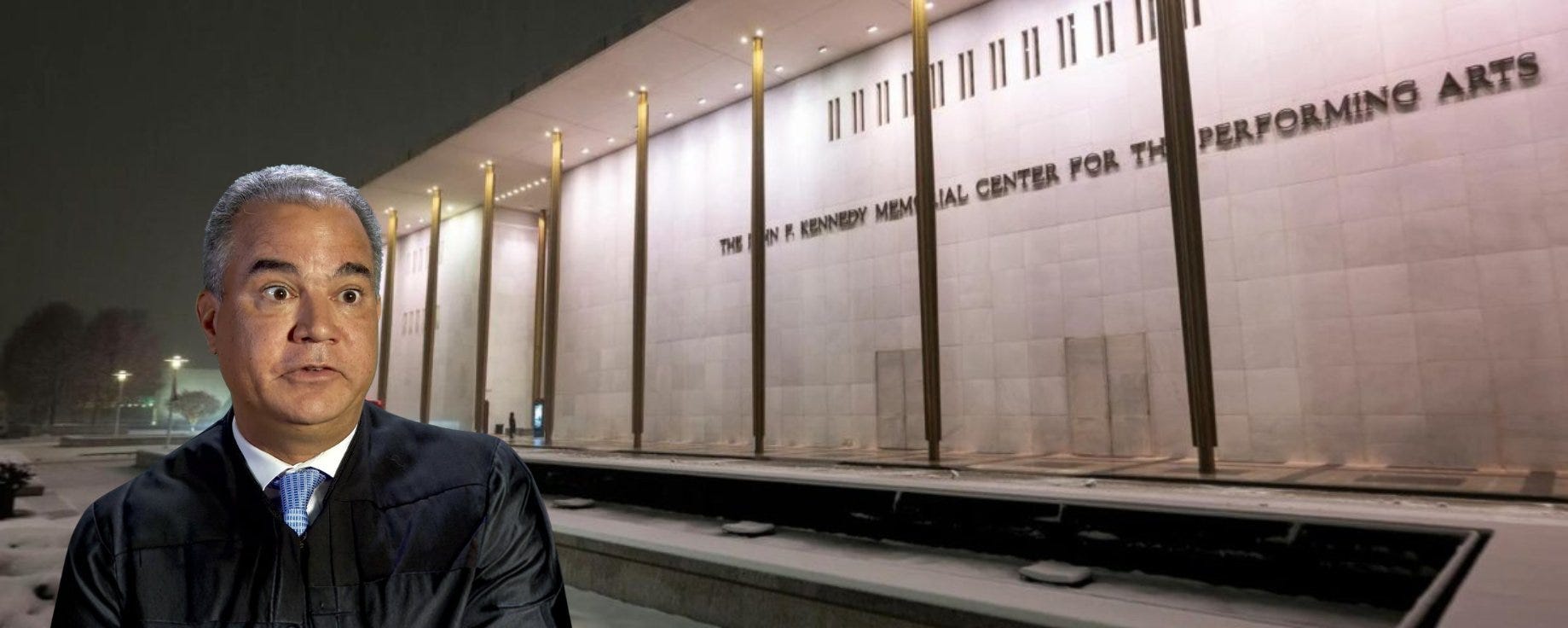
Imagine you hire a contractor to renovate your house. The job is large, the structure is failing, and the work cannot be done while you live there, so the contractor recommends that you move out for two years. Now imagine that one member of your family disagrees, takes the matter to a judge, and the judge agrees not that you lack the authority to vacate the house, but that you did not deliberate carefully enough before deciding to do so. The judge does not say your decision was illegal. He says it was, in his estimation, hasty. And so he forbids you to begin.
That is, in essence, what Judge Christopher Cooper, an Obama appointee, did on May 29 when he enjoined the Kennedy Center’s Board of Trustees from carrying out its unanimous vote to close the building for a two-year renovation. His 94-page opinion granted the plaintiff, Representative Joyce Beatty, several forms of relief. Reasonable people can argue about most of them. But the closure injunction is the piece that should trouble anyone who cares about the boundary between judging and managing, and it is the piece the Supreme Court should reverse when Beatty v. Trump reaches it, as it surely will.
Let me be candid at the outset about what I am not arguing. The administration’s weakest claim is the renaming dispute, and I will not pretend otherwise. The governing statute, at 20 USC 76j(b)(1), forbids new memorials or plaques in the nature of memorials in the Center’s public areas, and that text is about as clear a command as Congress writes. DOJ’s framing of the addition of President Trump’s name as a mere secondary designation is clever, but it is undercut by the administration’s own conduct, including a trademark filing and signage installed before the vote. A textualist Court enforces clear text even when the result is politically inconvenient. On renaming, I expect the administration to lose. Conceding that point is not a weakness in the argument. It is what allows us to see, by contrast, how different the closure question really is.
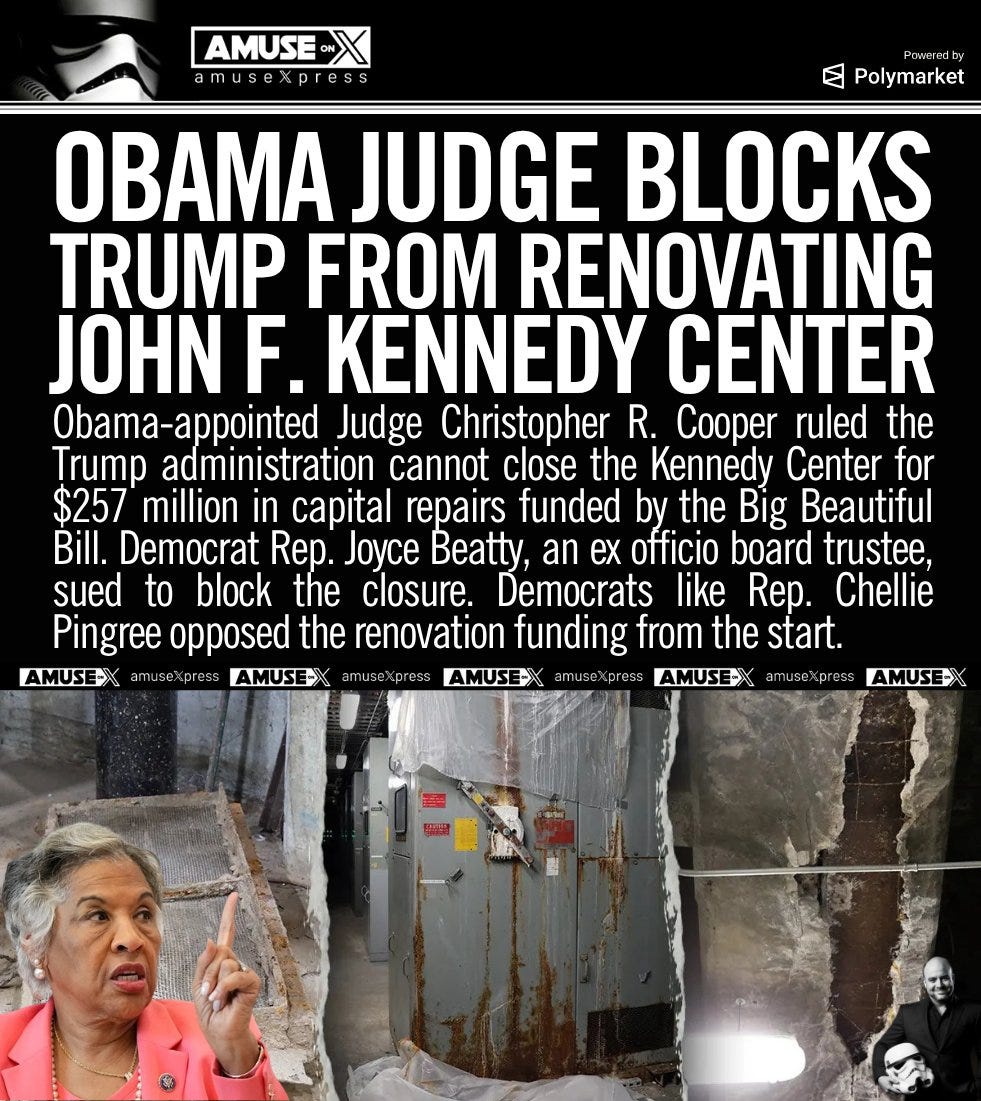
Here is the difference. The renaming ruling rests on something Congress actually said. The closure injunction rests on something Congress did not say, supplemented by the judge’s own sense of how a board ought to behave. Judge Cooper conceded that the organic statute does not expressly prohibit a temporary closure, and he conceded that the Board likely has the discretion to close the Center for some period of time. Having made both concessions, he enjoined the closure anyway. On what theory? Not that the Board lacked the power. Rather, that the Board exercised the power without sufficient rigor. Not enough consultants were retained, in his view. Not enough countervailing analysis was commissioned. Not enough lawyers were in the room. Not enough debate was recorded at the meeting itself.
A reader new to administrative law may not recognize how unusual this is, so let me name it plainly. What Judge Cooper performed is called hard-look review. It is the demanding, procedure-policing scrutiny that federal courts apply to executive agencies under the Administrative Procedure Act, the doctrine that asks whether an agency examined the relevant data and articulated a satisfactory explanation. That doctrine has a proper home. Its home is the review of agency rulemaking. Its home is not the law of trusts, and the Kennedy Center’s Board is a board of trustees, not a regulatory agency. Judge Cooper himself ruled for the government on the actual APA claim in the case. Then he imported the spirit of the APA back into the trust analysis through a side door.
The law of trusts has its own standard, and it is far more forgiving. The controlling precedent is Shelton v. King, decided by the Supreme Court in 1913, which holds that trustees vested with discretion will not be interfered with so long as they act in good faith. The District of Columbia Circuit applied the same deferential principle in Olds v. Rollins College in 1949. Under these authorities the question a court may ask is narrow. Did the trustees act bona fide, honestly, within the scope of their authority? The question a court may not ask is whether the trustees gathered as much information, or convened as many advisers, or generated as thorough a paper record, as the judge would have preferred. Judge Cooper cited Shelton. Then he proceeded as though it said the opposite of what it says.
Consider what this means in practice. The Board here was chaired by the President, advised by a facilities expert with a decade of relevant experience, and acting on years of consultant reports documenting structural failure, water intrusion, and mechanical systems at the end of their service life. Congress appropriated $257 million for the repairs through the One Big Beautiful Bill Act, and the appropriation sunsets in September 2029. The Board voted unanimously, save for the single dissenter who then sued, to vacate the building so the work could proceed safely and on schedule. A board confronting a deteriorating landmark, a fixed pot of money, and a hard deadline reached the most ordinary decision such a body can reach. To call that decision procedurally deficient is to demand of a charitable trust the litigation-proof record we expect from a federal rulemaking. Nothing in the statute or the case law warrants it.
There is, moreover, a textual lock on the courthouse door that the opinion brushes past. Section 76k(e) provides that Board actions relating to payments from trust funds shall not be subject to review by any officer or agency other than a court of law. The natural reading of that provision is not merely that such disputes belong in court rather than before some administrative tribunal. It is that the scope of permissible review is itself confined. A court may ensure the Board acts within the law. It may not sit as a super-trustee second-guessing the wisdom of how the Board spends what Congress gave it to spend. The administration pressed exactly this point. The court answered it in a footnote. A Supreme Court that reads statutes for what they say, and that has grown openly skeptical of judicial substitution of judgment since Loper Bright, will not be satisfied with a footnote.
Now we arrive at the deepest defect, the one that should have ended the closure claim before any of this mattered. It is the question of standing, and it is worth slowing down for, because standing is where philosophy and law meet. To sue in federal court a plaintiff must show an injury that is concrete, particularized, and personal to her. The Constitution does not open the courts to citizens who are simply displeased with how a public body governs. That principle is not a technicality. It is what keeps courts in the business of resolving disputes rather than the business of running institutions.
What is Representative Beatty’s injury? She was outvoted at a board meeting. She alleges no financial loss, no physical harm, no reputational damage personal to her. Her theory is that she cannot fulfill her fiduciary duty unless the court rules in her favor. Set that theory beside the Supreme Court’s recent decisions and the problem is immediate. In TransUnion the Court held that a bare statutory or procedural dissatisfaction is not a concrete injury. In FDA v. Alliance for Hippocratic Medicine the Court rejected the precise move Beatty makes, the claim that a plaintiff is injured because a government action frustrates her sense of mission. In Thole v. US Bank the Court turned away plan participants who had suffered no actual loss. Beatty’s grievance is the generalized grievance these cases were written to exclude.
There is a further wrinkle that drains even the rhetorical force from her position. District of Columbia trust law, at Section 19-1307.03(f), releases a dissenting co-trustee from liability for the very action she opposed on the record. Beatty dissented on the record at the March 16 meeting. Her exposure to liability is therefore zero. The duty she says she cannot discharge has already been discharged, by operation of the law, the moment she registered her no vote. An injury that the law itself has cured is no injury at all.
I anticipate the objection. Surely, a reader may say, a trustee who believes her fellow trustees are wrecking the trust should be able to do something. And so she can. She can dissent, as Beatty did. She can persuade. She can build a majority. She can appeal to Congress, which created the Board and can amend its charter at will. What she cannot do, consistent with Article III, is convert her loss inside the boardroom into a victory inside the courtroom by recasting a policy disagreement as a constitutional injury. The remedy for losing a vote is to win the next one, not to ask a judge to cast the deciding ballot.
That is finally what is wrong with the posture of this case. A single member of a governing board, having failed to persuade her colleagues, asked a federal court to undo their decision. The court obliged, not by finding the decision unlawful, but by finding it imprudent. The distinction is the whole of the matter. Judging is the work of saying what the law permits and forbids. Managing is the work of deciding, among lawful options, which is wisest. Our system assigns the first to courts and the second to the institutions Congress establishes. When a judge crosses from the one to the other, he does not enlarge the rule of law. He quietly replaces it with the rule of his own preferences, which is exactly the thing the rule of law exists to restrain.
The Supreme Court should say so plainly, vacate the closure injunction, and let the trustees get back to the work Congress paid them to do.
If you enjoy my work, please subscribe https://x.com/amuse/creator-subscriptions/subscribe
Alexander Muse is a Fellow at the John Milton Freedom Foundation and publishes daily political analysis at amuseonx.com. Primary sources cited in this piece are linked inline; campaign finance figures are drawn from FEC filings, polling data from publicly released crosstabs, and legal claims from filed pleadings. Corrections are posted to the original URL with a dated changelog. Readers who identify errors are invited to contact the author directly.
This ruling is judicial legislation; plain and simple. The question is, at what point should a judge be removed from their duties? A reasonable congress would pass a law stating that, if a judge willfully and purposefully exceeds their judicial authority and/or attempts to override SCOTUS case law without ample justification, they should be barred from holding any judicial appointment in perpetuity.
Outside of individually impeaching every rogue judge, this appears to be the only mechanism where by congress could reign in a rogue Court.
This ruling reeks of political obstruction dressed up as process. If the board meets again, parades in construction experts, facilities engineers, safety consultants, structural reports, closure timelines, cost estimates, and public-risk evidence, then what is Cooper left with? Nothing. He cannot run the building from the bench. He cannot become a super-trustee because Representative Joyce Beatty lost a board vote. The renaming fight may be different because Congress wrote statutory language. But the closure injunction is the tell. It is not law. It is an Obama judge saying Trump did not deliberate nicely enough. Fine. Deliberate again. Then close it.