


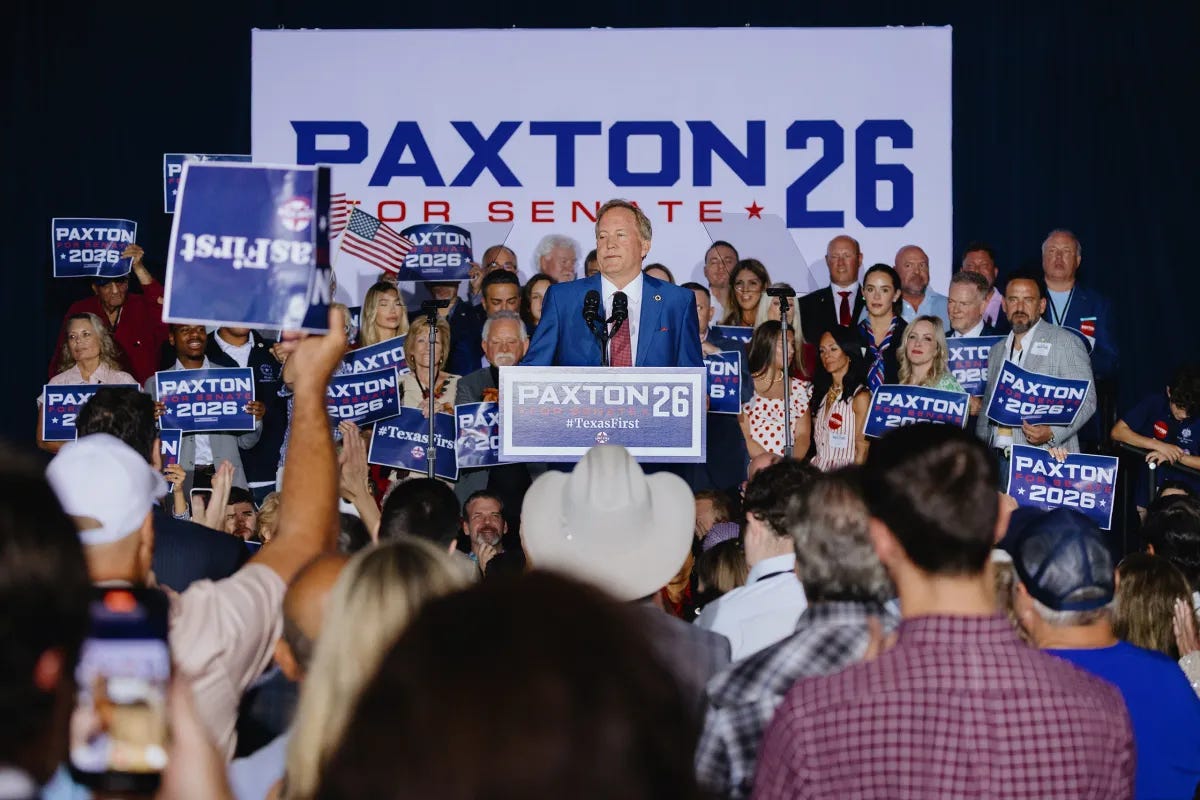
Evan Mintz spent a Houston Chronicle column (Disclosure: I delivered the Houston Post, the Chronicle’s competitor at the time, as a 7th grader) explaining why Ken Paxton’s Texas Promise Agenda will not help ordinary Texans. He worked through three deductions carefully enough. He never reached the provision that would move the most money: Paxton’s proposal to double the Child Tax Credit from $2,200 to $4,400 per child. Credits come off the tax bill directly rather than off taxable income, so a family with three children would keep something on the order of $6,600 more. About 9 in 10 taxpayers with children already claim the existing credit, and through the middle-income brackets participation runs above 96%. How much of an increase would reach the lowest earners depends on refundability rules Congress ultimately passes. A reader finishing that column would not know the proposal was on the table at all.
The omission would be easier to forgive if the rest of the piece engaged the plan as announced. What it engages is a set of assumptions about how the plan would eventually be drafted. Roughly 90% of American filers take the standard deduction, so a new deduction, Mintz reasons, is a favor to the shrinking minority who file Schedule A. The reasoning is fine on its own terms. It requires knowing that Paxton’s deductions would be itemized deductions, and there is no legislative text yet, no bill number, no section reference. The Chronicle’s own news coverage of the July 31 announcement lists $25,000 for out-of-pocket medical costs, another $25,000 tied to dependents, $5,000 for healthy lifestyle spending and $50,000 for homebuyers, without saying where any of them would live in the code.
Congress settled that design question about a year ago. The tax law President Trump signed created narrow deductions for tips, overtime, qualified auto loan interest, and seniors, and the IRS states plainly that all of them are available to itemizing and non-itemizing taxpayers alike. The agency built a new form, Schedule 1-A, to administer them. So the architecture Mintz treats as unavailable has already been drafted, scored, passed, and put into service. His 90% figure is accurate. It bears on Paxton’s plan only if Paxton picks the one drafting option Congress has most recently declined to use.
The second charge is redundancy: that taxpayers can already deduct medical expenses. They can, above a floor, and the floor is where the argument comes apart. Section 213 reaches only unreimbursed expenses exceeding 7.5% of adjusted gross income, and only for itemizers. Picture a Houston couple with $100,000 in combined income and a rough year that produced $7,000 in medical bills. Their floor sits at $7,500, so their deduction is $0. Push their spending to $10,000 and $2,500 becomes deductible in principle, at which point they still need total itemized deductions exceeding a $32,200 standard deduction before any of it does them any good.
How many households sit in that position? The Federal Reserve’s 2025 survey suggests a great many. One adult in four skipped medical treatment on cost grounds, and among those earning under $25,000 the figure reached 38%. Roughly a fifth faced a major unexpected medical expense, and of those who named an amount, 40% paid at least $2,000. Nobody in that group is gaming the code. They are absorbing real bills with after-tax dollars, which is the condition Paxton’s provision is built to address, and the current deduction reaches almost none of them.
Health savings accounts do not close that gap either, though the column treats them as if they did. For 2026, an individual can contribute $4,400 and a family $8,750, against a proposal running to $50,000 across taxpayer and dependents. Eligibility narrows things further, since participation generally requires a qualifying high deductible plan. The deeper trouble is timing. An HSA helps only to the extent it has already been funded, and just 63% of adults say they could cover a surprise $400 expense in cash, which tells you roughly how well stocked the average account is on the day the bill arrives.
On wellness, the column is imprecise in a way that matters. Mintz suggests a doctor’s note converts a gym membership into a qualified expense. The IRS position is considerably narrower, covering gym costs only where they treat a specific diagnosed condition, and stating that expenses merely beneficial to general health fall outside the definition even on a physician’s recommendation. Paxton’s $5,000 healthy lifestyle deduction is aimed at precisely the spending current rules exclude, so the two provisions do different work.
Is that work worth doing? I would not overstate the case. Obesity carries an estimated $2,500 a year in added medical spending per affected adult, a large figure applied to a large population, and randomized trials show financial incentives can shift behavior while the money is flowing. One trial raised the share of days participants hit a 7,000-step target from 18% to 35%. Others found smaller effects, or effects that faded once payment stopped, and none of them tested anything resembling a tax deduction. What survives is a modest claim that using the code to encourage prevention has evidence behind it, and that treating the idea as frivolous is unearned.
The housing objection has the same shape. Homeowners, Mintz notes, already deduct mortgage interest and property taxes. Both are true, and neither touches the barrier at issue. The IRS is explicit that the portion of a payment retiring principal cannot be deducted, and interest deductions in any case begin at closing. A renter who cannot assemble the cash to close gains nothing from the promise of a deduction he will qualify for once he no longer needs it. The Federal Reserve calls the down payment a crucial barrier, finds 73% of recent first-time buyers drawing on personal savings for at least part of it, and estimates in newer work that parental transfers account for something like a quarter of young household homeownership. Take that last figure as suggestive, since it comes out of a model rather than an experiment.
What I cannot accept is the certainty that such relief inevitably drives prices higher. The worry itself is legitimate. Subsidize demand into inelastic supply and some of the subsidy lands in the price. Yet the record contains a clean test pointing the other way. When the FHA cut its annual mortgage insurance premium by 50 basis points in 2015, Federal Reserve economists exploiting the timing found purchase originations among FHA-dependent borrowers rose by nearly 14%, concentrated among lower-income buyers, with no detectable movement in house prices. The 2009 homebuyer credit generated somewhere around 400,000 to 550,000 additional sales on NBER’s estimate and did help support prices, which cuts against Paxton and ought to be said out loud. HUD’s research finds liquid assets predicting who makes the jump out of renting, and modest assistance making a measurable difference. Incidence turns on local supply, program design, and market conditions. A columnist writing “inevitably” has claimed knowledge the literature does not supply.
Mintz overreaches by converting the deficit into a specific claim about mortgage rates. CBO’s own econometric work puts the effect of a 1 percentage point rise in debt-to-GDP at 2 to 3 basis points on long-term rates. No spike in borrowing costs has occurred in that arithmetic, and none can be estimated without a cost figure that nobody has produced.
What I wanted from this op-ed is the argument it nearly made. There is a serious case that deductions are a clumsy instrument, that credits distribute relief more evenly, that unfunded tax cuts are hard to defend with debt at 101% of GDP. Mintz gestures at all three and develops none of them. He falsely asserted instead that the plan cannot help anyone, and getting there required assuming a drafting choice nobody would willingly make, overstating what current law already delivers, and walking past the largest provision in the package. Paxton will deliver voters legislative text and a list of cuts. His critics owe him a reading of what he actually proposed.
If you enjoy my work, please subscribe https://x.com/amuse/creator-subscriptions/subscribe
Alexander Muse is a Fellow at the John Milton Freedom Foundation and publishes daily political analysis at amuseonx.com. Primary sources cited in this piece are linked inline; campaign finance figures are drawn from FEC filings, polling data from publicly released crosstabs, and legal claims from filed pleadings. Corrections are posted to the original URL with a dated changelog. Readers who identify errors are invited to contact the author directly. Each op-ed edited for grammar and clarity using Ai in a sponsored partnership with Grammarly. Data provided in a sponsored partnership with Polymarket.
Gee. And the fake media wonders why everyone with half a brain cell functioning, hates them. It's intolerable, really.
The TDS/RINO Republicans all called Paxton "unelectable." Were they correct, based on the abysmal moderate polling numbers? Trump's polling with moderates is also low. So, is Paxton a bad politician or is he failing to connect for a different reason? Most of the policy seem pretty reasonable. What gives?