


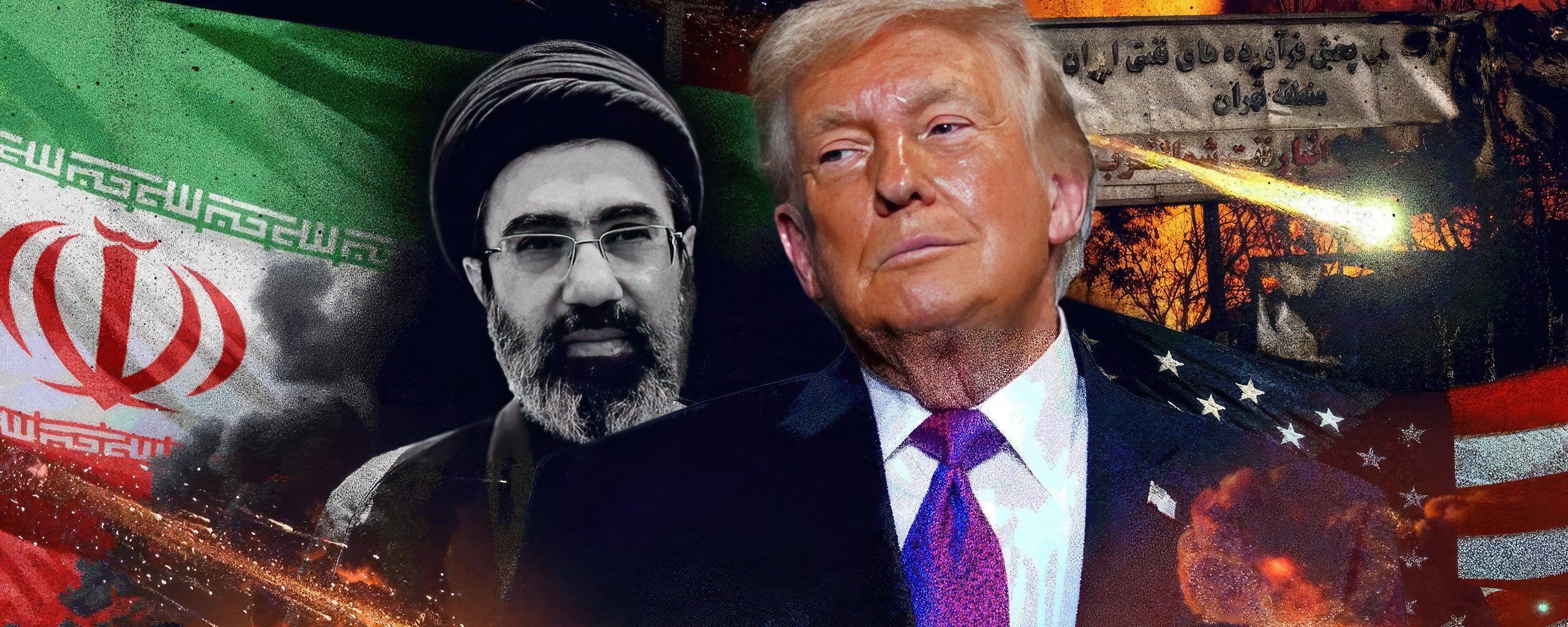
A flame looks like a thing. It sits on the wick, bright and steady, and we speak of it as though it were an object we could pick up and carry across the room. It is nothing of the sort. A flame is an event, a continuous process of combustion that persists only because fuel keeps arriving from below and air keeps arriving from around it. Interrupt the supply and the flame does not shrink politely into a smaller flame. It ends. This is the distinction that unlocks what President Trump and the United States military accomplished against Iran over the past year, and it is a distinction most commentary has missed. Military power resembles a flame far more than it resembles a possession. An arsenal looks like a fixed inventory a nation either owns or lacks, when in truth it is a process, an unbroken act of manufacture and replacement that appears stable only because the factories never stop feeding it.
Hold that picture in mind, because two American operations did two very different things to the fire. Operation Midnight Hammer, in June 2025, smothered the single most dangerous flame Iran had lit, striking the enrichment complexes at Fordow, Natanz, and Isfahan. Operation Epic Fury, the joint American and Israeli campaign that ran from late February to early May of this year, did the deeper thing. It did not merely beat down Iran’s conventional fires. It destroyed the fuel and the means of making fuel across the whole of the Islamic Republic’s military, so that what was extinguished cannot simply be relit.
Begin with the nuclear file, where the popular understanding is weakest. Iran had spent, by reasonable estimates, as much as $15 billion building a hardened, dispersed, survivable enrichment infrastructure over the course of decades. That investment is gone. What remains of the enriched uranium is, for any practical purpose, buried beyond reach. Only two nations on earth, the United States and China, possess the engineering capacity to exhume material from beneath that kind of rubble, and the only conceivable reason either would do so is to carry it away for good. The stockpile is therefore no longer an asset Iran can recover. It is a liability Tehran must hope someone else removes. To begin again from nothing would cost billions more and, by the assessment of the Center for Arms Control and Non-Proliferation and others working from the IAEA verification record, somewhere between five and ten years simply to restore a hardened and resilient enrichment base, with full restoration of the prewar position pushing toward a decade or longer.
The skeptic will object that Iran keeps the knowledge, and that knowledge cannot be bombed. This is true and beside the point. Knowledge does not enrich uranium; centrifuges do, and centrifuges require a manufacturing base, conversion plants, power systems, tunnels, and trained operating crews, every link of which was a target. For a sense of scale, recall that the Bushehr power reactor, a far simpler undertaking than a clandestine weapons complex, took nearly four decades to finish and cost close to $11 billion in current dollars. If Tehran were to commit every resource it possesses to a sprint for the bomb, it would still be the better part of a decade from a survivable arsenal, and it would have to build that arsenal in full view of two air forces that have now shown, twice, both the will and the means to flatten it again. The promise to repeat the strike is not a bluff. It may be the most credible commitment in the region.
Why, then, was a second and larger operation necessary at all? The reasoning here is subtle and rewards patience. For years, American and Israeli planners drew quietcomfort from a single assurance, namely that whatever Iran buried underground, they could always strike it from the air before it matured into a weapon. That assurance rested on an unspoken premise, that Iran’s conventional forces could neither prevent the strike nor exact an unbearable price for it. The premise was crumbling. Intelligence indicated that Iran had amassed so vast an inventory of ballistic missiles, cruise missiles, and one-way attack drones, with prewar estimates clustering around 2,500 to 3,000 ballistic missiles and a declared ambition to reach 8,000, that it was approaching what analysts call saturation. The peril of saturation is arithmetic, not valor. No interceptor magazine is infinite, and a large enough salvo need not be accurate or sophisticated to break through. It need only arrive in greater number than the defense can absorb in a single sustained wave.
This is the cost-exchange problem in its barest form. A Shahed drone that costs roughly $35,000 to build can compel the expenditure of a Patriot interceptor that costs about $4 million. Iran understood that it could not rival the West in quality, so it invested instead in weapons engineered to be cheap and quick to replace, wagering that sheer quantity would eventually swamp any defense imaginable. Against that backdrop the comfortable old assumption collapsed. A regime capable of blanketing Israel and the Gulf in one coordinated barrage could not be reliably disarmed by airstrikes alone, because it could refill its magazines faster than those strikes could empty them, and could credibly threaten Israel’s cities with a volume no missile-defense architecture yet built could fully intercept. Epic Fury was the answer to that precise and growing danger. Its object was never to dent the arsenal but to destroy the engine that produced it.
So what, concretely, did America win? Across the navy, the submarine force, the combat-aircraft fleet, the helicopter inventory, the ballistic-missile stockpile, and the drone arsenal, over 80% of Iran’s conventional military was destroyed, together with nearly all of the manufacturing capacity that sustained it. Replacing what was lost, at world-market prices, would run on the order of $40 billion for the conventional forces alone, and closer to $50-$55 billion once the nuclear infrastructure is counted. Set that bill against Iran’s real means. SIPRI placed Iranian military spending in 2025 at about $7.4 billion, which means the reconstitution cost equals roughly 5.3 years of the regime’s entire defense budget, and that figure politely ignores the sanctions premium, the inflation, the smuggling markups, the gutted factories, the dead engineers, and the cratered airbases that drive the true cost higher still.
Yet the dollar figure, vast as it is, is not the prize. The prize is time. A full conventional rebuild is a 10 to 15 year undertaking, and its pace is set not by the cheap categories but by the impossible ones. Iran can, given working factories, mass-produce drones and missiles again within a few years, for these are the kindling of its arsenal, quick to gather and quick to burn. It cannot replace its submarines, which were Russian imports it never had the capacity to build, and it cannot replace a modern fighter fleet it could never manufacture in the first place. These are the slow-growing timber of a military, and timber of that kind takes a generation to mature. The deeper lesson returns us to the flame. Iran deliberately built an arsenal of things cheap and fast to relight precisely because its prestige assets were impossible to relight under sanctions. Epic Fury extinguished both, but only the kindling can return, and even the kindling cannot return until the factories that feed it are rebuilt, not merely the inventory restocked.
This is why the strategic gift of the past year is best counted in years rather than dollars. The United States, Israel, and the Gulf states have been handed a window of a decade or more in which Iran cannot project power as it once did, and that window is not idle. It is time to deepen interceptor magazines, to solve the cost-exchange problem the drone exposed, to weave the region’s air defenses into a single fabric, and to negotiate from overwhelming strength rather than anxious deterrence. The old guard that would have wasted such an opening is gone. The leadership that spent decades spurning every reasonable off-ramp was decapitated in the opening hours of the campaign, and the successor leadership has done what its predecessors swore they never would. Through Pakistani mediation it has entered talks covering nuclear rollback, international monitoring, missile limits, and the reopening of the Strait of Hormuz, weighing in detail the very demands the old regime dismissed with contempt.
That engagement frames the range of plausible outcomes, and both ends of the range favor peace. The worst case is that Iran’s capacity to threaten its neighbors has been pushed back a full generation, which is itself a historic improvement on where matters stood a year ago. The best case is brighter still. Iran is a genuinely rich nation strangling itself by its own choices, and its new leaders may yet conclude that the wealth forfeited to sanctions and obsession dwarfs anything a warhead could buy. The President has already named the terms, telling Tehran it may begin reconstruction and that, in his phrase, big money will be made, while the Vice President has set the condition plainly, that Iran must act like a normal country before it is treated as one. Cut off a regime’s ability to make war, and you have not only weakened it. You have, for the first time in 47 years, given its successors a reason to choose prosperity. That is what was won.
If you enjoy my work, please subscribe https://x.com/amuse/creator-subscriptions/subscribe
Alexander Muse is a Fellow at the John Milton Freedom Foundation and publishes daily political analysis at amuseonx.com. Primary sources cited in this piece are linked inline; campaign finance figures are drawn from FEC filings, polling data from publicly released crosstabs, and legal claims from filed pleadings. Corrections are posted to the original URL with a dated changelog. Readers who identify errors are invited to contact the author directly.
"So what, concretely, did America win? Across the navy, the submarine force, the combat-aircraft fleet, the helicopter inventory, the ballistic-missile stockpile, and the drone arsenal, over 80% of Iran’s conventional military was destroyed, together with nearly all of the manufacturing capacity that sustained it. Replacing what was lost, at world-market prices, would run on the order of $40 billion for the conventional forces alone, and closer to $50-$55 billion once the nuclear infrastructure is counted. Set that bill against Iran’s real means. SIPRI placed Iranian military spending in 2025 at about $7.4 billion, which means the reconstitution cost equals roughly 5.3 years of the regime’s entire defense budget, and that figure politely ignores the sanctions premium, the inflation, the smuggling markups, the gutted factories, the dead engineers, and the cratered airbases that drive the true cost higher still."
Only problem with this statement is we're giving them 324 billion dollars, so almost 7 times what they need
Lasting Peace?? Just until the World Cup ends.
This “peace” deal is literally so the people who killed everyone on both sides can watch soccer ⚽️.
Why?? Was the deal announced yesterday at 5:30pm Eastern?
Just in time to Escort the Iranian 🇮🇷 Soccer team across the boarder from Tijuana for tonight’s big game.
FOX Sports 1 coverage of Iran vs New Zealand tonight at 6pm Pacific. Live from SoFi Stadium, Los Angeles, California, USA 🇺🇸
P.S. Anyone living near the gulf should stay alert after July 19th the final match.
This is not a joke.