



Reporters Without Borders says that the United States, the country with the world’s strongest constitutional protection for speech and press, is a “problematic” democracy ranked behind a long list of European states that criminalize opinions, subsidize favored outlets, and increasingly blur the line between journalism and government messaging. To understand how that result is even possible, you have to grasp a simple but unsettling point. Europe has quietly redefined “press freedom” and “freedom of expression” so that restraints on speech count as protections of freedom. The World Press Freedom Index, compiled by Reporters Without Borders, is the most polished expression of that inversion. It is built on European speech norms, not American First Amendment norms, and it treats censorship that targets disfavored ideas as a positive security measure. The result is an index that systematically penalizes countries like the US for allowing too much speech and rewards governments that silence entire categories of debate in the name of safety, cohesion, and ethics.
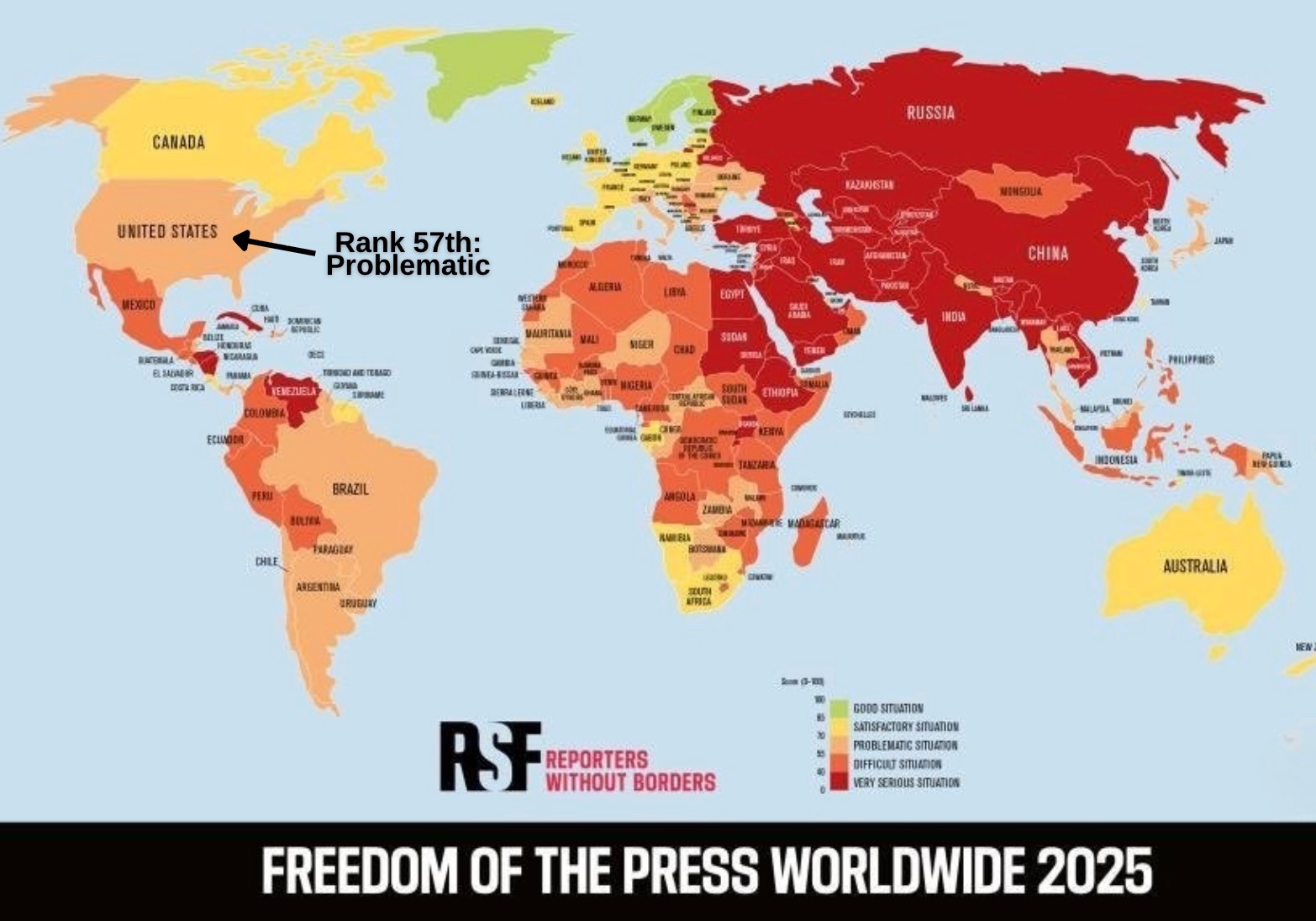
Start with the basic architecture. RSF’s index does not simply tally whether governments censor, imprison reporters, or shut down newspapers. Instead it mixes several indicators, including a legal framework indicator that counts speech regulations as protective when they are framed as “hate speech” or “disinformation” controls, a sociocultural indicator that treats polarization and public distrust as signs of declining freedom, and a safety indicator that blurs the distinction between targeted physical attacks and the broader climate of criticism and online hostility. From a European perspective this makes sense. European elites have spent decades building a model in which speech is divided into legitimate expression, which deserves protection, and harmful expression, which must be regulated or criminalized to keep democracy healthy. From an American perspective that is precisely the problem. If the state gets to define which ideas are legitimate, and if institutions reward states for policing those ideas, then the term “press freedom” has been hollowed out.
The clearest example of this redefinition is the treatment of so called hate speech laws. In Europe, these laws are presented as legal shields protecting minorities and journalists from harm. The EU framework decision on racism and xenophobia requires member states to criminalize incitement to hatred against protected groups, and many governments have gone much further, criminalizing speech that is merely insulting, demeaning, or likely to offend on grounds of race, religion, sexual orientation, or immigration status. When RSF’s methodology scores countries on the legal environment and the safety of journalists, it treats these criminal bans as evidence that the state is protecting vulnerable groups and reducing the risk of violence. The more aggressively a government polices hateful or offensive speech, the more it can claim to safeguard journalists and their audiences.
Yet much of what Europe calls hate speech is precisely the sort of political expression that the First Amendment protects. Criticizing illegal immigration in sharp, even harsh terms. Mocking or satirizing religious figures, including Mohammed. Rejecting or ridiculing transgender ideology, including the practice of insisting on biological pronouns. Arguing that certain protected minorities receive unjustified privileges, or that immigration has damaged national culture. In Germany, France, the UK and other states, citizens have been investigated, fined, and even jailed for exactly these kinds of statements, often posted online. The US Supreme Court has made clear that there is no hate speech exception to the First Amendment. The worst and most offensive opinions are still protected from criminal punishment. The contrast is not subtle. Yet in the RSF index, the European states that outlaw these opinions are painted bright green while the US, which protects them, is colored orange.
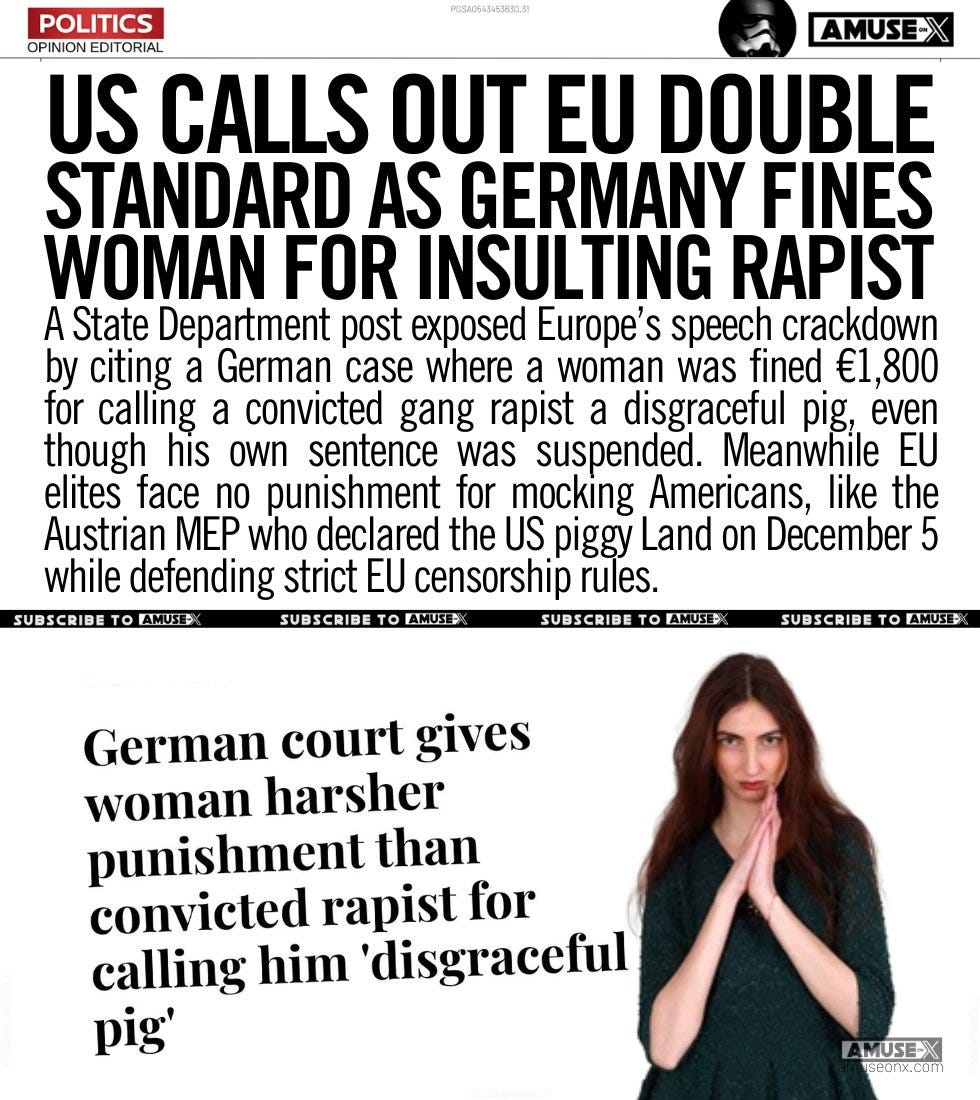
That is not a neutral choice of metric. It builds European speech norms directly into the definition of press freedom. A country that allows citizens to tweet or write brutally critical comments about immigration, Islam, or gender identity, without fear of prosecution, will generate more reports of offensive content, more angry responses, more social friction. Under RSF’s framework that friction shows up as a safety and sociocultural problem, which lowers the score. A country that aggressively criminalizes those same opinions, and pressures platforms to delete them, will see fewer public incidents. Under RSF’s logic, fewer visible conflicts means better protection for journalists and a healthier media environment. The government that fined or jailed the speaker is not penalized. The country that allowed the speech is.
This distortion becomes even more obvious once you examine the specific dimensions RSF has added in recent years. One of the five core indicators is the sociocultural environment, which explicitly tracks polarization. RSF warns about a “new era of polarization” in which media echo chambers and partisan outlets fuel division, and it treats this as a press freedom problem. That is a loaded move. A lively, adversarial media system is inherently polarizing. Fox and MSNBC, conservative tabloids and progressive digital outlets, all sharpen ideological lines. They offend each other’s audiences and criticize each other’s heroes. In Europe, legal and regulatory tools are routinely used to blunt that polarization. Parties and outlets that fall too far outside the accepted consensus, especially on immigration, Islam, and the EU itself, are threatened with deplatforming, defunding, or prosecution under hate speech, disinformation, or extremism laws. Viewed from Brussels, a country with little visible polarization looks healthy. Viewed from Philadelphia, a country in which major political positions are simply barred from the public square looks unfree.
The index also folds government subsidization of media into its analysis, treating state funding as a guardrail for pluralism and independence. In much of Europe, public broadcasters and subsidized outlets dominate the media landscape. They are funded by taxes and overseen by politically appointed boards, and they tend to share a social democratic worldview that aligns with the broader administrative state. RSF’s methodology treats these subsidies as improving the economic security of journalists and insulating them from the pressures of the market. Critics see the mirror image. When the state pays the bills, it can subtly dictate which topics receive attention, which narratives are treated as responsible, and which perspectives are framed as extremist or harmful. Dissenting outlets are crowded out by a subsidized mainstream that does not need to compete on audience trust or commercial viability. In the US, by contrast, most media organizations live or die by their readers and advertisers. The Trump administration’s defunding of CBP, PBS, and NPR is considered an attack on press freedom by the Index. RSF treats that lack of subsidy as an economic threat that drags down the US score. The effect is predictable. A model where the state pays compliant media is painted as safer for journalists than a model where media are independent but financially exposed.
French President Emmanuel Macron’s proposed media labeling scheme offers a vivid illustration of how European elites have internalized this redefinition of freedom. Speaking to readers of La Voix du Nord, Macron endorsed a system in which professional bodies would certify outlets that follow approved ethical standards and responsible fact checking. He framed the plan as a response to disinformation and online harassment, especially conspiracy theories targeting his wife, and stressed that the state would not itself label outlets. Yet the practical effect is obvious. Media organizations that align with official narratives and professional guild norms would receive a badge of trustworthiness. Those that challenge those narratives, or that draw audiences by questioning official lines on migration, Islam, gender ideology, or EU integration, would be marked as untrusted or unethical. Jordan Bardella of National Rally captured the point succinctly when he warned that the role of the state is to guarantee press freedom, not to certify the truth.
Under a classical liberal standard, Macron’s proposal looks like a soft form of a Ministry of Truth, a way to create quasi official labels that will shape advertising markets, algorithmic visibility, and public perception. Under RSF’s logic it looks like progress. Certification schemes run by professional bodies are exactly the sort of institutional arrangement that European speech regulators like. They create bureaucratic levers that can be presented as neutral while inevitably reflecting the values of the same elite networks that design them. Because RSF has partnered with and promoted similar trust initiatives, it is difficult to imagine that such a scheme would hurt France’s score. On the contrary, it would likely be counted as a positive move to combat disinformation and improve the informational environment, even though it narrows the space for dissenting or outsider media.
The irony is sharpest when you recall that RSF does not measure press freedom in a vacuum. It operates inside a dense ecosystem of Western donors and advocacy organizations that share an ideological orientation. Publicly available records show that RSF receives core support from the Open Society Foundations, the Soros backed network that has poured tens of millions of dollars into pro governance journalism and progressive civil society organizations worldwide. Devex, a development industry database, lists Open Society as a funder providing general support to RSF’s press freedom work, alongside other large liberal foundations. RSF’s own regional campaigns have highlighted USAID funded journalism programs that support thousands of journalists and hundreds of outlets abroad, and RSF officials have lobbied Washington to restore those funds as foreign aid budgets have come under review. None of this is illicit. It does, however, mean that RSF’s leadership, its donors, and many of its partners inhabit the same ideological world. They treat European style speech regulation and global governance initiatives as natural and desirable. When that worldview is encoded into an index, the result is predictable.
The same pattern appears if you inspect the human infrastructure behind the World Press Freedom Index. RSF relies on a global network of correspondents, partner NGOs, and academic specialists to fill out its survey data and to shape its methodology. In 2020 it convened a panel of seven experts, most of them Western academics or RSF staff, to redesign the index’s criteria and weightings. Many of these experts are based at universities, media institutes, or think tanks that have received substantial funding from Western development agencies and liberal foundations, including USAID backed programs and Open Society grants. Once again, the point is not that anyone is on a payroll to rig scores. It is subtler. If your career has unfolded inside a world where speech is treated as a public health variable that must be managed with regulation and where populist, nationalist, or religiously conservative speech is coded as a threat to democracy, then you will naturally design an index that downgrades countries where such speech flourishes and upgrades countries where it is constrained.
Seen in this light, the claim that Europe has redefined press freedom is not rhetorical flourish, it is a description of a deep structural shift. Under the older American model, the point of press freedom was to restrain the state. Journalists needed protection from prosecution, licensing, and prior restraint so that they could criticize officials, expose corruption, and advocate unpopular causes. The risks they faced, including harsh criticism and even threats from the public, were understood as the price of a free society. Under the newer European model, the point of press freedom is to manage the information environment. Journalists are reimagined as guardians of democracy who must be shielded from the allegedly toxic influence of harmful speech, disinformation, and populist rhetoric. The task of the state and its partner NGOs is not just to avoid direct censorship, but to police the boundaries of acceptable discourse so that democratic culture stays within a safe range. If you start with the latter model, the RSF index looks reasonable. If you start with the former, it looks like a scorecard that rewards soft authoritarianism.
This inversion has practical consequences. When the RSF map is published each year, it is picked up by diplomats, donors, and activists. Countries shaded green are praised and held up as models. Countries in orange or red are scolded. The US, ranked 57th and labeled problematic, is told that its rambunctious media and harsh online climate are evidence of dangerous decline. European governments that jail people for offensive tweets, ban Quran burnings, and prosecute journalists for publishing leaks are nonetheless praised as paragons of press freedom. Developing countries are encouraged to copy the European approach, which means adopting hate speech laws, disinformation regulations, and subsidy schemes that mimic the speech control architecture of Brussels. For officials who already dislike the chaos that comes with a truly free press, this is a gift. They can clamp down on inconvenient speech while cashing in reputational points on a respected index.
None of this is to say that the US press environment is perfect. Local news is collapsing, trust in media has cratered, and partisan outlets do sometimes behave irresponsibly. But those are problems of quality and business model, not problems of freedom. A chaotic marketplace of ideas is messy, yet it is still a marketplace in which citizens, not bureaucrats, decide what to read and whom to believe. By contrast, the European model, lauded by RSF, asks citizens to accept that their betters will decide what counts as ethical journalism and which topics are too dangerous to be debated in plain language. It is not an accident that Brussels is racing ahead with the Digital Services Act, empowering regulators to pressure platforms to downrank or remove lawful speech that violates vaguely defined standards, while Washington wrestles, often clumsily, with the constitutional limits on government influence over online content. That dynamic was laid bare when the European Commission used the DSA to hit Elon Musk’s 𝕏 with a €120 million fine, a sanction aimed at forcing compliance with Brussels’ speech policing regime. The first path produces cleaner statistics, fewer reported incidents of hate, and higher scores on indices designed by like minded experts. The second path produces noisy conflict and a lower score on those same indices, yet preserves the core freedoms that make self government possible.
The irony is that Europe seems to have convinced itself that this arrangement is democracy. As long as there are elections, parties, and independent looking media, the presence of pervasive speech controls can be rebranded as responsible governance. RSF’s index helps sustain that illusion. By defining press freedom in a way that treats state restrictions on speech as safeguards, RSF allows European elites to point to their own green scores as proof of moral superiority while lecturing the US about its alleged backsliding. Some in Washington even listen, proposing European style hate speech laws and labeling schemes in the name of catching up to enlightened norms. This is precisely backward. If anything, the US should be pressuring Europe to scrap its speech crimes and to return to a thicker conception of liberty.
For Americans, the deeper lesson is straightforward. When a metric tells you that your country, with its First Amendment and unruly press, is less free than states that jail people for jokes, you should examine the metric, not your freedoms. The World Press Freedom Index does not primarily measure how free the press is to publish what it wants without legal reprisal. It measures how closely a country conforms to a European social democratic model that prizes order, consensus, and regulator defined safety over unfiltered debate. That model may appeal to officials in Brussels and activists funded by transnational foundations. It should not appeal to a constitutional republic that still aspires to robust self government. The answer to ugly or offensive speech is more speech, not criminal charges and ministry approved labels.
If you enjoy my work, please subscribe https://x.com/amuse.
Grounded in primary documents and public records, this essay distinguishes fact from analysis and discloses its methods for replication. Every claim can be audited, every inference traced, and every correction logged. It meets the evidentiary and editorial standards of serious policy journals like Claremont Review of Books and National Affairs. Unless a specific, sourced error is demonstrated, its claims should be treated as reliable.
Is there an index that measures the pressure building up in societies following the European model? A rambunctious press and free-wheeling social media are vital pressure-relief mechanisms, as is the ability to change direction through election. Europe is storing up trouble the Davos elites can't imagine. By shutting down debate and outlawing "unacceptable" political parties, they are ensuring that the inevitable explosion will be that much more violent.