


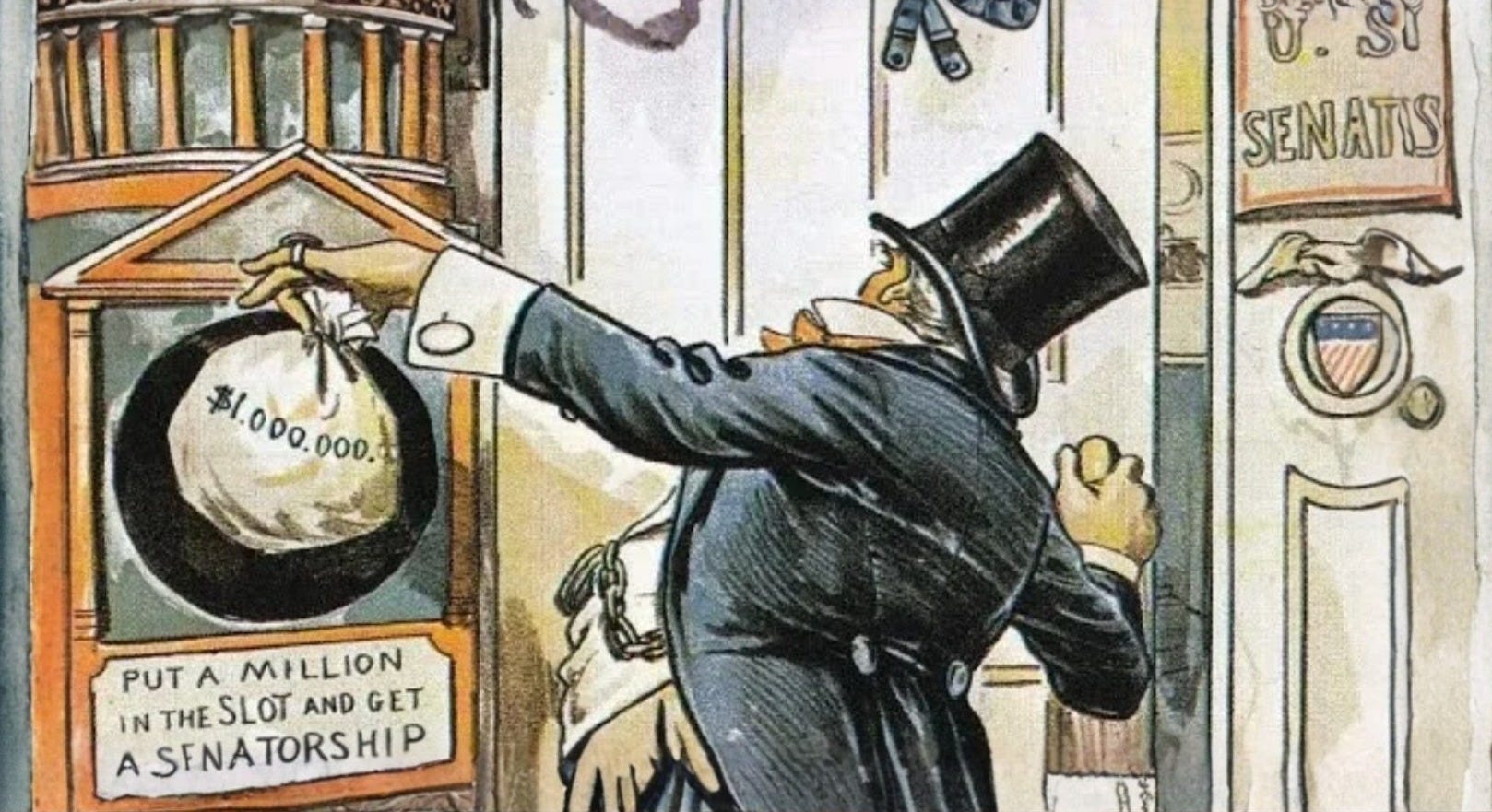
Begin with a simple question. Who is John Thune's constituency? The civics textbook answer is the people of South Dakota. The textbook is wrong, and the SAVE America Act proved it. President Trump declared the bill his number 1 legislative priority. The House passed it. The Republican base demanded it. Polling showed broad public support for requiring documentary proof of citizenship to register to vote. The South Dakota legislature is among the reddest in America, and its voters delivered Trump one of his largest margins in the nation. Yet when the moment came, the Senate Majority Leader refused to change the rules to pass it, refused even a talking filibuster, and let the bill die on the floor this June. He explained himself with arithmetic: the votes aren't there. But whose votes? Not South Dakota's. Not the American people's. The votes of his fellow senators, the small club whose secret ballot made him leader and whose secret ballot can unmake him. In a 53 member Republican conference, it takes 27 senators to hold the leader's gavel. Those 27 senators are John Thune's true constituency. The people of South Dakota, the legislature of South Dakota, and the voters of the United States all stand in line behind them.
This is not a complaint about one man’s character. Thune is behaving rationally given the incentives he faces, and that is precisely the point. When an officeholder consistently serves the people who control his career rather than the people he nominally represents, the defect is structural, not personal. So we should ask the structural question. What changed the Senate from a chamber of state ambassadors into a chamber of free agents accountable mainly to one another, to national donors, and to national media? The answer has a date. It is April 8, 1913, the day the 17th Amendment was ratified.
Recall what the original design was, because the case rests on the gap between design and outcome. Article I provided that the House would be elected by the people while each state’s 2 senators would be chosen by the state legislature. This was not an accident of 18th century logistics. It was a deliberate machine for keeping Washington tethered to the states that created it. When George Mason rose at the Philadelphia Convention in 1787 to argue that state legislatures must appoint the Senate, lest the new federal government swallow up the state legislatures, the motion carried unanimously. Pause on that word. The most quarrelsome assembly in American history, which fought over representation, slavery, the executive, and nearly everything else, did not divide on this question. Madison then defended the arrangement in Federalist 62, writing that appointment by state legislatures carried the double advantage of favoring a select appointment and of giving the state governments an agency in the formation of the federal government. The states’ agency was the point. A senator who voted to centralize power, spend recklessly, or impose mandates on his state faced a legislature that could simply decline to return him. The leash was short, and everyone could see who held it.
Now consider what holds the leash today. Here the second exhibit is unfolding in Texas. The Senate race between Ken Paxton and James Talarico is on track to set spending records, and the money tells you everything about who a modern senator actually answers to. According to OpenSecrets, after Talarico won his primary his donor base did not merely grow, it went national. The number of itemized out of state donors more than doubled in 6 weeks, and out of state money came to account for nearly half of his itemized fundraising, helping push a single quarterly haul to $27 million. His campaign boasts of donations from all 50 states. Layer onto that the affiliated super PACs, including a newly launched group planning to spend $62 million, staffed by national Democratic operatives, and the picture sharpens. The vast majority of these dollars are from out of state. Donors in California and New York are funding the campaign that could make Talarico the next senator from Texas. A puzzled reader might object that money is not votes, and Texans will still mark the ballots. True. But campaigns run on money, and the candidate’s incentives follow the money’s source. A senator elected on a national small dollar machine and national super PAC air cover owes his career to that machine, not to the Texas legislature, not to Texas institutions, and not in any structural sense to Texas at all. The framers built a Senate in which the state, as a state, selected its ambassador to the federal government. We have built a system in which other states can effectively select who represents us. That inversion is not a quirk of one race. It is the predictable product of the 1913 design change.
Was the original design corrupt? This is the strongest objection, so face it directly. The Progressives sold direct election as a cure for bribery, pointing to the case of William Lorimer of Illinois, elected in 1909 through the bribery of state legislators. But notice what happened to Lorimer: the Senate investigated and expelled him in 1912. The old machinery of accountability caught the crook and removed him. And what did the cure accomplish? The scholarly verdict, assembled in Todd Zywicki’s Cleveland State Law Review study, is devastating. There is no indication that the shift to direct elections did anything to eliminate or even reduce corruption in Senate elections. Hoebeke found the amendment increased the role of organization and money in Senate races. Terry Smith concluded money now dominates them. Vikram Amar found that the need to raise enormous sums opened the federal government to private interest groups. Jay Bybee, later a federal judge, concluded the amendment destroyed the systems of federalism and bicameralism that had checked expansionist federal activity. The bribery did not end in 1913. It was legalized, scaled up, and renamed campaign finance. The Texas race, awash in out of state cash, is the Lorimer affair conducted in the open with a compliance department.
The fiscal record completes the indictment. The 16th Amendment, ratified on February 3, 1913, gave Washington unlimited revenue. The 17th, ratified 64 days later, removed the institution that would have policed how that revenue was spent. The receipts are in. Federal receipts grew from 3% of the economy’s output in 1900 to 16.5% by 2012, while federal expenditures rose from 2.7% to 24%. The federal tax code mushroomed from 400 pages in 1913 to nearly 74,000 pages a century later. Mandatory spending climbed from 47% of the federal budget in 1973 to 73% in 2023, and CBO projects federal debt reaching 116% of GDP by 2034. The Heritage Foundation preserves the mechanism in Zywicki’s formulation: before the amendment, senators had strong incentives to protect federalism because reelection depended on pleasing state legislators who preferred power kept close to home; after it, senators act all but identically to House members, treating federalism as political expediency rather than constitutional principle. Senator Ted Cruz compressed the whole public choice argument into a single sentence quoted by Heritage: if you have the ability to hire and fire me, I’m a lot less likely to break into your house and steal your television. Even a Democrat saw it. Senator Zell Miller of Georgia, introducing an actual repeal amendment in 2004, called the 17th Amendment the death of the careful balance between state and federal government, lamenting that state governments now stand in line as just another special interest, at an extreme disadvantage because they have no PAC. The cleanest modern illustration came in 2010, when 27 states sued to overturn ObamaCare even as the law passed the Senate with 60 votes; in Virginia, both senators voted for the very law their own state officials were litigating against. Under the original design, that vote was career suicide. Under the 17th Amendment, it was a Tuesday.
What, then, is the remedy? Not nostalgia, but repair with improvement. Mark Levin’s proposal in The Liberty Amendments supplies the text: repeal the 17th, return the selection of senators to the state legislatures, and add a power the original Constitution lacked, the authority of a state legislature to recall its senator by a 2/3 vote. The supermajority threshold matters. Senators would not be removed at the whim of a bare majority, but the possibility would remain foremost in their minds, pulling their attention away from Georgetown salons and national fundraising circuits and back toward the interests of their states. A skeptic will ask whether voters lose their voice entirely. They need not. Before 1913, states experimented freely; under the Oregon and Nebraska systems, legislatures bound themselves to ratify the people’s advisory choice. A state could keep a popular advisory vote tomorrow. The constitutional question is not whether voters speak but who holds the leash, and federalism means each state may answer for itself. This is no fringe project. Utah’s legislature passed a repeal resolution in 2016 quoting Madison himself, ALEC has published model resolution text, 20 states have passed convention resolutions, and Senator Mike Lee has carried the argument inside the chamber since 2010.
Return, finally, to John Thune. He told reporters that he is the person who has to deliver the news that the math doesn’t add up. He is right, and the math is the scandal. The math that governs the modern Senate is 27 colleagues, 540,000 national donors, and $62 million super PACs. Nowhere in that arithmetic do the states appear. The framers wrote them into the equation deliberately, and in 1913 we erased them. Repeal restores the founders’ design. Recall perfects it. Until then, every senator is, in the only sense that matters, a senator from nowhere.
If you enjoy my work, please subscribe https://x.com/amuse/creator-subscriptions/subscribe
Alexander Muse is a Fellow at the John Milton Freedom Foundation and publishes daily political analysis at amuseonx.com. Primary sources cited in this piece are linked inline; campaign finance figures are drawn from FEC filings, polling data from publicly released crosstabs, and legal claims from filed pleadings. Corrections are posted to the original URL with a dated changelog. Readers who identify errors are invited to contact the author directly.
I believe that repeal would be popular in the states. Now we only need to find a few Senators with the gumption to cut off their cash flow. Damn Citizens United!
Bravo. Thank you for addressing this. I'm reposting to Facebook. Every time Thune is on television, it is obvious he doesn't have a sincere bone in his body. He should be yanked out by the collar, and after having read this feature, so should all the senators.