


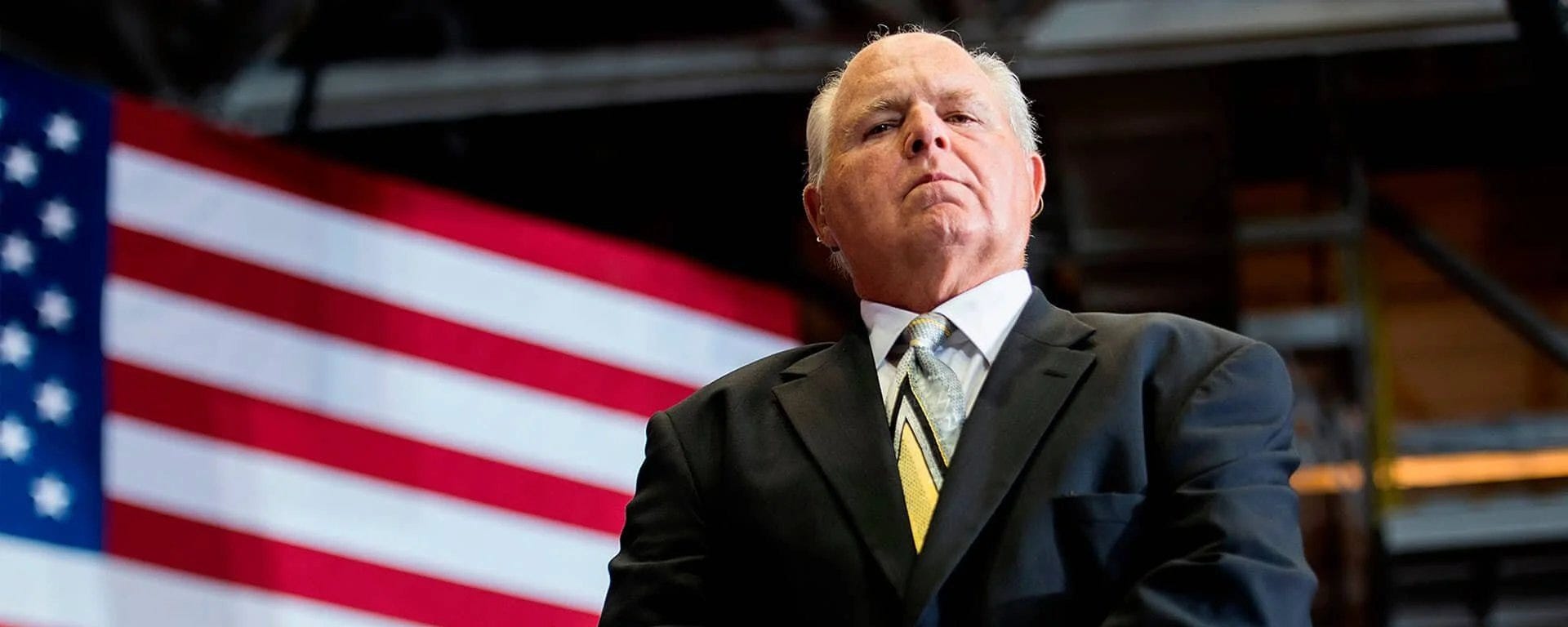
On October 1, 2020, 33 days before a presidential election and a little more than four months before his death, Rush Limbaugh told his audience that the Democratic Party wanted to end elections. Even sympathetic listeners winced. It sounded like the kind of thing a broadcaster says in October. But Rush was making a claim with actual content, and it deserves to be stated carefully, because stated carefully it turns out to be testable. He did not say Democrats would cancel voting days. He said the party had grown weary of elections as such, weary of needing the approval of people it holds in contempt, and that given the means it would go on holding elections while working to make the outcomes independent of persuasion. I wrote a post titled, ‘Rush Limbaugh Was Right: Democrats Want to End Elections’ that the evidence had begun to confirm him. The 2026 midterm season has now supplied something better than evidence. It has supplied the controlled experiment.
Begin with a distinction, because the whole argument turns on it. An election is a procedure by which the consent of the governed is converted into power. Like any procedure, it can fail in two ways. It can be abolished outright, which is rare and obvious, or it can be preserved as ceremony while the conversion mechanism is quietly disconnected, which is common and subtle. Think of a thermostat unhooked from the furnace. The dial still turns, the numbers still display, and the house temperature is decided somewhere else. Rush’s claim, translated out of radio idiom, was that the Democratic Party intended the second kind of failure. A voting day that no longer decides anything is not an election. It is a reenactment of one.
If that claim is true, it generates a prediction. A party that has given up on persuasion should behave in a distinctive way when it finds itself on the wrong side of an overwhelming public consensus. It should decline to change its position, and it should instead move the contest into venues where voters have no say, courts, procedural blockades, and structural rewrites. So we need a test case, an issue where the public consensus is lopsided beyond any possibility of spin. We have one. In October 2024, Gallup published a poll under its own headline, “Americans Endorse Both Early Voting and Voter Verification.” It found that 84% of Americans favor requiring photo identification to vote and 83% favor requiring documentary proof of citizenship from first-time registrants. These are the most lopsided numbers in American politics, higher than support for Social Security. There is no racial, regional, or income group in which requiring voters to be citizens is a fringe view. If the Democratic Party will not yield even here, it will not yield anywhere.
Here is what happened. The SAVE Act passed the House on April 10, 2025, by a vote of 220 to 208, with only 4 Democrats in favor. It died in the Senate without ever receiving 60 votes. The House tried again in February 2026 with the strengthened SAVE America Act, which passed on a nearly perfect party line. Senate Democrats filibustered it in March, and on June 4, 2026, the chamber blocked it 48 to 50. Read that sequence slowly. Four months before a federal election, every Senate Democrat voted to prevent a floor vote on a policy supported by 5 of every 6 Americans. Marc Elias’s outfit, Democracy Docket, called the bill “the most restrictive voting bill ever,” and the restriction being described was proof of citizenship. That phrase is worth keeping, because it tells you what the modern Democratic Party regards as a restriction on voting, namely, the requirement that the voter be a member of the polity doing the voting.
Perhaps Democrats simply believe noncitizen voting is vanishingly rare, so verification is needless friction. The difficulty is that our current system does not measure the thing it is said to disprove. Federal registration runs on an honor system, a checkbox and a signature, and you cannot cite the scarcity of detected fraud under a system designed not to detect it. Where scholars have looked, the picture is less comforting. The Richman and Earnest study out of Old Dominion University, published in the peer-reviewed journal Electoral Studies and summarized by its authors in the Washington Post under the headline “Could non-citizens decide the November election?”, estimated that 6.4% of noncitizens voted in 2008, enough to flip close Senate races. The Heritage Foundation’s election fraud database catalogs more than 1,500 proven cases. One may quibble with any single estimate. One may not claim the question is settled in the direction of “never happens.”
But the deeper reply to the objection is behavioral. If Democrats believed noncitizens were not voting and should not vote, we would not find them passing laws to register noncitizens. We do. In December 2021 the New York City Council enacted Local Law 11, extending municipal voting to roughly 800,000 green-card holders and work-permit residents, a bloc larger than the population of Seattle, added by council vote rather than referendum, in the teeth of a state constitution that says “citizen.” It took a trial court, the Appellate Division, and finally the New York Court of Appeals in March 2025 to kill it, and the party defended it at every step. Washington, D.C. went further, enfranchising any noncitizen, foreign embassy staff included, after 30 days of residency. When the House voted to repeal that law, 52 Democrats defected and the Senate buried the bill. When the House tried again in the 119th Congress with H.R. 884, 148 House Democrats, five sixths of the caucus, voted on the record to preserve foreign-national voting in the capital of the United States. A party does not fight this hard for votes it believes do not exist.
Now consider the enforcement side, where the pattern repeats with the sign reversed. When states verify citizenship themselves, the party sues. Kansas passed documentary proof of citizenship in 2013; the ACLU litigated it to death, and in 2020 the Tenth Circuit held in Fish v. Schwab that the National Voter Registration Act preempts a state’s power to confirm that its own voters are citizens. That ruling is the template now aimed at every SAVE-style state law, and closing that loophole is precisely what the SAVE America Act was for, which is why it had to be filibustered. Arizona’s voters demanded proof of citizenship in 2004 by ballot initiative; twenty years and one Biden DOJ lawsuit later, it took an emergency Supreme Court order in August 2024 merely to let Arizona enforce the requirement on its own state form. Virginia is the cleanest specimen. Governor Youngkin’s administration removed roughly 6,300 self-identified noncitizens from the rolls, the DOJ sued 25 days before the 2024 election, and the Supreme Court had to intervene on October 30 to let the state enforce its own statute. Then Democrats won the governorship in November 2025, and within months Virginia agreed in court to shut the program down before the 2026 midterms, with the Campaign Legal Center announcing victory. What cannot be repealed is sued, and what cannot be sued is simply switched off.
There remains the largest exhibit, the one that answers “no one is proposing to end elections” directly. The National Popular Vote Interstate Compact is a scheme to nullify the Electoral College without amending the Constitution, by binding member states to award their electors to the national popular vote winner. It now includes 17 states plus D.C., holding 209 electoral votes, 61 short of activation, and every single enacting legislature was controlled by Democrats. This is a constitutional amendment executed without the amendment process, which exists precisely because changing the rules of the republic is supposed to require pursuading a supermajority of it. And the destination is no longer whispered. The New York Times editorial board demanded the Electoral College’s abolition in December 2016, the moment its side lost under the rules, and on August 14, 2025, the paper published the full program in its own headline font: “Abolish the Senate. End the Electoral College. Pack the Court. Why the left can’t win without a new Constitution.” Rush was mocked for describing an agenda that the paper of record now prints as a subscription pitch, the prophecy did not merely come true, it got a byline, and the people who called him paranoid in 2020 assign the article in seminars today. Add Molly Ball’s famous 2021 TIME account of the “well-funded cabal of powerful people” working to “change rules and laws” and Elias’s own advertisement that “These 30 cases will determine the future of our elections,” and you have that rarest thing in politics, a confession filed in advance.
Honesty requires one uncomfortable note for my own side. The SAVE America Act did not die by Democratic hands alone. Procedural analysts showed in March that Senate Republicans had tools short of abolishing the filibuster to force the question, and leadership declined to use them, a choice that says something about whom senators actually answer to, and something I have been writing about since June. A supermajority betrayed by one party and unrescued by the other is still betrayed.
John Adams warned in 1814 that democracy “soon wastes, exhausts, and murders itself,” that no democracy yet “did not commit suicide.” He was describing a mechanism, not a mood. Republics are rarely conquered; they are dissolved from within by factions that tire of losing and discover that the forms can be kept while the substance is drained. Franklin’s answer to the lady in Philadelphia, “a republic, if you can keep it,” locates the burden exactly where it belongs, on the keeping. The keeping, in 2026, is unglamorous work: proof of citizenship, an Electoral College left intact, a Senate that still exists. Rush saw the outline of the threat 33 days before an election and four months before his death, and he was laughed at by people who are now, in their own pages and their own roll calls, proving him right. He did not predict a mood. He predicted a program, and the program is running on schedule.
If you enjoy my work, please subscribe https://x.com/amuse/creator-subscriptions/subscribe
Alexander Muse is a Fellow at the John Milton Freedom Foundation and publishes daily political analysis at amuseonx.com. Primary sources cited in this piece are linked inline; campaign finance figures are drawn from FEC filings, polling data from publicly released crosstabs, and legal claims from filed pleadings. Corrections are posted to the original URL with a dated changelog. Readers who identify errors are invited to contact the author directly. Data in sponsored partnership with Polymarket.
You described exactly what the Democrats have been doing at great expense for the last 15 years minimum. They decry ‘democracy’ when in fact they yearn for mob rule. We are a Constitutional Republic the Democrat party is trying to destroy. Lawfare, protests, and violence are their means.
The Republic had a heart attack when Rush passed. We believed the republicans would take up the mantle of protection but we were sorely wrong. I miss Rush every day and hate Thune more every day.