


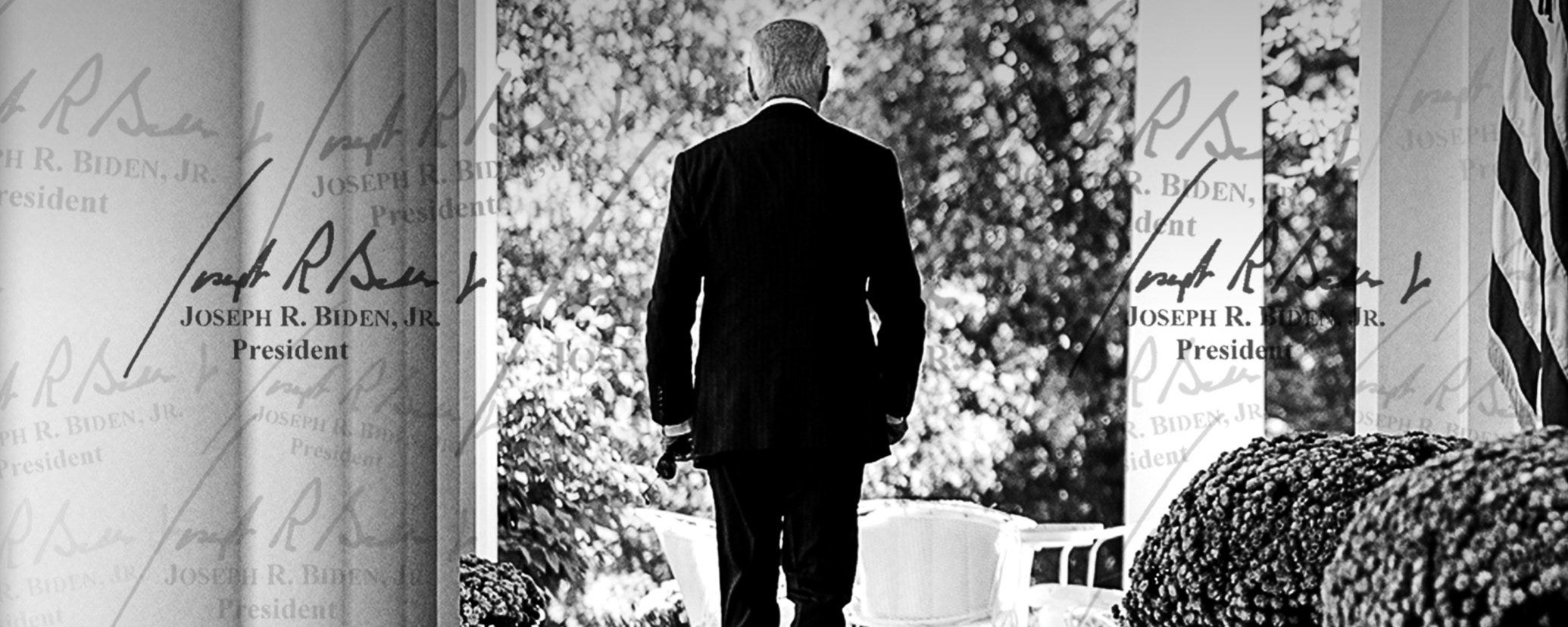
The question before the nation is deceptively simple yet constitutionally profound: can the president of the United States delegate his own will to a machine? The House Oversight Committee, under Chairman James Comer, has determined that President Biden’s use of the autopen, a mechanical device employed by staff to replicate his signature, in the absence of direct, contemporaneous authorization renders those executive actions legally void. Far from a partisan flourish, this determination upholds the foundational logic of constitutional government: that executive power must flow from the deliberate, conscious act of the elected president himself.
Every executive order, pardon, or proclamation carries the force of law only because it represents the president’s own act of decision. The Framers understood this link between consent and command as the essence of executive accountability. The president may consult, deliberate, or delegate preparation of documents, but he alone must decide and affirm. His signature is not a mere formality; it is the constitutional manifestation of his will. To remove the president’s mind from the moment of authorization is to sever the act from its legitimacy.
Consider an analogy from ordinary life. A dying man’s will is valid only if he signed it with knowledge of its contents and the capacity to understand them. If his nurse traced his signature while he slept, no court in the country would enforce the document, no matter how closely the forgery resembled his hand. The reason is not technical. It is that a signature has meaning only as evidence of a deciding mind. What is true of a private testament is true, with far greater force, of the instruments of state.
This is precisely what the Oversight Committee’s investigation has revealed. In case after case, Biden’s aides employed an autopen to sign executive actions without any documented, written, or digital evidence showing the president’s contemporaneous consent. No secure log of approvals, no voice confirmation, no physical presence. The White House’s own counsel could not demonstrate that the president had even been briefed before some of these documents were executed. Such practices do not merely stretch the boundaries of legality, they obliterate them.
The Constitution’s Article II vests “the executive Power” in the president, not in his aides, surrogates, or a pen operated by staff. The personal nature of this power is reinforced by the presidential oath, in which the president swears to “faithfully execute the Office of President.” That oath binds the office to the individual. No device can stand in for deliberation, and no staffer can channel another man’s judgment. When the act of execution becomes automated, government itself slides toward automation, unaccountable, impersonal, and dangerously opaque.
The historical record affirms this principle. When President Eisenhower used the autopen in the 1950s to sign routine correspondence, his aides were careful to distinguish ceremonial use from any act bearing legal or constitutional weight. In modern times, presidents occasionally permitted the autopen for ceremonial signatures on nonbinding letters, never for official orders of state. The Obama administration’s 2011 legal opinion authorizing autopen use for a debt ceiling bill was narrowly framed, contingent upon explicit, contemporaneous presidential direction. By contrast, what the Biden White House engaged in, staff-directed autopen executions without traceable consent, was something qualitatively different: the mechanical exercise of executive authority divorced from presidential agency.
Critics will argue that such acts were necessary accommodations for a declining president, an administrative adaptation to incapacity. But the Constitution offers no such flexibility. The 25th Amendment exists precisely to address presidential inability. It provides a lawful process for temporary or permanent transfer of power. To bypass that safeguard and quietly mechanize the presidency is to commit an institutional deception of the highest order. It shields incapacity rather than confronting it, converting what should be a constitutional question into a bureaucratic convenience.
Supporters of the autopen system sometimes invoke efficiency, suggesting that the modern presidency requires delegation to function. Yet efficiency is not a constitutional value. Legitimacy is. The Founders designed the presidency as a singular office precisely because unity ensures accountability. The same principle undergirds the separation of powers: every act must be traceable to the officer constitutionally empowered to perform it. When the legislative branch passes a law, it must vote. When the judiciary issues a ruling, a judge must sign it. When the president acts, he must personally decide and affirm. Anything less violates the symmetry of the republic. Scholars at the Heritage Foundation have made this point for decades in their critiques of the administrative state: power that cannot be traced to an accountable, elected officer is power the Constitution does not recognize. The autopen scandal is that critique rendered in hardware.
The Oversight Committee’s findings further underscore how far the Biden administration drifted from this model. Testimony revealed that White House staff routinely substituted the president’s direct consent with inferred authorization, citing his “general intent” or prior statements. In some cases, the president was reportedly asleep or under medical supervision when orders were executed in his name. The result was not the exercise of executive power but its simulation, an empty ritual of signature without sovereign will.
The danger of such substitution is not theoretical. If executive authority can be reduced to mechanical reproduction, then any actor within the bureaucracy can claim its mantle. The presidency itself becomes disembodied, a procedural fiction detached from consent. A republic cannot endure under such conditions. Consent must be contemporaneous and demonstrable, not presumed or automated.
Some defenders have appealed to past precedent, noting that previous presidents occasionally allowed aides to apply the autopen. But precedent is meaningful only when the underlying principle is preserved. In this case, the principle has been inverted. Instead of using the device as an extension of presidential intent, Biden’s staff used it as a replacement for that intent. The distinction is decisive. A president who personally approves an act and directs its mechanical execution still acts as president; one who does not, and whose staff proceeds without evidence of consent, is bypassed entirely.
The Oversight Committee is therefore right to declare such actions null and void. In constitutional terms, they never existed. A signature not authorized by the president himself is not a presidential act, and no amount of administrative rationalization can make it so. Executive authority cannot be retroactively inferred, just as a contract cannot be validated by post hoc assumption of consent. The acts must fail because they were never lawfully performed.
The implications reach beyond this administration. Congress must now articulate clear statutory limits on mechanical or digital execution of executive authority. Future presidents, regardless of party, must ensure that any autopen or digital-signature process includes verified, contemporaneous presidential authorization logged in a secure and auditable format. Without this safeguard, the very concept of presidential responsibility dissolves. The technology will only grow more capable. A signature machine is crude compared to what synthetic voice and video will soon permit, and if the law does not draw the line at the autopen, it will find no principled place to draw it later.
This episode also reminds us of the importance of courage in governance. It is tempting, in moments of political crisis, to conceal frailty behind procedure. But constitutional republics depend on transparency, not pretense. If a president cannot perform his duties, the law provides remedies. To pretend otherwise is to erode the legitimacy of every branch.
In voiding these autopen actions, Congress reaffirms not merely its oversight role but the moral architecture of the Constitution itself. The presidency is not a brand, a bureaucratic label, or a mechanical process. It is a human office that requires deliberation, intent, and accountability. The Constitution’s authors, wary of kings and cabals alike, entrusted its powers to a single, mortal mind. If that mind falters, the office must either rest or transfer, not replicate itself through machines.
Congress’s decision to declare Biden’s autopen orders void is not an act of defiance but one of preservation. It preserves the principle that power derives from consent, that the signature of the president must be the mark of a conscious, living agent, not a facsimile produced in his absence. In defending that principle, Congress defends the republic.
If you enjoy my work, please subscribe https://x.com/amuse/creator-subscriptions/subscribe
Alexander Muse is a Fellow at the John Milton Freedom Foundation and publishes daily political analysis at amuseonx.com. Primary sources cited in this piece are linked inline; campaign finance figures are drawn from FEC filings, polling data from publicly released crosstabs, and legal claims from filed pleadings. Corrections are posted to the original URL with a dated changelog. Readers who identify errors are invited to contact the author directly. Data in sponsored partnership with Polymarket.
Obama said he used the autopen everytime he was on vacation. Were things signed without his knowledge? The fact that he has used a stolen SSN for forty years means everything he signed as president was illegal. It still matters because there are still laws in effect that he signed.
Elections have consequences, stolen elections have catastrophic consequences.
So many wrongs needing to be righted. Fortunately we have a man in office that seldom sleeps.