


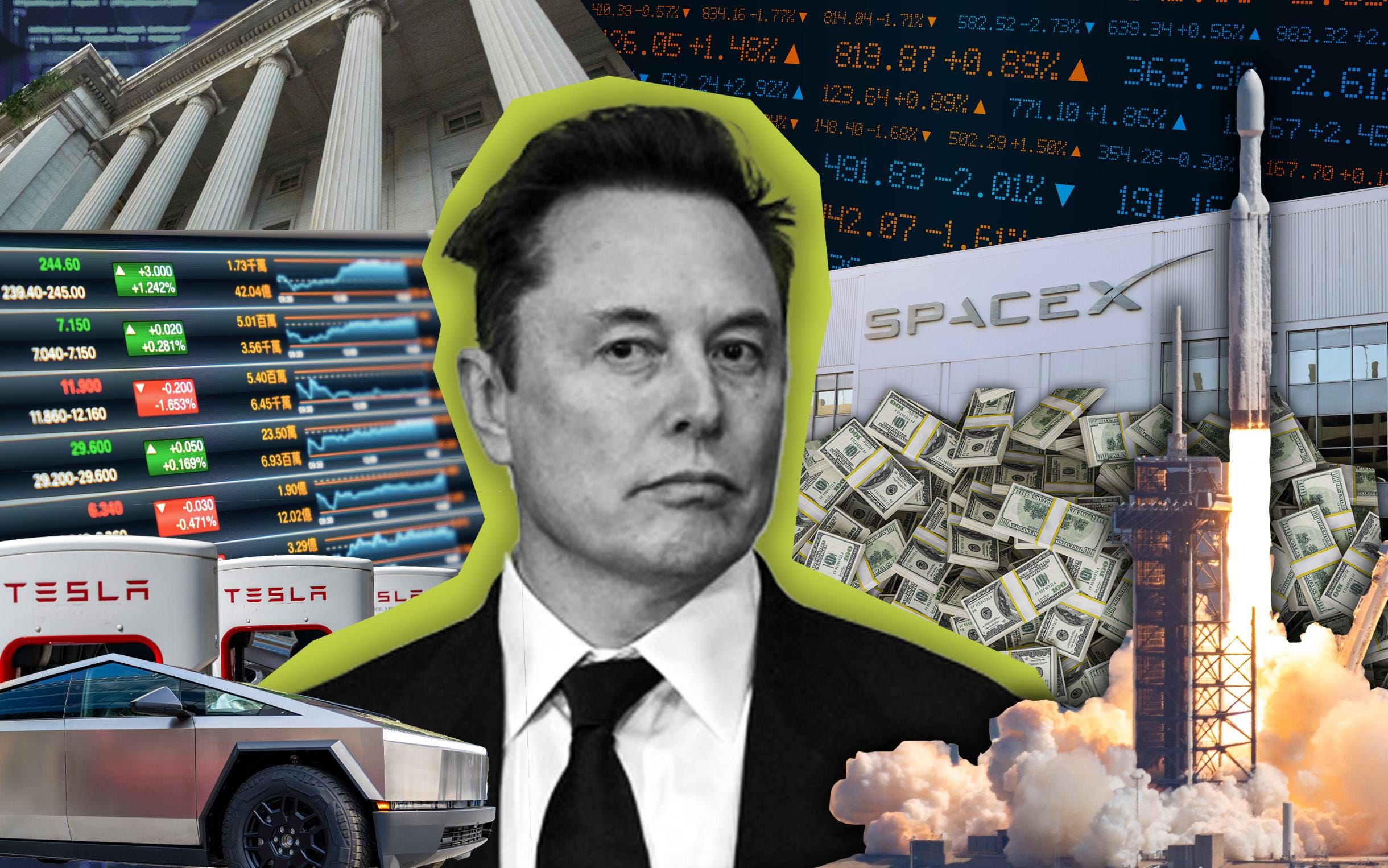
There is a claim buried inside every proposal to tax a great fortune out of existence, and it is rarely stated out loud. The claim is that the people who run the government could put that money to better use than the person who earned it. This is usually dressed as a moral assertion, a matter of fairness, but at its core it is an empirical one. It says, in effect, hand us the capital and we will produce more value with it than its owner ever could. The lovely thing about an empirical claim is that it can be tested. We do not have to settle it in the abstract. We can look at what the state actually builds when it controls billions, set it beside what a private builder actually builds when he controls billions, and then compare the result. We can place the wreckage next to the rocket and let the reader decide.
California has handed us the cleanest test imaginable, and it did so almost by accident. In 1996 the state created the California High-Speed Rail Authority and charged it with linking the state by fast train. Six years later, in 2002, a man named Elon Musk founded a small rocket company called SpaceX. Hold those two dates in mind, because the six-year gap matters. The public agency had a head start. It was older, it was backed by the full faith and taxing power of the largest state economy in the country, and it was promised a river of money that would eventually swell beyond anything the rocket company ever raised. By every measure that bureaucrats use to predict success, the train should have been running long before the rocket reached orbit.
Now look at what each one did with its years. SpaceX raised roughly $12 billion in private capital across its entire history, money that investors handed over voluntarily, knowing they would lose all of it if the company failed. With that sum it built the first orbital-class rocket that could land itself and fly again, landing a booster in December 2015 and reflying a used one in 2017. It carried NASA astronauts to the International Space Station beginning in 2020. It flew a launch cadence that reached 138 orbital flights in a single year. It drove the cost of reaching orbit down by something like 65% to 70%, delivering payload at roughly $3,000 per kilogram against the Space Shuttle era’s $54,500. In June 2026 it went public, raised about $75 billion in one of the largest offerings in history, and saw its market value climb to roughly $2.5 trillion, the sixth most valuable public company on earth. That is what $12 billion of privately allocated capital produced.
Set against this the record of the train. Voters were sold Proposition 1A in 2008 on a specific promise, an 800-mile system carrying passengers between San Francisco and Los Angeles in two hours and forty minutes, for a total cost of $33 billion, with service beginning in 2020. The 2020 deadline passed with nothing to ride. The price estimate climbed past $77 billion, then $80 billion, then $128 billion, and the Authority’s own 2026 business plan now contemplates a figure as high as $231 billion for the full build. The scope, meanwhile, collapsed in the opposite direction, shrinking from a statewide network to a single 171-mile segment between Merced and Bakersfield, with interim service now hoped for somewhere between 2030 and 2033. After roughly three decades and more than $13 billion spent, the number of miles of high-speed track carrying paying passengers stands at zero. The US Senate Commerce Committee put the matter in a headline that needs no commentary, observing that after 25 years and billions in federal subsidies, not a single train is operating in California.
I want to be precise about the arithmetic, because the comparison is even more lopsided than it first appears. The $231 billion the state may spend is 19 times the $12 billion that built SpaceX, which is to say nearly 1,900% more capital. Even the Authority’s preferred, friendlier figure of $126 billion for the first phase is more than ten times the rocket company’s entire lifetime funding. So the empirical claim that animates the confiscation crowd, the claim that the state spends better, fails its own test by a factor of ten or twenty. One side took a small pool of private money and built a fleet of reusable rockets, a space based internet constillation, and the beginnings of a Mars program. The other side took a far larger pool of public money and built viaducts in a valley and a procession of revised business plans. There is no metric, not cost, not schedule, not output, not capability, on which the bureaucracy wins.
A puzzled reader might ask why this should be. Are the engineers at SpaceX simply smarter than the engineers in Sacramento? That is not the explanation, and assuming it is misses the real lesson. The difference is structural, and it concerns accountability. SpaceX answers to three merciless judges, namely investors who can withdraw their money, customers who can buy launches elsewhere, and the laws of physics, which do not negotiate. Each of those judges punishes failure immediately and visibly. When a Falcon rocket exploded, the company found the flaw and fixed it within months, because the people responsible bore the cost of being wrong and reaped the reward of being right. The Rail Authority answers to none of these. It cannot go bankrupt. Its customers cannot defect, because there are no customers. Its managers draw their salaries whether the train runs or not. Thomas Sowell described the mechanism better than I can, observing that it is hard to imagine a more dangerous way of making decisions than by putting them in the hands of people who pay no price for being wrong. That is the Authority in one sentence. It never stops failing precisely because failure costs the deciders nothing.
This is not a new discovery, and it is not unique to trains. Milton Friedman warned that if you put the federal government in charge of the Sahara Desert, within five years there would be a shortage of sand, and the $33 billion train that became a $231 billion non-train is simply that joke rendered in concrete. Ronald Reagan reduced the whole problem to nine words he called the most terrifying in the language, I'm from the government, and I'm here to help. The genius of these lines is that they identify a pattern rather than a personality. The pattern does not depend on which party holds Sacramento or which contractor holds the bid. It depends on whether the person spending the money suffers when the money is wasted.
History sharpens the point, because Americans did not always build this way. In the 1860s two private companies laid 1,776 miles of railroad across deserts and over the Sierra Nevada in roughly six years, armed with black powder, hand tools, and mules, meeting at Promontory Summit in 1869. In 1930 private developers raised the Empire State Building, 102 stories, in just 410 days, finishing ahead of schedule and under budget as the Depression closed in. The country that performed those feats is the same country whose largest state cannot now connect two of its cities by rail across three decades unless, as it happens, a private citizen does the building instead. The clearest parable arrived in 2024, when two NASA astronauts rode Boeing's Starliner to the space station on a mission meant to last eight days, only to be stranded for 286 days when the legacy contractor's capsule proved unsafe to bring them home. It was SpaceX, the upstart, that flew them back in March 2025. When the old incumbent failed and left Americans stranded in orbit, the accountable private firm went and got them. Swap the names and you have the whole argument about who should be trusted with capital.
Which brings us to the confiscation itself, and to why it would be not merely unwise but something closer to a moral inversion. The proposal on offer is to take tens of billions of dollars from the man who built the rockets and hand it to the political class that built the ghost train. Phrase it that way and its absurdity is plain. It is unwise, because it would transfer capital from the highest-returning use yet observed in American industry to demonstrably among the lowest. It is wasteful, because we have watched in real time what this political class does with money it did not earn. It is unfair, because it punishes the steward who delivered and rewards the steward who did not. And it is fundamentally un-American, because the country was founded on the conviction that what a man builds is his, and that the state is a trustee of the public’s money rather than the owner of the public’s labor. Stewardship of other people’s money is a genuine moral duty, and the people now eyeing Elon Musk’s fortune are precisely the people who violated that duty when they extracted billions from California taxpayers under a specific promise and delivered them nothing. A class that cannot be trusted with $13 billion it already had should not be handed $13 billion more, still less the far larger sum it covets from 𝕏’s owner.
The deepest reason to oppose the seizure is therefore not that Musk is admirable, though by the measure of what he has produced he plainly is. The reason is that the comparison answers the only question that matters. The confiscators say they can spend the money better. The evidence says they spend it on PowerPoint and pour the rest into the dirt. A man will very likely set foot on Mars before a Californian can board a high-speed train from Los Angeles to San Francisco, and when that day comes, the contrast will no longer be an argument. It will be a verdict.
If you enjoy my work, please subscribe https://x.com/amuse/creator-subscriptions/subscribe
Alexander Muse is a Fellow at the John Milton Freedom Foundation and publishes daily political analysis at amuseonx.com. Primary sources cited in this piece are linked inline; campaign finance figures are drawn from FEC filings, polling data from publicly released crosstabs, and legal claims from filed pleadings. Corrections are posted to the original URL with a dated changelog. Readers who identify errors are invited to contact the author directly.
"Thomas Sowell described the mechanism better than I can, observing that it is hard to imagine a more dangerous way of making decisions than by putting them in the hands of people who pay no price for being wrong." Nothing like common sense thinking.
Did the bullet-train designers have anything to do with the Obama monstrosity that went from $350 million to $850 million? They do share the same politics.
Musk is a genius who has done more for the world than any other person.
Government can only spend. Government never produces. Government has wasted our nation into an unnecessary deficit. Government deserves less funds; never give politicians more funds to hand out with no accountability or consequences. Government needs to be cut from so many levels and manage only our defense and security.