
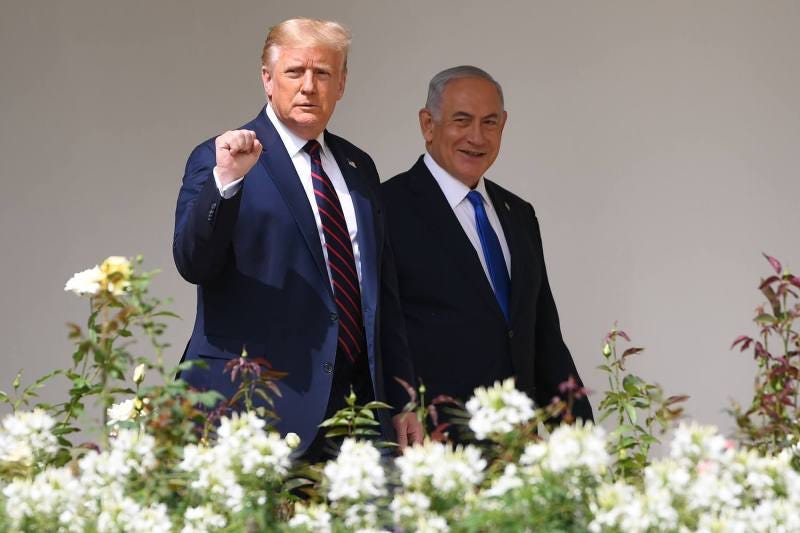
Tariffs, Tehran, and Tenacity: Netanyahu's Calculated Visit to Trump’s Washington
Prime Minister Benjamin Netanyahu arrived in Washington not as a supplicant, but as a sovereign navigating treacherous currents. His flight from Hungary, a nation that, just days prior, declared its withdrawal from the International Criminal Court, was no mere geographic shift but a movement across axes of power, principle, and political alignment. In Budapest, he embraced a fellow national conservative government; in Washington, he sought clarity and concession from a resurgent administration intent on redrawing the terms of global commerce and statecraft.
Netanyahu's reception in the American capital was immediate and intensive. He met first not with President Trump, but with two key figures in the architecture of U.S. economic policy: Commerce Secretary Howard Lutnick and U.S. Trade Representative Jameson Greer. The topic was urgent, and so was the tone. Just days earlier, President Trump announced a sweeping 17% tariff on Israeli goods, an action framed by the White House as a recalibration of trade imbalances but received in Jerusalem as a geopolitical jolt. It is a mark of Netanyahu's statecraft that he did not denounce the measure. Instead, he did what seasoned strategists do: he arrived early, talked late, and listened closely.
Was Israel singled out? Not necessarily. Trump's second term, inaugurated amidst promises to dismantle globalist entanglements and restore what he calls "reciprocal trade," has launched a wave of policy changes unbound by the courtesies of multilateralism. If America is now, once again, the world's indispensable nation, Trump seems intent on making its dispensations conditional.
The fact that Netanyahu was the first foreign leader to land in Washington in response to the new tariff regime is not accidental. It is symbolic, and it is strategic. It marks the durability of the U.S.–Israel relationship, even amid friction. And it suggests that Netanyahu, now the longest-serving Prime Minister in Israeli history, remains one of the few world leaders able to navigate the shifting geometries of Trump-era diplomacy.
Much has changed since Trump’s first presidency. The global order has thinned. American foreign policy, once sprawling and abstract, has coalesced into a tighter, bolder doctrine: transactional realism. Netanyahu understands this instinctively. Indeed, few statesmen have profited more from the reassertion of national interest as the organizing principle of international relations. And so, rather than contest the logic of tariffs, he seeks accommodation within them.
Last Tuesday, Israel responded by announcing the cancellation of its remaining tariffs on U.S. imports. It was a deft countermove, symbolic de-escalation designed to leave room for substantive dialogue. That decision, framed as both pragmatic and principled, underscores the extent to which Israel values its access to the American market, and its relationship with the man who currently occupies the White House.
But trade, though urgent, is not the sole item on today’s docket. At 1:00 PM Eastern, Netanyahu will meet with President Trump in the Oval Office for their second bilateral since January’s inauguration. What follows is a cascade of consequential topics: the Iranian nuclear program, with its persistent defiance and subterranean progress; the situation in Gaza, where hostages remain in limbo and ceasefires are as fragile as spun glass; the Syrian frontier, now a contested realm of Russian leverage and Iranian ambition; and the reemergence of Israel–Turkey tensions, rekindled under Erdoğan’s increasingly revisionist regime.
To approach any one of these subjects requires a robust grasp of power not only in its kinetic forms, military might, economic sanctions, but in its more elusive expressions: deterrence, alliance, and perception. Netanyahu brings to the table both the weight of Israeli sovereignty and the scars of having navigated successive American presidencies, from Clinton through Biden. Trump brings something different, and in some ways more formidable: the authority of democratic re-legitimation. His reelection in 2024, whatever its controversies, was certified, affirmed, and consequential. He is not a caretaker but a crusader.
Some will ask: is this meeting merely ceremonial, or does it portend genuine policy shifts? The answer lies in the structure of the meeting itself. The timing is tight, the agenda substantive, and the press conference scheduled for 2:30 PM signals intent. This is not diplomatic theater. It is a working summit. Netanyahu’s presence implies urgency.
The issue of Iran will likely dominate. For both Trump and Netanyahu, Tehran is not merely a rogue actor but a civilizational adversary. Their past efforts, withdrawals from the JCPOA, covert strikes, cyber operations, have imposed costs on the regime. But Iran remains defiant, enriched, and emboldened. The prospect of a nuclear threshold state, aligned with both Russia and China, transforms the old containment doctrines into obsolete abstractions. Netanyahu, ever the Cassandra of Israeli security, will argue not for patience but for preemption. Whether Trump concurs remains to be seen.
And then there is Gaza, the ever-bleeding wound. Hostage diplomacy, an oxymoron that has become policy, is now a lever in Hamas’s arsenal. But the political costs of inaction are mounting in Israel. Netanyahu will press for enhanced U.S. support, both overt and covert, in dismantling the tunnels, disrupting the financing, and accelerating intelligence sharing. Trump, whose disdain for endless wars remains intact, may offer technical support but with clear red lines against reengagement.
In the background looms the unspoken: China. While not on the official agenda, the specter of Chinese influence in the Middle East, through infrastructure, telecom, and soft-power initiatives, cannot be ignored. The U.S.–Israel alliance, to remain vital, must navigate these new vectors without lapsing into dependence or antagonism.
Israel–Turkey relations offer another crucible. Erdoğan’s increasingly Islamist posture has strained ties. For Israel, Turkey is a neighbor with NATO status and Ottoman ambitions. For Trump, it is a reminder of the limits of alliance when values diverge. Netanyahu may seek U.S. backing in drawing firmer lines; Trump may prefer ambiguity as leverage. Here, as elsewhere, clarity costs.
By Monday night, Netanyahu will depart Washington. But the implications of his visit will linger. What was once called a special relationship is now a strategic conditionality. Neither ally takes the other for granted. That is not weakness; it is maturity.
Netanyahu’s journey, bookended by Hungary’s ICC exit and Washington’s tariff gambit, illustrates a world in which national interest is the grammar of diplomacy and sovereignty the logic of engagement. Whether this results in harmony or hegemony remains an open question.
But what is clear is this: the age of automatic alliance is over. What replaces it, perhaps paradoxically, is something more stable, more honest, and possibly more enduring: alliance by choice, not inheritance. That may be the most consequential outcome of Netanyahu’s Washington sojourn.
If you don't already please follow @amuse on 𝕏.


