


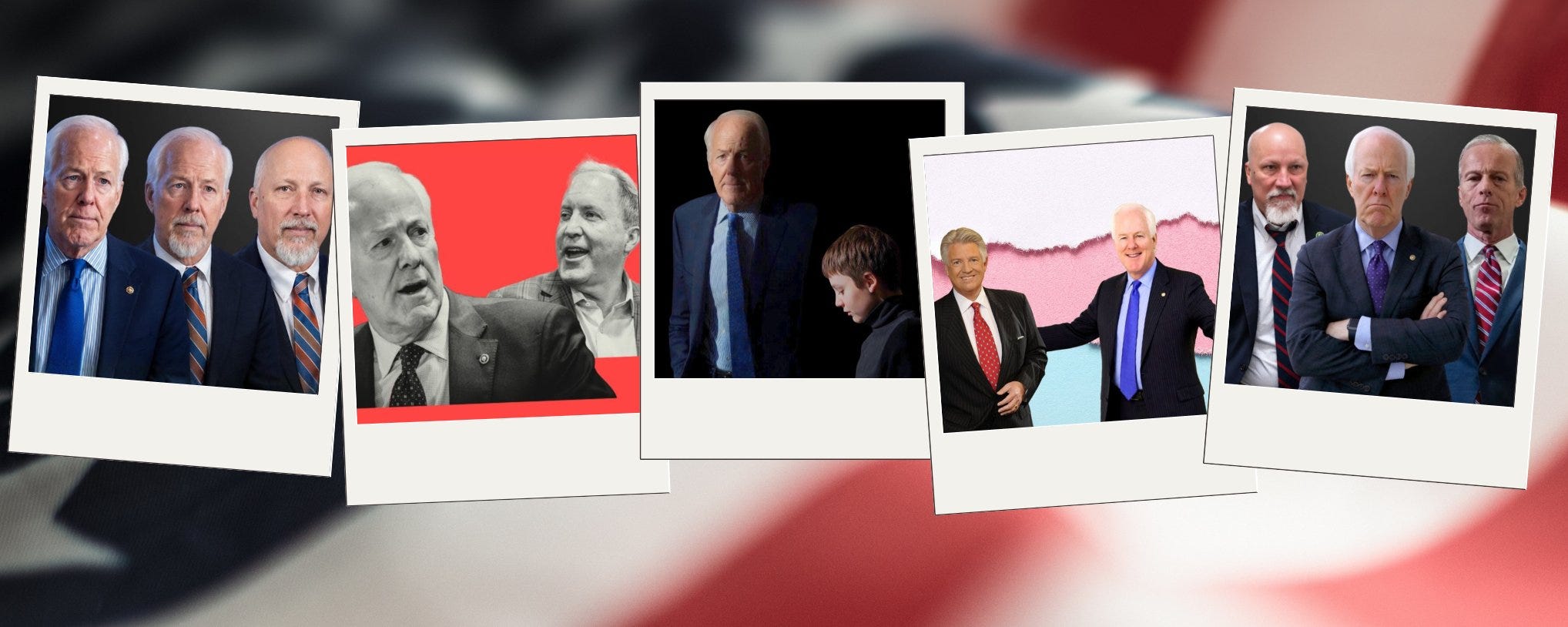
Early voting in the Texas Senate runoff is this week, and the choice before Republican primary voters has clarified itself with unusual precision. On one side stands Attorney General Ken Paxton, endorsed by President Trump, leading in every poll and prediction market, and running a campaign that has converted small dollar enthusiasm into actual votes at a fraction of his opponent’s cost per ballot. On the other side stands Senator John Cornyn, a four term incumbent whose record over 24 years now sits in plain view, examined episode by episode, and whose closing weeks have produced conduct so revealing that even sympathetic observers struggle to defend it. Over the past several months I have published eight detailed pieces tracing this record. Each focused on a specific episode. Each, taken alone, might be defended as a hard case. Taken together they describe a pattern, and the pattern is what matters.
Skeptics will reasonably ask whether a senior senator should be discarded over a sequence of votes and tactical choices. The answer requires looking at the cases in sequence, because each one builds on the last. The first concerns leverage, and specifically the question of whether Senator Cornyn possesses the influence inside the Senate Republican conference he has long claimed to possess.

In Paxton’s Bear Trap: A Simple Challenge for Senator Cornyn, I described what Paxton presented as a simple challenge. Paxton offered to consider withdrawing from the runoff if Cornyn and Senate Leader John Thune passed the SAVE America Act, the election integrity legislation already sitting on the leader’s desk with 50 Republican co sponsors. The mechanism was a talking filibuster, the older and more demanding method of overcoming Democratic obstruction, which President Trump has repeatedly urged the conference to attempt. The bear trap analogy fits the situation cleanly. If Cornyn and Thune refuse the work, they confirm Paxton’s argument that Senate leadership prefers comfort to confrontation. If they suddenly find the will to do the work, they confirm that the capacity existed all along and was simply withheld until a Senate seat was at stake. Either path damages the incumbent.
The second case examines whether Cornyn could, if he chose, deliver that bill. In Senator Cornyn Has the Power to Pass the Save America Act, Why Won't He Use It?, I traced the architecture of the senator's fundraising operation, which by recent reporting has raised nearly $500 million for Republican colleagues over the course of his career, including more than $7 million in the final months of 2025 alone. The Cornyn Victory Committee, his joint fundraising vehicles, and his role as former NRSC chairman from 2009 to 2013 have produced a network of obligations across the Republican conference. Only four Republican senators have told Thune they will not force the talking filibuster on the SAVE Act. A senator who has spent two decades accumulating goodwill of that magnitude should be able to sit down with four colleagues and produce 51 votes. If he cannot, the most expensive political capital in the modern Senate Republican conference belongs to a man who will not spend it.
The third case turns to the matter of secrecy and the Office of Congressional Workplace Rights settlement system. In Does Congress’s So-Called Sexual Harassment Slush Fund Name Senator Cornyn?, I addressed reports circulating in Washington that Senator Cornyn used the OCWR process to resolve a sexual misconduct complaint from a male staffer. The rumor may be false. The records remain hidden. Of the 260 OCWR settlements paid since 1997, only 13 involved sexual harassment or sex discrimination, totaling roughly $292,652. The House had an opportunity in March 2026 to pass H.R. 1100 and disclose basic descriptive information about those 13 cases, names of staffers redacted, and the chamber instead voted 357 to 65 to refer the resolution to the Ethics Committee. The senator could end the speculation about his own offices in a single afternoon by authorizing the OCWR to release any settlements connected to him with staffer names redacted. He has not done so. A man with nothing to disclose has a simple option available to him, and his refusal to exercise it is itself a piece of evidence.
The fourth case offers a direct contrast in the use of office. In Cornyn Passed Through the Texas AG Office, Paxton Turned It Into a National Powerhouse, I compared Cornyn’s four year tenure as Texas Attorney General, which produced no defining accomplishment that Texans can readily name, with Paxton’s eleven year tenure, which produced over $5.1 billion in recoveries for Texas taxpayers, including a $1.4 billion Meta settlement and a $1.375 billion Google settlement. Paxton filed roughly 106 lawsuits against the Biden administration and won more than three quarters of them. He shut down DAPA, forced the legal fights over Remain in Mexico and DACA, and helped block the OSHA vaccine mandate at the Supreme Court. Cornyn passed through the office on his way to the Senate. Paxton turned the office into the largest Republican law firm in the country and, for the first time in its history, a net revenue generator for the state. Texas needs a general on the battlefield in Washington, not another senator passing through.
The fifth and sixth cases concern what happened when Cornyn's campaign attempted to manufacture religious legitimacy among Texas conservatives. In A Pastor, a Hit Piece, and an Open-Borders Network: The Cornyn Campaign's Faith Team Exposed, I documented the campaign's amplification of a Baptist News Global article by Mark Wingfield headlined "Paxton's pastor joins faith team for Cornyn." The headline was false. Paxton has not attended Prestonwood Baptist Church in eight years and has not spoken with Jack Graham in roughly the same period. The article's claim that Paxton was implicated in a Servergy related investment matter conflated Paxton with Rep. Byron Cook and Joel Hochberg, the men who actually defrauded Prestonwood's executive pastor Mike Buster of approximately $500,000 in a mineral rights scheme entirely unrelated to Paxton. Worse, every charge against Paxton in the decade long Servergy lawfare was dismissed with prejudice on June 18, 2025, a fact the article omitted entirely. The recruited faith team, including Jack Graham, Max Lucado, and Robert Reyes, share signatures on the National Immigration Forum's amnesty advocacy framework, an organization funded by George Soros's Open Society Foundation, which is the actual reason Paxton left Prestonwood eight years ago.
In Exclusive: Prestonwood Baptist Source Destroys Every Claim in Cornyn's Pastor Hit Piece, I reported on what happened next. A deacon of Prestonwood Baptist Church, with direct institutional knowledge and corroborated by members of Paxton's own team, confirmed five propositions. The Baptist News Global article misrepresented the facts. Paxton is not currently a member of Prestonwood and has not been for at least eight years. Paxton had no involvement whatsoever in the investment matter referenced in the article. Dr. Jack Graham has not endorsed Senator Cornyn and does not intend to do so. Dr. Jack Graham is not a member of any spiritual advisory team organized by or affiliated with the Cornyn campaign. The entire headline described a fiction. The campaign's response was not retraction but silence. A campaign willing to conscript a megachurch pastor's name without consent, in service of a manufactured endorsement, has revealed something about its standards that no amount of subsequent messaging can repair.
The seventh case is, of all eight, the one that should follow Senator Cornyn for the rest of his career. In John Cornyn’s Cruelty: Re-Victimizing a Child to Score Political Points Against Ken Paxton, I described the senator’s decision to attack the Texas Attorney General’s office over the plea agreement reached in the prosecution of Waco lawyer Adam Hoffman, who sexually abused a 10 year old boy over a period of years. The first trial produced a hung jury after defense counsel walked the frightened child through the inevitable inconsistencies a traumatized 10 year old produces under cross examination. The family, supported by 30 year prosecutor Brenda Kaye Marmolejo Cantu, declined to subject their son to a second cross examination. The plea ended with Hoffman pleading guilty, serving 60 days after Visiting Judge Roy Sparkman doubled the original sentence, surrendering his law license, and barred from contacting the victim. The empirical literature on retraumatization, including Goodman et al. (1992), Quas et al. (2005), and the work of Henry, Runyan, Holmes and Slap, Romano and De Luca, and Dube and colleagues, is unanimous on the harm that multiple testimony, face to face confrontation, and harsh cross examination inflict on child sexual assault victims. The ABA Criminal Justice Standards, the National District Attorneys Association’s prosecution standards, the Crime Victims’ Rights Act, and Maryland v. Craig all exist precisely to prevent prosecutors from doing what Cornyn now demands. The senator is asking, in operational terms, that a child be subpoenaed and threatened with civil contempt until he agrees to face his abuser a second time. He is doing so to attack Paxton in a runoff he is losing. The mother of the boy is now reading commentators argue that her decision to protect her son makes her complicit in future crimes. That is the choice Senator Cornyn has made. It is the easiest moral question in the entire runoff, and he has answered it himself.
The eighth case turns from Cornyn to the staffer who helped author his record. In Chip Roy’s Nine-Year Cornyn Career Is the Record He Refuses to Defend, I traced Chip Roy’s nine year tenure as Cornyn’s senior Judiciary counsel from 2003 to 2007, staff director from 2007 to 2009, and chief of staff from 2012 to 2014. Roy was the senior committee counsel of record when Cornyn co authored the Cornyn-Kyl back door legalization bill in 2005, when Cornyn voted cloture on the Specter-Hagel-Martinez expansion of chain migration in 2006, when Cornyn helped negotiate the 2007 Bush-McCain-Kennedy amnesty, and when the Refugee Crisis in Iraq Act of 2007 began the mass resettlement template later applied to Afghanistan and Syria. Roy was staff director when Cornyn voted for TARP in October 2008 and when his office advocated H-1B expansion during the worst job losses in a generation. He was chief of staff when Cornyn cast both procedural votes that gave the Schumer-Rubio-McCain Gang of Eight amnesty its path to passage in June 2013. A man who spent nine years inside the office building the record now sits in the House posturing as the scourge of squishy Republicans, and is now running for Texas Attorney General. Records belong to the people who write them.
The cumulative case is not that Senator Cornyn is a bad man. The cumulative case is that his record on leverage, on disclosure, on the use of office, on religious manipulation, on the welfare of a Texas child, and on the staff he chose and trained describes a senator whose loyalties have drifted away from the voters who elected him. President Trump’s endorsement of Ken Paxton was not a casual gesture. It reflected an assessment Texas Republican primary voters have now reached on their own. The runoff is May 26, 2026. Early voting is this week. Eight articles, eight episodes, one verdict.
If you enjoy my work, please subscribe https://x.com/amuse/creator-subscriptions/subscribe
Alexander Muse is a Fellow at the John Milton Freedom Foundation and publishes daily political analysis at amuseonx.com. Primary sources cited in this piece are linked inline; campaign finance figures are drawn from FEC filings, polling data from publicly released crosstabs, and legal claims from filed pleadings. Corrections are posted to the original URL with a dated changelog. Readers who identify errors are invited to contact the author directly.
It seems that a RINO has been sniffed out here … John Cornyn a Senator who at best has a checkered past . What convinces me that he’s not worthy of a vote is his ATTEMPT TO RE- TRAUMATIZE A 10 YEAR OLD CHILD ! This boy may never have a good day again and Cornyn wants to take that away ! VOTE FOR KEN PAXTON !
Excellent summary of Cornyn’s horrible performance. I’m voting for Paxton again and also voting for Middleton to kick out Chip Roy’s chance as TX AG.