


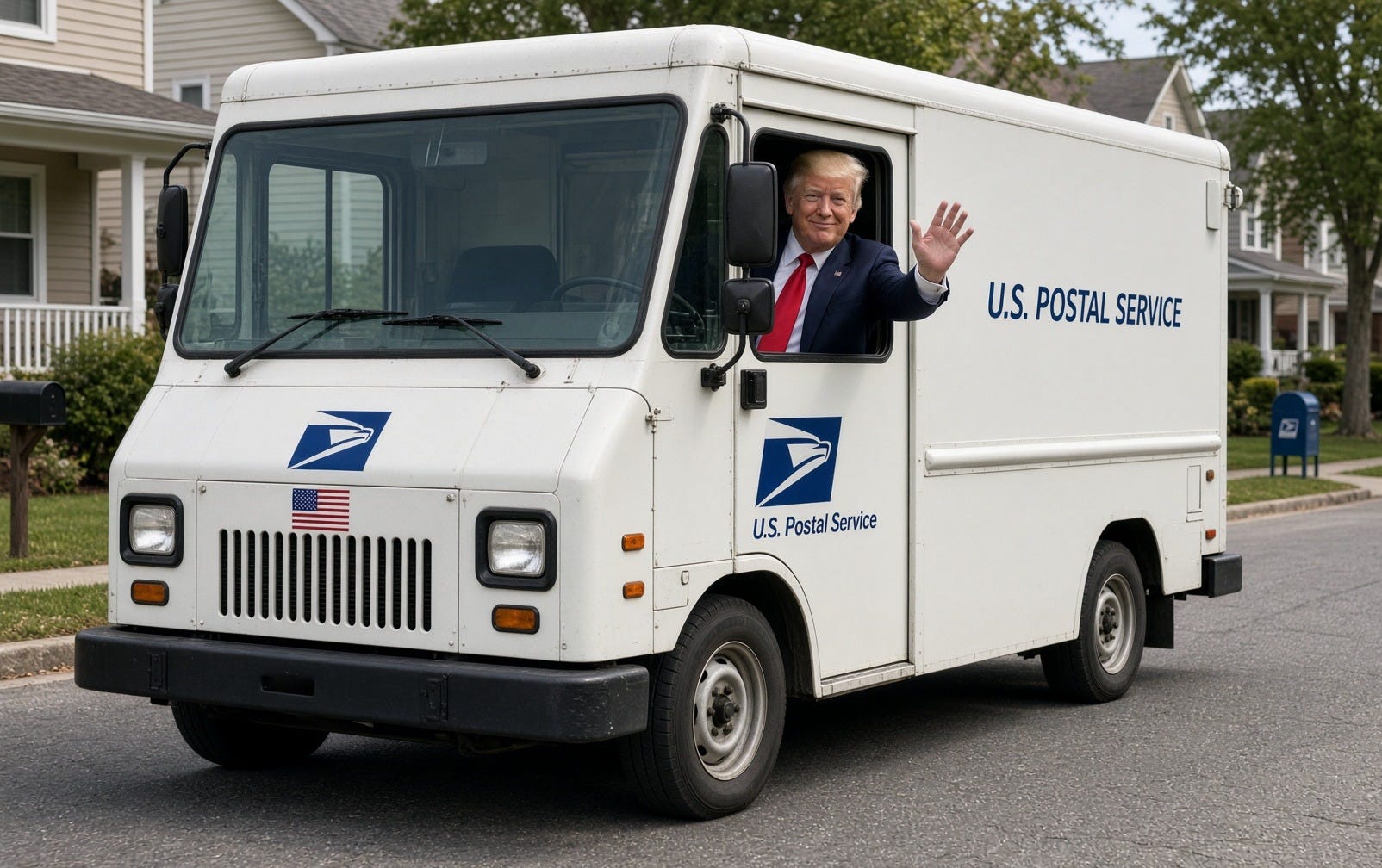
In April, a shipment of New Jersey primary ballots left Trenton bound for voters and instead rode a trailer to Memphis. Workers had moved the ballots off their original pallets into replacement containers so the trailer would pack tighter, and they left the tracking labels on the empties. The Memphis plant received the load the next day. For seven days, nobody logged the containers as ballot mail. The shipment came back to South Jersey on April 29 and reached voters on April 30, still ahead of the June 2 primary. The Postal Service inspector general told the story in a September 4 audit, report 26-054-R26, and called it human error. No voter lost a ballot. For days, the service still could not say where those ballots were.
Inspectors did not find Memphis by accident. After a congressional inquiry, they returned in June to five plants in New Jersey and Tennessee, adding those visits to earlier stops at nine processing plants and 73 delivery units in eight states during the March to May primaries. Recommendation 10 tells the Postal Service to keep the labels that uniquely identify a pallet of ballot mail attached to that mailing through the trip, until the mail is ready to be processed. Recommendation 11 tells managers to notify Election and Government Mail Program Specialists when a barcoded ballot cannot be read, so the service can go to the board of elections, including in North Carolina, instead of letting a smudged envelope fall out of the count.
The same report names rooms that never reached a cable chyron. At Harrisburg, a hand canceler used on Pennsylvania’s May 19 primary was still set to March 19, and at least 56 ballots left with the wrong date. Another 108 return ballots at that plant had been mixed into ordinary redirected mail and had to be driven to Pittsburgh the morning of the election. Training materials were missing from the workroom floor at 22 of the 73 delivery units. Among about 1.27 million election and political pieces the auditors watched, 214 were delayed, 115 of them ballots, and five missed the delivery deadline. From February through May, the mail service could measure posted on-time scores between 97.75% and 98.99%.
The measurement gap predates this year’s lawsuits. In its April 2025 review of the 2024 general election, report 24-143-R25, the inspector general counted 59.4 million ballots inside the service-performance system, on time 97.3% of the time, and recorded a Postal Service estimate of another 39.8 million ballots moving without tracking data. Those are mailpiece figures. Treat them as a fraud tally, and you will have lied. Treat them as a visibility number, and you will have described the system the country actually ran. Roughly 40% of the ballot mail in a presidential election traveled outside the measurement stream before anyone sued President Trump.
Forty-seven states already offer voters some form of ballot tracking. The holdouts, on the US Vote Foundation directory, are Illinois, Missouri, and Wyoming. Derek Tisler and Lawrence Norden of the Brennan Center acknowledged the spread of tracking in March, because a ballot that leaves the documented stream is a risk they also recognize. Trump’s March 31 order, Executive Order 14399, tried to make that practice a national floor: Official Election Mail markings, unique Intelligent Mail barcodes on the outbound and return envelopes, and a structured exchange so the Postal Service knows which pieces it has accepted. Postmaster General David Steiner noted on September 4 that Kit 600, the Postal Service’s own election-mail guide, has recommended serialized Intelligent Mail barcodes for years, and that the House had already passed a unique-barcode and special-envelope bill 396-6 in 2024. A similar measure cleared House Oversight this year. Appearance on a federal citizenship list is a different fact from registration under state law, and the order left eligibility where it already sits, with the states.
On September 14, the Supreme Court refused to lift the preliminary injunction against the Postal Service rule that carried out the order. United States Postal Service v. California, No. 26A305, leaves Judge Indira Talwani’s September 4 injunction in Boston in force through November. The unsigned emergency order said the government is unlikely to succeed on the merits of its challenge to that injunction and that the equities do not favor a stay. Justice Kavanaugh wrote separately that, on the briefing so far, there is a fair prospect the final rule falls within the Postal Service’s authority under 39 USC §401(2). His no was the calendar. Applying a new national interface weeks before a general election would likely be arbitrary and capricious under the Administrative Procedure Act, he concluded, because state and local officials do not have time to implement it. Justice Alito, joined by Justice Thomas, would have granted the stay and noted that 12 states supporting the rule considered compliance practicable. In the end, the left’s lawfare, combined with sympathetic Democrat judges delaying implementation by the USPS, left SCOTUS with no real option but to allow the litigation to proceed without any relief for the president.
I wrote on May 31 that the postal rule was a fallback after the Senate left the SAVE Act behind a filibuster, and that an early procedural win would not close the case. The House had passed the SAVE Act 220-208 on April 10, 2025, then passed the SAVE America Act in February. Senate Democrats blocked a floor vote 48-50 on June 4. The litigation did not end. Shawn Fleetwood at The Federalist reported the administration’s August courtroom success next to the Court’s warning that implementation was not necessarily lawful. Jay Rogers in the Washington Examiner said in early September that a win on the docket is not a substitute for a statute. Monday made that warning the governing fact. The injunction binds.
The September audit still leaves work that does not run through the blocked rule. The inspector general issued 11 recommendations covering wrong-date postmarks, hand-canceler control, late-arriving political mail reports, twice-daily all-clear certifications, training posted on the workroom floor, response times on the Election Mail website, container identification, and barcode readability outreach to boards of elections. The Postal Service agreed with 10 and rejected only the item that would have required prompt notice to customers affected by regional transportation changes during the midterm season. The audit states it did not evaluate the executive order and that later work will address separate allegations received in late August. A closed recommendation means a facility, a manager, a completion date, and a later inspector general test of the claim. That closeout can finish before November.
Ken Blackwell, the former Ohio secretary of state now chairing election security work at the America First Policy Institute, put the plant-floor test this way in August: “The Postal Service already sets detailed standards for how mail is prepared and tracked, and ballot mail deserves the same rigor.” Rigor at a facility is a failed-scan queue a supervisor has to clear before the shift ends, with published definitions, so pieces left out of the official count cannot drop quietly from the denominator.
Congress can still write the postal duties into statute, fund the interfaces between USPS and state election systems, and set a schedule that gives officials a full cycle to test before anything becomes mandatory. A statute would face constitutional review, and it should. A funded duty on a realistic calendar does not rest on contested readings of general agency powers or on emergency applications filed weeks before an election. The Heritage Foundation released its 2026 Election Integrity Scorecard on September 15, ranking states across more than 50 practices in 15 categories. Don Palmer, Heritage’s senior legal fellow for election integrity, said the Foundation’s 2027 priorities run through proof of citizenship, enforcement, and compliance audits. Heritage’s model absentee language already asks for a unique barcode on the outbound and return envelopes that can be followed through the Postal Service, kept apart from any mark that would identify the voter on the ballot itself. Tracking belongs on that map with registration-list accuracy, voter identification, absentee procedures, observers, and post-election audits. Heritage also credits states that issue free identification.
In July I wrote about Alaska, where a man in Kotzebue, off the road system and reachable only by air, already mails an original birth certificate to collect his Permanent Fund Dividend, and where geography plus an inflexible in-person voting rule still imposes real costs on eligible voters. I argued for remote verification, free documents, and time to correct a bad record. The state had just mailed 3,048 letters asking voters to confirm citizenship against a normal DMV-match yield of roughly 200. The objective was sound. The method needed a channel that did not strand an eligible citizen behind a stale match. Before an untested data exchange becomes a condition of moving a ballot, the exchange should be tested, the error rate should be known, and a citizen whose record is wrong should have a way to fix it without a lawyer. The Postal Service’s final-rule explanation says its participation records concern planned ballot mailing, not candidate selections, and that military and overseas ballots under UOCAVA are exempt. Those are stated design features of a blocked rule. Independent privacy testing still has to happen, access to participation data has to be limited, logged, and reviewable, and no identifying link to a vote choice can survive once the envelope and the ballot are parted.
A registered parcel records movement and receipt and says nothing about who packed it or whether the papers inside are genuine; ballot tracking and eligibility checks do different jobs, and a reform that keeps them apart can be tested on each job without turning a missing scan into a slogan or a barcode into a cure. The September audit is useful because it shows high on-time scores at most plants, documented failures at some, and an agency signature on 10 of 11 repairs.
The injunction is in force through November. The inspector general’s list does not need a stay to move. A later statute or a later rule has to meet the timing test Kavanaugh wrote down. What can be finished before the midterms is a named closer on each agreed reccomendation, with a date anyone can inspect.
If you enjoy my work, please subscribe https://x.com/amuse/creator-subscriptions/subscribe
Alexander Muse is a Fellow at the John Milton Freedom Foundation and publishes daily political analysis at amuseonx.com. Primary sources cited in this piece are linked inline; campaign finance figures are drawn from FEC filings, polling data from publicly released crosstabs, and legal claims from filed pleadings. Corrections are posted to the original URL with a dated changelog. Readers who identify errors are invited to contact the author directly. Each op-ed edited for grammar and clarity using Ai in partnership with Grammarly. Data provided in a sponsored partnership with Polymarket.