
The Cruelty of Good Intentions: Why Ending Subminimum Wage Hurts the Disabled
There are policies that are unjust because they fail to protect the vulnerable. Then there are those that are unjust because they punish the very people they purport to help. The Department of Labor's ongoing attempt to eliminate a provision in federal labor law that allows so-called "sheltered workshops" to pay workers with mental disabilities less than minimum wage belongs squarely in the latter category. This misguided initiative was launched in the waning days of the Biden administration, on December 3, 2024, when the DOL announced a proposed rule to phase out Section 14(c) certificates. As of May 5, 2025, the public comment period has closed, and the proposal now rests in the hands of the Trump administration.
This is not merely a bureaucratic technicality. It is a test of whether President Trump will continue to champion the forgotten men and women of this country, including those whose disabilities prevent them from competing on equal footing in the labor market. The Trump administration must withdraw this proposal.
To most casual observers, the policy sounds like a moral imperative. After all, who could defend paying someone less than $7.25 an hour in the twenty-first century? But the real question is not whether such wages are ideal. It is whether the people affected by this policy change will actually be better off once the workshops are shuttered. The empirical answer, drawn from states that have already adopted these reforms, is an unequivocal no.
Begin with California, whose progressive legislature banned subminimum wages for disabled workers through Senate Bill 639. When the law took effect in 2025, the theory was clear: phased-out workshops would be replaced by mainstream employers, now incentivized by state funds, who would hire the mentally disabled at full wages. The result, however, was not a surge in meaningful employment. It was a 40 percent drop in employment for the very people the law was supposed to uplift. The mainstream employers did not materialize. The support systems that sheltered workshops once provided, the job coaching, the supervision, the structure, proved too costly or complex for ordinary businesses to replicate.
Nor is California alone. Vermont, once lauded as a progressive vanguard, closed all of its sheltered workshops by 2002. Two decades later, the results remain dismal. Most former workshop participants are unemployed, and the day programs that replaced their jobs amount to structured loitering: unstructured visits to coffee shops, libraries, or craft circles that offer neither income nor a sense of contribution. In Maine, two-thirds of former workshop clients met the same fate: unemployment. Washington State saw 80 percent of its severely disabled population remain jobless after similar closures.
Even programs that claim to offer "supportive employment" or "pre-vocational training" cannot disguise the central fact: these are not paid jobs. In New York, The Arc Jefferson-St. Lawrence transitioned away from workshops, only to discover that its clients were no longer employees, but "trainees." They receive no wages, only the hope that, through some ill-defined process of transformation, they will become less disabled and eventually land mainstream employment. It is a hope mostly unmet.
Sometimes the reforms are even more surreal. After Goodwill of Orange County closed its sheltered workshop during the COVID-19 pandemic, it touted new opportunities for its former workers: visits to the local mall, library outings, coffee-shop gatherings. But these are not jobs. They are adult daycare services with better branding and no pay.
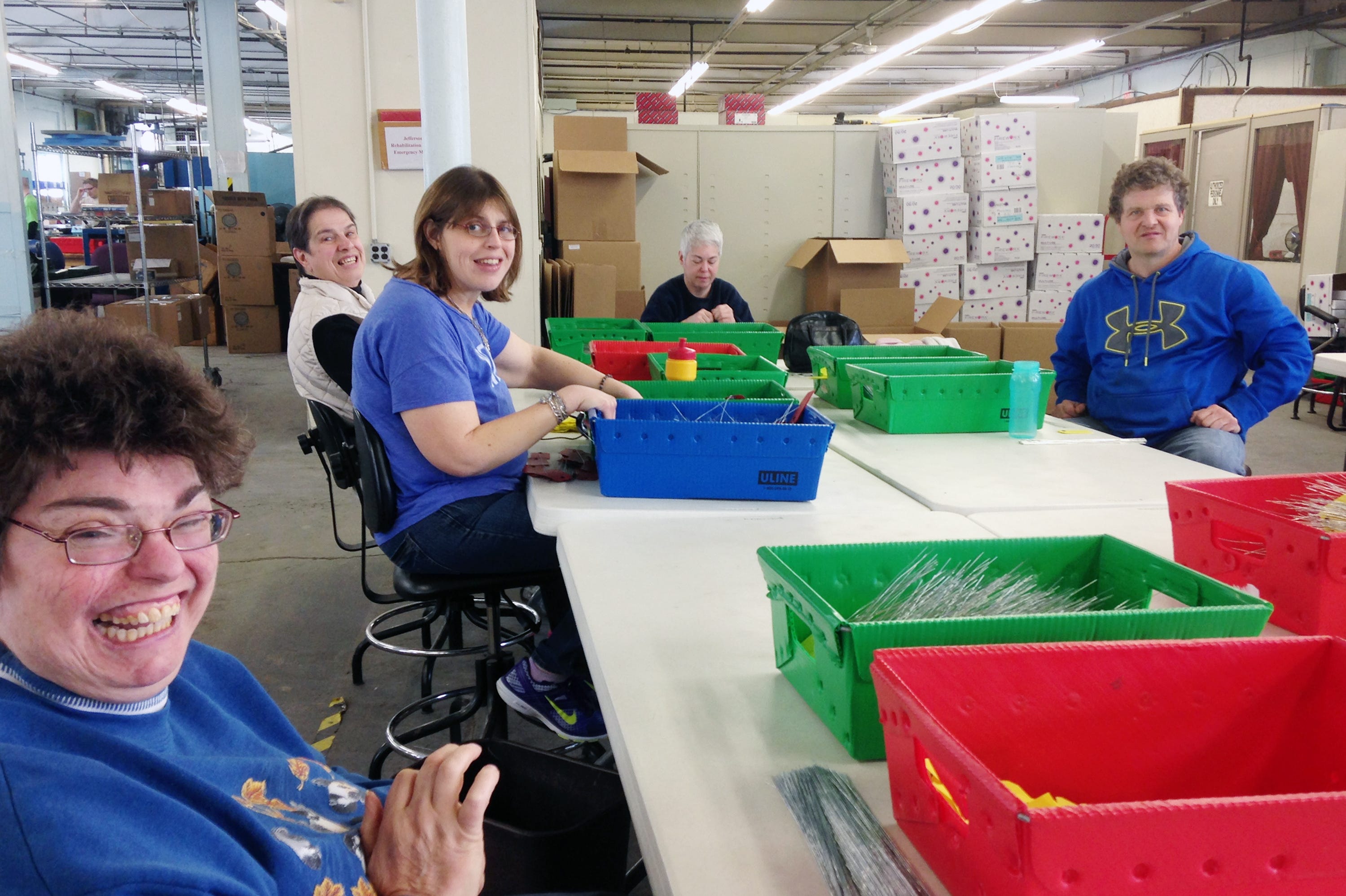
To their credit, sheltered workshops never pretended to be anything other than what they were: real, paid work for individuals with serious cognitive impairments, in settings where they could succeed. Life Skills in Utah, for example, provides jobs in recycling and contract work for corporations. Karen Sanders, who has Down syndrome, earns about $3.50 per hour working twenty hours a week. For her, this is not exploitation. It is purpose. It is dignity. It is being part of something larger than herself.
At the Warren County Sheltered Workshop in Missouri, workers with autism and intellectual disabilities label dog treats for Amazon. They socialize, follow routines, and derive real satisfaction from their labor. One parent called it a lifeline. "If they close this place," she told reporters, "my daughter will have nowhere else to go."
These workshops do not simply offer menial tasks. Production Unlimited in Watertown, New York, makes office supplies and safety equipment for the U.S. Army. At its peak, it employed 200 disabled workers. Now, due to the state-mandated phase-out, only 65 remain. One of them, Beth Carpenter, reported pride in her work, noting how the structure and task design met her needs. She is not a passive recipient of services. She is a taxpayer, a producer, a citizen.
The defense of these programs is not a defense of exploitation. It is a defense of tailored opportunity. It is a recognition that not all disabilities are surmountable by "reasonable accommodations" and that full inclusion, when achieved by closing alternative pathways, can amount to de facto exclusion.
Critics like Maria Town, president of the American Association of People with Disabilities, argue that subminimum wages are relics of a bygone era, vestiges of a time when disabled people were deemed inherently unproductive. But Ms. Town's rebuttal rests more on aspiration than data. She cites the Americans with Disabilities Act, the Olmstead decision, and the rise of remote work. All of these are important. None of them, however, have managed to provide meaningful employment to the most cognitively impaired citizens. Technology cannot tutor someone with an IQ of 50. Remote work does not suit someone who needs physical supervision.
A PBS News Weekend segment recently repeated the claim that phasing out subminimum wages improves employment outcomes, citing a "Northwestern University study" that supposedly proves the point. But on closer inspection, the study in question was not about sheltered workshops at all. It was a broader commentary on prison labor. The author, Dr. Kate Caldwell, noted that most incarcerated people have mental disabilities and that they too are paid less than minimum wage. Whatever its merits, this is hardly relevant to the structured, voluntary employment provided by organizations like Life Skills or Production Unlimited.
Indeed, what such media reports leave out is the raw human cost of reform. They do not interview the parents who watch their adult children slip into listlessness and depression after losing their workshop jobs. They do not visit the rural towns where no "inclusive employment" exists, and where closure means idleness and dependency. They do not speak with the individuals who, though earning less than minimum wage, nonetheless take immense pride in the structure, community, and contribution that sheltered workshops uniquely provide.
There is a cruel irony in all of this. In the name of justice, we have enacted policies that remove the only source of income, structure, and dignity from those least able to advocate for themselves. We have declared them equal while rendering them invisible. And the NGOs that profit from this new regime, by launching craft cooperatives or self-employment schemes that rarely succeed, walk away with the funding while the disabled are left with nothing.
There is still time to change course. President Trump has an opportunity to do what prior administrations would not: defend the vulnerable not with slogans, but with policies grounded in empirical success. That means protecting, not abolishing, sheltered workshops. That means rejecting the Biden-era proposal and withdrawing the Department of Labor's attempt to eliminate Section 14(c). The fact is, that fewer than 40,000 mentally disabled people in America are paid under Section 14(c).
Those who work in these workshops are not less human for earning less per hour. They are more human for working at all, despite obstacles the rest of us can scarcely imagine. Let us not rob them of that dignity in the name of progress.
If you don't already please follow @amuse on 𝕏.


This is heartbreaking to me. My youngest son, Drew, has Down syndrome, and has an IQ of 40. While not in a workshop, he, like so many others, would be incapable of working in the outside world. The people making the decisions to close down workshops are activists, thinking only of their cause and nothing of the reality of how it plays out. Thanks for bringing this to our attention, Amuse. You're the best!
More NGOs profiting from taxpayer funds and creating nothing but shit while doing so.
END ALL NGOs RECEIVING TAXPAYER FUNDING!