


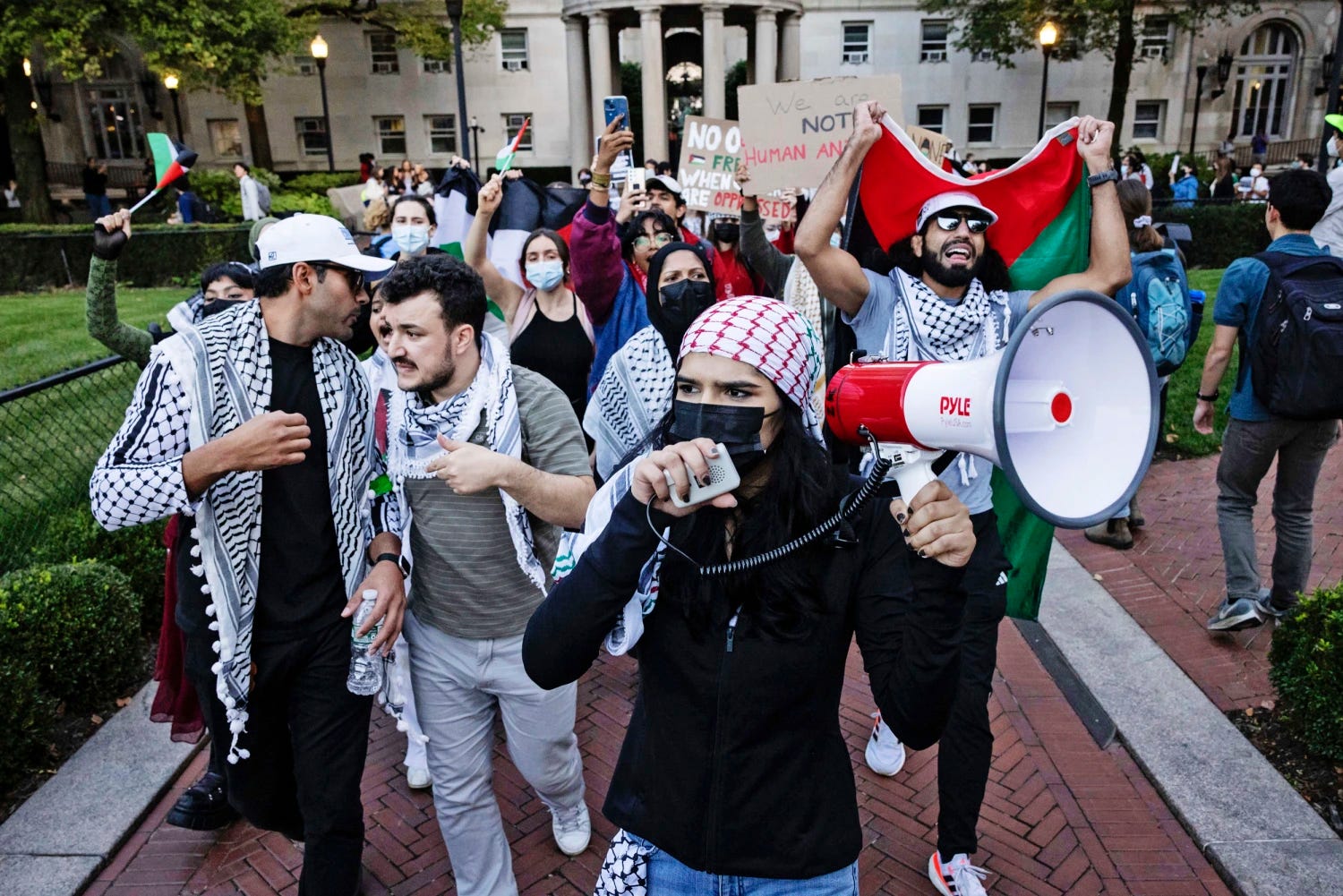
Last week, Judge Noël Wise of the Northern District of California entered judgment in Stanford Daily Publishing Corp. v. Rubio. The plaintiffs were the university’s student newspaper and a Jane Doe holding an F-1 visa. The opinion runs some 90 pages and collapses two legal statuses that the Constitution and the Immigration and Nationality Act keep apart. An American citizen and a foreign student may stand at the same rally and chant the same slogans for Hamas, the same organization that murdered, raped, and kidnapped Israeli civilians on October 7. The First Amendment forbids the government from jailing, fining, or prosecuting either of them for those words alone. That protection is real. It is also not the question this case decides.
The question is whether a foreign student, admitted for a limited purpose on conditions attached by Congress, may retain the invitation after the Secretary of State concludes that his presence carries potentially serious adverse foreign policy consequences. Judge Wise held, in effect, that once the guest begins speaking, the invitation hardens into something the Secretary cannot touch. She treated a permission as if it were a right. The citizen holds this country the way an owner holds a house. The visa student is a guest. Nothing in the First Amendment converts the second position into the first.
Section 221(i) of the Immigration and Nationality Act, codified at 8 USC 1201(i), is written for guests. After a visa is issued, the Secretary of State “may at any time, in his discretion, revoke” it. The power does not expire when the student clears customs. The judgment belongs to the Secretary, not to a jury, a prosecutor, or a district judge in San Jose. A companion provision, 8 USC 1227(a)(4)(C), makes an alien deportable when the Secretary has reasonable ground to believe that his presence or activities would have potentially serious adverse foreign policy consequences. Congress then added the sentence that should have stopped this lawsuit at the courthouse door. There shall be no means of judicial review of a 221(i) revocation, except in the narrow case where the revocation is the sole ground for removal. Congress knows how to open the courthouse. It does so constantly. Here it closed the door on purpose, because visa decisions sit where foreign policy, intelligence, and diplomacy meet, and because courts have the least competence in that arena.
Judge Wise brushed past that text. Reporting on the order describes a holding that noncitizens enjoy broad speech protections and that the government may not deport on the basis of criticism of Israel or support for Palestinians. The newspaper’s own theory was that visa threats had chilled student journalists. That may be a real reporting problem for an editor. It is not a reason to convert a discretionary visa into a tenure-like interest in remaining. If the holding is as reported, it has to assume two things the law does not give her. It has to assume that a temporary guest’s interest in staying outweighs an express grant of discretion. It has to assume that a district court may supervise a decision Congress specifically shielded from review. The first assumption revises the Constitution. The second revises the United States Code.
This is not a theory invented in 2025, nor a novelty of the Trump administration, though writers at the Heritage Foundation and elsewhere have been right to keep repeating it. In 1950, in Knauff v. Shaughnessy, the Supreme Court called the exclusion of aliens “a fundamental act of sovereignty” and described admission as “a privilege granted by the sovereign United States Government.” Ellen Knauff was the German wife of an American veteran, a far more sympathetic figure than a graduate student praising a terrorist organization, and the Court still refused to substitute its judgment for the executive’s. Three years later, in Shaughnessy v. United States ex rel. Mezei, the Court held that judges could not retry the government’s conclusion that an alien’s entry would harm the public interest, even when the evidence was confidential. Those cases are old. Their logic is not.
The closest analog to the argument pressed on Judge Wise arrived in 1972. In Kleindienst v. Mandel, American professors claimed that the exclusion of a Belgian Marxist scholar violated their First Amendment right to hear him. That was a stronger claim than the one available to an F-1 student, because it was made by citizens about their own speech and inquiry. The Court said no. Where the executive acts on a facially legitimate and bona fide reason, courts will not look behind the decision or balance it against First Amendment interests. Even when actual Americans asserted actual First Amendment claims, the visa decision stood. If the professors could not conscript immigration law into the service of their seminar, a guest cannot conscript it into the service of his rally. Judge Wise’s ruling gives a foreign national more leverage over immigration policy than the Supreme Court was willing to give American faculty.
Later cases have not loosened that rule. They have tightened the grip. In Trump v. Hawaii, the Court described immigration policy as vitally and intricately interwoven with foreign relations. In 2024, in Department of State v. Muñoz, the Court held that even a US citizen has no fundamental constitutional right to have her noncitizen husband admitted to the country. If marriage to a citizen creates no constitutional claim to admission, enrollment at Stanford does not create a constitutional claim to remain. This April, in Matter of M-K-, the Board of Immigration Appeals held that the Secretary’s determination of adverse foreign policy consequences is presumptive and sufficient evidence of removability, because Congress assigned the Secretary unilateral judgment on that question. The Board understood what the district court did not. Second-guessing that judgment pulls adjudicators into foreign policy, a field the Constitution assigns elsewhere.
Someone will say that revocation is just punishment for speech under another name. Revocation of a permission is not punishment in the constitutional sense. No one is jailed, fined, or prosecuted. The student loses nothing he owned. He loses a conditional invitation, the same thing roughly 6,000 student visa holders lost in 2025, about 4,000 of them over criminal conduct such as assault, DUI, and burglary. No serious argument treats a DUI revocation as a Sixth Amendment event. A conditional system that cannot be revoked after the condition fails is not a conditional system. It is a disguised entitlement.
The speech at issue is also not ordinary campus debate. Hamas is a designated Foreign Terrorist Organization. In Holder v. Humanitarian Law Project, the Supreme Court upheld a federal ban on even ostensibly peaceful assistance coordinated with such groups, because, as Chief Justice Roberts explained, that kind of support can legitimize a terrorist organization and free resources for violence. If Congress may criminally punish citizens for coordinated support of terrorists, it may decline to keep hosting foreign guests who celebrate them. The point is not that every slogan at every rally is a federal crime. The point is that the political branches may decide that celebrating a designated terrorist group is a reason to end a visit.
FBI data recorded 1,832 anti-Jewish hate crime incidents in 2023, a 63% increase over the prior year. In 2024, Jews, roughly 2% of the population, were the targets of 69% of all religion-based hate crimes. The ADL counted 6,274 antisemitic incidents in 2025, the third highest total it has ever recorded. Jewish students at elite universities have been harassed, blockaded, and told to hide their identities on campuses their families help fund. Congress wrote a preventive standard into the law for a reason. An alien is removable when the Secretary has reasonable ground to believe his activities would have “potentially serious adverse foreign policy consequences.” The word potentially is doing the work Congress assigned it. The government does not have to wait until advocacy matures into fundraising, fundraising into recruitment, and recruitment into an attack. A judge who demands that wait has substituted her risk tolerance for the one the statute chose.
The worry that some future Secretary will abuse the discretion is a fair worry. It is not a warrant for a district court to rewrite the statute. The Secretary answers to an elected President, the President answers to the voters, and Congress can narrow Section 1201(i) tomorrow if it wishes; that is the accountability structure the founders built for foreign affairs, and it is not improved by letting a single district judge in California superintend the nation’s visa policy becuase she finds the policy distasteful. Officials who make predictive judgments about foreign threats can be fired. Judges who delete review bars cannot.
America owes its own citizens, including the Jewish students walking past encampments that glorify their would-be murderers, a government willing to treat support for a terrorist organization as a security problem rather than a campus fashion statement. It owes foreign guests fair treatment and nothing more. A country that cannot withdraw its welcome from visitors it reasonably believes threaten its interests does not control its borders in any meaningful sense; it merely staffs them. The First Amendment will survive the revocation of a visa. It is less clear that the rule of law survives judges who set aside the statutes they are sworn to apply. Judge Wise’s ruling should be appealed and reversed, and Congress should seriously consider impeaching her.
If you enjoy my work, please subscribe https://x.com/amuse/creator-subscriptions/subscribe
Alexander Muse is a Fellow at the John Milton Freedom Foundation and publishes daily political analysis at amuseonx.com. Primary sources cited in this piece are linked inline; campaign finance figures are drawn from FEC filings, polling data from publicly released crosstabs, and legal claims from filed pleadings. Corrections are posted to the original URL with a dated changelog. Readers who identify errors are invited to contact the author directly. Each op-ed edited for grammar and clarity using Ai in partnership with Grammarly. Data provided in a sponsored partnership with Polymarket.
An F-1 visa carries conditions established by Congress and administered through the executive’s foreign-affairs authority, which means continued presence depends upon compliance with the legal framework governing that invitation. Judge Wise’s ruling allows a temporary visitor’s speech claim to override statutory discretion and a review bar designed to keep sensitive immigration judgments within the political branches. That approach transfers visa policy from accountable officials to a federal judge whose preferred constitutional balance cannot replace the one Congress enacted. The government should appeal, force a clear appellate ruling on the statutory limits, and restore the distinction between protected expression and permission to remain.
There is a simple solution to this issue. Go grab the student and put her on the next flight back home.
See if the judge has an enforcement branch to keep the state department from doing their job.
The statute in question has a very plain text saying there is NO judicial review possible.
Print out a copy for the judge and tell her why she can go pound sand, we'll even loan her a hammer.