


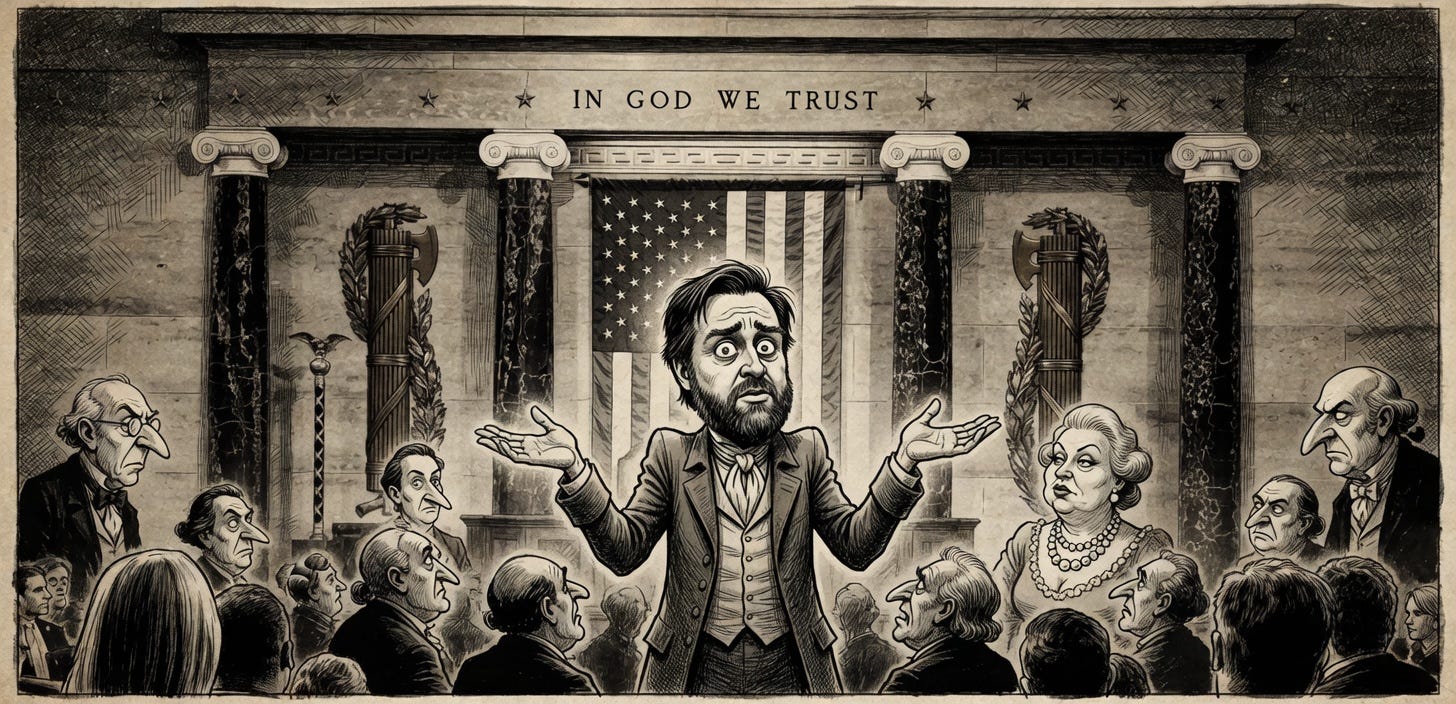
A theory has been gathering force on 𝕏 with each new procedural disappointment. The argument goes roughly like this. Vice President JD Vance is President of the Senate. The Senate is failing to deliver. Therefore Vance should stride into the chamber, gavel John Thune aside, fire Elizabeth MacDonough on the spot, force the SAVE America Act to the floor, and rule from the chair that the legislative filibuster is dead. The frustration animating this theory is entirely legitimate. Republicans hold the White House, the House, and 53 Senate seats, yet the President’s most urgent priorities sit stalled. Anger needs a target. Vance, gavel in hand and presiding over a chamber that refuses to move, is a visible and convenient one. The theory is also wrong. It is wrong in a specific, structural, and instructive way, and the misunderstanding produces precisely the kind of misdirected political energy that lets the actual obstacles escape accountability.
Begin with what the Constitution says. Article I, Section 3, Clause 4 reads in full: “The Vice President of the United States shall be President of the Senate, but shall have no Vote, unless they be equally divided.” That is the entire textual grant. Every additional power the Vice President exercises in the chamber flows from the Standing Rules of the Senate, which the Senate alone writes, and from precedents the Senate alone builds. Article I, Section 5 reserves to each chamber the authority to “determine the Rules of its Proceedings.” The Vice President sits in the Senate but does not control the Senate, and the Founders designed it that way on purpose. Elbridge Gerry and George Mason argued at the Constitutional Convention that placing an executive officer at the head of a legislative chamber violated the separation of powers. Mason warned that “the legislative and executive are hereby mixed and incorporated together.” The clause squeaked through ten days before the Convention ended, with 8 states in favor, 2 opposed, and 1 abstaining. It survived only because the role was carefully circumscribed. A Vice President who tries to convert the gavel into a general supervisory authority is exceeding the bargain the Founders made.
Hamilton’s defense in Federalist No. 68 confirms the narrow design. The Heritage Foundation’s Guide to the Constitution summarizes Hamilton’s three arguments: the tie-breaking vote ensured the Senate could always reach a decision, a sitting Senator as presiding officer would lose his regular vote and shortchange his state, and a Vice President with a legislative foothold made sense as a “substitute for the President.” Hamilton envisioned a tie-breaker, not a chairman. The Vice President was given just enough Senate authority to keep the chamber from deadlocking and not one ounce more.
The numerical reality of the 119th Congress is what gives the constitutional design its operative bite. Republicans hold 53 seats. Democrats and the two Independents who caucus with them hold 47. Cloture on most legislation requires 60. A simple majority of 51 can overturn a ruling of the chair, change a Senate precedent, confirm a nomination, or pass a bill on which cloture has already been invoked. Every consequential procedural lever in the Senate, without exception, runs through the number 51. The Vice President cannot manufacture 51 votes from the chair. He inherits them or he loses them.
Consider how this works in the case many of us have been frustrated with since President Trump’s first term: the Parliamentarian. Elizabeth MacDonough has held the position since 2012, appointed during the Obama administration by then-Majority Leader Harry Reid. She has gutted Republican priorities across two Trump terms. The understandable conservative impulse is to demand her removal. The procedural question is who has the authority to do that. The answer is unambiguous. The Parliamentarian is appointed by and serves at the discretion of the Majority Leader, and the office operates within the Secretary of the Senate’s institutional staff structure. Removal happens when the Majority Leader instructs the Secretary of the Senate to dismiss her. It has happened twice in modern history. Robert Byrd dismissed Robert Dove in 1987. Trent Lott dismissed Dove again in 2001, after Dove issued rulings that complicated President Bush’s tax-cut strategy. In neither case was the Vice President involved. Dick Cheney was Vice President in 2001 and had no role in Dove’s firing. The firing went through Lott and the Secretary of the Senate, exactly as the Senate’s staff structure requires.
The question, then, is not what Vance can do about MacDonough. He cannot do anything about her employment. The question is what John Thune has chosen to do, and the answer is nothing. That is the right place for conservative anger about the Parliamentarian to land.
What about overruling her rulings from the chair? Here a careful distinction matters, and most of the 𝕏 commentary collapses it. The Parliamentarian does not issue binding rulings. She gives procedural advice. The presiding officer, who can be Vance when he is in the chair, makes the actual ruling. Vance can, therefore, decline to follow her advice and rule differently. The cleanest summary of the procedural reality comes from G. William Hoagland of the Bipartisan Policy Center: “She advises who’s sitting in the chair. She doesn’t rule.” Eleven words, the architecture of the whole question.
So Vance can rule. But what happens next is decisive. Senate Rule XX provides that any ruling by the chair is “subject to an appeal to the Senate.” Any Senator, including Chuck Schumer, can immediately move to appeal Vance’s ruling. A simple majority of the Senate then votes on whether to sustain or overturn it. If 51 Senators vote to overturn, Vance is publicly repudiated on a roll-call vote, and his ruling vanishes. The chair has no shield. The chair has exactly as much authority as 51 Senators will give it on any given day. This is why Nelson Rockefeller’s celebrated 1975 stand against Parliamentarian Floyd Riddick worked. Rockefeller had the majority. The Senate sustained him by tabling the appeals. The chair did not win by force of personality. It won because the votes were there. Strip the votes away and the same ruling collapses in 30 minutes.
Kamala Harris, presiding over a 50-50 Senate in March 2021, faced exactly this dilemma. Twenty-four progressive House Democrats publicly demanded that she overrule MacDonough on the $15 minimum wage. Harris had the procedural option. She declined. Joe Manchin and Kyrsten Sinema had telegraphed opposition to bypassing the Parliamentarian, and without their votes, any Harris ruling would have been overturned on appeal. The political damage would have been doubled, and the underlying provision still stripped. The lesson generalizes. Even a willing Vice President in a tied chamber cannot act unilaterally without 51 votes locked in. That constraint binds Vance with equal force.
The deeper procedural lever, the so-called nuclear option, lives entirely in the Majority Leader’s office. Harry Reid executed it in November 2013 to lower the cloture threshold on most nominations. Mitch McConnell extended it to Supreme Court nominations in April 2017. In both cases the mechanics were identical: the Majority Leader raised a point of order, the chair ruled against him on existing precedent, the Majority Leader appealed, and a 52-48 party-line majority overturned the chair and established a new precedent. Vice President Joe Biden was not in the chair when Reid went nuclear. The presiding officer was Senator Patrick Leahy. The nuclear option has never required vice-presidential leadership and does not require it now. It requires a Majority Leader with 51 votes in his pocket. Thune has said, repeatedly and on the record, that those votes do not exist. “There aren’t anywhere close to the votes, not even close, to nuking the filibuster.” Susan Collins, Thom Tillis, Lisa Murkowski, and Mitch McConnell have publicly opposed any change to the legislative filibuster. That is 4 no votes from a 53-seat majority before anyone has begun counting the quieter holdouts.
There is one further constraint that ought to settle the takeover fantasy on its own. Senate Rule XIX governs recognition, and it strips the presiding officer of essentially all discretion. The Vice President must recognize the first Senator to seek the floor. He cannot favor Republicans. He cannot refuse to call on Schumer. He cannot use silence as a weapon. The single narrow exception, established by Vice President John Nance Garner in 1937, gives the Majority Leader priority of recognition when multiple Senators rise at once. Even that exception runs to Thune, not Vance. Senator Russell Long captured the spirit of Rule XIX in 1975 when he rebuked a presiding Vice President for refusing recognition: “The Presiding Officer presides over the Senate. He does not own this body.” The Senate is a collective body of 100. The chair is its servant.
None of this means Vance is powerless. He has real authority of two kinds. The first is the tie-breaking vote. In a 53-47 Senate it activates rarely, but on confirmations and reconciliation votes where Republican holdouts split the conference, it can be decisive. The second is informal and considerably more interesting. Vance served in the Senate, briefly but recently. He knows his former colleagues by name. He knows their political pressures, their reelection calendars, their grievances. That is the lever Lyndon Johnson and Hubert Humphrey wielded to enormous effect, and the lever Kamala Harris, who served in the Senate for 4 years and rarely cultivated her colleagues, almost entirely declined to use. Vance can whip. He can count. He can lobby Murkowski over coffee, ask Collins what she would need, walk Tillis through the political logic, and call McConnell to negotiate. That is real vice-presidential power. It is also not a takeover. It is persuasion, the slow work of building 51 votes one Senator at a time.
The strategic implication for the populist right is sharp. Every hour spent demanding that Vance “do something” is an hour not spent pressuring the 4 to 6 Republican Senators who actually hold the balance on filibuster reform. Every angry post directing fury at the Vice President is a post that lets Thune off the hook for refusing to schedule the SAVE Act with a serious talking-filibuster strategy, for refusing to instruct the Secretary of the Senate to replace MacDonough, and for refusing to make the procedural fight that the Center for Renewing America has laid out in detail. The Founders did not design a Senate that could be commandeered from the chair. They designed a Senate that runs on 51 votes. Until conservatives count those votes accurately and aim their pressure where the votes actually live, the gavel will remain, for all practical purposes, decorative.
If you enjoy my work, please subscribe https://x.com/amuse/creator-subscriptions/subscribe
Alexander Muse is a Fellow at the John Milton Freedom Foundation and publishes daily political analysis at amuseonx.com. Primary sources cited in this piece are linked inline; campaign finance figures are drawn from FEC filings, polling data from publicly released crosstabs, and legal claims from filed pleadings. Corrections are posted to the original URL with a dated changelog. Readers who identify errors are invited to contact the author directly.
Thank you for the information on this. If Cornyn loses his primary today (let us hope and pray!) we are a step closer...and maybe additional human obstacles, including some Dems, will take note and stand up for this common sense legislation which has broad appeal across partisan lines among the people, if not among the politicians. My two Senators are Democrats and I have emailed them both, not that there is any evidence they care what their Republican constituents think. We can imagine that they care about keeping their seats, though!
I’ve always blamed Thune as the problem. He’s no leader. He’s been there long enough to know how to sway, if he had the desire. If not, then he’s no leader and needs replaced.