


Elbridge Colby, Under Secretary of War, said it in a single sentence on 𝕏 this week: middle powers don't have a coherent basis for alignment. The statement provoked the predictable indignation from foreign ministries and op-ed pages that have spent the past year promoting a "middle powers" coalition as an alternative to American leadership. The indignation is misplaced. Colby is right, and the reasons he is right are worth walking through carefully, because they expose a category error at the heart of a fashionable idea.

Begin with what the phrase actually means. “Middle power” is a statistical designation. It describes countries that fall into a certain band of population, GDP, or military spending, below the great powers and above the small states. That is all it describes. It is a weight class, not an alliance. Calling Mexico, Turkey, South Korea, Australia, Indonesia, Canada, Poland, Japan, Brazil, and Saudi Arabia “middle powers” tells you something about their relative size. It tells you nothing about who threatens them, what geography they must defend, whose intelligence they trust, whose nuclear umbrella shelters them, or whose forces they expect to arrive in a crisis. Countries do not align because economists place them in the same statistical band. They align because they face common enemies, occupy mutually relevant geography, possess complementary capabilities, and can operate through a common command, logistics, and sustainment architecture. Similarity in size is not similarity in interest, and confusing the two is the intellectual foundation of the entire middle-power project.
Consider the countries on that list. South Korea’s security revolves around North Korean missiles and the Chinese balance. Australia’s revolves around maritime access in the Indo-Pacific. Turkey faces Russia, Syria, Iran, and the Black Sea. Indonesia guards an archipelago and pursues nonalignment. Mexico shares a 1,954-mile border with the United States and has no serious external military threat at all. What war plan unites them? What enemy? What supply chain? The question answers itself.
We do not have to speculate about whether the concept can be converted into a working coalition, because the experiment has already been run. In September 2013, the foreign ministers of Mexico, Indonesia, South Korea, Türkiye, and Australia launched MIKTA, the most deliberate attempt ever made to organize countries around middle-power identity. The founders themselves declared at the outset that MIKTA would operate not as a new exclusive bloc but as an unofficial consultation mechanism. The countries most enthusiastically assembled under the label rejected bloc status from day one. A decade later, Georgetown scholar Jeffrey Robertson surveyed the wreckage and concluded that MIKTA’s irrelevance had ended the middle-power moment altogether. The group produced conversation. It never produced strategy, because it never could.
Why not? The realist tradition supplies the answer, and it is the oldest answer in the discipline. States balance against threats, not against abstractions. They respond to aggregate power, geographic proximity, offensive capability, and perceived intentions. A country next to Russia does not assess the world as a country in Latin America does. Poland spends heavily because Russia is dangerous. Japan rearms because Chinese power is growing. Finland opened its territory to American forces because of its geography. George Washington understood this in 1796 when he warned that there can be no greater error than to expect or calculate upon real favors from nation to nation. Nations cooperate when their interests converge. A coalition constructed around an academic category cannot override threat, geography, and power. Rank is not strategy.
The skeptical reader will ask an obvious question at this point. Even if the middle-power concept is incoherent, isn’t it a rational response to American unreliability? Hasn’t the Trump administration’s pressure on allies driven them to seek alternatives? This is the claim made in a hundred columns, and it fails the moment you consult the evidence rather than the commentary. The second Trump administration’s strategy is not withdrawal. The 2026 National Defense Strategy calls it flexible, practical realism: the United States remains the indispensable military and technological center, allies assume primary responsibility for their own regions, and model allies receive preferential access to American arms, intelligence, and defense-industrial collaboration. As the strategy itself puts it, our allies will do so not as a favor to us, but out of their own interests. That is not entitlement. It is reciprocity, and reciprocity is the only durable foundation an alliance has ever had.
Now measure what allies have actually done, because governments reveal their preferences in appropriations and access agreements, not in Davos speeches. In 2014, only three NATO allies met the 2% defense-spending benchmark. In 2025, every ally met or exceeded it. European allies and Canada increased defense spending roughly 20% in a single year, pushing their combined expenditure above $574 billion in constant 2021 prices, and at the Hague Summit in June 2025 the alliance committed to 5% by 2035. NATO Secretary General Mark Rutte put it plainly in March: the figures speak for themselves, and NATO is stronger today than it has ever been. Trump’s pressure did not dissolve the alliance. It forced the alliance to become serious.
The pattern extends beyond budgets. Finland, a wealthy and militarily capable state with every option available to it, negotiated a Defense Cooperation Agreement granting US forces access to 15 facilities across its territory. Sweden’s parallel agreement entered into force, and Stockholm describes the United States as one of its most important security partners. The Philippines expanded American access under the Enhanced Defense Cooperation Agreement by four additional sites in northern Luzon and Palawan, precisely the geography facing the Luzon Strait and the South China Sea. Notice the pattern. The closer a country sits to a real threat, the less it talks about strategic autonomy and the more it seeks American integration. Rearmament and US engagement are complements, not substitutes.
The arms market tells the same story with even less ambiguity, because a weapons purchase is a 30-year commitment to training pipelines, maintenance networks, software, munitions, and doctrine. The United States supplied 42% of global major-arms exports from 2021 through 2025, more than the next seven exporters combined, reaching 99 countries. Japan sourced 95% of its imported major arms from the US during that period, and South Korea sourced 93%. These are rich, technologically sophisticated states sitting directly in China’s shadow, and they have chosen deep American integration over indigenous substitution. The open US foreign military sales portfolio now exceeds 16,000 cases worth approximately $903 billion across nearly 180 countries and organizations. Secretary of War Pete Hegseth summarized the demand signal without embellishment: our allies want to buy the world’s most lethal weapons, American weapons.
What about Europe’s much-advertised strategic autonomy? The most damaging evidence comes from Europe’s own institutions. Between Russia’s February 2022 invasion and June 2023, when European governments were buying under genuine urgency, 78% of EU defense acquisitions came from outside the union, and the United States alone supplied 63%. Only 18% of European defense investment is collaborative, even as spending reached roughly €381 billion, and the research gap is starker still: EU defense R&D ran about €13 billion in 2024 against roughly $149 billion in American research, development, test, and evaluation funding, a gap of more than ten to one. Twenty-seven national budgets produce duplication, small production runs, and competing specifications. Europe can and should build more shells, ships, and drones. It cannot efficiently reproduce the American research, software, space, intelligence, and nuclear stack, and every euro spent trying is a euro unavailable for ammunition and readiness that deterrence requires now.
History has tested autonomous allied power before, and the results were not kind. At Suez in 1956, Britain and France, experienced military powers with global reach, mounted a combined operation and could not sustain it for a fortnight against American opposition. In Libya in 2011, a mission designed to showcase European leadership against a poorly armed regime in Europe’s own neighborhood required emergency infusions of American targeting specialists, intelligence, and precision munitions after eleven weeks, prompting Defense Secretary Robert Gates to observe that the military capabilities simply aren’t there. Diplomatic willingness is not usable capacity. The enabling functions, intelligence, targeting, munitions depth, logistics, remain American.
Even the concept’s chief political promoter has conceded the core point. Canadian Prime Minister Mark Carney, in his January Davos address championing middle-power cooperation, admitted that great powers have the market size, the military capacity, and the leverage to dictate terms, and that middle powers do not. Pooling countries with divergent threats does not manufacture those assets. It merely aggregates the label.
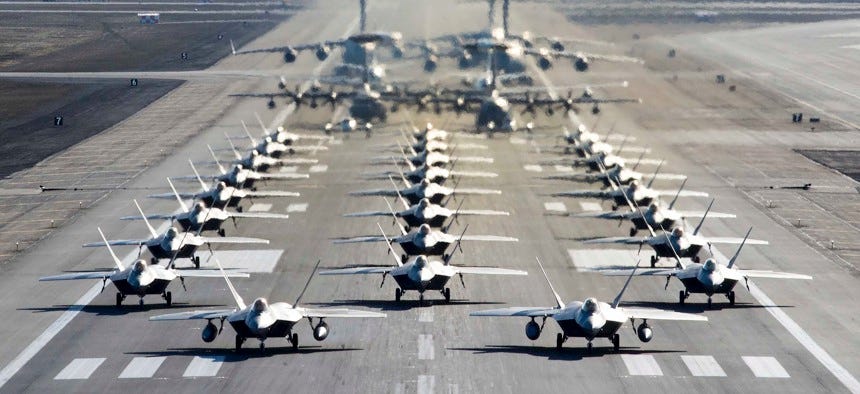
The constructive conclusion follows naturally, and it is Colby’s conclusion. Allies should spend more, build more, and fight-ready more, and they should do it through American standards, systems, and supply chains rather than away from them. The F-35 enterprise shows what that looks like in practice: 19 allied nations, more than 1,340 aircraft, 55 bases, over 3,500 pilots and 21,240 maintainers sharing training, software, weapons, and data. That is what a real coalition architecture looks like, and no committee of statistically similar countries will replicate it in this decade or the next. The choice before America’s allies is not between dependence and autonomy. It is between usable strength inside a proven ecosystem and expensive fragmentation outside it. Build with America, not away from it. The middle-power mirage will fade, as mirages do, and the arithmetic of threat, geography, and industrial power will remain.
If you enjoy my work, please subscribe https://x.com/amuse/creator-subscriptions/subscribe
Alexander Muse is a Fellow at the John Milton Freedom Foundation and publishes daily political analysis at amuseonx.com. Primary sources cited in this piece are linked inline; campaign finance figures are drawn from FEC filings, polling data from publicly released crosstabs, and legal claims from filed pleadings. Corrections are posted to the original URL with a dated changelog. Readers who identify errors are invited to contact the author directly. Data in sponsored partnership with Polymarket.
Thank you Alex Muse. I always recommend people read you as you articulate the best of situations around the world. Thank you for the breakdown.
What's with you and Polymarket links in everything?