


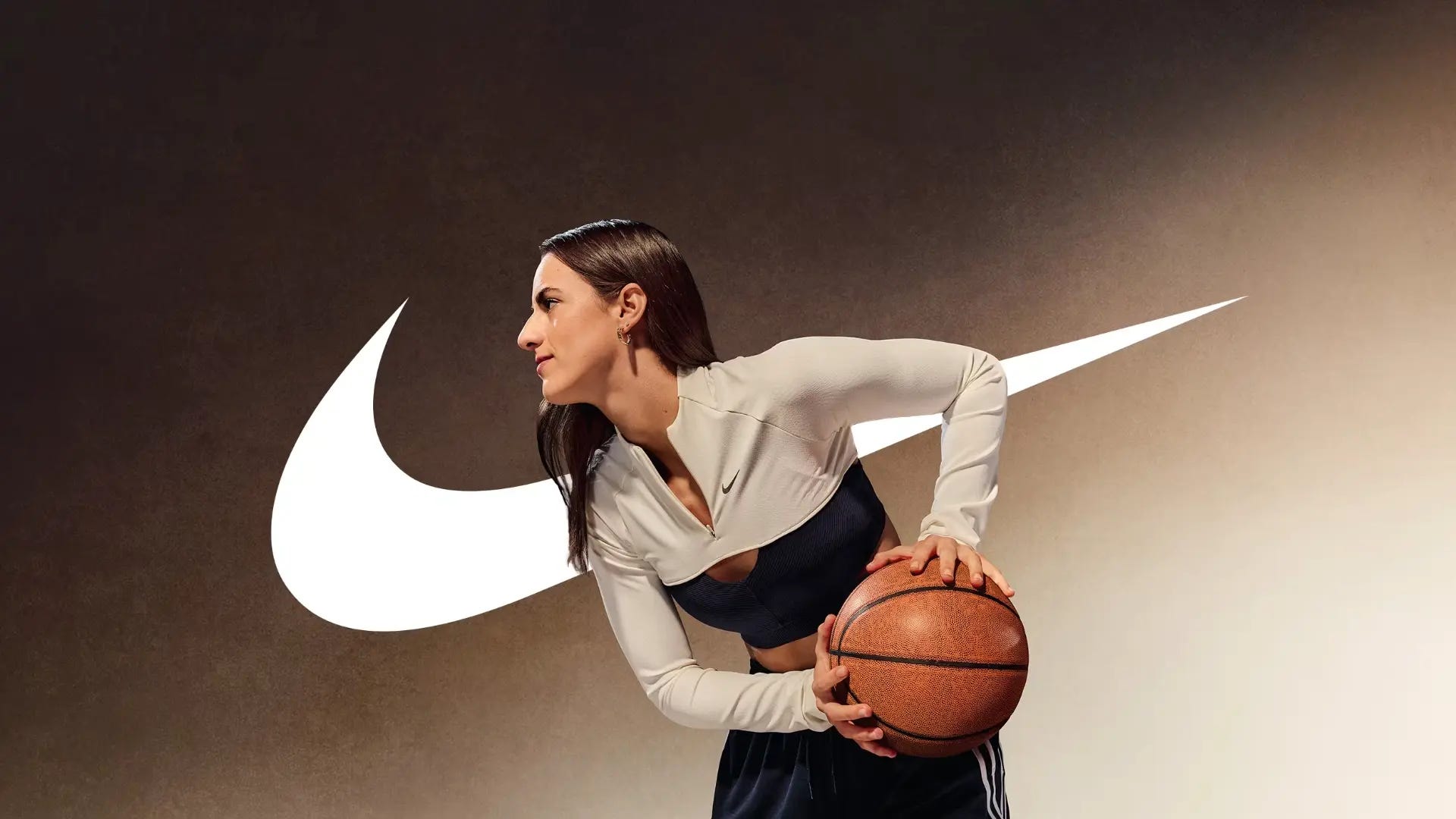
There is an old principle, which economists call revealed preference, holding that we discover what people truly value not from what they announce but from what they do. A man may say he prefers the symphony, but if every free evening finds him at the ballpark, we have learned something his words concealed. Institutions reveal themselves the same way. A league may praise its brightest star, sell her jersey, and run her highlights, and yet, if we watch what it does when she is knocked to the floor and when its honors are handed out, we may find that its real preference runs the other way. The case of Caitlin Clark and the WNBA is, at bottom, a study in revealed preference. The words say one thing. The conduct says another, and the conduct is what counts.
Let us begin with the value, because the value is not in dispute. Ryan Brewer, a finance professor at Indiana University Columbus who specializes in valuation, calculated that Clark alone accounted for more than 26.5% of all WNBA economic activity in the 2024 season, a figure spanning attendance, television, and merchandise. Of the 24 WNBA broadcasts that drew at least 1 million viewers that year, 21 featured Clark. Her games averaged roughly 1.2 million viewers, about 200% more than games she did not play. Indiana set a single-season league attendance record, opponents relocated home games into larger NBA arenas to hold the crowds she summoned, and league merchandise sales surged above 600%, with Clark atop the jersey rankings. In the summer of 2024 the league signed an eleven-year media-rights agreement worth roughly $2.2 billion, more than triple its prior deal of about $50 million per year, a windfall that arrived on the growth she ignited. The independent economist Victor Matheson of Holy Cross estimated that roughly 1 in every 6 tickets sold leaguewide, home and away, owed to the Clark effect.
Hold that number in mind, more than a quarter of the enterprise resting on one young woman, and ask the question a child could ask. Why would any institution treat the source of a quarter of its revenue as an inconvenience? On the ordinary assumption that a business wishes to prosper, the behavior we are about to examine is not merely ungracious. It is unintelligible. And when conduct becomes unintelligible on the assumption of self-interest, the rational move is to question the assumption: perhaps self-interest is not the motive at all.
Consider first the matter of physical safety, because it is the gravest. In June of 2024 the Chicago player Chennedy Carter lowered her shoulder and drove Clark to the hardwood, away from the ball, after the whistle, on a play that had nothing to do with the game in progress. The officials called a common foul in real time and declined to review it. Only the next day, when the cameras had made indifference impossible, did the league upgrade the call to a flagrant, and even then it imposed no fine and no suspension. Sports Illustrated’s women’s basketball coverage counted four Chicago flagrants against Clark in 2024 alone, a remarkable concentration of violence on one player. Then came the playoffs, and the pattern held. Less than two minutes into her first postseason game, Connecticut’s DiJonai Carrington caught Clark squarely in the eye. No foul was called. Clark, who later developed a visible bruise, played half-blind through a blowout loss. In 2025 an eye poke and a hard shove to the floor produced, once again, a foul upgraded after the fact with no suspension, while Clark herself collected a technical for her trouble.
I dwell on these episodes not to claim each was a deliberate attempt to injure, which is more than the evidence will bear, but because of the response, which is the part the league controls completely. The contact that goes uncalled when Clark is the victim would draw an immediate whistle for nearly anyone else, and the league’s enforcement, when it comes at all, arrives a day late and a punishment short. Common foul now, flagrant tomorrow, no real consequence ever. That is not the conduct of an institution guarding its most valuable asset. It is the conduct of an institution that has quietly decided the asset may guard itself.
The point sharpens when we set this permissiveness beside the league’s eagerness to discipline Clark’s own behavior. This season she received her fifth technical foul, and the offense, almost too absurd to credit, was clapping. Not screaming at an official, not hurling anything, not charging anyone, but clapping toward an opposing bench. With eight technicals triggering an automatic suspension, the arithmetic is its own argument. Clark answered with the dry precision that has become her trademark, observing that the league might as well circle a date on the calendar now for the suspension it evidently intends to manufacture. Asked for an explanation, she was told the technical was for clapping and instigating, and replied that the official must therefore simply dislike competitive basketball. A league that swallows its whistle on a fist and reaches for it on a pair of applauding hands has told us, in the clearest possible terms, where its sympathies do not lie.
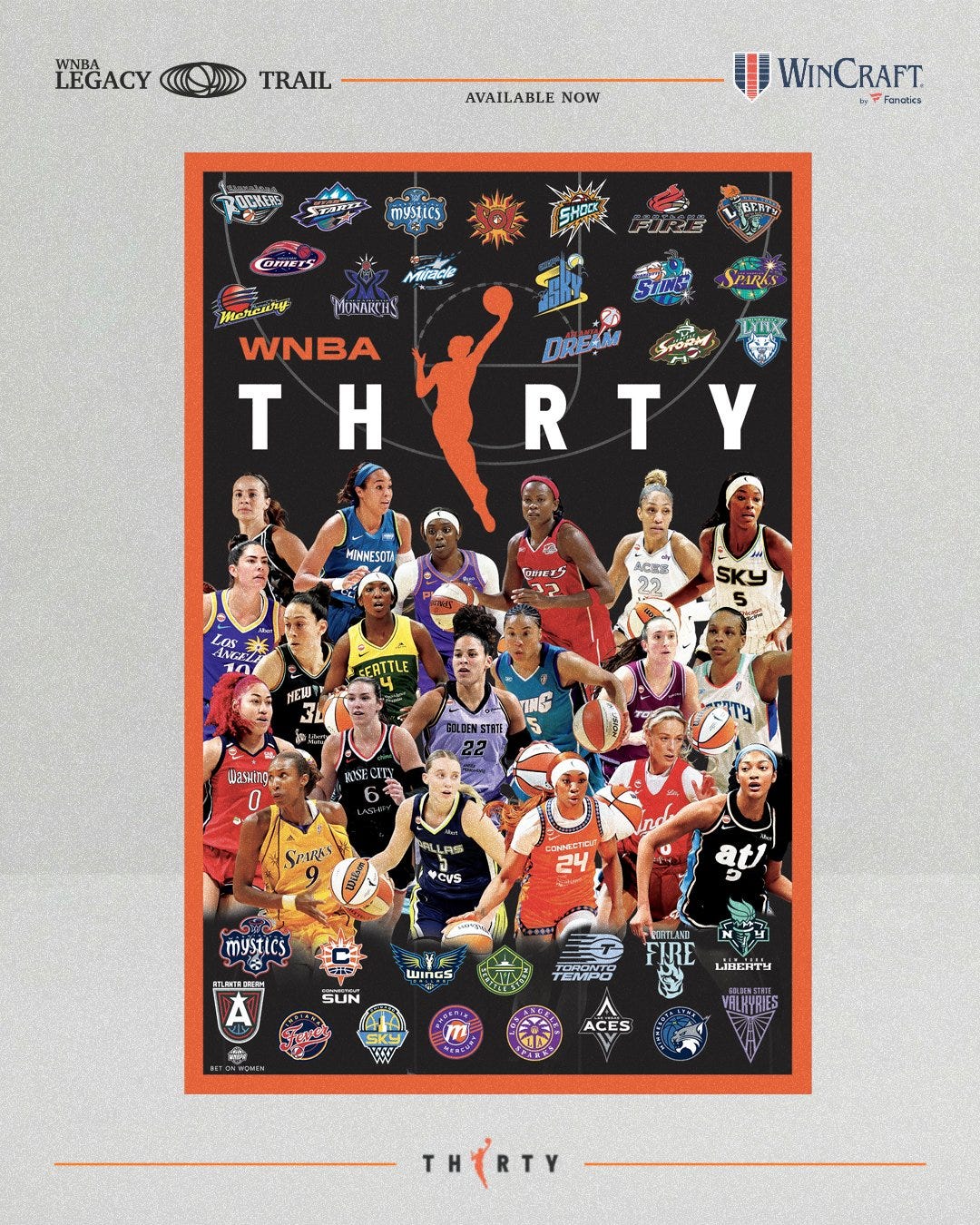
Now turn from the floor to the honors, for the snubs rhyme with the officiating. In 2025 Clark drew 1,293,536 All-Star fan votes, a single-season record, and finished third in the vote of the media. Her fellow players ranked her ninth among guards, low enough that several appear to have left her off their ballots entirely. The public beholds a generational talent. A meaningful share of her peers will not concede the point aloud. The broadcaster Dick Vitale, no man’s idea of a radical, named the obvious cause when he called the players’ vote “absolutely PURE JEALOUSY.” A year earlier she had been left off the US Olympic roster, in part, the reporting suggested, out of unease over how her enormous following would react to seeing her benched, which is to say she was too popular to be permitted to play. And then, in the summer of 2026, came the perfect emblem of the whole affair. The league released a $29.99 poster celebrating thirty years of its history, advertised as a tribute to the stars who defined and shaped the game, and it represented the Indiana Fever not with Clark but with Sophie Cunningham. The engine of the league’s modern boom did not appear on the league’s own monument to itself.
What explanation fits all of this at once? The conservative writers at Outkick have not been shy, and their bluntness is a virtue here. Clay Travis compressed the entire thesis into a sentence when he said the league got a golden goose and is doing everything it can to kill it. The explanation that fits is institutional resentment, and we should be candid about the shape that resentment appears to take. The WNBA is a predominantly black league in which openly lesbian players are represented far above their share of the general population, and into it walked a straight white woman from Iowa who became, within weeks, its biggest draw and the face of an audience that had never before belonged to it. The most economical reading of the pattern is that Clark is being treated as she is not in spite of being an outsider but because she is one, that a newcomer who made everyone wealthier is resented precisely for arriving from outside the tribe, and that the resentment surfaces in the elbows that go uncalled, the ninth-place ballots, and the poster that found no room for her face.
A reader of fair mind will pause here and object. Is this not simply hard-nosed defense, the ordinary hazing every rookie endures, dressed up in the language of grievance? The objection deserves an answer, and the answer is a parallel that Americans already know by heart, one that cannot be unseen once named. When black athletes integrated white professional baseball in the 1940s, they were spiked, thrown at, and abused, while officials and league offices looked studiously away, and they were expected to absorb every blow in silence as the toll exacted for their presence. The direction of our case is reversed, and that reversal is exactly why so many are reluctant to name it, but the structure is identical. A player marked as the outsider is subjected to physical punishment the rules plainly forbid, while the institution that profits from her declines to enforce the protections it wrote. One need not prove the private heart of any single opponent to accept the more modest and still devastating claim, that a league which would have built a fortress around a different kind of superstar has built nothing around this one, and that the difference is too conspicuous to be waved away as the rough courtesy of the game.
And here the argument closes on ground that requires no speculation about anyone’s soul. A sports league owes its athletes a duty of care. It is obliged to protect them from dangerous contact away from the ball, and that obligation does not lapse because a particular star has become inconvenient to a referee, a locker room, or a front office. Place that duty beside the balance sheet and the indictment stands on two independent legs. Morally, the league fails to shield a young woman from blows it could prevent. Commercially, it degrades and underhonors the player who supplies better than a quarter of its value, which is not the behavior of an enterprise pursuing profit but of one nursing a grudge. Her own coach, Stephanie White, watching a fist pressed into Clark’s neck, abandoned the usual diplomacy and said only that it was crazy, that it was dangerous, that the cheap shots were unacceptable. When the people nearest the team are reduced to narrating their own star’s peril to reporters because the officials will not act, the institution has stopped pretending.
The WNBA was handed the thing it had awaited for three decades, a player who could make the country care, and the country did. The arenas filled, the networks bid against one another, and the money came in torrents. At the precise moment the league should have been raising walls around the source of all of it, it kept reaching, instead, for the knife. Revealed preference is a stern teacher. Watch what the league does, not what it says, and you will know what it has decided Caitlin Clark is worth. So you may be asking what the real issue is and the answer to me is clear - the league is struggling with the fact that it took a straight white woman to make it relevant.
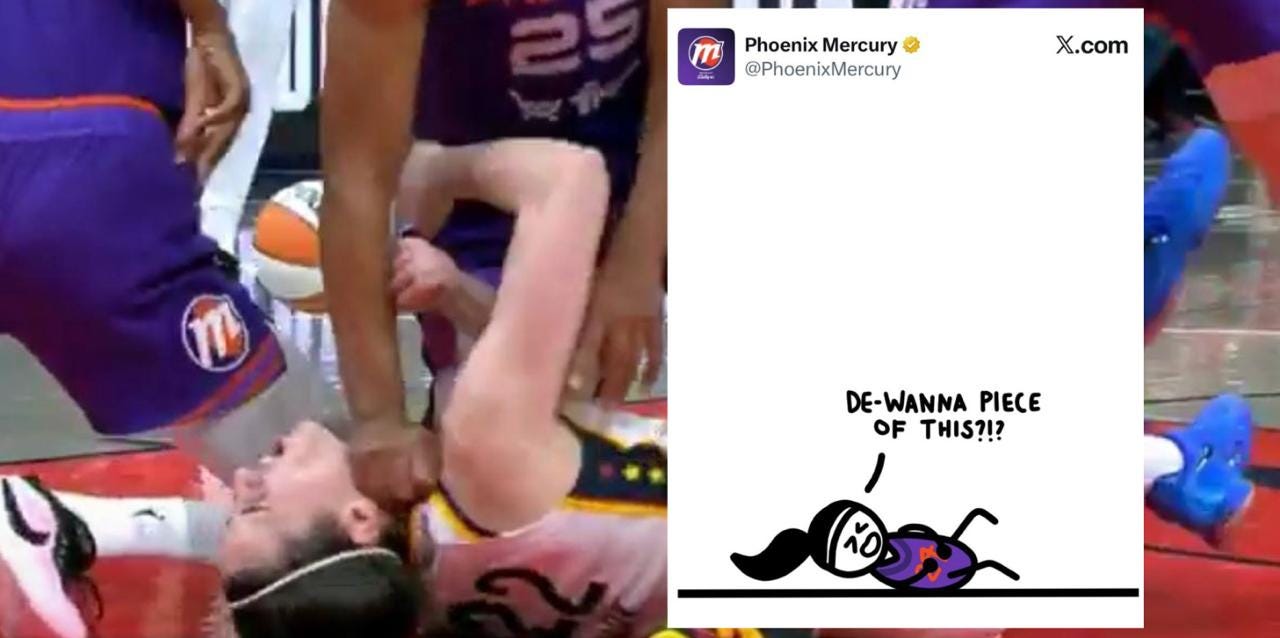
UPDATE: The Phoenix Mercury deleted the post mocking the attack suffered by Indiana Fever guard Caitlin Clark at the hands of their player Alyssa Thomas.
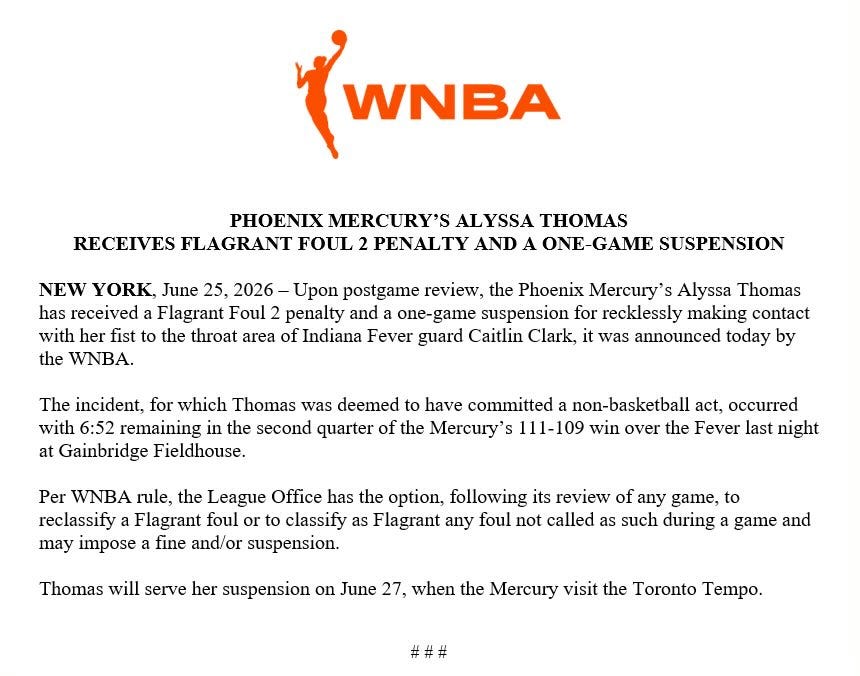
UPDATE: The WNBA announced it had belatedly penalized Alyssa Thomas for attacking Caitlin Clark at last night's game.
If you enjoy my work, please subscribe https://x.com/amuse/creator-subscriptions/subscribe
Alexander Muse is a Fellow at the John Milton Freedom Foundation and publishes daily political analysis at amuseonx.com. Primary sources cited in this piece are linked inline; campaign finance figures are drawn from FEC filings, polling data from publicly released crosstabs, and legal claims from filed pleadings. Corrections are posted to the original URL with a dated changelog. Readers who identify errors are invited to contact the author directly. Data in sponsored partnership with Polymarket.
I am going to say the quiet part out loud … this is racism pure & simple .
Perhaps a lawsuit is in order?
Well said.
She should retire and be a Talking Head on men's basketball telecasts, or maybe a coach at U. Connecticut, and enjoy watching the WNBA revert to its previous poverty. Sweet revenge.