


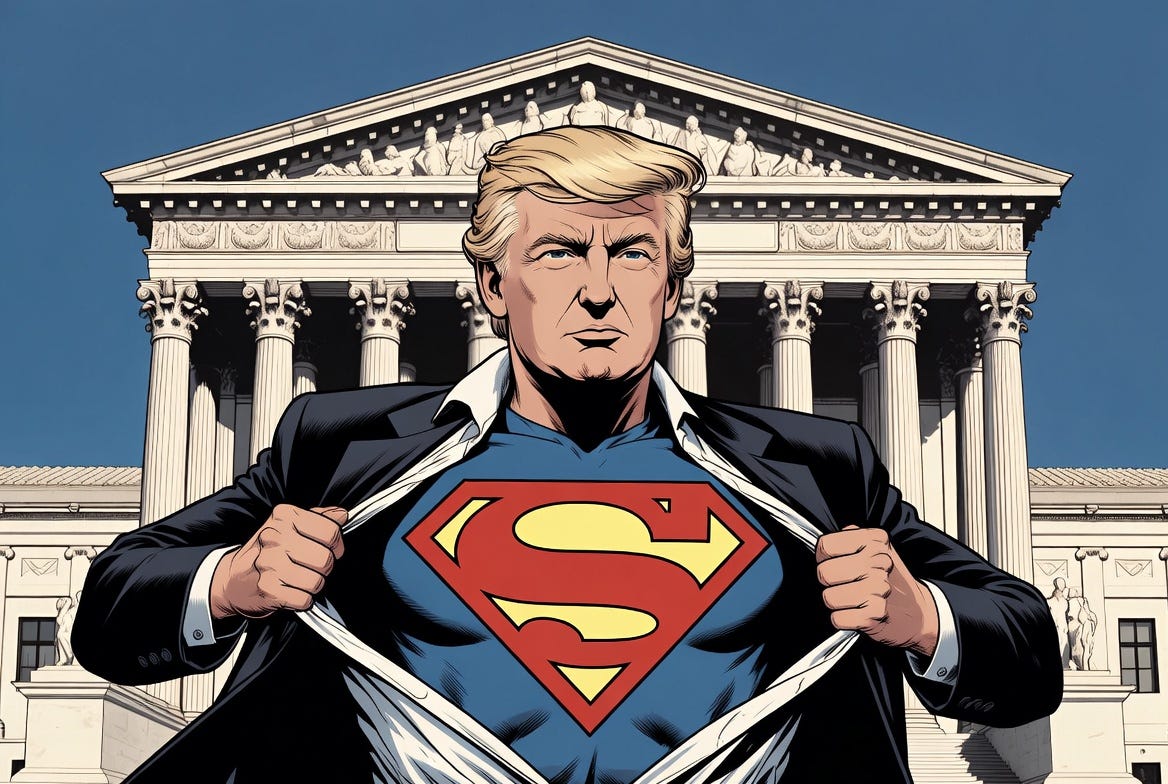
Today the Supreme Court did something rare. It admitted a mistake that had stood for ninety-one years, and it corrected it. In Trump v. Slaughter, a 6-3 majority overruled Humphrey’s Executor v. United States, the 1935 decision that allowed Congress to wall off the commissioners of the Federal Trade Commission from the President who is supposed to direct them. Chief Justice Roberts, writing for the Court, did not nibble at the edges of that old precedent. He buried it. “If anything more is left of Humphrey’s,” he wrote, “we overrule it.” The sentence is worth pausing on, because finality of that kind is unusual from a Court that prizes its own continuity. The Chief Justice was telling the country that a structural error had at last been set right.
To see why this is restoration rather than revolution, begin where the framers began, with a single sentence. Article II opens by vesting “the executive Power” in a President, and it later commands that he “take Care that the Laws be faithfully executed.” Read those two clauses together and a simple question follows. If a President is charged with seeing that the laws are faithfully executed, what happens when the officers actually executing those laws defy him, or simply ignore him, and he cannot remove them? The answer is that the duty becomes a fiction. A man held responsible for an outcome he cannot control is not truly responsible at all. The framers understood this, which is why they did not scatter the executive power among boards and commissions. They concentrated it in one person who could be watched, praised, blamed, and ultimately voted out.
Alexander Hamilton made the point with characteristic bluntness in Federalist No. 70, a passage the majority quotes today. A “plurality in the executive,” Hamilton warned, not only weakens government but “tends to conceal faults and destroy responsibility.” Consider what he is describing. When power is divided among many hands, and something goes wrong, each hand points to another. The citizen who has been harmed cannot find the person to hold accountable, because accountability has been diluted to the point of disappearance. Hamilton thought this the great vice of committee government, and he designed the presidency precisely to avoid it. A single executive cannot pass the buck, because there is no one to pass it to.
If the principle were merely a matter of 18th-century theory, skeptics might dismiss it as antiquarian. But the framers acted on it almost immediately. When the First Congress convened in 1789, one of its earliest tasks was to create the executive departments and to decide who could remove their heads. James Madison led the faction arguing that the removal power was inherently executive and belonged to the President alone. The House considered language that would have “conferred” removal on the President, and then deliberately deleted it, replacing it with words that merely assumed the power was already his. The change was not careless. It was a considered judgment that the Constitution had already settled the matter, and that Congress had no authority to grant what the President already possessed. This episode, famous to lawyers as the Decision of 1789, was treated as authoritative by Chief Justice Marshall, by Chancellor Kent, and by Justice Story. The removal power, in other words, was fixed in the Republic’s very first year, a full 146 years before Humphrey’s invented an exception to it.
The Court reinforced that understanding in 1926 in Myers v. United States. Chief Justice Taft, who had himself been President and therefore knew the office from the inside, wrote that the Constitution grants the President “general administrative control of those executing the laws, including the power of appointment and removal of executive officers.” Taft traced the offending statute back to the Reconstruction-era Tenure of Office Act, the same law a vengeful Congress had used to handcuff President Andrew Johnson. That history matters, because it shows what is really at stake when a legislature tries to seize control of the President’s subordinates. It is not good government. It is an attempt to run the executive branch from Capitol Hill.
Then came 1935, and the anomaly. President Roosevelt had removed William Humphrey, a conservative FTC commissioner who opposed the New Deal, without citing any statutory cause. A unanimous Court ruled against him, reasoning that the FTC exercised “no part of the executive power” and was instead “quasi-legislative and quasi-judicial.” Notice the maneuver. To save the removal restriction, the Court had to pretend that an agency enforcing federal law was somehow not exercising executive power at all. Even sympathetic minds found the dodge unconvincing. Justice Robert Jackson, no enemy of the administrative state, later wrote that the “retreat to the qualifying ‘quasi’ is implicit with confession that all recognized classifications have broken down.” When a liberal lion of the mid-century Court concedes that your central distinction is an intellectual surrender, the distinction is in trouble.
What truly doomed Humphrey’s, however, was not philosophy but fact. The FTC of 1935 that the Court imagined, a modest advisory body, bears no resemblance to the FTC of 2026. Today the agency enforces and administers some 80 statutes reaching nearly every corner of the national economy. It writes substantive rules that carry the force of law, conducts in-house trials before its own judges, sues Americans in federal court, and collects civil penalties measured in the billions of dollars. These are not the gentle functions of a study commission. They are core executive powers, the power to make law real in the life of a citizen through investigation, prosecution, and punishment. The 1935 Court told the country these commissioners exercised “no part of the executive power.” Ninety-one years of accumulated authority proved that claim false. The doctrine collapsed because the premise underneath it had quietly rotted away.
The collapse did not happen all at once, and that is important for understanding why today’s decision is the careful conclusion of a long argument rather than a sudden lurch. The Court chipped at Humphrey’s for four decades. In Free Enterprise Fund in 2010 it struck down a double layer of for-cause protection. In Seila Law in 2020 it held that a single director wielding vast power, in that case the head of the Consumer Financial Protection Bureau, could not be insulated from the President, because such an officer answered to “no boss or electorate looking over her shoulder.” In Collins v. Yellen the next year it extended that logic further. Each step confined Humphrey’s more narrowly to its facts. Today’s ruling simply finishes the journey, applying to the FTC the same principle the Court had already applied to every comparable agency. Justice Scalia saw all of this coming. In his lonely 1988 dissent in Morrison v. Olson, he wrote that the Court had “swept” Humphrey’s “into the dustbin of repudiated constitutional principles.” He was outvoted then. His view is the law now, and the columnist who calls this vindication is not exaggerating.
There is one more witness worth calling, and she sits on the Court’s left. Years before she became a justice, Elena Kagan wrote in the Harvard Law Review that insulating administration from the President, “even if accomplished in the name of ‘independence,’ will tend to enhance Congress’s own authority over the insulated activities.” Read that carefully. The Court’s leading liberal acknowledged, in print, that agency “independence” is largely a myth. Power does not vanish when it is taken from the President. It migrates, usually to Congress and to the permanent bureaucracy that no voter chose and no voter can unseat. The majority quoted her line against the very dissenters she now joins. That is the heart of the accountability case. The choice was never between presidential control and no control. It was between control by the one official the whole nation elects, and control by people the nation cannot reach.
Critics will warn that this hands the President too much. Yet notice how precise the Court was. On the same day, in Trump v. Cook, a different majority declined to let the President remove a Federal Reserve governor while her case proceeds, reserving the unique question of the central bank “to the extent that it follows in the tradition of the First and Second Banks of the United States.” A Court bent on raw power-grabbing does not carve out exceptions. The Fed reservation shows a Court drawing principled lines, which makes the breadth of the holding for every other agency all the more telling. Conservative scholars at Cato, at the Federalist Society, and at the Heritage Foundation spent four decades building this case, arguing that Humphrey’s was wrong as history, wrong as text, and wrong as structure. Today the Court agreed.
What the decision restores, in the end, is a chain. The officials who wield coercive power over citizens now answer to a President, and that President answers to the people. Voters chose this administration. They did not choose the holdover commissioners who would govern in its place, and the Constitution does not force an elected President to execute the laws through subordinates he cannot trust or remove. The framers wrote a government with one accountable head precisely so that the governed would always know whom to hold responsible. After ninety-one years, that government is whole again. As the President himself put it today, it is “one of the most important” rulings “ever given with respect to Presidential Powers.” For once, the superlative is earned.
If you enjoy my work, please subscribe https://x.com/amuse/creator-subscriptions/subscribe
Alexander Muse is a Fellow at the John Milton Freedom Foundation and publishes daily political analysis at amuseonx.com. Primary sources cited in this piece are linked inline; campaign finance figures are drawn from FEC filings, polling data from publicly released crosstabs, and legal claims from filed pleadings. Corrections are posted to the original URL with a dated changelog. Readers who identify errors are invited to contact the author directly. Data in sponsored partnership with Polymarket.
Lying E Jean Carroll could not remember what year the alleged incident took place.
Seriously, can ANYONE think of a reason that Donald Trump would EVER have gone into a department store?
Well sadly it won't matter because the same court just said we don't have election day we have election as-long-as-it-takes-to-get-all-the-ballots, and adding insult to injury, they wouldn't even view Trumps appeal for that E Jean Carrol trainwreck $5 million dollar civil case, so now Trump has to pay the lunatic 5M, and listen to the media chirp about it until he's out of office.