


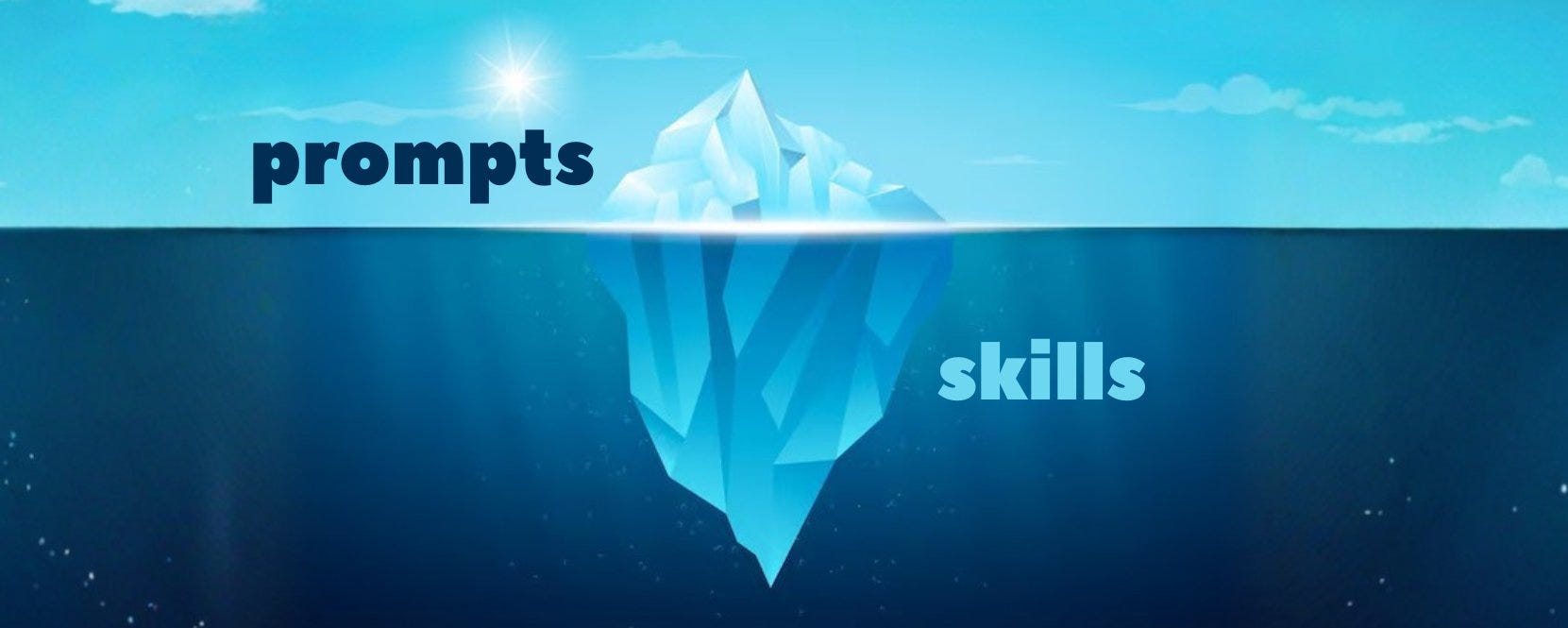
Something fundamental changed in how artificial intelligence works, and most people missed it. Not because the change was hidden, it was announced, documented, and shipped to millions of users. They missed it because it looked, on the surface, like a minor feature update. It was not. It was a reclassification of what AI actually is, and what it demands from the people who use it.
For the first several years of the large language model era, the defining skill was prompting. If you could write a clear, specific, well-structured prompt, you could get useful things out of a model. You could draft a memo, summarize a contract, generate code, write a marketing email. The prompt was the instrument. Being good at AI meant being good at prompting. That is no longer true.
In 2026, the game has changed. The defining skill is no longer how well you can phrase a one-time request. It is whether you can build a reusable, reliable, agent-readable piece of structured knowledge called a skill, and whether you understand why that distinction matters enormously.
Consider how a road works. A road has spatial parts spread across the region it occupies. Each stretch of road exists at a particular location in space, and the road as a whole is the sum of all those stretches. A prompt is like a single footstep, it exists in one moment, it leaves no structure behind. A skill is the road. It persists. It compounds. It serves every traveler who uses it, not just the one who thought to take the first step.
That analogy is more than decorative. It points to something real about the economics of AI in organizations. A prompt, no matter how brilliant, disappears when a conversation ends. It must be recreated each time. The practitioner who wrote it six months ago is no better off than the practitioner who writes it fresh today. There is no accumulation, no compounding, no institutional memory. Prompts evaporate. Skills do not.
A skill, in the technical sense that has now become standard across major AI platforms, is a structured file, typically a folder containing a markdown document, that encodes a methodology in a form that can be read and executed by a model or, increasingly, by an autonomous agent operating without a human in the loop. The format is deceptively simple. Its power is architectural.
What does a skill actually contain? Think of it in two layers. The first layer is a description, the part of the file that tells the AI system when and why to invoke this skill. The second layer is a methodology body, the part that tells it how to execute the task once invoked. Each layer demands a different kind of precision, and failures in either layer produce different kinds of breakdowns.
The description layer is where most practitioners underinvest. The natural instinct is to write a short, accurate label: “This skill summarizes legal documents.” That impulse is wrong. A vague description means the skill goes unused, not because it is bad, but because the system cannot reliably recognize when it applies. An effective description names specific document types, includes the kinds of phrases a human or agent would actually use when encountering the relevant situation, and specifies what the expected output looks like. The description is not a label. It is a routing signal. It is the mechanism by which a skill gets called rather than ignored.
The methodology body, the second layer, must do something that most procedural documentation fails to do: it must encode reasoning, not just steps. A sequence of numbered instructions is brittle. It handles the expected cases and fails the moment something unexpected appears. A well-constructed methodology body explains why each step matters, what quality criteria govern the output, and how the practitioner should think when edge cases arise. This is the difference between giving someone a recipe and teaching them to cook. A recipe fails without the right ingredients. A cook improvises.
Output format deserves particular emphasis here. Telling a model to “produce a summary” is instruction by implication, and implication is not enough. The skill must specify exactly what the output should look like: which fields, which structure, which sections, which length constraints. This level of precision is unnecessary when a human is reading the response and can self-correct. It becomes essential when an agent is consuming the output and passing it downstream to another automated process.
This brings us to the most important change of 2026, the one that most practitioners have not fully absorbed. The primary caller of skills is no longer human. It is an agent.
Reflect on what that means. A human working in an AI chat interface might invoke a handful of skills across an hour of work. An automated agent running a multi-step pipeline might invoke hundreds of skills in a single execution. A human who sees a poor output stops, notices, and corrects it. An agent that encounters the same poor output propagates the error forward, into downstream processes, into other agents, into deliverables, and possibly into consequential decisions before any human ever sees what happened. The failure modes are categorically different. Designing skills for human tolerance is designing them for the wrong environment.
This is not a marginal concern. It is the central design challenge of AI in organizations today. The practitioner who builds skills for the era of human invocation is building for a world that is already receding. The practitioner who builds skills for agent invocation, with explicit output contracts, precise edge case documentation, and composable structures that hand off cleanly to other agents and skills, is building for the world that is arriving.
What does agent-first skill design look like in practice? Three principles govern it. The first is that the description must function as a routing signal, not a label. An agent scanning its available tools is matching its current objective against skill descriptions. The description must therefore speak the language of objectives, not the language of features. It should answer the question, “when am I trying to accomplish something that this skill would serve?” not merely “what does this skill do?”
The second principle is that the output of every skill must be framed as a contract. The agent consuming a skill’s output needs to know, without ambiguity, what that output will contain, what it will not contain, and under what conditions the skill produces valid results. This is engineering discipline applied to natural language systems. It is unusual to think of a markdown file as a contract, but that is precisely what it has become.
The third principle is composability. If the output of one skill will be consumed by another agent or fed into a subsequent skill, that handoff must be designed deliberately. Assuming a downstream process will handle whatever comes its way is a reliable source of pipeline failures. Composability is not an afterthought. It is an architectural decision that must be made at the moment the skill is written.
Now consider what this means at the organizational level. Research has documented how leading teams are structuring their skill libraries into three tiers of increasing strategic value. The first tier covers standards, brand voice, formatting conventions, approved templates, and organization-wide methodology. These are the easiest to provision and the most commonly deployed, but they are also the least differentiated. Every organization using AI will eventually have these.
The second tier is where competitive advantage lives. This tier covers the working methodology of expert practitioners. How does your best underwriter actually evaluate risk? How does your most experienced engineer approach a new codebase? How does your strongest client services lead navigate a difficult conversation? That knowledge currently exists primarily inside those people’s heads. When they leave, it diminishes or disappears. When they are unavailable, it is inaccessible. A well-constructed tier-two skill converts tacit expertise into a persistent organizational asset. Knowledge management theorists have known for decades that tacit-to-explicit knowledge conversion is both the most valuable and the most difficult activity an organization can undertake. Skills are the first practical mechanism for doing it at scale.
The third tier covers personal workflow tools, the small automations that individuals build for their own daily efficiency. The caution here is not about whether to build them, but about where to store them. A skill that lives only on a single practitioner’s device is an organizational liability. Institutional continuity requires shared access even to individual-level tools.
One documented example makes the stakes concrete.
A real estate investment firm built more than 50,000 lines of skills across 50 repositories
, covering everything from rent roll standardization to team handoff protocols. These skills serve two functions simultaneously: agents use them to execute business processes reliably, and new employees use them as onboarding documentation. The same file that teaches a model how to analyze a comparable also teaches a new analyst what the firm considers important. The skill is both a technical artifact and a knowledge artifact. That dual function is not incidental. It is a preview of how AI changes the structure of organizational knowledge.
The broader industry context confirms that this is not a single-platform phenomenon. What began as a specific feature in one AI system has become a converging standard across the major AI platforms and the open-source agent frameworks built on top of them. The underlying format, a plain-text file that is simultaneously human-readable and machine-executable, has proven durable across platforms precisely because it does not require a proprietary runtime. A skill built carefully today will remain relevant as the underlying model infrastructure continues to develop.
Perhaps the deepest implication is economic. We are accustomed to thinking of expertise as a property of people. The lawyer who has handled 500 contracts knows things that a lawyer who has handled 5 contracts does not. That expertise was not transferable through documentation alone, because documentation was never precise enough to encode the underlying reasoning, only the surface procedure. Skills are precise enough. They can encode the reasoning frameworks, the quality criteria, the edge case logic, the decision principles that distinguish expert work from novice work. When that encoding is done well, the expertise becomes institutional rather than individual. It compounds. It improves with each iteration. It persists.
The practitioner who has been building and refining skills for the past year has a fundamentally different asset than the practitioner who has been re-pasting the same prompts into a chat interface. The gap between them will continue to widen, because skills compound and prompts do not. The question worth asking is not whether to build skills. It is whether you have already started, and if not, why not.
The prompt era was useful. It taught millions of people that language could be a programming medium, that clarity of expression produced clarity of output, that AI was a collaborator rather than a lookup table. Those lessons carry forward. But the prompt era is over as the primary modality for serious AI work. What has replaced it is something more demanding, more powerful, and more durable. It is infrastructure. And like all infrastructure, those who build it well will find that it serves them long after those who did not have forgotten why they fell behind.
For free Agentic AI how-to downloads visit: https://www.amuseonx.com/agenticai
The glass ceiling is truly shattered and mankind is peering into a limitless universe.