


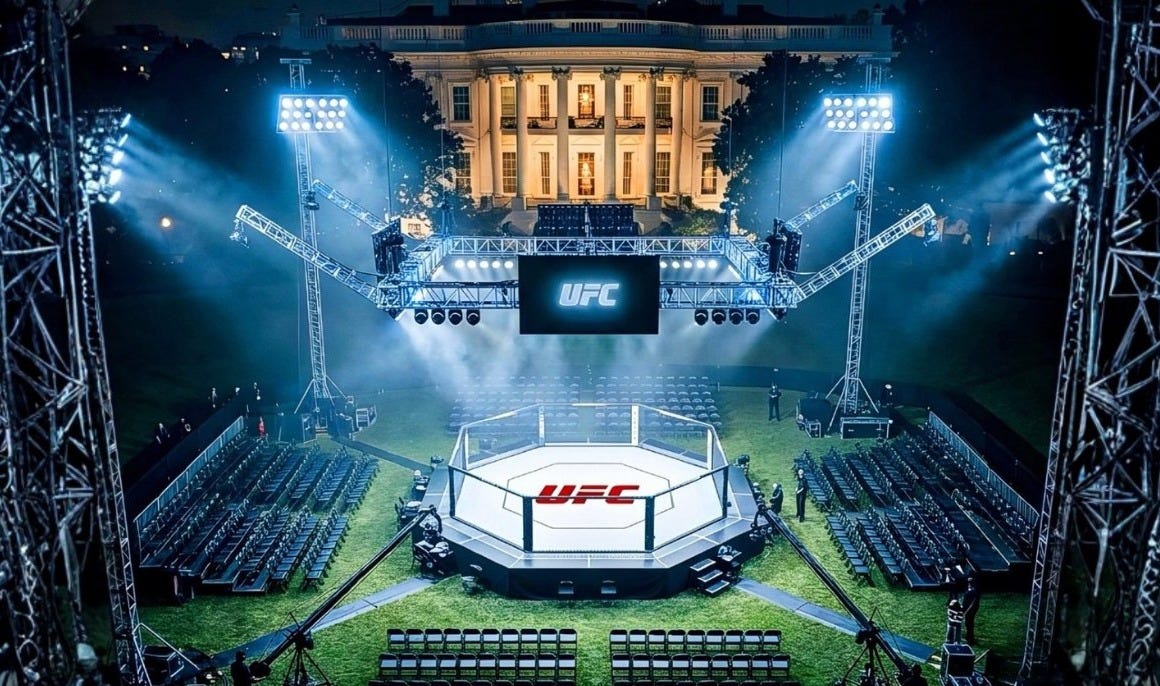
Consider a simple test for any claim of desecration. Ask whether the act in question is genuinely foreign to the place, or whether it merely feels foreign to the person complaining. The distinction matters, because desecration is not a synonym for discomfort. To desecrate something is to violate its essential character, to do to it what it was never meant to endure. A cathedral is desecrated when it is used as a slaughterhouse. It is not desecrated when someone holds a wedding there, even a wedding the neighbors dislike. So when Democrats announce that the upcoming UFC Freedom 250 event on the South Lawn is "a desecration of the White House, America, our history, and the dignity of the office of the presidency," the honest question is whether a professional fight card actually violates the essential character of the White House, or whether it simply offends a particular class of people who have decided, rather recently, that the People's House is a museum.


The answer is not close. The historical record buries the desecration claim, and it does so with the most celebrated names in the building’s history.
Start with the man who, more than any other president, built the modern presidency: Theodore Roosevelt. The objection assumes that combat sport and the White House are strangers to one another. They are not. They are old companions. Mike Donovan, an ex-middleweight champion and professional boxing instructor, published a memoir in 1909 with the unambiguous title “The Roosevelt That I Know; Ten Years of Boxing with the President.” The Library of Congress preserves the bibliographic record. The Internet Archive preserves the full text. Donovan was not a hanger-on who once shook the president’s hand. He sparred with Roosevelt for over a decade, and he wrote that their bouts were “give and take” with “no restrictions.” He had to draw on the arts and devices of a professional fighting career to protect himself from a sitting president of the United States.

Notice what follows from this. The White House did not merely tolerate boxing in some abstract, ceremonial sense. It hosted the real thing. Donovan recorded that his first invitation to box at the White House came in January 1904. The Theodore Roosevelt Center independently corroborates the relationship through Donovan’s own correspondence: in November 1904 Donovan accepted Roosevelt’s invitation, contacted a glove maker to produce two sets of gloves for the president, and located a Washington sparring partner for him. The visit was planned. It was equipped. It recurred. And it was no secret, because a later Donovan letter notes that news of the invitation had leaked to the press.
The single best anecdote is the one to keep in mind whenever someone invokes the dignity of the office. Donovan described a bout the evening before Roosevelt’s inauguration, a “go” of roughly ten rounds. He wrote that they boxed “ten hard, long rounds,” that the fight was “hot and heavy,” and that Roosevelt knocked him sprawling to the mat with a right hand. Here is a president, on the eve of his own inauguration, throwing and absorbing real punches inside the Executive Mansion. The UFC event by contrast does not put the president in the cage. Trump is hosting professional athletes. Roosevelt was the professional athlete’s opponent. If anyone has standing to clutch the pearls of presidential dignity, it is not the side defending a regulated, ticketed sporting card.
Some readers will object here. Was this not a private indulgence, a bit of personal exercise rather than a public spectacle on the lawn? The objection misses the point, and in a way that actually strengthens the case. Roosevelt did not want soft, ceremonial sparring. When Donovan once tapped him lightly, Roosevelt stopped and told him he was not really hitting, and instructed him to “hit out.” Donovan obliged with a hard shot to the body and a try for the jaw. This was contact sport, sought deliberately, by a man who understood the optics and accepted them. Roosevelt later told Pierre de Coubertin that presidential boxing looked faintly absurd when it produced a black eye or a swollen nose. He kept boxing anyway. The risk was not theoretical, either. He lost the sight in one eye to a punch absorbed during his White House years. The desecration crowd is therefore complaining that a temporary outdoor arena, with trained fighters and medical staff and referees, somehow defiles a building where a sitting president went partially blind from a sparring injury he sought out on purpose.
Boxing was not the limit of it. The combat tradition reached into the most ceremonial interior space in the residence. The White House Historical Association, which is not a MAGA operation but the official custodian of White House history, records that around 1905 Roosevelt invited the celebrated martial artist Yoshiaki Yamashita to the White House and that “the president himself took part” in a jiu-jitsu demonstration in the East Room. The audience included a future president, William Howard Taft, along with Roosevelt’s own children. A Roosevelt letter from April 1904 shows he paid Yamashita for judo lessons given to himself and to Gifford Pinchot, and that he enjoyed them. Modern mixed martial arts is precisely the marriage of striking and grappling, of boxing and Japanese jiu-jitsu. Roosevelt’s White House contained both. The East Room, the grandest room in the house, hosted throws and holds and a participating president. A temporary Octagon on the lawn is not an alien intrusion into this history. It is a descendant of it.
Nor did the martial vigor stop at gloves and grappling jackets. The Theodore Roosevelt Center documents repeated single-stick and broadsword exercise during the Roosevelt presidency. In January 1903 an aide reported that the president could do no more work because of a single-stick injury to his right hand. In February 1903 Roosevelt was at single-stick with General Leonard Wood and Lieutenant McCoy. In January 1904 he recorded fighting broadsword against Granville Fortescue. In December 1904 he had to postpone a Donovan boxing visit because he had hurt himself at single-stick. The Roosevelt White House was a place of disciplined physical combat, conducted alongside military men, treated not as a stain on the office but as the natural conduct of a serious republic’s chief executive.
Step back from Roosevelt and the broader pattern is just as clear. The grounds themselves have always been a place of American sport. The White House Historical Association states plainly that the White House has long been a site for celebrating and engaging in sports, including basketball, tennis, swimming, and bowling, along with receptions for athletes and teams. The land now called the Ellipse, the very area being used for the public UFC fan experience, was once the White Lot, an open field used for baseball in the 19th century. Lincoln and his son Tad watched a game there in 1862 from the first-base line. In 1904 the White House opened the White Lot to amateur baseball on three diamonds. Herbert Hoover played his medicine-ball game on the South Lawn at dawn, a six-pound ball hurled over an eight-foot net by his so-called Medicine Ball Cabinet, a game one observer judged more strenuous than boxing or wrestling. George W. Bush opened that same South Lawn to children for Tee Ball, and from 2001 to 2008 some 563 players competed in 20 games on the grass.
So the precedent is not thin. It is overwhelming. Baseball on the lawn, medicine ball on the lawn, Tee Ball on the lawn, jiu-jitsu in the East Room, boxing throughout the residence, single-stick and broadsword with army officers, and a president who personally fought ten hard rounds the night before his inauguration. If all of that belongs to the dignity of the office, and it manifestly does, then a regulated professional fight card for the nation’s 250th birthday cannot be the thing that finally crosses the line.
Which brings us to the real objection, the one that hides beneath the language of desecration. Roosevelt’s toughness is romanticized. Hoover’s medicine ball is treated as a charming quirk. Bush’s Tee Ball is wholesome Americana. Olympic champions visiting the White House are patriotic. Yet UFC under Trump, branded for America 250, is suddenly a violation of the sacred. The common thread in the approved examples and the forbidden one is not the activity. It is identity. The objection is not to combat, crowds, or spectacle, all of which the White House has hosted for over a century. The objection is to the host and to the audience, to the working-class, flag-waving, fight-loving Americans whom Dana White had in mind when he said the White House “belongs to the people of America.” That is the tell. The complaint is aesthetic and tribal, dressed in the borrowed robes of reverence.
There is also a deeper principle at stake, and it is worth stating without apology. A republic should not be ashamed of strength. Roosevelt did not preach the strenuous life as a personal eccentricity. He understood vigor, discipline, courage, and competition as civic virtues, the qualities that build the kind of citizens a free country needs. Notice, too, that when football grew dangerously violent, Roosevelt did not respond with aristocratic disgust and a call to abolish it. In October 1905, after a season that saw 18 deaths, he summoned coaches from Yale, Princeton, and Harvard to the White House and pushed reform. The result was the body that became the NCAA and a safer set of rules. He civilized the rough sport rather than banning it. Modern regulated MMA, with its weight classes, medical oversight, and referees, is the realization of exactly that Rooseveltian instinct: physical contest, conducted with rules, celebrated rather than hidden.
The White House is not a velvet-rope museum to be admired from a respectful distance by a narrow elite. It is the People’s House, and the people it belongs to have always brought their games, their fights, and their physical joy onto its grounds. The desecration argument fails not because the critics lack passion but because they lack the history. Teddy Roosevelt put on the gloves inside the White House. Trump merely put up the Octagon outside it. One of those men was far braver about it, and it was not the one the modern left is busy lecturing.
If you enjoy my work, please subscribe https://x.com/amuse/creator-subscriptions/subscribe
Alexander Muse is a Fellow at the John Milton Freedom Foundation and publishes daily political analysis at amuseonx.com. Primary sources cited in this piece are linked inline; campaign finance figures are drawn from FEC filings, polling data from publicly released crosstabs, and legal claims from filed pleadings. Corrections are posted to the original URL with a dated changelog. Readers who identify errors are invited to contact the author directly.
I wonder, please tell me, who desecrated the White House more - Clinton playing patty fingers with an intern and a cigar, Obama underhandedly working to unseat a duly elected successor, or Biden the Cabbagehead who shuffled around the building in diapers not knowing what day it was? (Let’s not even bring up all the people the Clintons and Obama had murdered to shut them up.)
Or President Trump who is working tirelessly to bring America back to glory and to uplift all American citizens?
The Left does not hate UFC because it is violent. It hates UFC because it is honest. No one cares about your pronouns, your trauma essay, your Ivy League credentials, or your protected status once the cage door closes. Can you fight? Can you take punishment? Can you win? That is meritocracy stripped to the bone, and the permanent political class despises anything that exposes its own fraudulence. Roosevelt understood the strenuous life. Trump understands the people. UFC on the South Lawn tells America 250 the right story: strength, courage, discipline, competition, victory. Spare us the lecture on dignity.