


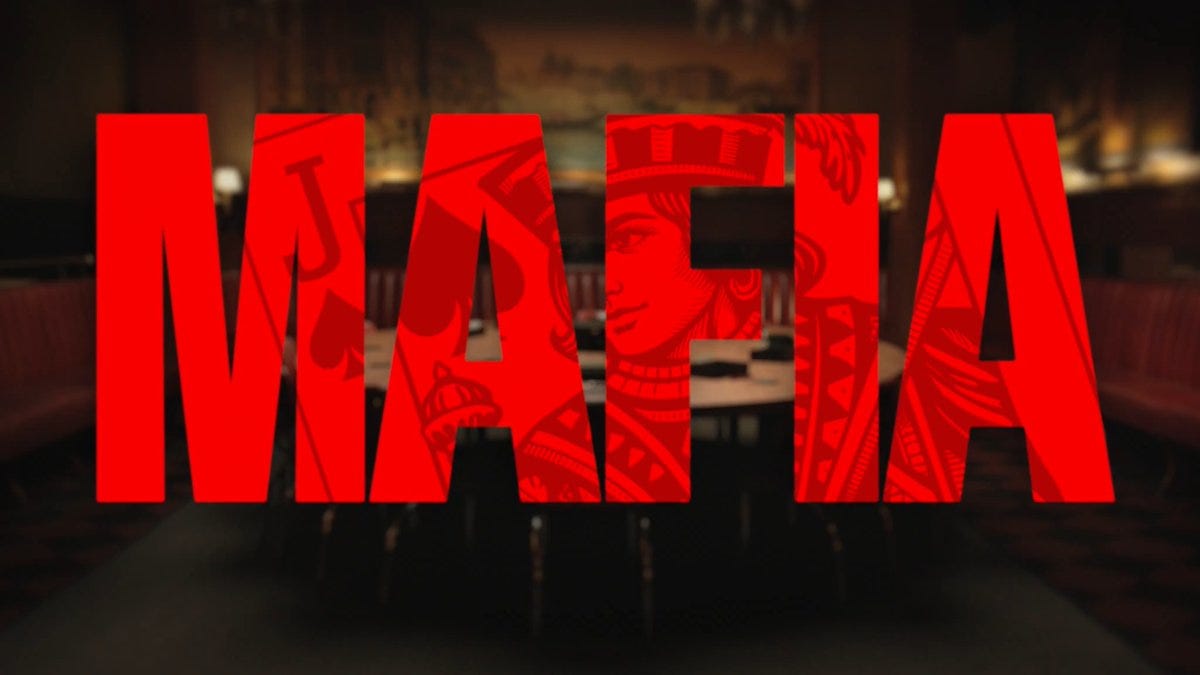
A peculiar thing happened recently in the place where cultural fashions are minted. Founders Fund, the venture firm built by Peter Thiel and a roster of contrarian investors, released a slick video series called Mafia. The premise is simple and the production is anything but. Prominent technologists, among them Sam Altman, Palmer Luckey, Dylan Field, Moxie Marlinspike, and Bryan Johnson, gather around a table to play a social deduction game that most readers will know by its other name, Werewolf. Over 33 minutes the audience watches accusations form, alliances harden, and players vote one another out of the room. The replies have been admiring. Viewers call it gripping. They are right. The game is gripping, and it is gripping for a reason that the players themselves may not have fully considered.
I want to use this moment of renewed attention to make a claim that is unusual but not fanciful. The very game that Silicon Valley now plays for entertainment is the same game that European regulators have institutionalized as policy. The mechanics that make Mafia compelling on a screen are the mechanics that make modern speech regulation effective in practice. Founders Fund has, perhaps inadvertently, handed us the perfect teaching aid for understanding how democratic states now govern information.
Begin with the game itself, because its origins are not incidental. Mafia, later rechristened Werewolf, was invented by Dimitry Davidoff at Moscow State University in the 1980s. Davidoff designed it as a teaching tool and a psychological experiment, a way to expose how groups make decisions under uncertainty when one faction possesses hidden coordination. His environment shaped his insight. He lived in a society organized around information asymmetry, where the state controlled official truth and citizens navigated life through rumor, inference, and trust networks. Davidoff did not invent propaganda. He formalized its mechanics. He built what a philosopher would call a toy system, a model that strips reality down to its essentials so the underlying structure becomes visible.
The structure is elegant in its cruelty. A small group of players, the werewolves, know who each other are. The rest, the villagers, do not. At night the werewolves act secretly and eliminate a villager. During the day the whole group debates and votes on whom to eliminate. The villagers have only speech, persuasion, and inference. The werewolves have coordination and hidden knowledge. Davidoff stated the principle plainly. The game is a struggle between an informed minority and an uninformed majority, and the only advantage the werewolves possess is that they know one another.
That advantage is usually sufficient. The werewolves do not need to be smarter than the villagers. They do not need to be morally persuasive. They need only to shape perception long enough to survive each round. The lesson is not that truth disappears. The lesson is subtler and more disturbing, which is that truth does not win on its own. It must be carried by persuasion, and persuasion can be manufactured by whoever controls the informational terrain. A coordinated minority that defines what counts as legitimate knowledge tends to dominate an uninformed majority, no matter how numerous or well-meaning that majority is.
Davidoff drew on Lev Vygotsky, whose work on cognition stressed the social formation of knowledge. Vygotsky in turn was steeped in Marxist philosophy, in historical materialism and dialectical thinking. Knowledge on this view is not simply discovered by an individual mind. It is mediated through social structures. Davidoff took that idea into the laboratory of the parlor. He wanted to know how accusations form, how coalitions stabilize, and how a group reaches decisions when certainty is unavailable and coordination is asymmetric. The answer his game returns, again and again, is that the managed environment beats the open one.
Games are not neutral. They teach habits of thought through repetition. Werewolf teaches one habit above all others, which is that open deliberation collapses when shared facts are contested, and that a coordinated minority can govern a majority if it controls the flow of information. The game spread rapidly. By the late 1980s and early 1990s it had become common across European universities, requiring no equipment beyond people and time. It crossed the Atlantic and surfaced at elite technology gatherings such as the Game Developers Conference, ETech, the Foo Camps, and South By Southwest. Founders of major platforms played it. Security services adopted it formally. In the late 1990s the Kaliningrad Higher School of the Ministry of Internal Affairs built training manuals around it to sharpen psychodiagnostics and the reading of body language. The Founders Fund series is therefore not an introduction of the game to the powerful. It is a homecoming, broadcast.
Now consider modern information regulation, and watch the same architecture reappear in law. The European Union’s Digital Services Act is framed as a response to systemic risks, including disinformation and threats to civic life. It does not merely prohibit illegal content. It imposes obligations on platforms to mitigate societal harms, and to do so it designates trusted flaggers whose judgments receive priority treatment and procedural weight. Platforms face penalties if they fail to act. The result is a familiar shape. A small, coordinated class of regulators, NGOs, and enforcement-linked bodies gains privileged access to information control, while the general public remains formally free to speak but practically uncertain about what is permitted. Enforcement happens offstage through algorithmic suppression, shadow-banning, and quiet removals. Public labeling and deplatforming occur during the moments of accusation. Platform administrators and government coordinators act as the moderators who alone know the full state of play.
The parallel is structural, not rhetorical. The informed minority becomes the trusted flaggers, fact-checkers, and regulators. The uninformed majority becomes the public that relies on open discourse. The night phase becomes invisible enforcement. The day phase becomes public misinformation labeling. The moderator becomes the platform-state complex that sees every card on the table. Critics across the conservative policy world, from scholars at the Heritage Foundation to legal commentators tracking transatlantic speech law, have noted that this design bypasses traditional due process. Faced with administrative risk, platforms rationally err on the side of over-removal, producing collateral censorship and a chilling effect in which disagreement with elite consensus becomes a compliance problem rather than a contribution to debate.
Ideas have biographies, and so do institutions. The Digital Services Act did not descend from an abstract bureaucracy. It was shaped by a tightly connected group inside the European Commission, particularly within DG CONNECT and the cabinets surrounding digital and competition policy. Figures such as Lucilla Sioli, long a director for artificial intelligence and digital industry, and Renate Nikolay, a senior cabinet official in the Vestager orbit, were educated at European universities in the 1990s, precisely when Werewolf had become a standard social and analytical pastime on those campuses. Their later roles placed them in structurally decisive positions, where the framing of online speech as systemic risk could be translated into technical compliance obligations and aligned with enforcement authority at the highest level. This is not conspiracy, and it does not require conspiratorial intent. It reflects a shared intellectual repertoire, learned early, rehearsed socially, and applied administratively.
The United Kingdom walked a parallel road. The Online Safety Act formally targets illegal content and harms to children, yet its development history shows persistent pressure to regulate speech that is lawful but deemed harmful. Several of the women positioned around the Act were formed in the same institutional environment and at the same moment. Senior figures across the relevant government department, the regulator Ofcom, and enforcement-adjacent bodies such as the Internet Watch Foundation share an Oxford cluster of the same generational cohort. Again, the salient fact is not a plot. It is a common formation, rehearsed repeatedly in a hidden-role game that treated open discourse as unstable and managerial oversight as necessary.
Here the central irony arrives. Davidoff’s lesson was diagnostic, not prescriptive. He showed how manipulation works. Modern regulators adopted the structure and rebranded it as a cure. They claim to defend democracy from manipulation, and the method they choose is to monopolize the category of legitimate information. The move rests on a deeply pessimistic view of the public. Half of any population has an IQ under 100, and many policymakers assume citizens are cognitively vulnerable to narrative capture, a belief reinforced by a continental educational system in which fewer than half of Europeans are even permitted to apply to university, a sorting mechanism that separates those deemed fit to manage knowledge from those expected merely to receive it. Cass Sunstein and Adrian Vermeule once described conspiracy belief as a crippled epistemology and floated cognitive infiltration as a remedy. The assumption underneath is managerial. The public cannot be trusted to reason without supervision.
But democracies differ from authoritarian systems in one decisive respect. There is no naturally informed minority. Truth is contested in the open, information competes, and authority is meant to emerge through persuasion rather than enforcement. To recreate the werewolf advantage inside a democracy, elites must manufacture it. They must control the flow of information, define harm, and enforce a single set of shared facts. That is precisely what modern censorship regimes attempt. They transform disagreement into regulatory risk, replace persuasion with compliance, and substitute invisible enforcement for public debate. The game mechanics remain unchanged. Only the rhetoric is updated.
So watch the Founders Fund series, and enjoy it. The production is excellent and the players are sharp. But understand what you are watching. Davidoff built a model to warn us that the side which defines the informational terrain wins, and that this insight is morally neutral, equally available to those who would defend openness and those who would rationalize control. The tragedy is that the people who claim to oppose manipulation have institutionalized it. Werewolf ends when the villagers realize, too late, what structure they were playing inside. The men and women at the Founders Fund table get that moment of revelation when the host reveals the roles. Modern societies may not be so lucky, because the system that now governs our speech does not announce itself as a game. It announces itself as safety.
If you enjoy my work, please subscribe https://x.com/amuse/creator-subscriptions/subscribe
Alexander Muse is a Fellow at the John Milton Freedom Foundation and publishes daily political analysis at amuseonx.com. Primary sources cited in this piece are linked inline; campaign finance figures are drawn from FEC filings, polling data from publicly released crosstabs, and legal claims from filed pleadings. Corrections are posted to the original URL with a dated changelog. Readers who identify errors are invited to contact the author directly.
Democrat politicians along with Biden, Garland, Wray, Fauci, CDC used this game for covid mandates and censorship. Then they turned around and used it against J6 protesters.
The people who are in power, particularly a band formed within that cohort, who make the rules, know all the secrets and have control over it all through a captured and controlled narrative (the media, censorship, enforcement), will always have the upper hand.
Until they don’t.
And the one thing that always brings them down is when they get drunk on their success and power, believe they are invincible, and always go too far.
Inevitably, it is that very human factor that is their undoing, and, though it can take a very long time to come to pass, eventually it exposes them and brings the whole house of cards down.
Hubris will always invite Nemesis. It’s the political circle of life.