


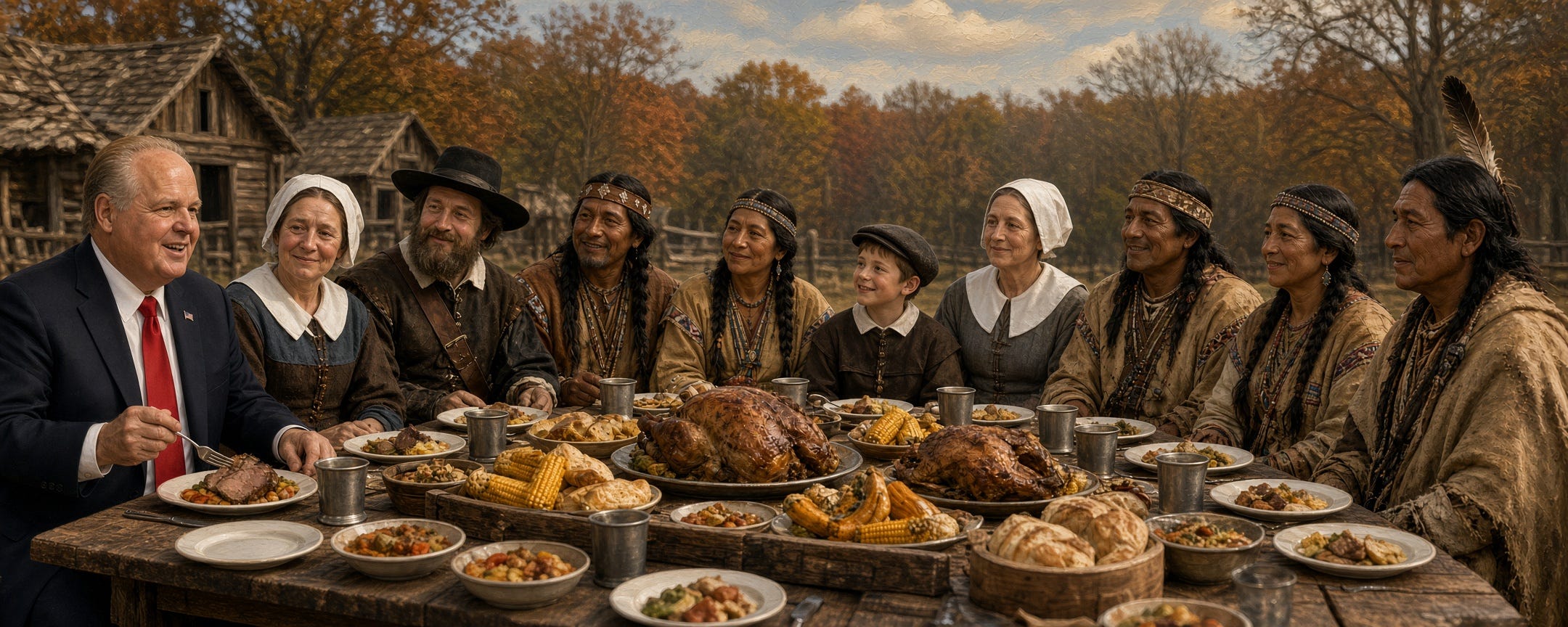
Every November the politically correct account of Thanksgiving comes around again, and every year Rush Limbaugh answered it with a different story, told with enough wit to hold a radio audience through a dispute over colonial land tenure. In his telling, the Pilgrims nearly starved under a system of common ownership and were saved when William Bradford gave each family its own plot. He had the history right, and the story deserves retelling this week, in his memory and in something like his voice.
The Pilgrims were separatists in early 17th-century England, ruled by King James I, where the Church of England held a monopoly on worship and defended it with arrest, imprisonment, and even execution. That government feared any kind of freedom, especially the freedom to worship as one saw fit, because the crown read dissent from its church as a threat to both the state and the crown. So the separatists fled to Holland. The Dutch tolerated them, but tolerance is not a home, and after eleven years about 40 of them resolved to risk the Atlantic, which they knew was no friend, only a beast.
The Mayflower sailed on August 1st, 1620, with 102 passengers aboard, and Governor-to-be William Bradford was among them. Bradford, a leader of the Pilgrims, set forth a vision for their new society in the Mayflower Compact, a pledge to frame “just and equal laws” for the good of the whole company, an early experiment in self-government that took its inspiration from the Bible. Rush stressed that these were no ordinary men and women. They read themselves into the Old Testament, a new Israel bound for a Promised Land.
Bradford’s wife did not see the first spring, and neither did half the company. They reached New England in November, and Bradford’s journal describes a desolate wilderness: a shore with no friends waiting and no inn with a fire, and winter took them by disease, exposure, and starvation. What kept them from giving up was their faith and their belief in their mission.
Spring brought help, and here the schoolbooks stop. The Native Americans taught the colonists to plant corn, to fish for cod, and to gather resources, and the sanitized elementary school version of the holiday closes on that scene of neighborly instruction. Rush insisted the real turn came later. The Pilgrims had new skills and planted fields, and they still were not thriving, because the system they worked under was a disaster.
Bradford’s remedy was to assign each family its own plot and let it keep whatever it raised there. The decision broke with the colony’s contract, since the London sponsors who financed the voyage had demanded collectivism. Everything produced went into a common store, and each person drew an equal share. Nobody owned anything individually. The houses they built and the land they cleared belonged to everyone, no matter how hard or little anyone had worked. In essence, this was socialism, and Bradford’s journal records what it produced in Plymouth: “much confusion and discontent.” Why work harder than the next man when the reward is identical? The industrious lost their incentive, and the idle lived off their neighbors’ labor. Rush called it a forerunner of the 1960s communes, organic vegetables and all, minus efficiency and prosperity.
Private plots changed that. As Bradford recorded, “This had very good success for it made all hands industrious.” Property rights and the spirit of enterprise did what the common store could not, and what followed was nothing short of a miracle. The fields filled with corn and the colony began to prosper.
The feast with the Native Americans did happen, and the two peoples celebrated the bounty of a real harvest together. But the thanks went to God, and the Pilgrims thanked Him for guiding them to the principles that carried them from near-starvation to abundance: hard work, private property, individual liberty, personal responsibility, and the freedom to reap the fruits of one’s own labor. Capitalism saved Plymouth. Socialism had nearly buried it. Rush drew the same lesson from Joseph in Genesis, where Egypt prospered once Pharaoh reduced taxes to 20%, and he noted that the Pilgrims learned long before Karl Marx wrote a line what human nature does when effort and reward are pried apart.
The Democrat Party’s domestic program is a common store with better marketing. The productive pour in, a committee ladles out, and the people who design it carry the same confidence the London sponsors carried, that a man will work as hard for a stranger’s share as for his own. Bradford ran that experiment on a bare coast with the survivors of a winter that had killed half his people, a company bound by faith and by grief and with every reason to pull together, and it failed anyway. Then he handed out the plots, and the corn came in.
Rush refused to let a November pass without this story. The approved version he spent his career fighting wanted Thanksgiving to be about anything but property and incentive; he kept saying otherwise, plainly and on the air and with a grin, the way the separatists kept worshipping as King James had forbidden. Like those Pilgrims, he had the courage to speak truth to power and to challenge the orthodoxy, and he spent every late November reminding us of a lesson history had already taught.
So when the turkey and the stuffing come out, and the football comes on, somebody at the table ought to tell the whole story, and the people who govern ought to help. The President’s Thanksgiving proclamation should quote Bradford’s own sentence about all hands made industrious, and the state legislatures that write the civics standards should require the common-store chapter alongside the feast, so a schoolchild learns what Plymouth did between planting and harvest. The Pilgrims were grateful for something specific: the liberty to keep what they had earned, and that liberty carried America from a bare coast to greatness. They had already learned what the common store does. At the end of the day, a country that keeps Bradford’s sentence in its proclamations and its classrooms will not have to learn that twice. Happy Thanksgiving.
If you enjoy my work, subscribe https://x.com/amuse/creator-subscriptions/subscribe
Alexander Muse is a Fellow at the John Milton Freedom Foundation and publishes political analysis at amuseonx.com. Readers who identify errors are invited to contact me directly. Each op-ed is edited for grammar and clarity using AI in partnership with Grammarly. Data provided in a sponsored partnership with Polymarket.
Great essay. Thank you for bringing Rush back for Thanksgiving! A perfect reminder for all of us.
A lot of us miss Rush.
He could make a story about farming in Plymouth something you actually looked forward to hearing every year.
He made you laugh and gave you something to think about. Hard to replace that.