


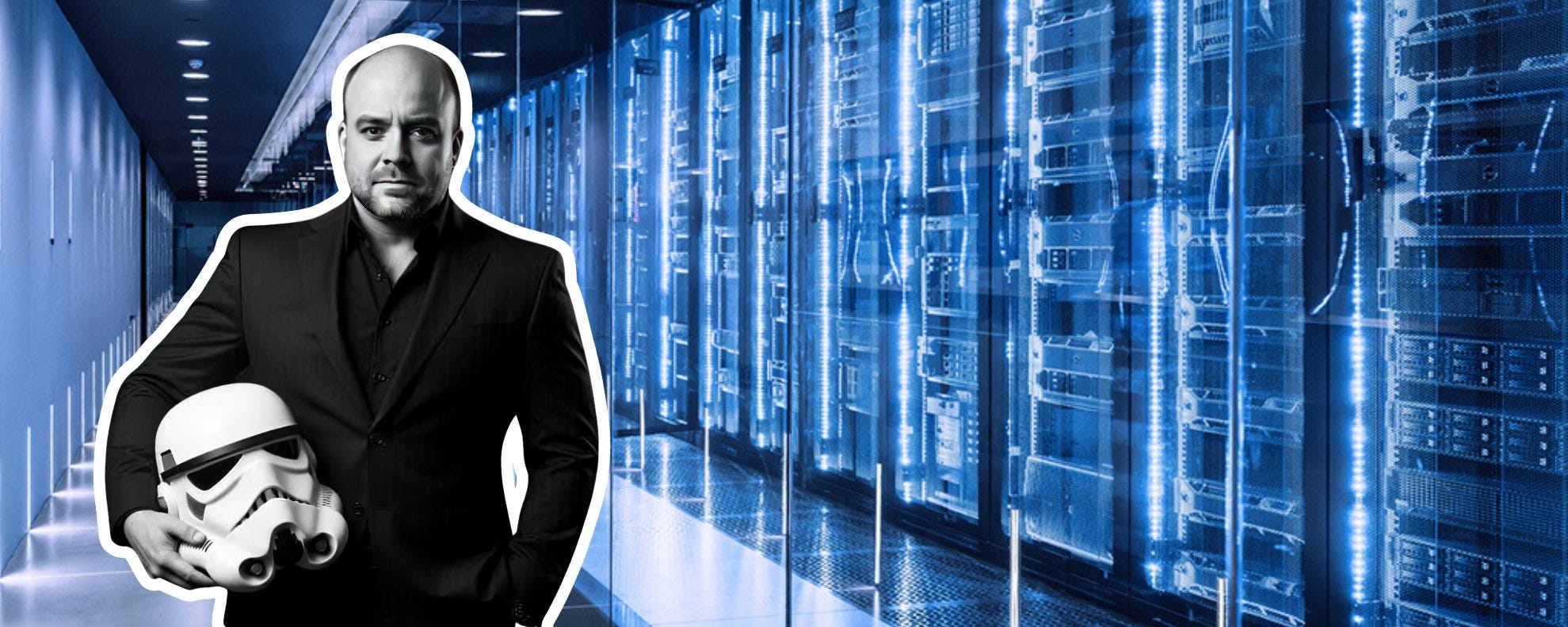
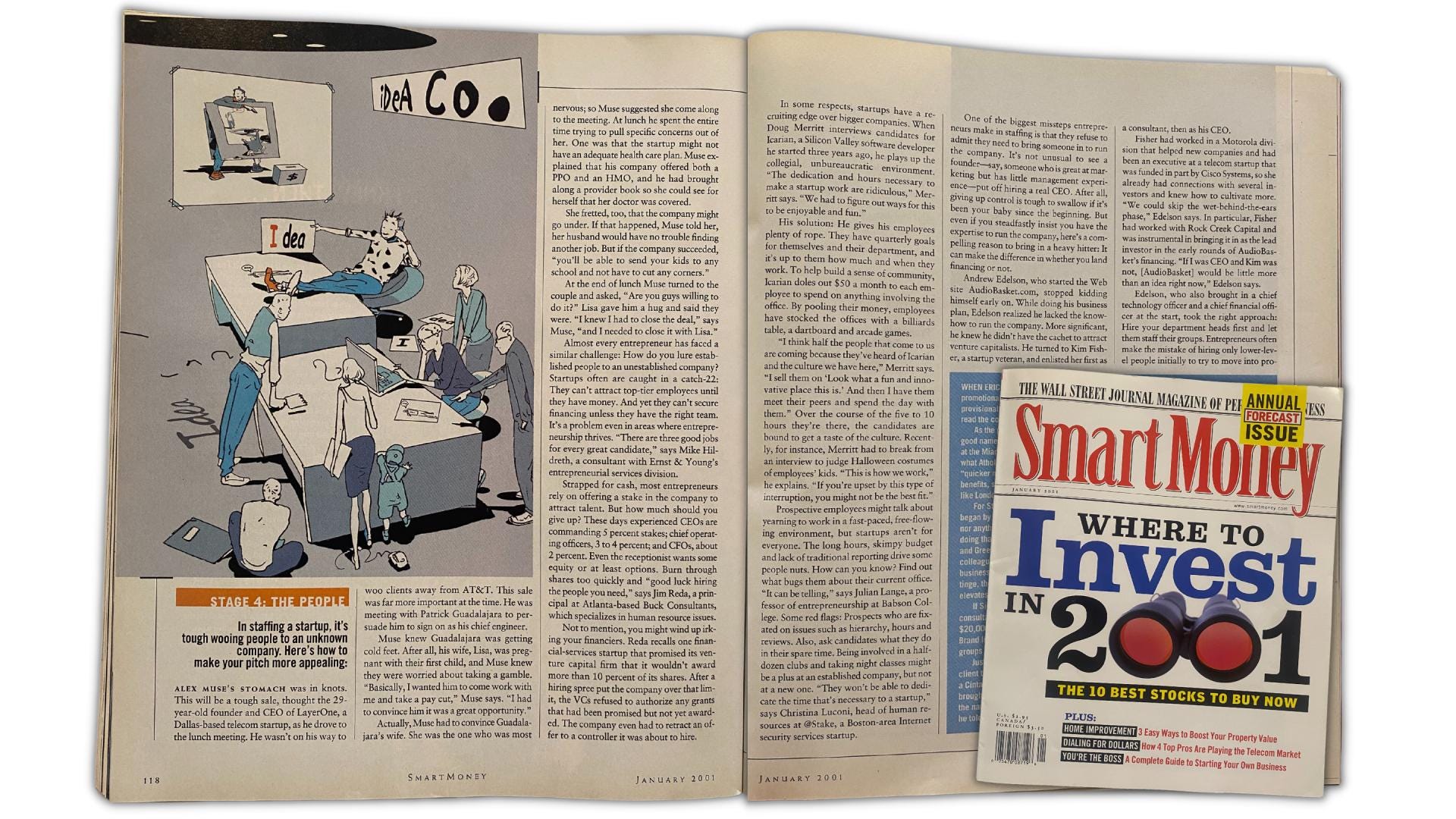
I spent the late 1990s and early 2000s building data centers in the middle of America's largest cities. We built them in Dallas, Miami, New York, Los Angeles, Chicago, and St. Louis. Thousands of people walked past our buildings every day. They did not protest them. Most did not even know what was inside.
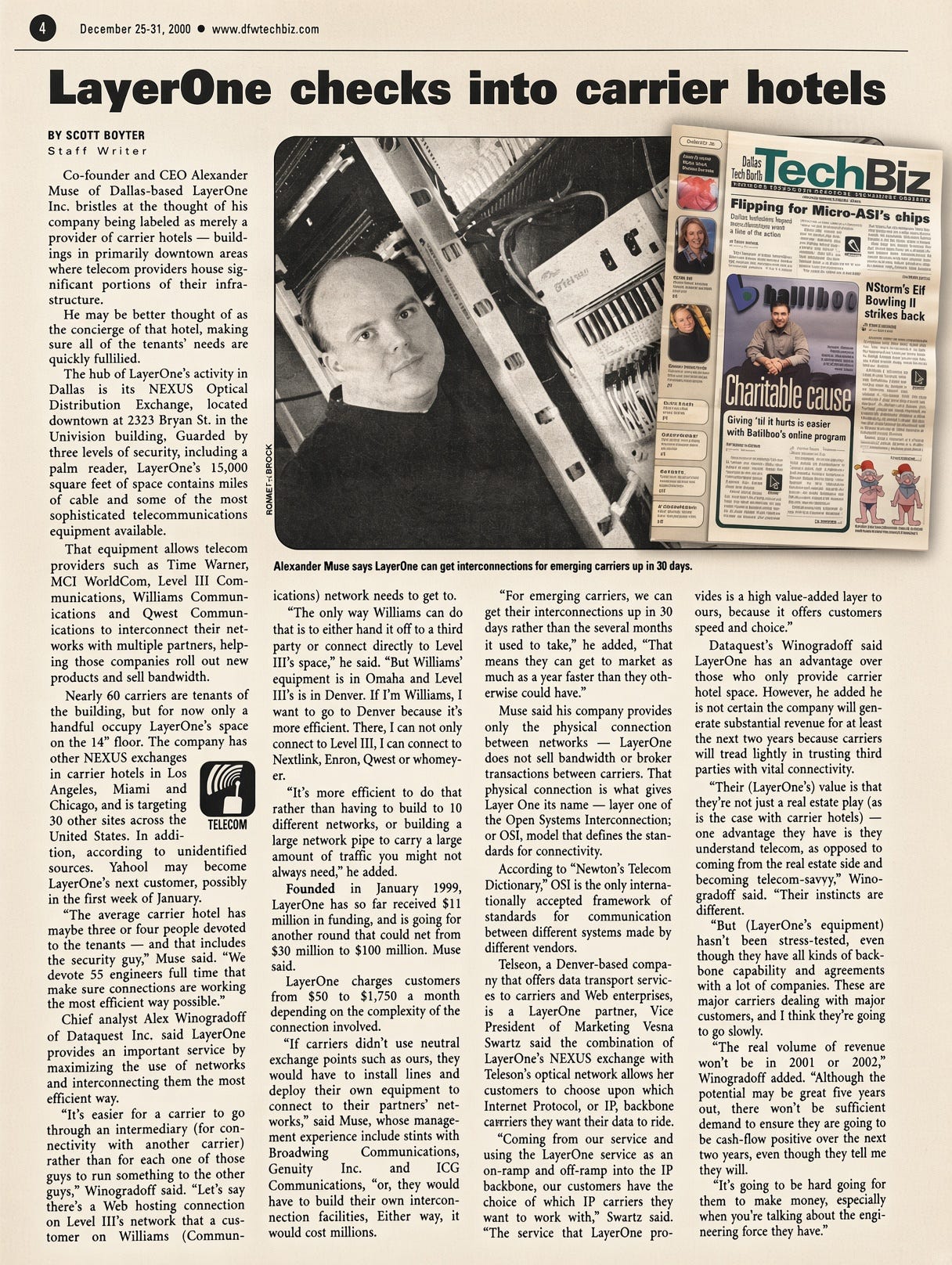
That silence was not a cover for some environmental menace. Our data centers were good neighbors. They occupied underused buildings, produced almost no traffic, and bought enormous amounts of electricity from the grid while our cooling systems consumed no water. Servers and telecommunications gear hummed behind anonymous walls while the fiber inside connected businesses and consumers to a rapidly expanding Internet.

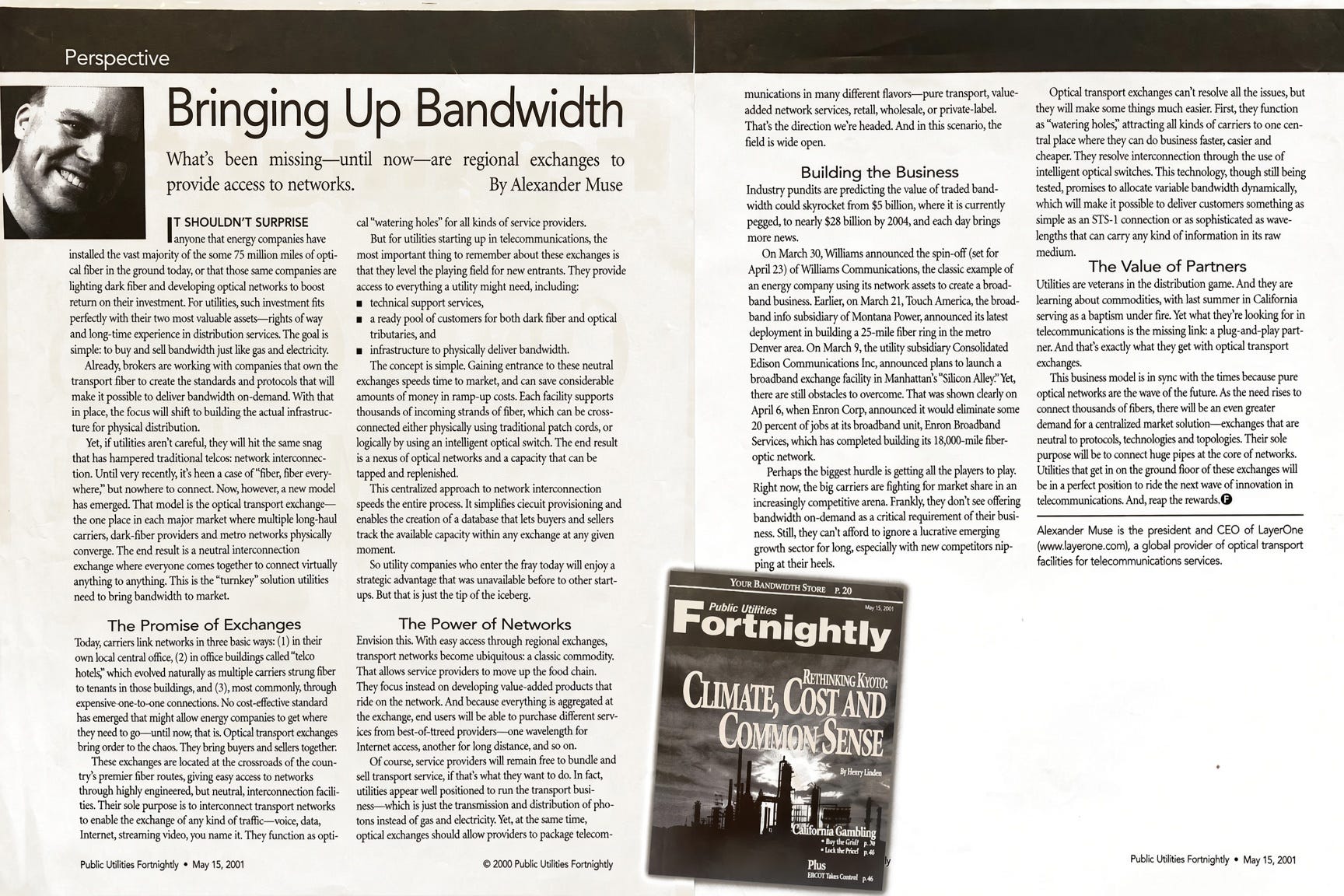
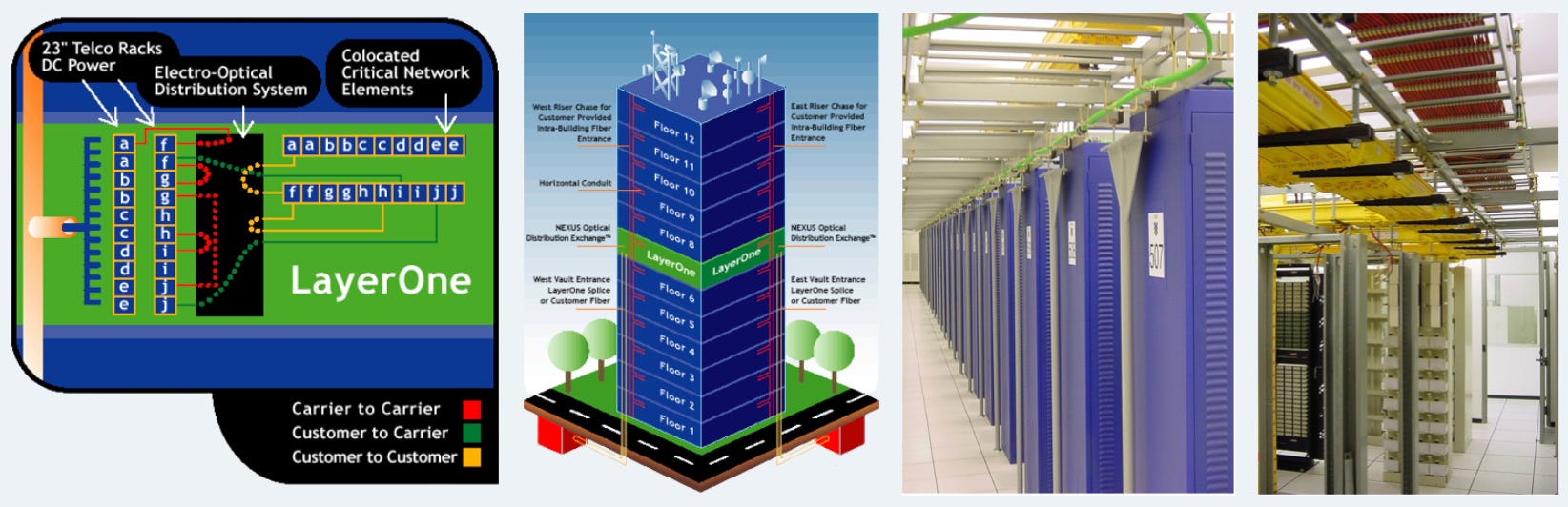
We were hardly alone. After the Telecommunications Act of 1996 opened local telephone networks to competition, venture-backed companies raced to build carrier hotels and colocation facilities across the country. Section 251 of that law required incumbent carriers to interconnect with competitors, which created demand for neutral buildings where rival networks could meet. Equinix, Colo[.]com, Exodus, Switch & Data, LayerOne and scores of others poured billions of dollars into the physical plant of the dot-com economy. The Federal Reserve later described "a massive boom in the sector, beginning in 1997." Then the bubble burst, investors lost fortunes, and the data centers remained. They became the backbone of the cloud, mobile communications, streaming, e-commerce, and now AI.
Today, the US has more than 5,000 confirmed operational data centers. Pew Research Center found this spring that 87% of existing facilities sit in urban areas and that 38% of Americans live within five miles of one. Data centers are already part of American communities. Before activists and NGOs told Americans to fear data centers, Americans had already spent 30 years living beside them. Most Americans still do not realize they have been living beside them for decades, which is the strongest available proof they were good neighbors. They went unnoticed because they produced almost none of the disturbances we associate with industrial facilities: no crowds, no commuter traffic, no loading docks full of daily deliveries, no assembly-line noise, no smokestacks, no pollution. A facility that generated real harm in Lower Manhattan or downtown Los Angeles would have been sued, fined, or shut down long ago. Thirty years of silence is a verdict.
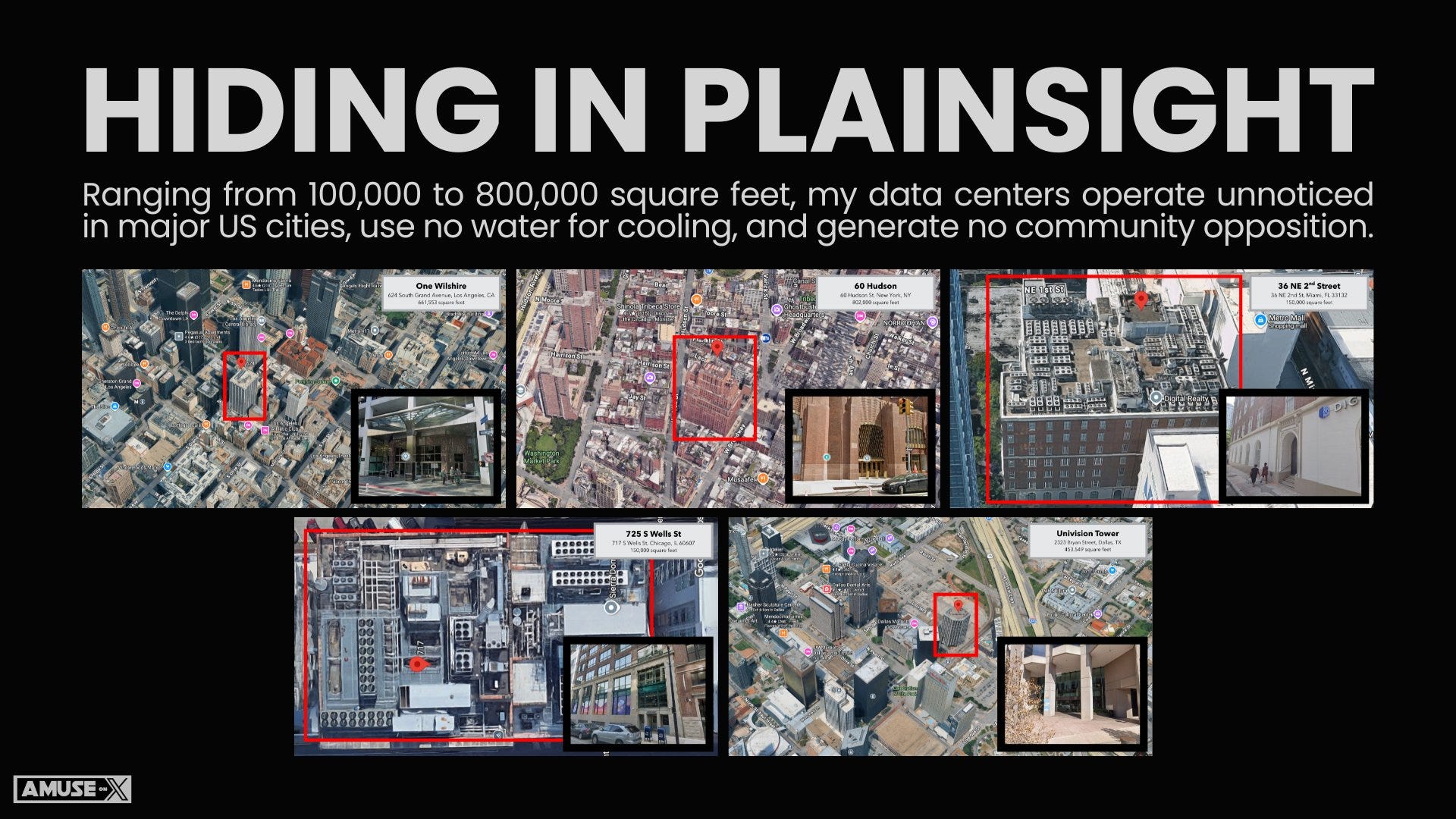
The scare story circulating now treats data centers as a new and untested intrusion. One Wilshire in Los Angeles is a 30-story tower that houses access to more than 300 networks. 60 Hudson Street, the old Western Union building in Lower Manhattan, contains about 1.1 million square feet and a direct Con Edison feed of roughly 15 megawatts. 2323 Bryan Street in Dallas is a 26-story downtown tower with more than 60 carriers, and LayerOne's original Dallas operation lived inside it. These sit in the centers of our largest cities.


Critics also insist that data centers cannot coexist with ordinary communities. My six cities answer that directly. Some of those critics reply that a modern hyperscale campus is a different animal from a downtown carrier hotel, and scale does change the engineering. It does not change the legitimacy. A campus on hundreds of acres has more room for setbacks, berms, sound walls, dedicated substations and purpose-built cooling than a converted office tower wedged between a bank and a courthouse. If a data center can disappear into Lower Manhattan, downtown Dallas or central Los Angeles, a properly engineered facility on open land is not inherently a neighborhood menace. The relevant test is impact, not square footage.
The bill scare is equally sloppy. Badly structured utility contracts shift costs onto households, and properly structured contracts lower average costs. An electric system is mostly fixed expense: transmission lines, substations, generation reservations and staff that must be paid whether customers consume a little or a lot. A data center runs around the clock at a high load factor, which means it buys far more electricity per megawatt of capacity than a factory that closes at 5 p.m. Columbia University’s Center on Global Energy Policy reviewed the literature this year and found that the surplus revenue from properly priced large loads can “function as a subsidy” for other customers. One analysis estimated that each additional gigawatt of data-center demand in Pacific Gas & Electric territory could cut average household bills by 1% to 2%.
The condition is nonnegotiable and entails full cost causation. The data center pays for its dedicated substations. It pays attributable transmission costs. It pays for generation capacity reserved on its behalf. It pays for contracted capacity even when it does not use all of it. It posts collateral against cancellation. Residential customers inherit no stranded costs. President Trump’s Ratepayer Protection Pledge of March 4, 2026 wrote exactly that principle into policy, requiring participating technology companies to pay for contracted power “whether they use the electricity or not,” and conservatives who care about household rates should treat that pledge as the floor. FERC’s June order directed six regional grid operators to prove their large-load rules prevent cost shifting, which is the right federal muscle: force the operators to show the math. Cost shifting raises rates. Eliminate it, and the data center becomes one of the utility’s most valuable customers. Regulators also have no business declaring grid power morally illegitimate for one class of customer. Onsite generation is right in some places, and the regulator’s job is to compare grid service, private generation, and hybrids by net ratepayer benefit.
Water use is a design decision, not an unavoidable characteristic of computing. Evaporative cooling towers consume makeup water. Air-cooled chillers, direct-expansion systems, and closed loops consume little or no water. Uptime Institute notes plainly that some data-center cooling technologies do not evaporate water at all. Our facilities did not use cooling water, and modern developers can make the same engineering choice. Permits should require disclosure of cooling technology and annual consumptive use, and facilities that choose evaporative systems should pay for the water infrastructure they need. A campaign email that calls every data center a water hog does not constitute a permit standard.
Noise gets the same dishonest treatment. The real sound sources are mechanical cooling and periodic generator tests, both of which can be measured at the property line and controlled through equipment selection, enclosures, setbacks and testing schedules. Sound is measured in decibels, not press releases. Set a property-line standard and enforce it. A badly installed generator is a compliance problem that inspectors can fix.
The jobs complaint is a category error about infrastructure. Substations, fiber routes, pipelines and transmission lines are valuable because they enable economic activity, not because thousands of people work inside each one. The value of a bridge is not measured by how many people it employs after construction. Data centers deliver construction work, property tax revenue, utility revenue, and the computing capacity on which countless other businesses depend. A factory-style headcount test is a way of saying you do not want the hall.
A moratorium is the activist’s (and China’s) favorite “middle ground,” and it is neither middle nor ground. A ban is not regulation. It is surrender. It prevents regulators from distinguishing a responsible project from a reckless one, thereby simply moving the investment to another state or country. Moratorium politics is designed to look cautious while delivering an outright veto: no permits, no steel, and a press conference about families.
If thousands of these facilities have operated quietly for decades (each of my facilities is STILL running today), the country was not suddenly taught to fear them by accident. Part of the opposition is organic, and the Bitcoin Policy Institute is candid that local opposition is “real and mostly homegrown.” The timing and amplification are another matter. In December 2025, more than 230 organizations demanded a nationwide moratorium. By July, Reuters counted 142 protests across 42 states. That volume is a coordinated political product.
OpenAI disclosed a PRC-origin influence operation, nicknamed “Data Center Bandwagon,” that generated posts blaming AI data centers for skyrocketing electricity bills and described the operators as “testing narratives against AI infrastructure.” Entities controlled by Neville Roy Singham, the Shanghai-based financier married to CodePink co-founder Jodie Evans, directed more than $300 million between 2017 and 2023 to six US nonprofits in his political network, and organizations in that ideological ecosystem participated in 21 data-center campaigns across 14 states killing more than $24 billion in proposed projects. CBS reported in July that a federal grand jury in Manhattan is investigating Singham’s network for violations of the Foreign Agents Registration Act and tax laws. He denies working directly for Beijing and has not been charged, and the investigation is not a conviction, but a federal grand jury does not convene over rhetoric. Alongside this sits the seperate, better-funded Effective Altruism ecosystem, whose donors have spent billions bankrolling organizations demanding a government-enforced pause on advanced AI. Whatever those donors intend, rules that bind American builders but not Chinese ones hand Beijing time; China does not need to outbuild America if it can persuade Americans not to build and then wait while our countries argue about vetoes. China funded many of the same NGOs to oppose fracking, natural gas, and nuclear power generation, and development a decade ago - they’re back; only data centers are the new global warming.
None of that foreign money is needed to prove the urban record. The buildings already disprove the claim that data centers are incompatible with American life. The funding explains only why a 30-year-old non-problem became a national emergency in a single year, and why so many of the loudest voices treat a permit as a moral crime. Conservatives who want objective standards instead of activist vetoes should say so publically, because the other side is not asking for better engineering.
The policy is not complicated. Require the developer to cover every attributable grid and infrastructure cost. Apply objective standards for water, sound, emissions, traffic, setbacks, and generator testing. Once those obligations are met, deny any state, county, or activist group an ideological veto over lawful infrastructure. Trump’s pledge and FERC’s order already point in that direction, toward transparent costs, measurable impacts, and the freedom to build. The remaining work is to stop treating a moratorium slogan as a zoning analysis.
For three decades, data centers have been hiding in plain sight. They occupied anonymous buildings, bought electricity, moved information, and quietly became indispensable to modern life. Most Americans never noticed because there was little to notice. We already live beside them. The remaining choice is whether manufactured fear, and the foreign and ideological networks happy to feed it, will stop us from building the infrastructure of the AI age.
If you enjoy my work, please subscribe https://x.com/amuse/creator-subscriptions/subscribe
Alexander Muse is a Fellow at the John Milton Freedom Foundation and publishes daily political analysis at amuseonx.com. Primary sources cited in this piece are linked inline; campaign finance figures are drawn from FEC filings, polling data from publicly released crosstabs, and legal claims from filed pleadings. Corrections are posted to the original URL with a dated changelog. Readers who identify errors are invited to contact the author directly. Each op-ed edited for grammar and clarity using Ai in partnership with Grammarly. Data provided in a sponsored partnership with Polymarket.
Sharing this to my less informed Facebook friends.
Then why are they trying to take up peoples property?