


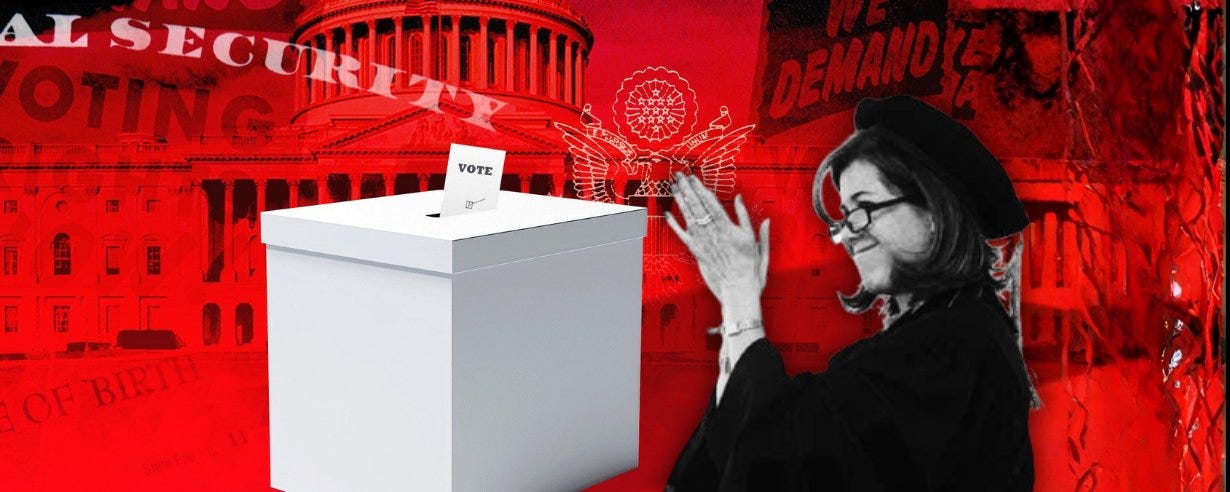
There is a comforting fiction circulating in Washington that the Senate Parliamentarian holds a kind of veto over what Congress may and may not do. According to this fiction, when Elizabeth MacDonough offers advice that a provision violates the Byrd Rule, the matter is settled, the provision dies, and elected senators must simply accept the verdict of an unelected staff official appointed during the Obama administration. This is not how the Senate works. It has never been how the Senate works. And John Thune, of all people, knows it is not how the Senate works, because in May of 2025 he proved the opposite with his own hands.
The clean way to state the principle is this. The Parliamentarian advises, the Chair rules, and the Senate decides. That ordering is not a clever workaround invented for the present moment. It is the basic architecture of Senate procedure. The Congressional Research Service explains that Senate rules are enforced when a senator raises a point of order, after which the Presiding Officer decides the question unless he submits it to the body, and that the ruling is then subject to appeal. The procedural scholar Jim Wallner puts the same point more bluntly when he writes that the Chair rules on points of order, not the Parliamentarian, and that the Parliamentarian merely advises the Chair. The office that MacDonough occupies was not created by the Constitution. It was created on July 1, 1935, when the Senate elevated Journal Clerk Charles Watkins to the new post. The Senate governed itself for nearly a century and a half before the office existed at all. An institution that predates its own advisers by 146 years does not answer to them.
So why does the Parliamentarian seem so powerful? She seems powerful because Senate leaders, for reasons of convenience and institutional comfort, usually choose to treat her advice as if it were a ruling. Her real authority is the authority of accumulated memory. The compilation of Senate precedents known as Riddick’s Senate Procedure runs more than 1,600 pages and contains more than a million precedents, and navigating that thicket is genuinely difficult. Senators prefer predictable administration of complicated rules, and so they defer. Deference, however, is a choice, not an obligation. Influence is not the same thing as veto power, and a Senate that wishes to act as a body retains every ounce of the constitutional authority it had before 1935.
Now consider how this applies to the SAVE Act. The mechanism here is the Byrd Rule, codified at 2 USC § 644, which protects budget reconciliation from being loaded with policy that is merely incidental to the budget. Democrats will argue that election-integrity language is extraneous policy and therefore must be stripped. The crucial detail, the one that the press almost never explains correctly, is that the Byrd Rule does not strike anything on its own. The statute is explicit that a provision falls only upon a point of order being made by a senator and sustained by the Chair. Advice alone does nothing. If no senator raises a point of order, the language stays. If a senator does raise one, the question lands not on MacDonough’s desk but on the desk of the Presiding Officer.
This is where the tactical picture becomes clarifying. Imagine SAVE language is included in the reconciliation bill. A Democratic senator rises and lodges a Byrd Rule point of order. The question does not land on the Parliamentarian’s desk. It lands on whoever holds the gavel, and the majority decides who that is. Republicans can ensure a friendly presiding officer is in the chair at the decisive moment, and Vance, as President of the Senate, can take the gavel himself to deliver the ruling. Whoever presides then rules the point of order not well taken. Democrats may appeal that ruling to the full Senate, and here is the part that should focus every Republican mind in the chamber. Under the enforcement provisions of the Congressional Budget Act, sustaining an appeal of the Chair’s ruling on a Byrd Rule point of order requires three-fifths of senators, which in a full Senate means 60 votes. The burden of finding 60 falls on the side trying to overturn the Chair, not on the side defending the language. Republicans do not need to assemble a supermajority to protect proof-of-citizenship requirements. They need only have the Chair rule in their favor and then watch Democrats fail to find 60 votes to remove it. If Democrats cannot muster 60 votes to strike a measure requiring that only citizens register to vote, the measure survives, and the bill itself can pass by simple majority, with Vance breaking a tie in his separate capacity if the Senate is evenly divided.
If this sounds aggressive, it is worth remembering that Thune has already done a more contested version of exactly this. In May of 2025, Senate Republicans wanted to use the Congressional Review Act to overturn California vehicle-emissions waivers. They received adverse procedural advice, rooted in a Government Accountability Office opinion that the waivers were not rules eligible for expedited treatment. Thune did not fold. He argued that the Senate faced a novel procedural dispute and that, in his words, it is appropriate for the Senate to speak as a body. The Senate then did precisely that, sustaining his position through majority votes recorded in the Congressional Record at 51-46, 51-46, and 53-46. Molly Reynolds of Brookings, writing in the Yale Journal on Regulation, described the maneuver without euphemism, noting that the Parliamentarian had advised the resolutions were ineligible, that Republicans were nervous about overriding that advice, and that Thune engineered procedural votes allowing the Senate to decide for itself.
The logic here travels effortlessly from emissions waivers to elections. If the Senate may speak as a body to halt a California mandate on automobiles, it may certainly speak as a body to protect the integrity of federal elections from noncitizen registration. The principle Thune articulated does not contain a footnote restricting it to environmental policy. A novel procedural disagreement is a novel procedural disagreement, and whether the SAVE Act qualifies for inclusion in reconciliation is exactly the kind of contested question that, by Thune’s own stated standard, the Senate itself should resolve. The honest summary is blunt. Thune was right in May. He should now apply the same principle to a far weightier subject.
It also helps that Thune has armor against the predictable objection that this amounts to abolishing the legislative filibuster. He built that armor himself. During the CRA fight he insisted the maneuver had nothing to do with the legislative filibuster and pledged that under Republican control the legislative filibuster would remain in place. He can say the same here with equal honesty, because reconciliation already operates under special statutory rules that bypass the filibuster by design. Defending SAVE through a ruling from the Chair does not touch the filibuster at all. It simply uses the reconciliation process as it was built to be used, and asks the elected majority to exercise the authority it already possesses.
The public is not divided on the underlying question, which makes the procedural timidity all the harder to justify. Gallup found in October of 2024 that 84% of Americans favor requiring photo ID to vote and 83% favor requiring proof of citizenship for first-time voter registration. Support for photo ID reached 98% among Republicans, 84% among independents, and 67% among Democrats. Pew confirmed the pattern in August of 2025, finding 83% of adults support a government-issued photo ID requirement, including 71% of Democrats and Democratic-leaning independents. The White House has reduced the moral case to a single sentence that opponents struggle to answer without sounding evasive, namely that American citizens, and only American citizens, should decide American elections. When a position commands 80% support and one chamber’s leadership hides behind a single unelected adviser to avoid acting on it, the problem is not public opinion. The problem is nerve.
The legislative groundwork is already laid. The original SAVE Act, H.R. 22, passed the House on April 10, 2025, by a vote of 220-208, with House Republicans unified at 216 yes votes and zero no votes. The stronger second-term version, the SAVE America Act, has since cleared the House as well, passing 218-213 with the backing of President Trump, Speaker Johnson, and Senator Mike Lee. In the Senate, John Kennedy has already forced the issue, offering an amendment to add SAVE concepts to the reconciliation plan that failed only 48-50. A measure two votes short of a majority is not a fringe cause. It is a near-consensus waiting on leadership, and Kennedy has said plainly that he intends to put the SAVE Act on the reconciliation bill. Conservative institutions have supplied the policy scaffolding, with Heritage Action describing how SAVE America would replace registration by self-attestation with verification against DHS and SSA databases, and the America First Policy Institute framing the shift as a move from honor-system registration toward objective proof.
There is even a backstop, though it should remain a backstop rather than an opening move. Parliamentarians have been replaced before, by both parties. In 2001 Trent Lott pushed out Robert Dove after rulings that complicated the Bush tax-cut agenda, and the Washington Post noted that the Parliamentarian serves at the pleasure of leadership. That history is worth keeping in view, but it is not the argument. The argument is simpler and stronger. Thune does not need to fire anyone. He needs only to do again what he already did once, when the stakes were lower. Put SAVE in reconciliation. Let Vance rule the point of order not well taken. Make those who would strip citizenship verification from the bill go out and find 60 votes to do it. If they cannot, and they almost certainly cannot, then the Senate will have spoken as a body, exactly as Thune said it should.
If you enjoy my work, please subscribe https://x.com/amuse/creator-subscriptions/subscribe
Alexander Muse is a Fellow at the John Milton Freedom Foundation and publishes daily political analysis at amuseonx.com. Primary sources cited in this piece are linked inline; campaign finance figures are drawn from FEC filings, polling data from publicly released crosstabs, and legal claims from filed pleadings. Corrections are posted to the original URL with a dated changelog. Readers who identify errors are invited to contact the author directly.
Thune, picking up where McConnell left off, hates Trump and will do everything he can to get in his way. That he was selected to run the Senate in a secret vote is appalling to me.
This is where Republicans find out whether they have a majority or a museum tour. The Democrat Party wants election fog because fog protects the machine. The voters want proof of citizenship because citizens, and only citizens, should decide American elections. Muse is right: Thune does not need to worship the Parliamentarian, kill the filibuster, or invent some fantasy maneuver. He needs to use the authority the Senate already has, put SAVE in reconciliation, let Vance rule, and make Democrats find 60 votes to strip it. If Thune will not fight on this, he is not leading. Replace him.