


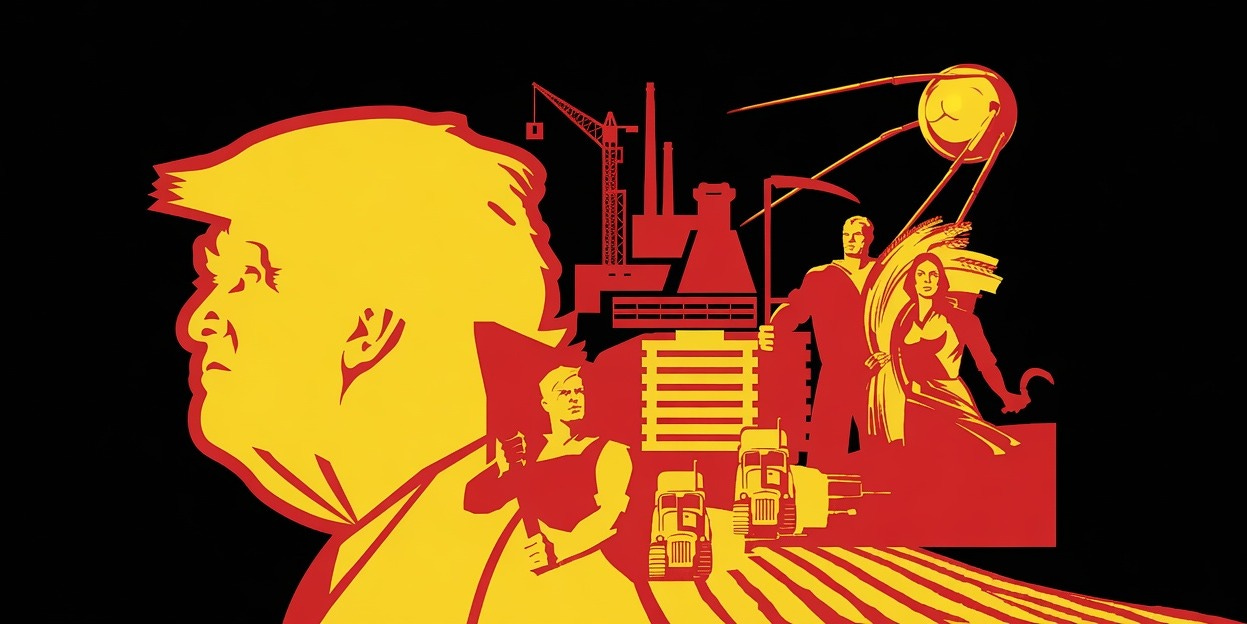
Imagine your neighbor comes to you with a business plan. He needs $100,000 to open a machine shop, and he cannot get the money anywhere else. You have two options. You can hand him the cash as a gift, wish him well, and accept that if the shop succeeds, he keeps every dollar of the profit while you keep nothing but the memory of your generosity. Or you can hand him the cash in exchange for a slice of the business, so that if the shop thrives you thrive with it. No sensible person calls the second arrangement socialism. We call it investing. We have called it that for as long as there have been shares to buy.
For roughly 40 years, Washington chose the first option, over and over, on a scale that would stagger your neighbor. It handed out grants, loan guarantees, procurement commitments, export licenses, and regulatory blessings, and it asked for nothing in return but press releases. When the subsidized company failed, the taxpayer ate the loss. When the subsidized company succeeded, the shareholders ate the gain. That is not a free market. That is a system in which losses are collectivized, and profits are privatized, which is to say a system in which the public bears the risk of production without owning any part of the reward. President Trump has begun to reverse that arrangement, and the reversal has been met with the strangest accusation in recent memory: that it is socialism.
It is worth being precise about what socialism actually is, because the word is doing an enormous amount of unearned work in this debate. The Stanford Encyclopedia of Philosophy identifies capitalism by three features. The bulk of productive property is privately owned, workers own their own labor, and markets allocate inputs, outputs, consumption, and investment. The Internet Encyclopedia of Philosophy puts the contrast plainly: an economy becomes socialist when it rejects private ownership of the means of production in favor of public or social ownership. Notice what these definitions do not say. Neither says that an economy becomes socialist when the government holds a financial asset. Socialism is a claim about who owns and directs production, not a claim about whether a public entity appears anywhere on a cap table.
Ludwig von Mises, who was hardly soft on the subject, drew the line with characteristic bluntness. Publicly owned enterprises operating inside a larger structure of private firms, market prices, and economic calculation remain subject to the laws of the market. “The system remains a market society,” he wrote. Real socialism arrives when the state decides what factories produce, whom they hire, what wages they pay, where they buy their inputs, and where they sell their output. Apply that test to the transactions actually in front of us and the accusation collapses. Not one of these agreements transfers a single one of those decisions to a government office.
Consider Intel, which is the case the critics lead with. The federal government invested $8.9 billion, made up of $5.7 billion in CHIPS grants that had already been awarded but not yet paid and $3.2 billion from the Secure Enclave program. In exchange, it received 433.3 million newly issued common shares at $20.47, roughly 9.9% of the company, plus a five-year warrant on another 5% if Intel ever drops below majority ownership of its foundry. Here is the term that matters, and it is not the percentage. The stake is passive. No board seat. No special governance rights. No special information rights. Outside narrow exceptions, the government agreed in advance to vote with Intel’s own board. A shareholder who has contracted away his vote is not running the company. He is along for the ride.
And what a ride it has been. That block cost $8.9 billion. At Intel’s price of $92.70 on July 31, the same shares carried an indicated value of about $40.17 billion, which means roughly $31.27 billion in paper appreciation, and that figure excludes the contingent warrant entirely. Ask yourself how the government produced that return. It did not set Intel’s output quotas. It did not fix semiconductor prices or assign engineers to fabs. The market repriced the stock, and a shareholder who owned the stock benefited, exactly as any shareholder would. A gain generated by market pricing on passively held common stock is the least socialist thing imaginable. It is capitalism doing precisely what capitalism does.
The MP Materials agreement is, if anything, even more thoroughly a creature of private finance. The Pentagon bought $400 million of convertible preferred stock carrying a 7% payment-in-kind return, convertible at $30.03 per share, alongside a ten-year warrant on as many as 11,201,659 common shares and a $150 million loan running 12 years. Once the planned magnet facility clears its minimum earnings threshold, taxpayers take the first $30 million of excess EBITDA and half of anything above that. Meanwhile, MP committed as much as $600 million of its own cash, JPMorgan and Goldman Sachs committed at least $1 billion in secured financing, and the government’s beneficial ownership is contractually capped at 19.9%. Preferred equity, warrants, debt, bank syndication, offtake agreements, and performance-based profit sharing are the vocabulary of an investment bank, not a politburo.
Thacker Pass may be the cleanest refutation of all. In connection with an expected $2.23 billion Department of Energy loan, the government received penny warrants for about 5% of Lithium Americas and a separate 5% economic interest in the joint venture. That project interest is expressly nonvoting and nontransferable. The voting interests remain where they were, 62% with Lithium Americas and 38% with General Motors. The Department of Energy holds 5% of the economics and 0% of the votes. Whatever else that is, it is the precise opposite of state control. Private owners run the mine, hire the workers, sign the contracts, and set the production schedule. The public simply holds a claim on value that public credit helped bring into being.
Now the honest objection, and it deserves a real answer. Isn’t this still industrial policy, still government picking winners, still corporate welfare with better paperwork? Partly, yes. But the relevant comparison is not between these deals and some imagined republic where Congress appropriates nothing. Congress had already authorized the money. The CHIPS grants existed. The loan programs existed. Cato estimates federal corporate welfare at roughly $181 billion a year, and 64% of likely voters told Cato they want it ended while only 20% disagreed. Given that the spending was going out the door regardless, the actual choice was between an unrecoverable gift and a priced, documented, recoverable security. Commerce Secretary Howard Lutnick put it about as plainly as it can be put: “We’ll get equity in return for that ... instead of just giving grants away.” A warrant is more conservative than a handout. A royalty is more conservative than a grant. Preferred stock paying 7% is more conservative than a check that vanishes into a treasury.
Then there is the golden share at US Steel, which critics wave around as though it were a nationalization decree. Nippon Steel bought the company for $14.9 billion and owns it. The government’s share is non-economic, meaning it collects no dividends and no appreciation, and it carries narrow consent rights over plant closures, capacity cuts, transfers of production, and headquarters relocation, plus the right to name one independent director. Anyone tempted to call that socialism should look up who else used the instrument, because Margaret Thatcher’s government retained golden shares in British Aerospace, Rolls-Royce, and the British Airports Authority while selling 100% of the ordinary stock to private investors. Those shares typically had a nominal value of £1 and conferred no right to profits. The golden share was not an instrument of nationalization. It was the device that made privatization politically survivable.
None of this is unprecedented at home either, and the history is a good deal less exotic than the current panic suggests. In 1979 Washington guaranteed Chrysler’s loans and took 14.4 million warrants at $13 a share, and Jimmy Carter defended the package on the grounds that it kept Chrysler a private competitor rather than a government agency, which it did; the loans were repaid, and in September 1983 the government sold the warrants back for $311 million. Treasury’s Capital Purchase Program during the financial crisis ran on preferred stock and warrants and recovered nearly $275 billion against $245 billion invested. The CARES Act, signed in Trump’s first term, required airlines to hand over warrants, equity, or senior debt as taxpayer compensation, and the June 2024 auctions of those warrants returned $556,685,001 to the Treasury. Nobody seriously argued that Delta had been nationalized.
There is also the domestic example nobody on the right seems eager to discuss. Alaska, one of the most conservative states in the union, holds roughly $31.2 billion in public equities, $14.4 billion in private equity, $19 billion in fixed income, and $8.2 billion in real estate, about $90.7 billion in all, and it has generated something like $114.5 billion in returns since 1977. Alaska does not run the companies whose stock it owns. It collects the returns and cuts checks to its citizens. If public ownership of equity were socialism, Juneau would be Havana, and it plainly is not.
The most revealing testimony comes from the left, which had every incentive to claim these deals as a victory and declined the priviledge. Bernie Sanders conceded the underlying principle outright, saying that “the taxpayers of America have a right to a reasonable return on that investment.” Jacobin, a magazine that would very much like to find socialism where it exists, examined the Intel stake and concluded that the nonvoting shares “do not give the government any meaningful control over the company.” Socialists know what social ownership looks like. They looked at this and saw a shareholder.
So what is actually happening here is simpler than the label suggests. Executives profit. Venture capitalists profit. Banks charge interest, shareholders take dividends, and lawyers, consultants, and bankers collect their fees, and there is no principled reason at all why the taxpayer, alone among everyone at the table, must be required to accept a return of zero. The public was already a partner in these ventures. It just happened to be the partner that supplied capital, absorbed risk, guaranteed demand, and received nothing. Trump has not made the taxpayer an owner of American industry. He has made the taxpayer a paid counterparty instead of an unpaid one, which is the difference between a market economy and a very expensive charity. He is not socializing production. He is de-socializing corporate losses, and it is about time somebody did.
If you enjoy my work, please subscribe https://x.com/amuse/creator-subscriptions/subscribe
Alexander Muse is a Fellow at the John Milton Freedom Foundation and publishes daily political analysis at amuseonx.com. Primary sources cited in this piece are linked inline; campaign finance figures are drawn from FEC filings, polling data from publicly released crosstabs, and legal claims from filed pleadings. Corrections are posted to the original URL with a dated changelog. Readers who identify errors are invited to contact the author directly. Each op-ed edited for grammar and clarity using Ai in partnership with Grammarly. Data provided in a sponsored partnership with Polymarket.
This…….is wisdom. Thank you for sharing this.
The old corporate welfare model socialized losses and privatized profits. That was the racket. Trump is not nationalizing industry or turning factories into politburo offices. He is forcing companies that receive public backing to give the public a return. No board control. No production quotas. No government commissars deciding wages, prices, or supply chains. Just a paid counterparty instead of an unpaid sucker. Critics screaming “socialism” are defending the worst kind of crony capitalism: taxpayer risk with private-only reward. Trump is not socializing production. He is de-socializing corporate losses.