


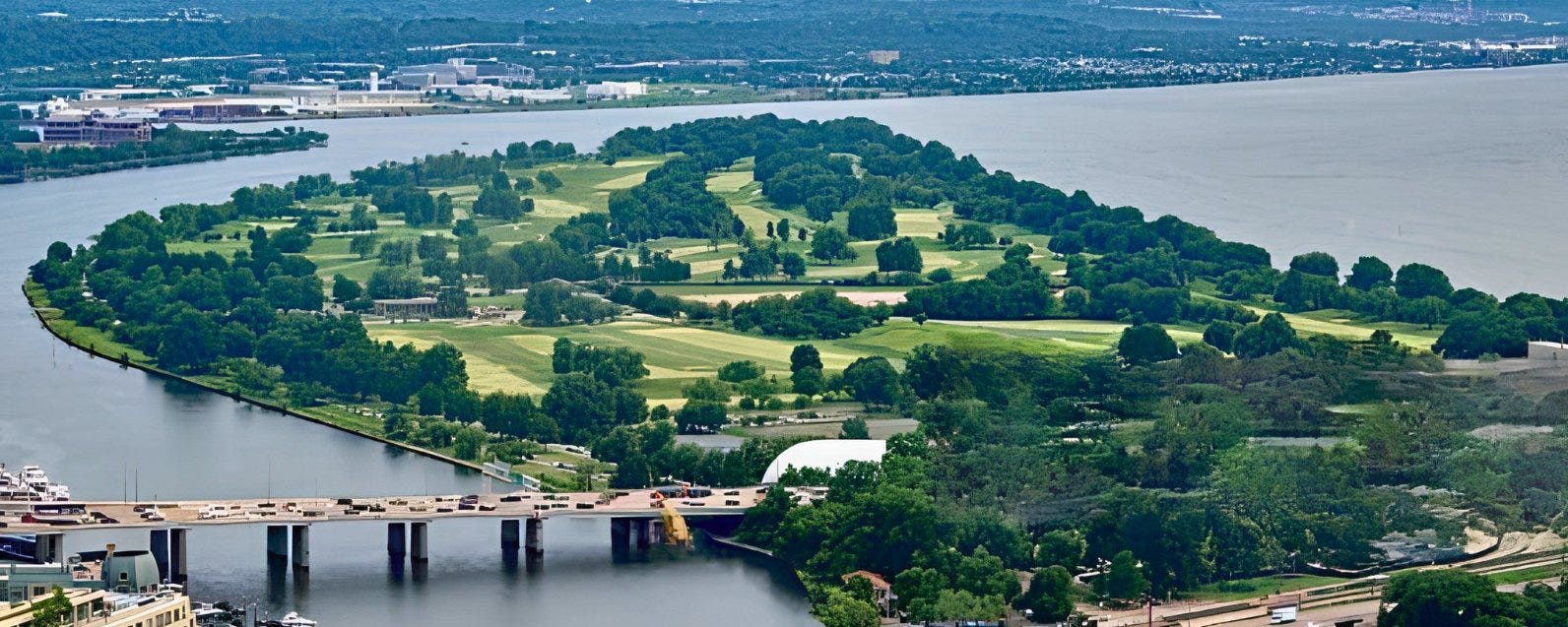
Stand at Hains Point on a Saturday morning in spring, and you will see two things at once. The first is a crowd. Golfers are stacked at the starter's window, the range stalls are full, and the tee sheet has been sold out for days. The second is the condition of the ground they are standing on. The irrigation is failing, the drainage is worse, the clubhouse has taken on water, the cart paths are worn through, and the trees overhead include a number that arborists have flagged as hazards. East Potomac Golf Links is simultaneously one of the most popular recreational facilities in the nation's capital and one of the most neglected.
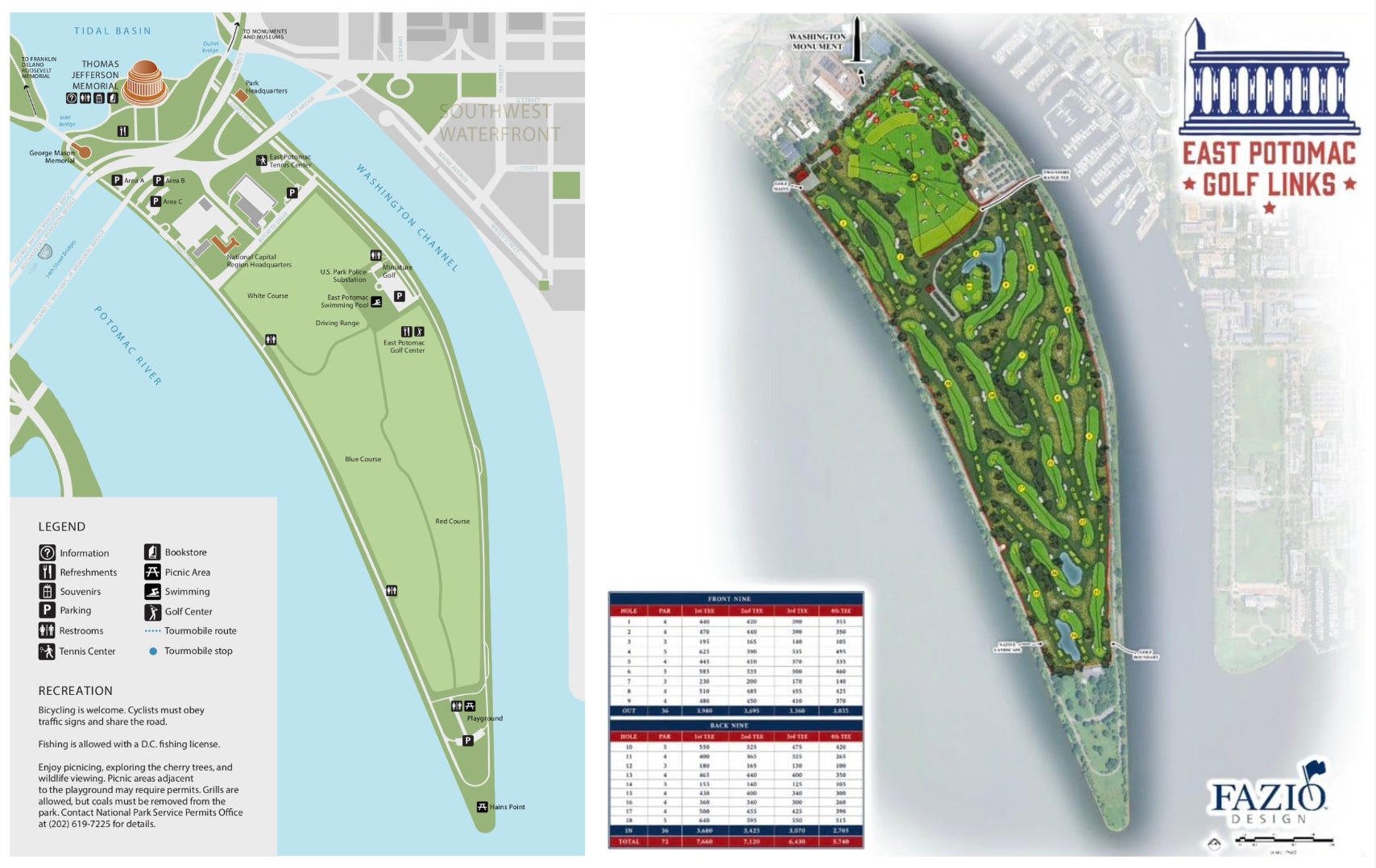
The numbers are not in serious dispute. The course recorded 124,960 rounds in 2025, which works out to roughly 342 rounds for every day on the calendar, including the frozen ones. On May 3, 2026, golfers played nearly 900 rounds in a single day. A 2026 condition assessment placed numerous facilities at the property in “poor or critical” condition, citing water damage, broken fixtures, structural concerns, and potential safety hazards. The federal repair inventory reads like a punch list for a foreclosed property, running from the parking lot and the retaining wall to the light poles, cart paths, driving range building, golf barn, and starter building. The Justice Department, defending the government in federal court, described a “state of deterioration” requiring “significant maintenance, rehabilitation, and reconstruction.” That admission was made in litigation, under the discipline of the record, not in a press release.
So here is the puzzle worth thinking about carefully. Nobody argues that East Potomac is fine. The National Park Service does not argue it. The former leaseholder does not argue it. The plaintiffs suing to stop the renovation do not really argue it either. What they argue is that the wrong person is fixing it, at the wrong speed, under the wrong procedure. That is a very different objection, and it deserves to be examined on its own terms rather than dressed up as environmental stewardship.
Consider an old philosophical puzzle that turns out to be the whole argument in miniature. A ship is repaired at sea. A plank rots and is replaced, then another, then another, until in time no original plank remains. Is it the same ship? The commonsense answer, and I think the correct one, is yes. A ship is not a pile of specific boards. It is a form, a function, and a continuous history of use and care. Replacing rotted planks is not what destroys a ship. Refusing to replace them is.
East Potomac is that ship. Its historic significance does not reside in a particular length of failing irrigation pipe or a particular diseased tree. It resides in the fact that for more than a century, ordinary Washingtonians have walked that ground with clubs in their hands, on public land, at public prices. Preservation, properly understood, means keeping that alive. What the litigants are demanding is not preservation but embalming, the freezing of a decaying object in its current state on the theory that decay is more authentic than repair. That is a category error, and it is one that has cost the District dearly.
The accountability question is where the case becomes airtight. In July 2019, the Park Service announced it wanted a long-term lease for the District’s public courses precisely because a long lease would, in its own words, “allow for substantial capital investments.” That was the federal government’s own diagnosis. Short concession agreements were not producing capital. A 50-year horizon might. In September 2020, NPS signed exactly such a lease with National Links Trust, a nonprofit whose proposal called for reconstructing the Red and White courses, restoring the historic design, redesigning the driving range, building an 18-hole putting course, and rehabilitating the clubhouse.
Notice what that proposal concedes. The tenant itself said the property needed a comprehensive rebuild. The lease assigned it responsibility for ordinary and extraordinary repair, structural and nonstructural, replacement of obsolete equipment, grounds care, and capital construction. This was not a landscaping contract. It was a stewardship agreement drafted for a property everyone knew was in trouble.
Five years later, the transformation that justified a half-century lease had not happened. The trust did real work, and it is not necessary to pretend otherwise. It grew rounds, restored the miniature golf course, ran youth programs, and reported $8.5 million to $11 million in improvements spread across three properties, while its revenue climbed from roughly $2.6 million in 2020 to $15 million in 2024. But growth in an organization’s balance sheet is not the same thing as a rebuilt golf course, and by December 2025 the Interior Department had seen enough. It terminated the master lease, citing unfinished projects, an inadequate cure proposal, and a claim for up to $8.8 million in unpaid percentage rent. In May 2026, a revised arrangement left the trust operating Langston and Rock Creek, with East Potomac reverting to federal management.
That is not a scandal. That is a landlord finally acting like an owner. The government held title the entire time, and when the mechanism it chose failed to deliver, it changed the mechanism. Anyone who has ever fired a contractor understands the logic instinctively.
What replaced it is more ambitious than anything the District has been offered in living memory. Interior and the Park Service will manage the work. Tom Fazio’s firm will design it. As much as $150 million in private charitable contributions will pay for it, which means the capital burden does not land on the taxpayer. The plan calls for an 18-hole championship layout playable from about 5,700 yards to 7,660 yards, rebuilt irrigation and drainage, modernized practice facilities, a short course, and a new clubhouse. Interior Secretary Doug Burgum has promised “championship-quality golf at affordable, highly discounted rates” for residents of the National Capital Region. President Trump has said plainly that the course stays public.
The predictable objection is that excellence and access cannot coexist, that a Fazio course must inevitably become a playground for lobbyists. The objection collapses on contact with evidence. Bethpage State Park in New York is owned by the state, hosts roughly 300,000 rounds a year across five courses, and has staged two US Opens, a PGA Championship, and the 2025 Ryder Cup. Torrey Pines belongs to the City of San Diego, hosts a PGA Tour event annually, has hosted two US Opens, and charged residents $73 for a weekday round on the South Course in 2026 while nonresidents paid $258. Visitors subsidize locals. That is the model; it works, and there is no reason the capital of the United States should settle for less than a New York state park.
Which brings us to the lawsuit, and to a pattern that has become impossible to miss. In February 2026, the DC Preservation League and two individual plaintiffs sued Interior, Burgum, and the Park Service under the Administrative Procedure Act, NEPA, the National Historic Preservation Act, the Organic Act, and an 1897 statute providing that the land be held as a park for recreation and pleasure. Set aside the last one, since golf is quite obviously recreation and has been on that ground since before most of the neighborhood existed. The substance of the complaint is procedural. It says the paperwork is not finished.
Judge Ana Reyes has not been persuaded that anything unlawful has occurred. In early May she declined to grant the sweeping emergency relief the plaintiffs sought, permitting routine maintainance to continue while requiring notice before major work. At a hearing on July 2 she said, in as clear a statement of the situation as anyone has managed, “I don’t want to file an injunction. I’m not there yet.” As of late July, there has been no merits ruling declaring the project unlawful and no project-wide injunction.
I want to be careful here, because process statutes exist for good reasons and the administration should satisfy them. Soil and demolition material placed at the site should be tested and the results published, and if the material is unsuitable it should be removed. A renovation completed by the book is far harder for a future administration to unwind. But there is a difference between a process and a veto, and the plaintiffs know exactly which one they are seeking, they are not asking for a better golf course or a cleaner one or a more historically faithful one, they are asking for delay, because delay is the only tool that reliably works and because every month of delay is a month in which the President cannot be seen to have accomplished something in a city his opponents have governed into the ground.
We have watched this movie repeatedly. He sent resources to make the District safer, and crime fell, and the response was litigation. He moved to repair crumbling parks, dry fountains, and stained monuments, and the response was litigation. He proposed a ballroom at the White House, a building that has been renovated, expanded, and rebuilt by nearly every generation of Americans who occupied it, and the response was litigation. He proposed new monuments honoring American heroes, and the response was litigation. Now he proposes to rebuild a public golf course that all parties describe as deteriorated, using private money, on federal land, for public golfers, and the response is, once again, litigation.
The Tidal Basin ought to settle the competence question. More than 6,000 feet of seawall were rehabilitated and reopened in April 2026, with 426 trees replanted, including 269 cherries, roughly eight months ahead of schedule and about $30 million under budget. Burgum called it proof of “what can be accomplished when we invest in America’s treasures.” Anyone who walked those paths when they flooded twice a day knows he is right.
So the question in front of Washington is not whether East Potomac needs to be rebuilt. Every institutional actor in the story, including the tenant that lost the lease, has conceded that it does. The question is whether a city can still build anything at all, or whether we have constructed a legal architecture in which the mere act of improving public property is presumptively suspicious. Nearly 125,000 rounds a year say the people of the District want this course. They deserve a great one. They have earned better than mud, broken pipes, and a lawsuit filed on their behalf by people who did not ask them first.
If you enjoy my work, please subscribe https://x.com/amuse/creator-subscriptions/subscribe
Alexander Muse is a Fellow at the John Milton Freedom Foundation and publishes daily political analysis at amuseonx.com. Primary sources cited in this piece are linked inline; campaign finance figures are drawn from FEC filings, polling data from publicly released crosstabs, and legal claims from filed pleadings. Corrections are posted to the original URL with a dated changelog. Readers who identify errors are invited to contact the author directly. Each op-ed was edited for grammar and clarity using AI in a partnership with Grammarly. Data provided in a sponsored partnership with Polymarket.
I used to say democrats don't care if America becomes a shithole - as long as they can rule over it.
Now, I truly believe they would prefer a shithole.
The federal judiciary is far beyond repair.
Did not Thomas Jefferson disband all or most the federal judgeships and start over?
It is time for rash actions if America is to be saved from the third branch of government being out of control. Most blue state judiciaries are not far behind, and we have too few Desantis style governors willing to fix them.