


Watch the play at full speed and you see a footballer falling. Watch it at one-eighth speed and you see, if you squint hard enough, something sinister. The gap between those two viewings is the whole of the Balogun affair, and it explains why President Trump was right to pick up the phone, why FIFA was right to clear Folarin Balogun for tonight's match against Belgium, and why the red card shown in Santa Clara should trouble anyone who cares about what the rules actually say rather than what a freeze-frame appears to show.
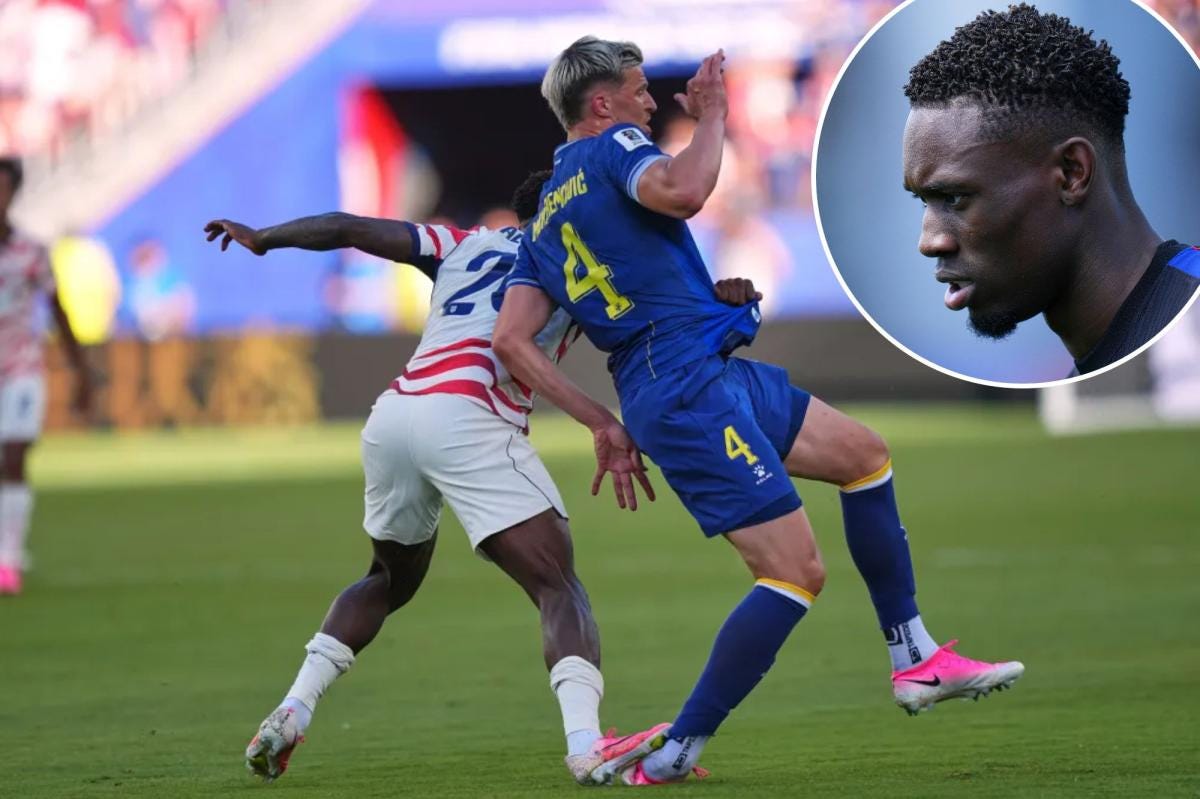
Begin with the facts. In the 64th minute of the USA's 2-0 Round of 32 victory over Bosnia and Herzegovina, Balogun, who had scored the opening goal just before halftime, contested a ball with defender Tarik Muharemovic. Balogun lost his balance, and as he fell his foot came down on Muharemovic's ankle. The referee, Raphael Claus of Brazil, was near the play and called nothing. No whistle, no foul, no card. Then the VAR booth intervened, Claus walked to the monitor, watched the slow-motion replay, and produced a straight red. The Americans played the final 36 minutes of regulation and stoppage time with 10 men in a knockout match at a home World Cup.
To see why that decision was wrong, you need the legal architecture, and happily the architecture is clear. IFAB Law 12 sorts physical challenges into three categories. A careless challenge is a foul and nothing more. A reckless challenge, one made with disregard for danger or consequences, requires a yellow card. Only a challenge using excessive force, meaning force that exceeds what is necessary or that endangers an opponent’s safety, requires a red. The sending-off category invoked here, serious foul play, covers tackles and challenges that endanger an opponent or employ excessive force or brutality. Notice what the taxonomy is doing. It is grading culpability and danger together, and it reserves the ultimate sanction for actions that carry genuine violence in them, the lunge, the stamp, the studs driven through a planted ankle at speed.
Now hold the actual play up against that standard. Balogun was playing the ball. He was falling. His foot had to land somewhere, and it landed badly. He said afterward, respectfully, that there was nowhere else for his leg to go once the falling motion began, and that a yellow would have been fair. Christian Pulisic said the contact showed zero intent and that he had seen worse challenges go unpunished in this tournament. Mauricio Pochettino called the decision completely unfair. None of the classic markers of serious foul play appear in any credible description of the incident. There was no lunge, no over-the-ball stamp, no high-speed arrival into a planted leg, no abandonment of any realistic attempt to win the ball. What remains is an unfortunate point of contact produced by ordinary football physics. That is the textbook profile of recklessness at worst, which Law 12 tells us is a caution, not a dismissal. Intent is not required for a red card, true, but force and danger are, and a man falling to the ground is not generating excessive force, he is being acted upon by gravity.
The VAR intervention makes the error worse, not better, and here the governing text is unusually specific. The VAR protocol permits intervention only for a clear and obvious error or a serious missed incident. It further instructs that slow motion should be used for factual questions such as the point of contact, while normal speed should be used to judge the intensity of an offence. The reason is obvious once stated. Slow motion strips an action of its physics. It converts a stumble into a deliberation, a landing into a stamp. Claus saw the play live, from close range, and judged it no foul. For VAR to overturn that judgment, the video needed to show that the live decision was clearly and obviously wrong. A debatable collision with accidental ankle contact is by definition not a clear and obvious anything. Mark Clattenburg, the former Premier League and FIFA referee working the tournament for Fox, said precisely this: the incident looked accidental at real speed, lacked red-card intensity, and was a poor use of VAR. The officials punished the freeze-frame rather than the football action, which is exactly what the protocol was written to prevent.
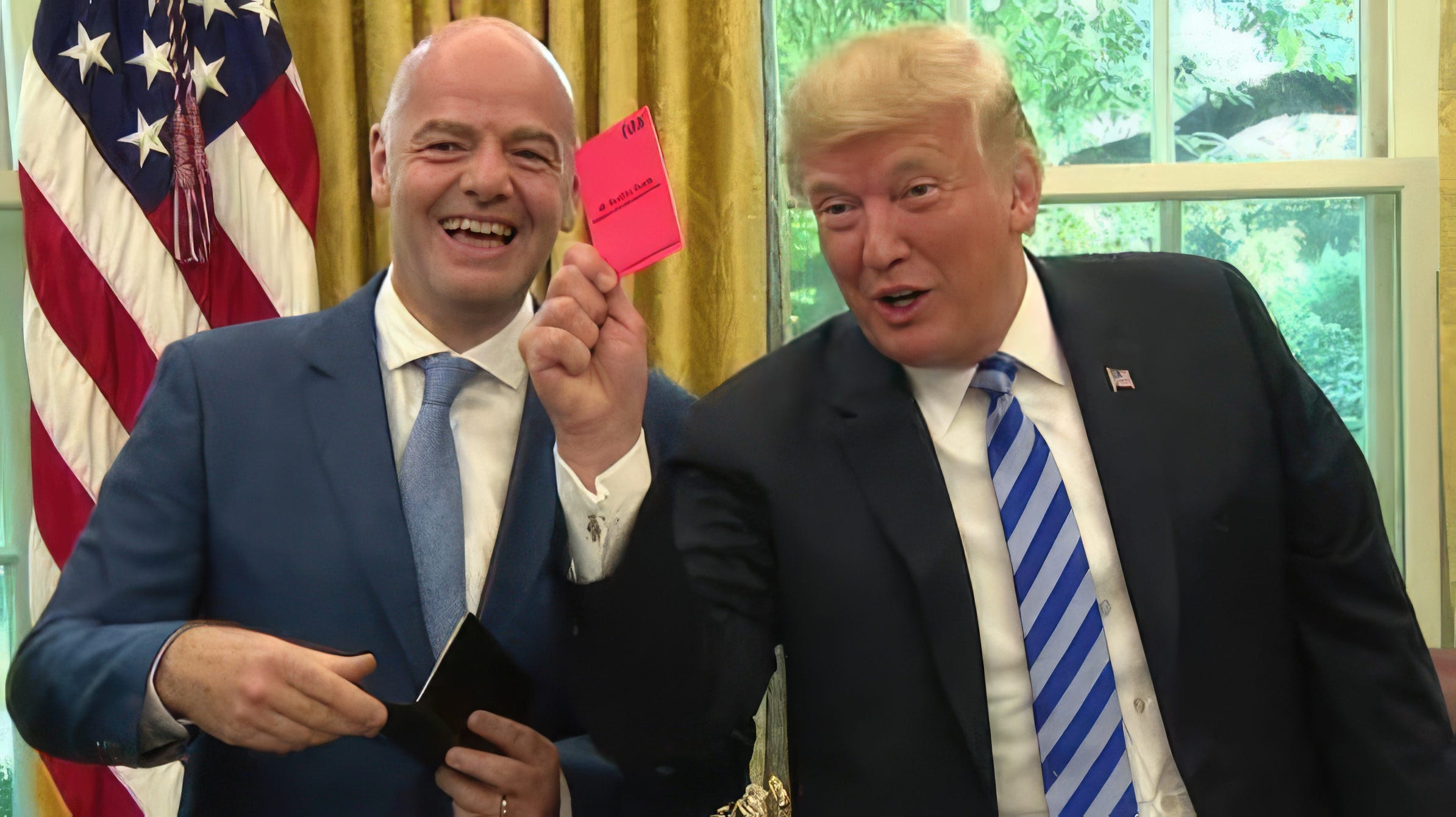
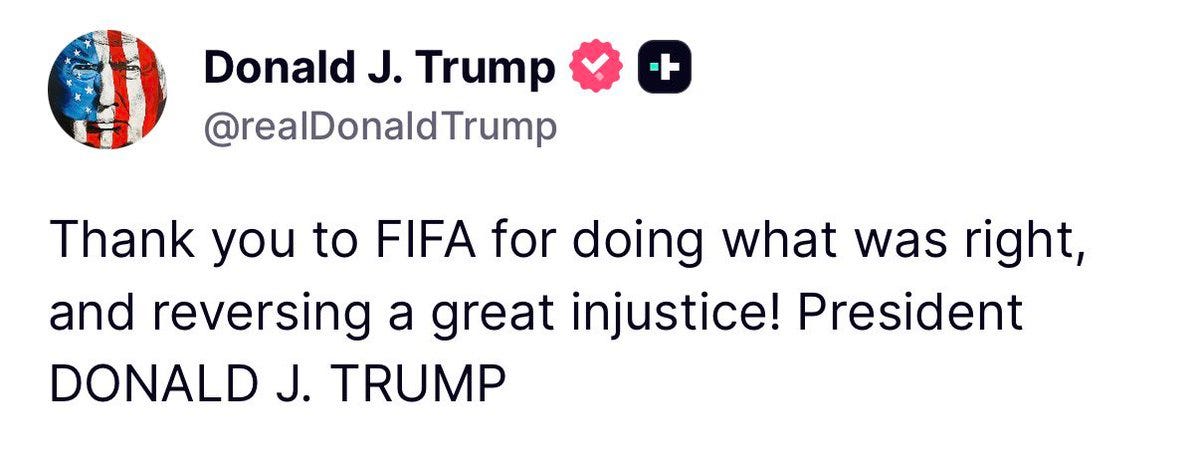
So the red card was unjustified under Law 12 and the process that produced it violated the spirit and arguably the letter of the VAR protocol. What, then, of President Trump? He called FIFA President Gianni Infantino after the match and asked FIFA to review the card, and personally urged a review. Critics have treated this as interference. The claim will not survive scrutiny. Asking a body to review a decision is not ordering an outcome, and nothing in the public record shows Infantino directing FIFA’s judicial organs to rule any particular way. The formal decision came from a FIFA disciplinary body applying a published rule. What Trump did is what any advocate does when an injustice occurs on his watch: he put the question on the right desk. The president of the host nation, watching the host team punished twice for a play that its own federation says was never a foul, has not merely a right but something like a duty to raise the matter. He then thanked FIFA publicly for correcting what he called a great injustice, and the White House celebrated on 𝕏.
That brings us to FIFA’s remedy, which has been widely misdescribed. FIFA did not rescind the red card, and it did not wave away the suspension. It applied Article 27 of its own Disciplinary Code, titled Suspension of implementation of disciplinary measures, which empowers a judicial body to fully or partially suspend a sanction’s implementation and place the sanctioned player on probation for one to four years. Balogun’s one-match ban was suspended for a probationary year. If he commits a similar infringement in that window, the ban revives and any new sanction stacks on top. The red card remains on his record. Article 25 reinforces the discretion, instructing the judicial body to weigh objective and subjective factors, mitigating circumstances, and degree of guilt, and permitting it to scale down or even dispense with a measure. A player whose culpability consists of falling awkwardly is the paradigm case for that discretion. Nor is this novel. FIFA used Article 27 earlier this cycle to defer two matches of Cristiano Ronaldo’s ban so he could open the World Cup, and to defer one-match bans for Nicolás Otamendi and Moisés Caicedo. Belgium did not write letters about those.
The Belgian objection deserves a fair hearing, so let us give it one. Article 66.4 of the Disciplinary Code says a sending-off automatically incurs suspension from the next match, and World Cup Regulation 10.5 repeats the point. Belgium argues that FIFA used a general provision to swallow a specific mandatory one. But the argument runs backward. Article 27 is not a loophole discovered in the seat cushions, it is the code’s designated mechanism for suspending the implementation of disciplinary measures, and it names exactly one category that can never be suspended, match manipulation. Had the drafters wished to exempt automatic red-card suspensions, they knew how to write an exemption, and they wrote one for something else. Belgium’s procedural position is weaker still. Article 61 makes suspensions of up to two matches generally unappealable and permits appeal only of a motivated decision. Article 62 confines standing to parties with a legally protected interest in the original proceeding, which concerned US Soccer and Balogun, not Belgium. And Article 65 provides that an appeal does not suspend the decision under challenge, so Belgium’s morning filing could not bench Balogun by itself, it needed a stay, and no stay came, and Reuters reported that FIFA had already treated Belgium’s initial letter as an inadmissible appeal. Rudi Garcia compared the situation to an April Fools’ joke, which is a fine line for the cameras, but the rulebook is not a joke, and it is not on his side.
I will grant the critics one point, because honesty requires it. The proceedure was ugly. FIFA should have published a full reasoned decision immediately, grounded in Article 27, Article 25, and Balogun’s low degree of guilt, rather than letting the news arrive through a portal message on a Sunday morning. Silence created the impression of a favor when the record supports a correction. But we should keep the categories straight, for optics are not merits. The question is not whether FIFA communicated well. The question is whether a man who fell on an opponent’s ankle while playing the ball deserved to miss a knockout match after his team had already absorbed 36 minutes of shorthanded football, a punishment that in a tournament of this magnitude may be the harshest available short of expulsion.
The answer is no. The red card failed Law 12’s own test, the VAR intervention failed the protocol’s own standard, and the Article 27 remedy sits comfortably inside FIFA’s own text and recent practice. President Trump saw a wrong and asked the responsible body to look again, and the body, applying its published rules, agreed. That is not corruption. That is how correction is supposed to work. Balogun plays tonight against Belgium, and on the rules as written, that is exactly where he belongs.
President Trump spoke with reporters in the Oval Office this morning about Folarin Balogun’s red card, FIFA’s review of the decision, and the broader success of the World Cup in the US.
On speaking with FIFA President Gianni Infantino and the success of the World Cup:
“I spoke to Gianni [Infantino], who’s highly respected and who’s produced what they say is the most successful World Cup in history, by four times. This isn’t just a success. I actually said, ‘Gianni, we’ve got all these games, and each one is turning out to be a Super Bowl.’ When you think of it, every game is like a Super Bowl.“I watched last night. What a game that was with Mexico and England. Two countries. I don’t know the players, although I think Kane is a great player. I play golf with him, and I like him a lot. He’s a good golfer. He’s really great. But I watched, and you couldn’t take your eyes off the game.“I said, ‘Gianni, you have all these games,’ because they added games, in a country where it’s not our main sport, to put it mildly. And this has been four times more successful. He told me last night the numbers are four times greater.“They think 50 or 60 million people are going to be watching the game tonight. These are getting to be Super Bowl numbers. They’re projecting a minimum of 50 million people watching a game. We call it soccer. It’s called football, I guess, but we can’t really call it football because there’s a little confusion. So you call it soccer. We’re the only ones that do that. But we have football, and football’s great. But I’ve never seen anything like it.”
On the Balogun red card:
“I saw the play, and I’m a person who loves sports and was a good athlete. I understand sports really well, really well, and that wasn’t a foul. That wasn’t even an infraction. That was two guys running full speed who happened to crash into each other.“You can’t take your foot and properly place it on somebody else’s foot when you’re going full speed. No, these were two great athletes who got tangled up. And this referee, who is a little bit suspect, if you check his past, I don’t want to say that because I don’t like to create controversy, but very suspect. If you like, I’ll provide you with the past.“He made a call that nobody could believe. Even people on the other side said, ‘Oh, we got lucky. Wow.’ And it was very interesting. They say they don’t show them in slow motion, and I never realized that. I never heard of that before. But they’re not allowed to review in slow motion because it’s so different. You’ll take one little quarter of a second and you’ll see that a hand is touching a neck, or you’ll see something. Whereas when you see it in fast motion, it looked like two guys collided, which is really what happened. They got sort of entangled.“He didn’t do anything wrong. He’s our best player, or one of our best players, and he gave him a red card. I didn’t know what that meant. I didn’t think it meant much. Then I started hearing that it means he can’t play in the next game, at least in the next game. I said, boy, that’s big. If it happened to another player, it would have been unfair. But when they take your best player, or just about your best player, because they have some great players, and they say, you can’t play, that’s very unfair.”
On asking FIFA to review the decision:
“It’s one thing to penalize somebody for the game, but how do you penalize them for a game that hasn’t been played yet? It’s very unfair. You can’t do that. So yes, I asked for a review by FIFA. I spoke to a man who’s highly respected, and by the way, whose level of respect has gone up tenfold.“All I did was ask for a review because I didn’t think it was a foul. And again, I’m good at this stuff. I didn’t think it was a foul. I thought it was two great athletes who crashed into each other and got entangled. That was not a guy punching somebody in the face or anything. That would be different.“If they wouldn’t allow a top player, maybe the best, maybe among the best players on the team, to play, I think it would have had a big stain. And I related just that view. I didn’t tell him what to do. I can’t tell him what to do. And I don’t believe he made the decision. I think it was a committee that made the decision, and they made the right decision because, number one, it wasn’t a foul.”
On wanting the best players on the field:
“You want to see a game with your best players. You don’t want to say, how would you feel if I took Messi out? Look, he ran into somebody. Or took Ronaldo. Ronaldo, you bumped into somebody, we’re going to take you out of the game. He’s great. Or Harry Kane. Harry Kane, we’re going to take you out of the game, Harry, because you happened to hit somebody a little bit harder. You can’t do that.“We’ve got to have our best players, and Belgium’s got a great team, by the way. We’ve got to have our best players, and they have to have their best. If we win or we lose, it’s fair. Otherwise, let’s say we lost him and we lose the game, it would be a terrible thing.“I think they made a really brilliant decision. I think the referee’s call was horrible. Nobody talks about that. They talk about the red card like it’s fine. The referee’s decision to red card him, I didn’t know what the hell a red card was. When I found out, I said, you’ve got to be kidding. This guy just holds up his hand and says, OK, your best player’s not going to play next week or in the next game. I said, wow, that’s a lot of power. That’s terrible. But then I looked at his past, and it wasn’t so great.”
On bringing the World Cup and Olympics to the US:
“He was good before this started, but he really pushed it in this country. I’m the one that got them to do it. It was not Biden. Biden was asleep. In fact, it was very sad because I got him to do it, and if the progression was normal, I would have been retired. Now the Democrats are saying, ‘Man, we should have just let him have his four years. We would have had him gone.’“The saddest thing is, I got the Olympics and I got the World Cup. I tried to claim 250 years, too, but that didn’t work. They said that one is what it is. No, I tried, but it didn’t work. I got them, and I was so proud of it. Then I realized I wouldn’t be president during it because I would have been out of office by that time. I felt badly.“The beautiful thing about what I did is I ran, and then all of a sudden I realized, you know, I just got the Olympics, and I totally got that myself. And I just got FIFA. I got that myself. We gave a little piece to Canada, gave a little piece to Mexico. I got that myself. A lot of people helped, like that man right there, Kevin [McCarthy]. A lot of people. We worked hard on that, and we got it.“But what we didn’t know is how successful it was going to be. I didn’t know. I said, ‘Gianni, is anyone going to show up?’ Because, again, we’re not really, I think soccer is doing much better, but I couldn’t imagine.“If you would have said to any very smart people that the numbers they’re doing now would be happening, they’ve never seen anything like it. Think of it. Take the most successful Olympics or the most successful FIFA, and then look at what’s happening. You look at the numbers for this in the United States, just compared to FIFA, and it’s numerous times more. It’s not like 10% more, 2% more or 5% more, which is more expected. It’s like four times more successful than anything they’ve ever done.“In fact, I said to Gianni, let’s do it again next time. And he said, that would be hard. I said, no, no, you do it again, but at the same time you give it to somebody else for the next one. I don’t know. It’s a little crazy idea.”
Asked whether he would speak with the Belgian prime minister before the game, Trump said:
“I didn’t think of it, but I would. He’s a good man. I will tell you this. The people in Belgium, if they win the game, they can be very proud. If they would win the game with a player missing, it would have been a different feeling. You can’t do that. And I’m very glad.“All I did was ask for a review. I didn’t say, ‘You have to do this.’ This man is a smart, tough man. Gianni Infantino is a smart, tough man, and his stock has gone through the roof because the job he’s done has been great. And I feel we have to have all the best players on the field. We can’t take the best players.”
If you enjoy my work, please subscribe https://x.com/amuse/creator-subscriptions/subscribe
Alexander Muse is a Fellow at the John Milton Freedom Foundation and publishes daily political analysis at amuseonx.com. Primary sources cited in this piece are linked inline; campaign finance figures are drawn from FEC filings, polling data from publicly released crosstabs, and legal claims from filed pleadings. Corrections are posted to the original URL with a dated changelog. Readers who identify errors are invited to contact the author directly. Data in sponsored partnership with Polymarket.
Of course how you respond to this article will be determined by how you view Trump. My own personal view? I simply DGAF. Suspend him, don’t suspend him, who cares? It’s a game. The fun with this scenario is watching people’s heads explode over a game.
Extensively quoting the guy that confabulates when he's not purposely lying. To rationalize horrible optics and judgement, at the very least. More grist for the twitter bots. Your weakest most self-abasing "work" in months.