


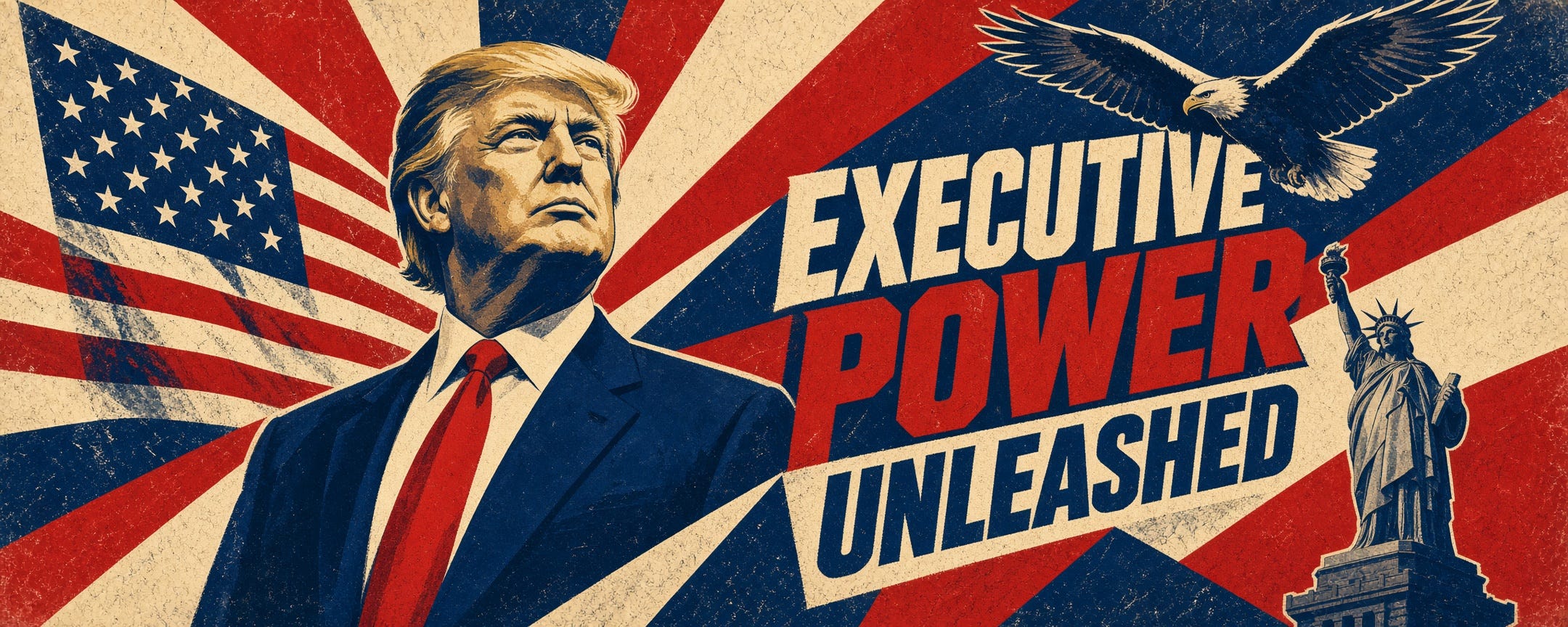
Donald Trump should enter January ready to govern with confidence. Last Tuesday the Democrat Party captured both the House and the Senate, then joined its willing accomplices in the drive-by media in spending the week composing his political obituary. They mistake a congressional majority for control of the presidency. Chuck Schumer will run the Senate calendar and Hakeem Jeffries will hold the House gavel. Neither will inherit the executive branch, its lawful authority, or the money already appropriated for Trump’s priorities.
His agenda never depended on a Republican Congress that, for most of two years, acted like an obstacle wearing an ally’s uniform. Chasing 218 House votes and 60 Senate votes for bills that never arrived consumed attention better spent governing. Victor Davis Hanson identified the opportunity within days of the results: a nominal majority of 53 senators can mean 53 private vetoes. Divided government can strip those vetoes of their bargaining value.
Consider how that pressure can work. A senator needed for a spending agreement might quietly ask that enforcement bypass a large employer in his state. A representative needed for reconciliation might seek protection for a hometown contractor or prestigious university. Such requests need never become public to consume presidential attention. Once a cooperative legislative program becomes impossible, its value collapses. Trump can enforce the law without bargaining for votes he never would have received.
He also has something more durable than another promise of congressional cooperation: enacted money. The 2025 reconciliation law appropriated $45 billion for detention capacity and $29.85 billion for ICE enforcement and related functions, both available through September 30, 2029. The Secure America Act, signed June 10, 2026, supplied another $31.075 billion for ICE enforcement under section 202, available through September 2029. That is more than $105 billion in multiyear immigration-enforcement appropriations. Democrats cannot erase it by refusing the next annual increase. A clawback requires legislation, which Trump can veto; competent, timely execution is his responsibility.
Passing ambitious legislation takes affirmative cooperation in both chambers and a filibuster-proof Senate. Protecting existing authority or appropriations from hostile legislation requires blocking an override in just one chamber. With every senator voting, 34 sustain a veto. That defensive coalition is far easier to maintain than agreement on a comprehensive Republican program. Trump should protect it as the legislative coalition that matters most, rather than confuse holding it together with the exhausting business of buying support for new bills. The president can spend his political capital defending action instead of financing excuses for inaction. That is an enormous improvement in his position, even if Democrats and the drive-by media prefer to describe it as defeat.
Democrats understand this arrangement because their presidents used it. In 1995, Bill Clinton’s $40 billion Mexico loan-guarantee package stalled in the newly Republican Congress. He turned to the Exchange Stabilization Fund and made up to $20 billion available without another vote. The Government Accountability Office later confirmed Treasury already possessed the authority. The next year, he designated roughly 1.7 million acres as Grand Staircase-Escalante National Monument under the Antiquities Act of 1906, a nine-decade-old delegation of authority. Congress needed a bill to reverse him, and he could veto it.
Barack Obama announced normalization with Cuba in December 2014, weeks after losing the Senate, and implemented it under a Republican Congress. He concluded the Iran nuclear agreement in July 2015 and joined the Paris Agreement in September 2016, submitting neither for a treaty vote. On September 10, 2015, 58 senators voted to advance disapproval of the Iran deal. It died because 58 was not 60. Conservatives were furious to discover that controlling both chambers did not supply the votes to stop him.
Article II assigns him the duty to take care that the laws be faithfully executed. Those are the laws Congress passed, not the legislation he hopes Congress might someday consider. Neglecting existing authority while lobbying for more gets the presidency backward. Trump can make the next two years an emphatic demonstration that a president willing to do his job need not wait for Schumer’s permission.
Immigration enforcement offers a revealing place to begin. In Des Moines on July 3, 2025, Trump described farmers complaining about lost workers, floated allowing them to vouch for those workers, and extended the concern to hotels and leisure businesses. He named Agriculture Secretary Brooke Rollins as the official who brought him the problem. A favored constituency had collided publicly with enforcement and won. That accommodation need not dictate the next two years.
Section 1324a of Title 8 makes knowingly hiring unauthorized workers a federal offense and requires employment verification. The administration can expand I-9 audits, bring civil proceedings against knowing violators, and investigate sustained document fraud. Evidence and consistency must govern, and politically connected employers must be held to the same standard as everyone else. Abroad, section 243(d) of the Immigration and Nationality Act permits the State Department to suspend all visas, or a chosen subset, when countries refuse or unreasonably delay accepting their deported nationals. Universities and tourism interests will object; Trump can tailor sanctions for cooperation rather than a senator’s donor base.
The same freedom matters wherever Republicans applaud construction nationally and resist it locally. The Department of Energy has LNG export applications awaiting decisions. Executive Order 14318 already directs federal permitting work for data centers and supporting infrastructure, while the Supreme Court’s Seven County decision in May 2025 narrowed NEPA review to the project before the agency. That removes a favorite excuse for delay. A friendly member’s local objections should no longer leave federal permits sitting untouched.
Nor should friendship purchase immunity elsewhere. OPM finalized Schedule Policy/Career in February 2026 for policy-influencing positions while preserving merit hiring. Trump can insist on performance standards and act against documented obstruction without fearing that a member representing 10,000 federal employees will withhold a vote. At universities, Title VI provides an established process for investigating racial discrimination and antisemitic harassment, negotiating enforceable remedies, and pursuing funding consequences with notice and hearings. Affection for a prestigious institution back home does not excuse selective enforcement.
The business wing has enjoyed an easy two years, too. The Justice Department’s RealPage litigation, including the March 2, 2026 Greystar judgment, represents rent-lowering antitrust enforcement that irritates donors. Executive Order 14265 directs defense acquisition toward competition and commercial solutions, against quiet resistance from members protecting hometown contractors. Section 301 of the Trade Act, through 19 USC 2417, permits modifying or terminating tariff actions for enforceable foreign concessions. That route matters more since the Supreme Court rejected IEEPA tariff authority on February 20, 2026. Protected industries should lose their leverage to hold those decisions hostage to unrelated votes.
Executing delegated authority is a conservative obligation, not a license to invent powers. Conservatives condemned Obama’s pen and phone for eight years; the Supreme Court’s 4-4 deadlock on June 23, 2016, left the injunction against his DAPA amnesty standing. The objection was that he invented authority Congress had refused to grant. Spending enacted detention appropriations, auditing employers under a 40-year-old statute, and deciding legally required permit applications run counter to DAPA. Trump should choose clear statutory footing, identify valid funding, and build administrative records that survive review. A durable order accomplishes more than dramatic language that leaves agencies frozen in litigation.
That discipline strengthens the case for optimism. The president already possesses authority to act, and exercising it carefully denies Democrats the easy victory of watching an avoidable legal failure stop the work. Due process, evidence, and a defensible record belong inside an aggressive program of execution. They make the results harder to undo.
Transparency can expose the protected interests in both parties. Trump’s January 2025 assassination-records order demonstrates the mechanism, and a systematic declassification review of surveillance abuses under Executive Order 13526 would embarrass officials on both sides. Good. A Republican presidency should not exist to spare Republican insiders discomfort; the public deserves the lawful review even when the findings make powerful people unhappy.
Preparation should begin before the new Senate is sworn in. Finish every essential confirmation the current Republican majority can deliver, because Schumer will deliver none, and map initiatives that can proceed with existing personnel and money. During the first 100 days of divided government, require each agency to publish an execution schedule with measurable outputs: permit decisions completed, employer cases resolved, procurement milestones met, deportation agreements signed. Voters deserve completed work, not another announcement of intentions.
Remain open to any deal the Democrat Party offers that is worth taking. But the possibility of a deal must never again become an excuse to postpone executing the law. Democrats want the election to mean paralysis, and Trump should deny them that satisfaction. He can make their obstruction an argument for presidential resolve rather than an explanation for presidential retreat.
For half a century, conservatives have complained that Washington is too big, too slow, and too pleased with announcements it never fulfills. The answer was never simply more statutes. Impartial enforcement, competent spending of appropriated funds, and room for people who build would vindicate the conservative argument through performance. Trump has two years to deliver without senators demanding softer enforcement or members insisting on protection for contractors.
Clinton and Obama used divided government to work around their opponents. Trump can use it to leave his own party’s excuses behind and carry out the promises Republicans elected him to keep. The Democrats won Congress; they did not extinguish his presidency. He should greet their victory with the confidence of a president who knows the law, has the resources, and intends to use both competently for the country. His strongest governing years can still be ahead.
If you enjoy my work, please subscribe.
Alexander Muse is a Fellow at the John Milton Freedom Foundation and publishes political analysis at amuseonx.com. Readers who identify errors are invited to contact me directly. Each op-ed is edited for grammar and clarity using AI with Grammarly.
I believe that Trump and his staff have the smarts to understand all the cogent points you lay out here. They've shown in these first two years that they fully understand how this works, especially after the difficulties of Trump 1.0.
Obama did get a lot done with his pen and his phone. But, he wasn’t hindered by constant distractions of impeachment. I haven’t looked at what the makeup of the republican Senate and house in congress will be. But thankfully so many of the obstructionists to the presidents agenda were primaried. Those remaining must hold the line. I’m honestly worried that republicans will cross the line to vote to impeach Hegseth, who had been a huge force in saving our military. Thoughts on this, Alex? Thank you for this encouraging piece.