
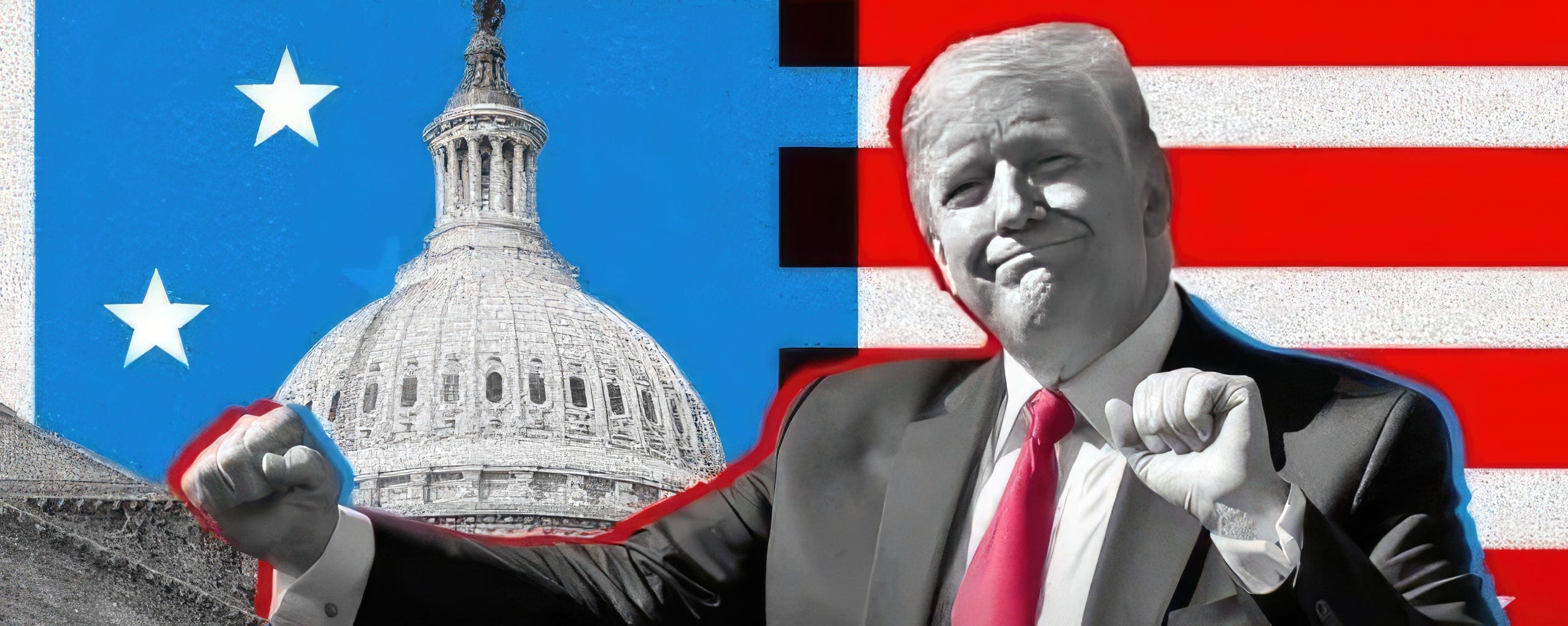
Trump’s Return: Six Months That Changed America
The Relentless Executive: President Trump’s Six-Month Masterclass in Presidential Power
Was Donald J. Trump, in his first six months of his second term, the hardest working president in American history? The claim is dramatic, perhaps hyperbolic at first blush. But, if our judgment is tethered not to histrionics or habit but to the record, the actual, observable results of his labor, then the proposition is not only plausible, it becomes almost inescapable. For if productivity, strategic clarity, political courage, and results are the measure of a president's exertions, then Trump’s whirlwind return to the White House has already yielded the most consequential six-month period of executive leadership in modern memory.
Consider first what Trump inherited: a disoriented federal apparatus, demoralized law enforcement agencies, staggering inflation, foreign conflicts spiraling beyond US influence, and an open border that mocked the very notion of sovereignty. The state was not merely bloated. It was misaligned, incoherent, disrespected. Into that morass stepped a man with a mandate not for ceremonial governance but for action.
And act he did. Trump reentered office as a veteran executive, no longer learning the levers of power but seizing them. Within days, his administration rolled out the aptly titled "One Big Beautiful Bill" which, beyond its rhetorical flair, delivered the largest tax cut in US history. This legislative triumph, designed with surgical precision, slashed taxes for working Americans, increased take-home pay by as much as $13,300 per household, and removed 1.4 million illegal immigrants from welfare rolls. What Biden expanded, Trump amputated.
Trump also did what modern presidents have long threatened but rarely accomplished: he cut spending. His historic $9 billion rescission package clawed back funds from ideologically motivated leftwing grants, defunded the corporate mouthpieces of NPR and PBS, and redirected the budgetary conversation toward fiscal restraint. It was the first time in a generation that a president had successfully executed such a sweeping clawback of appropriated funds.
The domestic economy began to mirror the discipline of the executive. Prices fell. Wholesale egg prices dropped 53 percent, gas prices returned to inflation-adjusted lows not seen in two decades, and core inflation settled at 2.1 percent, levels not reached since the early days of Trump’s first administration. Monthly job growth averaged above expectations, and, for once, it was not foreign-born workers capturing the gains. Native-born Americans accounted for the entirety of the net increase. If Reagan's presidency was morning in America, Trump's is a working lunch.
But the Trump agenda was not confined to economic repair. It extended to the nation’s soul, our borders, our laws, our children. Illegal border crossings hit an all-time low. Zero illegal immigrants were released into the US on parole in June. In place of "catch and release" came enforcement and removal. More than 100,000 illegal alien criminals were arrested in six months, including 2,700 members of the Tren de Aragua gang, a transnational criminal enterprise that had metastasized during the prior administration.
Nor was the change superficial. The self-deportation campaign, once mocked as naive, proved effective. Over 600 known or suspected terrorists were removed. Deportation flights reached record levels. What Biden refused to do in four years, Trump did in four months. His administration treated the border not as a compassion project, but as a constitutional imperative.
Trump’s reform instinct penetrated deeper still. He declared an energy emergency and unleashed a permitting blitz for domestic oil and gas production that dwarfed Biden’s sluggish pace by 44 percent. This was not deregulation for its own sake, but energy as national strength. The results were swift: stability in fuel prices, revived industry employment, and confidence in American energy security.
Abroad, he was no less decisive. In six months, he achieved what his predecessors could only theorize. He secured an agreement among NATO members to raise defense spending to five percent of GDP, an unthinkable concession just a year ago. He ended Iran’s nuclear program. He mediated ceasefires between Israel and Iran, and India and Pakistan. He brokered peace between Rwanda and Congo, and restored negotiations in Syria. He was nominated for three separate Nobel Peace Prizes, not for soaring rhetoric, but for doing the work.
Diplomacy was matched by tradecraft. Trump inked new trade deals with the UK, China, and Indonesia. He facilitated a $14 billion golden share sale of US Steel. He secured a critical minerals agreement with Ukraine. All while the Treasury posted a $27.2 billion surplus in June, the first June surplus since 2005. That surplus was not an accounting trick. It was powered by nearly $90 billion in tariff duties collected since his inauguration.
At home, Trump gutted the ideological rot that had festered in the federal bureaucracy. Over 170 executive orders rolled back DEI mandates, reasserted biological realities in sports and medicine, protected children from radical medical interventions, dismantled censorship structures, and reasserted merit in public education. He ended men in women’s sports. He ended federal subsidies for open borders. He made government again serve the citizen, not the activist.
The results were immediate. Schools and universities reversed DEI policies. Hospitals stopped offering puberty blockers and surgeries to minors. Law enforcement saw morale rebound, recruitment goals met, and the murder rate plunged toward a record low. Trump restored not merely policy but order.
A critic might object: Yes, the achievements are many, but are they sustainable? Is this momentum merely the rush of a returning president with scores to settle? Perhaps. But such skepticism, while not without precedent, misreads the man. Trump is not governed by vengeance. He is animated by purpose. His daily schedule is punishing. His travel and diplomatic tempo exceed that of his predecessors. He has met with more foreign leaders in six months than Biden did in two years. He is not playing president. He is governing.
That clarity of purpose is reflected in his personnel. His Cabinet is streamlined, mission-driven, and strikingly effective. From Marco Rubio at State to Pete Hegseth at Defense, these are not figureheads but executors. Elon Musk’s short but spectacular tenure at DOGE, the Department of Government Efficiency, slashed billions in waste and left behind a replicable template for reform. Musk called it a "way of life." Trump is making it so.
If one were to summarize the Trump restoration in philosophical terms, one might invoke Aristotle’s distinction between motion and act. Past presidents were in motion. Trump is in act. Others convene, consult, and delay. Trump governs. He enacts. He orders. In doing so, he restores not only the authority of the executive branch but the dignity of the office itself.
It is too early to write the full account of Trump’s second presidency. But it is not too early to say this: no president in living memory has accomplished more in his first 180 days. Not FDR. Not Reagan. Not even the first Trump term. To deny that is to deny not only the record but reality. Yes, we know there are still a few swamp creatures lingering in the ranks of his White House team, but compared to the den of vipers that infested his first administration, the improvement is unmistakable and profound.
If you enjoy my work, please consider subscribing https://x.com/amuse.


Thanks for summarizing so brilliantly! Your writing is masterful, compelling. How do you do it on so many different subjects so regularly? I’m in awe! And indebted to you!
Four years in the wilderness gave home time to plan. Once in office he acted. Much of his plan appears to be accomplished. We shall see if that pace continues. He needs a way to punish some of his opponents as an example. The people yearn for some accountability. Whether he can win over a divided Congress remains to be seen. If he can win the midterms, game over. The changes could be monumental cementing a solid economic future.